Health Insurance Guide · July 2026
Singapore Shield Plan Guide 2026: What It Is, How It Works & How to Choose
Covers MediShield Life, ISP tiers, MediSave limits, the 7 approved insurers & the April 2026 rider changes
A Singapore shield plan — officially called an Integrated Shield Plan (ISP) — is a private hospital insurance policy that sits on top of MediShield Life. It upgrades your hospitalisation coverage from subsidised Class B2/C wards in public hospitals to Class B1, Class A or private hospitals, depending on the tier you pick. Seven MAS-regulated insurers offer ISPs, and premiums are partly payable from your MediSave account.
Not financial advice. All figures are for educational reference only. Data verified as at 9 July 2026 unless noted. Always verify premiums and benefits with your insurer before purchasing.
- A shield plan upgrades MediShield Life from subsidised B2/C wards to B1, Class A or private hospital coverage
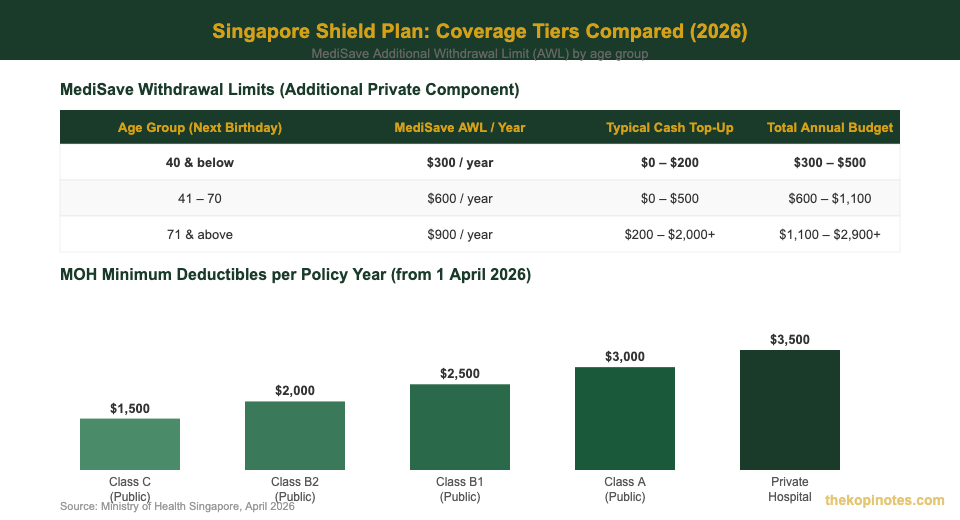
- Seven MOH-approved insurers offer ISPs; the MediShield Life portion is fully MediSave-payable; the private component has an Additional Withdrawal Limit ($300–$900/year by age)
- From 1 April 2026, new riders no longer cover your deductible ($1,500–$3,500 per policy year) — but rider premiums drop ~30% in return
In This Guide
- What Is a Shield Plan?
- MediShield Life vs Shield Plan: Key Differences
- How Shield Plan Premiums Work (MediSave & Cash)
- The 7 Approved Shield Plan Insurers in Singapore
- Shield Plan Tiers: B1, Class A & Private Hospital
- April 2026 Rider Changes: What Changed & Why
- How to Choose the Right Shield Plan
- Frequently Asked Questions
What Is a Shield Plan?
A shield plan is private health insurance that adds a second layer on top of Singapore’s national MediShield Life scheme. Every Singapore Citizen and Permanent Resident automatically has MediShield Life. A shield plan — or ISP — sits on top of it, extending what wards and hospitals you can claim for.
The term “shield plan” comes from the product names insurers historically used: AIA HealthShield, PruShield, Supreme Health, and so on. MOH’s official term is Integrated Shield Plan, or ISP. The two mean exactly the same thing.
You do not need an ISP to have hospital coverage. MediShield Life alone covers you for subsidised B2 and C wards in restructured public hospitals — places like SGH, NUH, and Tan Tock Seng. But if you would prefer a single-bed A ward, a private hospital like Mount Elizabeth, or the freedom to pick your own specialist, a shield plan is how you get there.
Here is the key structure: an ISP has two components. The first is the MediShield Life component, managed by CPF Board. The second is the additional private insurance component, provided by whichever of the seven approved insurers you choose. Your insurer handles both — premiums, claims, and administration — as your single point of contact.
If you want to understand your MediSave balance and how it funds your shield plan premiums, the Medisave Singapore complete guide covers withdrawal limits and contribution rates in detail.
MediShield Life vs Shield Plan: Key Differences
Many Singaporeans assume they already have a shield plan. They do not — they have MediShield Life. Here is the practical difference.
MediShield Life is a national scheme run by CPF Board. It is compulsory for all citizens and PRs. It pays for Class B2 and C hospital stays in public hospitals at subsidised rates. Annual claim limits apply.
A shield plan (ISP) is an optional private insurance product. You choose whether to buy it. It lifts your coverage to B1, Class A, or private hospital depending on your tier. It also raises claim limits — many private hospital plans offer unlimited annual coverage.
| Feature | MediShield Life | Shield Plan (ISP) |
|---|---|---|
| Provider | CPF Board | Private insurer (7 choices) |
| Ward coverage | Class B2/C (subsidised) | B1, Class A, or private hospital |
| Premium payment | 100% MediSave | MediSave + possible cash top-up |
| Annual claim limit | S$150,000 | Up to unlimited (varies by plan) |
| Pre-existing conditions | Covered for life | May exclude (additional component) |
| Optional | No — automatic | Yes — your choice to buy |
Source: Ministry of Health Singapore (moh.gov.sg), as at July 2026
The practical implication: if you are admitted to a private hospital without a shield plan, MediShield Life will only pay out at B2/C subsidised rates — leaving you to cover most of a private hospital bill yourself. That gap can run into the tens of thousands of dollars for a surgical admission.
How Shield Plan Premiums Work (MediSave & Cash)
Understanding ISP premiums is simpler once you break them into two parts: the MediShield Life component and the additional private insurance component.
MediShield Life component: This is fully payable by MediSave, regardless of your plan tier. CPF Board deducts it automatically.
Additional private insurance component: Also payable by MediSave, but only up to the Additional Withdrawal Limit (AWL). The AWL depends on your age at your next birthday:
| Age at Next Birthday | MediSave AWL / Year | What This Means |
|---|---|---|
| 40 and below | $300 / year | Most B1/A plans fully covered by MediSave |
| 41 to 70 | $600 / year | Higher-tier plans may need cash top-up |
| 71 and above | $900 / year | Private hospital plans often exceed AWL |
Source: Ministry of Health Singapore (moh.gov.sg), as at July 2026
Any premium above the AWL must be paid in cash. For a 35-year-old on a Class B1 plan, the AWL usually covers the entire additional premium — meaning zero cash outlay. For a 55-year-old on a private hospital plan, the premium might be $1,200 or more per year, requiring a $600+ annual cash top-up beyond the AWL.
Premiums rise steeply with age. A private hospital plan that costs $400/year at age 30 can cost $3,000+ per year at age 70. Review your plan regularly to ensure it remains affordable over the long term — especially as you approach retirement. The Singapore retirement planning calculator can help you model future healthcare premium costs alongside CPF projections.
The 7 Approved Shield Plan Insurers in Singapore
MOH approves seven insurers to sell ISPs. You can only hold one ISP at a time — but you can switch insurers if your needs change. Here is the complete list as at July 2026:
| Insurer | Plan Name | Tiers Offered | Panel Specialists (2025) |
|---|---|---|---|
| AIA | HealthShield Gold Max | B1, A, Private | 684 |
| Great Eastern | Supreme Health | B1, A, Private | 814 |
| HSBC Life | Shield | B1, A, Private | 894 |
| Income Insurance | Enhanced IncomeShield | B1, A, Private | 648 |
| Prudential | PRUShield | B1, A, Private | 957 |
| Raffles Health Insurance | Raffles Shield | A, Private | 198 |
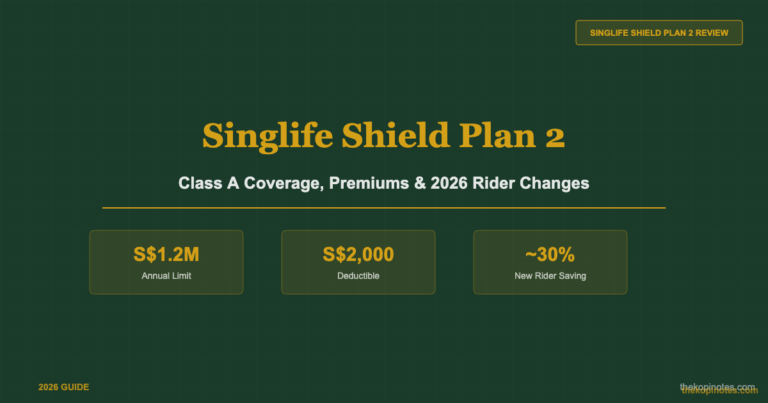
| Singlife | Shield Plan 1 / 2 / 3 | B1, A, Private | 705 |
Source: Ministry of Health Singapore, panel specialist data as at 2025 (moh.gov.sg)
Panel size matters more than you might think. Prudential had the largest private specialist panel at 957 in 2025, while Raffles Health Insurance — which focuses on the Raffles Hospital network — is more specialist with 198 listed. If you have an established relationship with a specialist clinic, check whether they are on your preferred insurer’s panel before committing.
For a deep-dive on specific insurers, TKN has dedicated reviews of the Singlife Integrated Shield Plan, Prudential PRUShield, and NTUC Income Enhanced IncomeShield.
Shield Plan Tiers: B1, Class A & Private Hospital
Every ISP falls into one of three tiers. Your tier determines which wards you can claim for — and the premium you pay.
Class B1 (Public Hospital, Non-Subsidised)
The most affordable tier. You get a 4-bed air-conditioned room in a restructured public hospital. Treatment is fully subsidised in terms of hospital costs, but you see the hospital’s doctors — not your own private specialist. Good for: budget-conscious policyholders who are comfortable in the public hospital system and do not need to choose their own specialist.
Class A (Public Hospital, Single or 2-Bed Room)
A step up in comfort and choice. Class A wards give you a single room or a 2-bed room in a public hospital. Many insurers offer “as charged” coverage at Class A, meaning the insurer pays the full bill above your deductible and co-payment. You still see doctors attached to the public hospital. Good for: those who want a more private environment without the cost of a full private hospital plan.
Private Hospital
The broadest coverage. You can be treated at private hospitals (Mount Elizabeth, Gleneagles, Raffles Hospital, Parkway East, and others) and choose any specialist — including those not attached to a public hospital. This tier carries the highest premiums, and they increase significantly from age 50 onwards. Good for: those who value specialist choice, faster scheduling, and private facilities, and who can absorb the higher long-term premium costs.
A common mistake is buying a private hospital plan at 30 without modelling the premiums at 60 or 70. The same plan that costs $400/year in your 30s can exceed $3,000/year by your late 60s — potentially outpacing your MediSave AWL and requiring a growing annual cash outlay in retirement.
April 2026 Rider Changes: What Changed & Why
MOH overhauled ISP rider requirements effective 1 April 2026. If you bought a rider before this date, it is not automatically affected — but new riders purchased after this date follow the new rules. Here is what changed.
Deductibles Are Now Your Responsibility
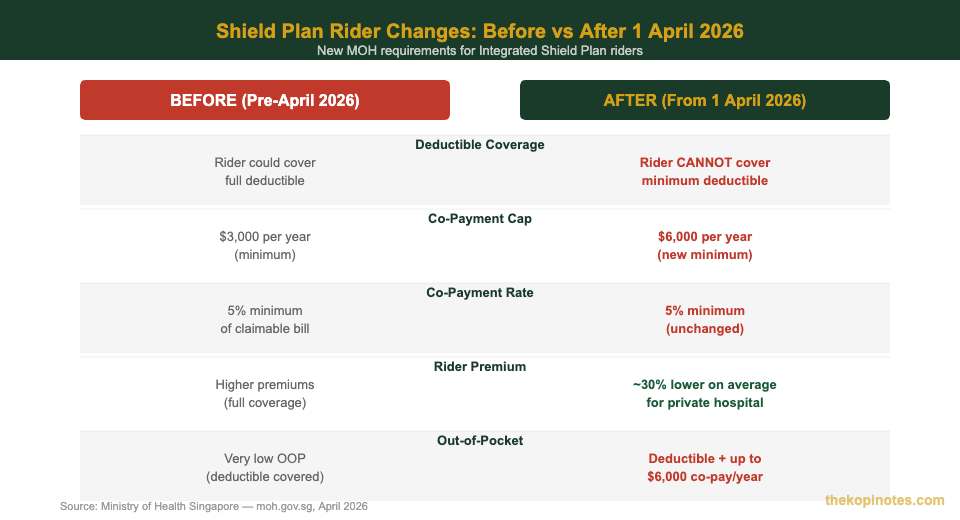
Before 1 April 2026, a rider could cover your full deductible. That meant some policyholders had zero out-of-pocket cost on admission — which MOH concluded was driving over-consumption and bill inflation.
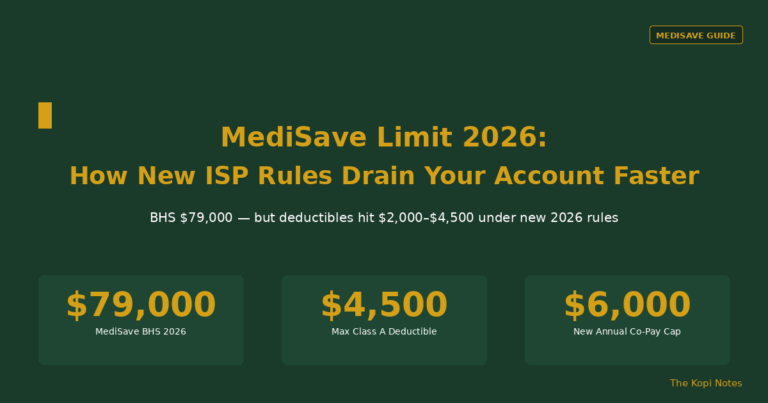
From 1 April 2026, new riders cannot cover the MOH-set minimum deductible. This ranges from $1,500 to $3,500 per policy year depending on ward class. You must pay this yourself before the insurer pays a cent. MediSave can be used to pay the deductible, subject to prevailing withdrawal limits.
Co-Payment Cap Doubled to $6,000
The co-payment is your share of the claimable bill above the deductible — set at a minimum of 5%. From 1 April 2026, the cap on how much co-payment you can be asked to pay per year has risen from $3,000 to $6,000. In practice, this means your maximum annual out-of-pocket exposure (above the deductible) is $6,000 under a new rider.
Rider Premiums Drop ~30%
Because new riders cover less (no deductible, higher co-pay cap), MOH estimates that new rider premiums will be about 30% lower on average compared to legacy riders. Private hospital rider holders save around $600 per year; public hospital rider holders save around $200 per year, on average. Older policyholders see proportionally larger savings because their legacy rider premiums were higher to begin with.
The bottom line: new riders are cheaper but leave you exposed to the deductible on every hospitalisation. Budget for $1,500–$3,500 per year in out-of-pocket costs even if you have a rider.
How to Choose the Right Shield Plan
Choosing an ISP comes down to five practical questions. Work through them in order.
Step 1: Choose Your Ward Tier
Decide whether you want B1, Class A, or private hospital coverage. Most financial advisers suggest Class A as a sensible middle ground — you get a private or 2-bed room in a quality public hospital without the steep private hospital premiums at older ages. If specialist choice matters deeply to you, go private. If budget is the priority, B1 is solid coverage.
Step 2: Model the Long-Term Premium
A plan that costs $400/year at 35 may cost $2,500/year at 65. MOH and CPF Board publish the Health Insurance Planner to help you model lifetime premium costs by insurer and plan tier. Run your numbers before committing to a tier — especially for private hospital plans.
Step 3: Check the Preferred Provider Network
Each insurer maintains a panel of preferred specialists. If you see a specialist regularly or plan to use private hospitals in a specific network, confirm they are on your preferred insurer’s panel. MOH publishes panel sizes publicly — and all seven insurers have grown their panels in recent years.
Step 4: Decide on a Rider
A rider reduces bill shock but costs extra. Under the 2026 rules, even with a new rider, you will pay the deductible ($1,500–$3,500) plus up to $6,000 co-payment per year. Ask yourself: could you absorb a $4,000–$9,500 hospitalisation cost in a bad year? If yes, skipping the rider and saving the premium may be rational. If that sum would cause real financial stress, a rider is worth the premium.
Step 5: Review Every 2–3 Years
Your healthcare needs and financial situation change with age. What made sense at 30 needs a fresh look at 45 and again at 60. If premiums outpace your MediSave AWL significantly in retirement, you may want to downgrade tiers rather than drop coverage entirely.
For insurer-specific comparisons — including riders, claim limits, and pre/post-hospitalisation coverage — see TKN’s review of the AIA HealthShield Gold Max and the full ISP comparison guide.
Frequently Asked Questions About Shield Plans
Can I use MediSave to pay for my shield plan?
How many shield plans are there in Singapore?
What is the difference between a shield plan and a rider?
What happens if I do not have a shield plan?
Are shield plans worth it for Permanent Residents?
What is the April 2026 rider change and how does it affect me?
Can I switch shield plan insurers?
Get Free Insurance Advice
Speak with a licensed insurance advisor. No obligation, no cost.
By submitting this form, you agree to our Privacy Policy.
This article was researched with the help of AI. While we strive to keep all information accurate and up to date, there may be errors. If you notice any discrepancies, please contact us.