Singlife Shield Plan 1 Review 2026
Private Hospital Coverage, Premiums & What Changed in April 2026
Singlife Shield Plan 1 is the top-tier integrated shield plan (ISP) from Singlife — covering any standard ward in a private hospital, with a S$2,000,000 annual policy year limit. It sits on top of your MediShield Life, extends coverage to private hospitals like Gleneagles and Mount Elizabeth, and can be paired with the Singlife Health Plus Private rider to cap your out-of-pocket costs. Base plan premiums are fully payable by MediSave.
Not financial advice. All figures are for educational reference only. Data verified as at July 2026 from the official Singlife website (singlife.com) and MOH unless otherwise noted.
- Plan 1 gives you private hospital access with a S$2M annual limit — the highest in the Singlife Shield range.
- From April 2026, the new Health Plus Private rider no longer covers your S$3,500 deductible, but costs ~30% less and adds a S$20,000 Recovery Support benefit.
- Plan 1 suits you if you want private hospital care; Plan 2 is better value if Class A at restructured hospitals is enough.
What Is Singlife Shield Plan 1?
Singlife Shield is an MOH-approved integrated shield plan sold by Singapore Life Ltd. Like all ISPs, it sits on top of MediShield Life — the basic national health insurance — and upgrades your coverage to higher ward classes and private hospitals.
Plan 1 is the private hospital tier. If you’re hospitalised, it covers any standard ward at a private hospital. That means Gleneagles, Mount Elizabeth, Parkway East, Thomson Medical, Raffles, and others. Singlife also partners with IHH Healthcare SG, giving Plan 1 policyholders priority access to over 700 medical specialists.
This is different from Plan 2, which covers Class A wards at restructured public hospitals like SGH, NUH, and TTSH. For a full breakdown of that option, read our Singlife Shield Plan 2 review 2026.
What Singlife Shield Plan 1 Covers
Plan 1 provides as-charged coverage for eligible inpatient hospital treatments. “As-charged” means you’re reimbursed for the actual bill — not a fixed daily benefit — subject to the deductible and co-insurance under your plan.
| Benefit | Singlife Shield Plan 1 |
|---|---|
| Ward Entitlement | Any standard ward, private hospital |
| Policy Year Limit | S$2,000,000 |
| Pre-Hospitalisation | Up to 180 days before admission |
| Post-Hospitalisation | Up to 365 days after discharge |
| Extra CI Benefit (5 CIs) | S$150,000 per policy year |
| CI Lump-Sum Payout | Up to S$10,000 per lifetime (+S$3,000 for kidney dialysis) |
| Organ Transplant (living donor) | S$50,000 per lifetime |
| Overseas Inpatient Treatment | Planned and emergency |
| Outpatient Psychiatric | Yes (after 10 months of continuous cover) |
| Letter of Guarantee | Up to S$80,000 deposit waiver at 20+ hospitals |
| Newborn Coverage | Free up to 6 months (both parents on Plan 1 or 2) |
| MediSave Payable | Yes (base plan) |
Source: Singlife official product page (singlife.com), as at April 2026
Two features of Plan 1 are worth calling out specifically.
The Extra Critical Illness Benefit of S$150,000 per year applies when you’re hospitalised for one of five conditions: heart attack of specified severity, major cancer, stroke, end-stage lung disease, or end-stage liver disease. This is on top of your normal hospitalisation coverage — so a cancer diagnosis that requires extended inpatient treatment could unlock an extra S$150,000 per policy year beyond what the standard coverage pays.
The 365-day post-hospitalisation benefit means your follow-up visits, medication, and physiotherapy for up to a full year after discharge are covered. Most competing ISPs cover 180 days post-discharge. The longer window matters for serious conditions where recovery takes time. For context on what private hospital bills actually look like, our Class A ward Singapore cost guide breaks down real bill sizes.
Plan 1 vs Plan 2 vs Plan 3: Side-by-Side
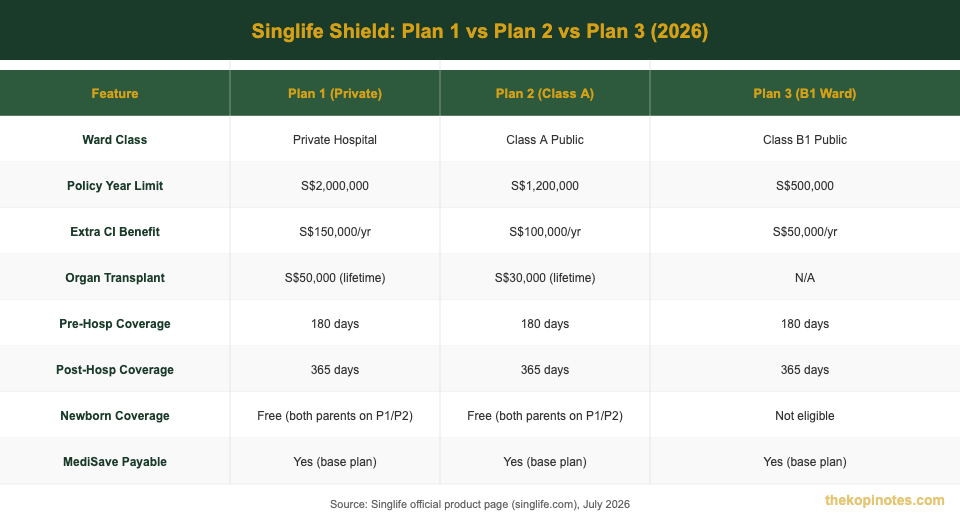
Most Singaporeans choosing Singlife Shield are deciding between Plan 1 (private hospital) and Plan 2 (Class A public). The chart below shows the full comparison across all three tiers.
Source: Singlife official product page (singlife.com), July 2026
The biggest difference is the policy year limit. Plan 1 covers S$2,000,000 per year — double Plan 2’s S$1,200,000. In reality, most hospital bills — even at private hospitals — stay well under S$500,000. But the higher limit gives you peace of mind for catastrophic scenarios like prolonged cancer treatment.
The CI benefit gap is also real. Plan 1 pays S$150,000 vs Plan 2’s S$100,000 when you’re hospitalised for one of the five covered critical illnesses. That S$50,000 difference could cover months of additional treatment costs or home nursing after discharge.
The organ transplant benefit is Plan 1-exclusive at S$50,000 per lifetime (for living donor situations where you are the donor). Plan 2 has a S$30,000 benefit; Plan 3 has none.
April 2026 Changes: Health Plus Private Rider
The biggest change to Plan 1 in years came into effect on 1 April 2026. MOH introduced new requirements for all ISP riders — and these directly affect Plan 1 policyholders.
Source: MOH press release and Singlife official website, April 2026
What changed?
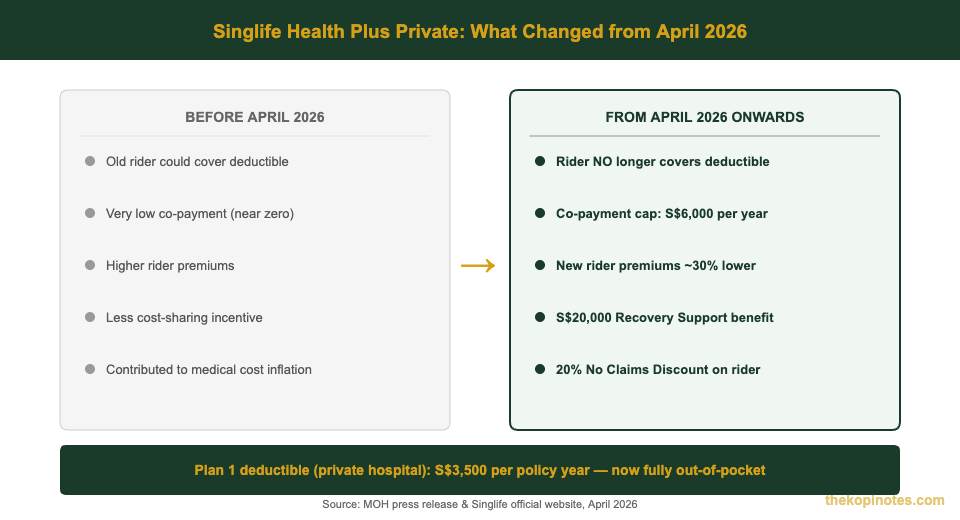
Before April 2026, ISP riders could cover the minimum deductible. Some policyholders had near-zero out-of-pocket costs for every hospitalisation. MOH found this was driving up healthcare utilisation and costs for everyone.
From 1 April 2026, new ISP riders cannot cover the minimum deductible. For Singlife Shield Plan 1, that deductible is S$3,500 per policy year. You pay this yourself — even with the Health Plus Private rider.
The rider still covers the co-insurance above the deductible, subject to a co-payment cap of S$6,000 per year. So your worst-case annual out-of-pocket is S$9,500 (S$3,500 deductible + S$6,000 co-insurance cap).
In exchange, new rider premiums are approximately 30% lower than pre-2026 riders. A new Recovery Support benefit of S$20,000 (over 2 years per lifetime) covers home nursing care and rehabilitation for policyholders who qualify for the Severe Disability Benefit and hold both Health Plus and Singlife CareShield.
- Deductible: S$3,500 per policy year (you pay this — rider no longer covers it)
- Co-insurance cap: S$6,000 per year
- Maximum annual out-of-pocket: S$9,500
Existing policyholders
If you purchased your Health Plus rider before 27 November 2025, your existing terms remain in place for now. You will transition to the new rider terms at renewal from 1 April 2028. Singlife will notify you at least 31 days before any changes.
Premiums and MediSave
Singlife Shield Plan 1 premiums are age-banded and subject to annual review. The good news: the base plan premium is fully payable via MediSave for most age groups. You don’t need cash for the base plan — your MediSave account handles it automatically.
From 1 April 2026, Singlife raised premiums for Plan 1 and the Health Plus Private rider to reflect rising healthcare costs and medical inflation. For the exact current premium rates by age band, refer to the official Singlife Shield and Health Plus premium table (PDF) effective April 2026.
| Age Band | MediSave Covers Base Plan? | Cash Rider Premium? |
|---|---|---|
| 21–40 | Typically yes, fully | Yes — rider always cash |
| 41–60 | Up to MediSave MAWL limit | Yes — rider always cash |
| 61+ | Up to MediSave MAWL limit — cash top-up likely | Yes — rider always cash |
Source: Singlife product terms (singlife.com). Exact amounts: see official premium table, effective April 2026.
One useful benefit: the 20% No Claims Discount on the Health Plus rider applies if you make no claims in the assessment period. Over two to three years without a hospitalisation, this meaningfully reduces your rider cost. It also encourages using outpatient care where appropriate, rather than heading straight to A&E.
Private hospital ISP premiums climb steeply in your 50s and 60s. It’s worth factoring these long-term costs into your retirement plan. Use our Singapore retirement planning calculator to see how healthcare premiums interact with your savings targets.
Who Should Choose Singlife Shield Plan 1?
Plan 1 makes sense in a few clear situations.
You want private hospital access. This is the core reason to choose Plan 1. If you want the choice of doctor, single-bedded rooms, and shorter waiting times that private hospitals offer, Plan 1 is the product that makes that affordable.
You value the highest CI inpatient benefit. Plan 1’s S$150,000 extra CI benefit per year is S$50,000 higher than Plan 2’s. For cancer or heart attack patients requiring extended inpatient treatment, this can fund months of additional care.
You want long post-hospital coverage. The 365-day post-hospitalisation benefit is longer than what many ISPs offer. If your condition requires a long recovery with follow-up visits and physiotherapy, this matters.
You might prefer Plan 2 if: you’re comfortable at SGH, NUH, or TTSH (which offer excellent care), you want to keep long-term premium costs lower, or you’re in your 20s and 30s and would rather invest the premium difference. You can always upgrade to Plan 1 later — subject to underwriting at the time of application. For more on building wealth alongside your ISP decision, check out our guides on investing with Endowus (referral code: 2V343) and Syfe (referral code: SRPRFFFCD).
How to Buy Singlife Shield Plan 1
Getting Plan 1 set up involves five steps.
Step 1: Get a quote. Visit the Singlife website or app to get a premium illustration for your age. Singlife Financial Advisers can also be reached at 6827 9980 (Mon–Fri, 9am–6pm).
Step 2: Complete your health declaration. All ISP applications require a health declaration. Pre-existing conditions may be excluded or subject to loading. Non-disclosure can void a future claim, so be thorough and honest.
Step 3: Choose your rider. The new Singlife Health Plus Private rider (April 2026) caps your out-of-pocket at S$9,500 per year. Rider premiums must be paid in cash — MediSave cannot fund riders.
Step 4: Authorise MediSave deduction. The base Plan 1 premium is deducted from your MediSave account. You authorise this via CPF Board or through your adviser during the application.
Step 5: Check continuity if switching ISPs. Singapore only allows one ISP at a time. If you’re switching from AIA, Great Eastern, or Prudential, make sure your Singlife Shield Plan 1 coverage starts before your old policy lapses. Gaps in cover can result in underwriting of conditions that arose during the gap. For a fuller comparison of the ISP market, see our Singlife integrated shield plan review.
Singlife Shield Plan 1: Frequently Asked Questions
What is the annual policy year limit for Singlife Shield Plan 1?
Can I use MediSave to pay for Singlife Shield Plan 1?
What changed for Plan 1 in April 2026?
What private hospitals does Singlife Shield Plan 1 cover?
What is the deductible for Singlife Shield Plan 1?
Is Singlife Shield Plan 1 available for foreigners?
Should I choose Plan 1 or Plan 2?
Get Free Insurance Advice
Speak with a licensed insurance advisor. No obligation, no cost.
By submitting this form, you agree to our Privacy Policy.
This article was researched with the help of AI. While we strive to keep all information accurate and up to date, there may be errors. If you notice any discrepancies, please contact us.