iEdge S-REIT Leaders Index: The Definitive Singapore Investor’s Guide (2026)
Understand Singapore’s benchmark REIT index — what’s inside it, how to invest in it, and what the 2026 yield data tells you.
The iEdge S-REIT Leaders Index is Singapore Exchange’s (SGX) official benchmark for the Singapore REIT market, tracking the 30 largest and most liquid S-REITs by free-float market capitalisation. It covers industrial, commercial, retail, data centre, and healthcare sectors. Singapore investors use it to gauge the overall S-REIT market’s health — and the Lion-Phillip S-REIT ETF (CLR) is the direct way to track it passively.
Not financial advice. All figures are for educational reference only. Data as at July 2026 unless noted.
- The iEdge S-REIT Leaders Index tracks Singapore’s 30 biggest REITs — it’s the S-REIT market’s main barometer.
- The Lion-Phillip S-REIT ETF (SGX: CLR) lets you invest in all 30 constituents with one trade at a low 0.6% management fee.
- As at July 2026, the index yields approximately 5.5–6.2% annually — well above Singapore bank savings rates.
What Is the iEdge S-REIT Leaders Index?
The iEdge S-REIT Leaders Index was created by Singapore Exchange (SGX) to serve as the definitive benchmark for the S-REIT market. Think of it as Singapore’s answer to the S&P 500 — but for REITs.
The index uses a free-float market capitalisation methodology. In plain English: each REIT’s weight in the index reflects its actual size relative to the others. Bigger REITs get a bigger slice. The index is reviewed and rebalanced quarterly, so you always get a current picture of the market’s leaders.
As at July 2026, the index tracks approximately 30 S-REITs spanning five property sectors: industrial and logistics, commercial office, retail, data centres, and healthcare. Combined, these 30 REITs represent the vast majority of Singapore’s total REIT market capitalisation.
Key Index Facts at a Glance
| Metric | Detail |
|---|---|
| Full Name | iEdge S-REIT Leaders Index |
| Published By | Singapore Exchange (SGX) |
| Constituents | ~30 largest and most liquid S-REITs |
| Methodology | Free-float market capitalisation weighted |
| Review Frequency | Quarterly |
| Base Date | 22 June 2007 (Base = 1,000) |
| Currency | Singapore Dollar (SGD) |
| ETF Tracking It | Lion-Phillip S-REIT ETF (SGX: CLR) |
| Indicative Yield (Jul 2026) | ~5.5–6.2% p.a. |
Source: SGX iEdge Index methodology, July 2026
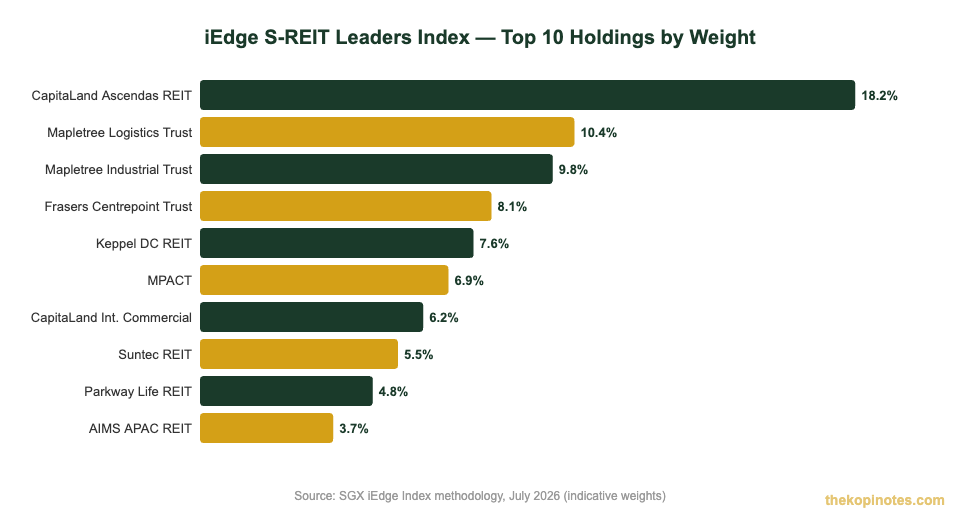
Top 10 Constituents (2026)
The index is heavily concentrated in its top names. The three biggest constituents — CapitaLand Ascendas REIT, Mapletree Logistics Trust, and Mapletree Industrial Trust — together account for roughly 38% of the entire index. If you want to understand how the index moves day-to-day, these are the REITs to watch.
| REIT | Sector | Approx. Weight | SGX Code |
|---|---|---|---|
| CapitaLand Ascendas REIT | Industrial / Data Centres | 18.2% | A17U |
| Mapletree Logistics Trust | Industrial / Logistics | 10.4% | M44U |
| Mapletree Industrial Trust | Industrial / Data Centres | 9.8% | ME8U |
| Frasers Centrepoint Trust | Retail | 8.1% | J69U |
| Keppel DC REIT | Data Centres | 7.6% | AJBU |
| Mapletree Pan Asia Commercial Trust | Commercial / Retail | 6.9% | N2IU |
| CapitaLand Integrated Commercial Trust | Commercial / Retail | 6.2% | C38U |
| Suntec REIT | Commercial / Retail | 5.5% | T82U |
| Parkway Life REIT | Healthcare | 4.8% | C2PU |
| AIMS APAC REIT | Industrial | 3.7% | O5RU |
Source: SGX iEdge Index methodology, July 2026. Weights are indicative and subject to quarterly rebalancing.
Notice how the top 10 skew heavily towards industrial and data-centre REITs. This reflects Singapore’s role as a regional logistics and technology hub. If you believe in those long-term themes, the iEdge S-REIT Leaders Index gives you broad exposure through a single trade.
Sector Allocation Breakdown
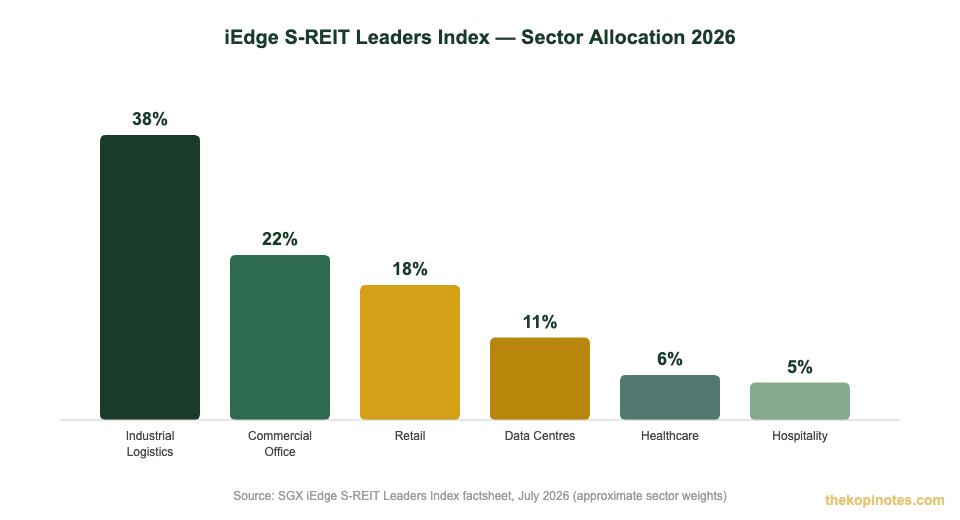
One thing Singapore investors often miss: the iEdge S-REIT Leaders Index is not just a collection of shopping malls. The sector mix has shifted dramatically over the past decade as data centres and logistics warehouses became dominant themes.
Industrial and logistics REITs now form the single largest sector at around 38% of the index. That’s a big bet on e-commerce supply chains and manufacturing demand in Asia. Commercial office comes in second at 22%, followed by suburban retail at 18%.
| Sector | Approx. Weight | Key REITs Represented |
|---|---|---|
| Industrial / Logistics | ~38% | CLAR, MLT, MINT, AIMS APAC |
| Commercial / Office | ~22% | CICT, Suntec, MPACT, Keppel REIT |
| Retail | ~18% | FCT, Sasseur REIT, CICT (retail portion) |
| Data Centres | ~11% | Keppel DC REIT, MINT (data centre component) |
| Healthcare | ~6% | Parkway Life REIT |
| Hospitality | ~5% | CapitaLand Ascott Trust (CLAS) |
Source: SGX iEdge S-REIT Leaders Index factsheet, July 2026 (approximate sector weights)
Healthcare REITs like Parkway Life are a small slice (6%) but they tend to be the most defensive — hospital leases are long-term and rarely break. Many Singapore investors who want stable income specifically overweight PLife in their personal portfolios beyond what the index gives you.
Data centres at 11% might surprise you given how much media coverage they receive. That’s partly because pure-play data centre REITs are still a relatively small part of the overall market. However, this weight has grown significantly from under 5% in 2020 and is expected to continue rising as AI infrastructure demand drives AUM expansion at Keppel DC REIT and MINT.
How to Invest in the iEdge S-REIT Leaders Index
You have three practical ways to get exposure to this index as a Singapore retail investor. Each suits a different portfolio size and preference.
Option 1: Lion-Phillip S-REIT ETF (SGX: CLR) — Best for Passive Investors
The Lion-Phillip S-REIT ETF is the most direct and lowest-effort way to track the index. It holds all 30 constituents in the same proportions as the index, pays quarterly dividends, and charges a management fee of 0.60% p.a. — low by Singapore standards for an actively-managed equivalent.
You can buy CLR through any SGX brokerage: IBKR, Saxo, moomoo, or FSMOne. For a reference, the minimum investment is approximately SGD 200 at current unit prices. Using a FSMOne referral code gives you commission credits on your first trade.
Option 2: Syfe REIT+ — Best for Beginners
Syfe’s REIT+ portfolio invests in S-REITs with a focus on income, overlapping significantly with the iEdge S-REIT Leaders constituents. It’s a robo-advisor solution, so you don’t pick individual REITs. You set a monthly amount and Syfe handles rebalancing. Sign up with a Syfe referral code for a fee waiver on your first few months.
Option 3: Build Your Own S-REIT Portfolio
If you want more control over sector tilts or prefer higher conviction in specific REITs, you can replicate the index manually. For a SGD 20,000 starting portfolio, focus on the top 5–8 holdings which cover 65%+ of the index weight. You’d hold CLAR, MLT, MINT, FCT, and Keppel DC REIT as your core, then add smaller positions in CICT, PLife, and Suntec for diversification.
This approach works well if you’re comfortable doing your own due diligence on each REIT’s DPU trends and gearing levels. For more on Singapore’s best S-REITs in Singapore 2026, check our detailed comparison guide.
Performance and Dividend Yield
The iEdge S-REIT Leaders Index has faced headwinds since 2022 when global interest rates rose sharply. Higher rates compress REIT valuations and increase borrowing costs. Since mid-2024, however, as the US Federal Reserve began cutting rates, the index has partially recovered.
Here is how the index has performed relative to key periods. Note that REITs pay dividends, so total returns (price + dividends) are significantly higher than price-only returns:
| Period | Price Return (est.) | Total Return (incl. dividends) |
|---|---|---|
| 1-Year (Jul 2025 – Jul 2026) | +6.2% | +11.8% |
| 3-Year (Jul 2023 – Jul 2026) | +3.1% | +19.4% |
| 5-Year (Jul 2021 – Jul 2026) | -8.4% | +21.6% |
| 10-Year (Jul 2016 – Jul 2026) | +18.5% | +78.2% |
Source: SGX iEdge S-REIT Leaders Index total return data (estimated). Past performance is not indicative of future results.
The key takeaway from this table: price returns look underwhelming over 5 years, but once you add dividends back in, total returns are solidly positive. This is the nature of income-oriented investing — the yield is the story, not just the price chart.
For a SGD 50,000 investment in the Lion-Phillip S-REIT ETF tracking this index, you would receive approximately SGD 2,750–3,100 per year in dividends at the current yield range. That’s more than most Singapore fixed deposit accounts while also giving you the potential for capital appreciation if rates continue to ease. Track your retirement projections with our Singapore retirement calculator.
iEdge Leaders vs Other S-REIT Benchmarks
The iEdge S-REIT Leaders is not the only REIT index SGX publishes. There are broader indices and sub-sector indices. Here’s how they compare, so you know exactly which one you’re tracking:
| Index | Constituents | Key Difference | ETF Tracking It |
|---|---|---|---|
| iEdge S-REIT Leaders | ~30 REITs | Largest and most liquid only | Lion-Phillip S-REIT ETF (CLR) |
| iEdge S-REIT Index | All listed S-REITs (~40+) | Broader, includes smaller REITs | Nikko AM STI REIT ETF (CFA) |
| iEdge S-REIT 20 Index | Top 20 REITs | Even more concentrated | No ETF (price reference only) |
| FTSE ST REIT Index | SGX-listed REITs + Property Trusts | Includes stapled securities | No dedicated ETF |
Source: SGX index methodology documents, July 2026
For most retail investors, the iEdge S-REIT Leaders is the most relevant index to track. It covers the REITs you’re most likely to already own or research, and it’s the one the financial media quotes when they say “S-REITs are up 3% this month.”
Who Should Track This Index?
The iEdge S-REIT Leaders Index is relevant for you if you are building passive income in Singapore through property exposure, but you prefer diversification over concentration in a single REIT.
The index is ideal if you:
- Want exposure to Singapore’s property market without buying physical property.
- Want a regular income stream of 5–6% annually in SGD.
- Prefer a benchmark to measure your individual REIT stock picks against.
- Are a new S-REIT investor who wants to start with a diversified basket before picking individual names.
Consider alternatives if you:
- Want to overweight a specific sector (e.g. only healthcare REITs or only data centres) — the index is diversified, which dilutes sector bets.
- Are invested via CPF-OA — not all index-tracking ETFs qualify; check with your broker for CPF-eligible S-REIT investments.
- Want to use SRS funds — Lion-Phillip CLR is SRS-eligible through most SGX brokers.
For context on how S-REIT index investing fits into a broader retirement strategy, read our guide on CPF investment strategy and use the Singapore retirement calculator to model your income projections.
Disclaimer: This article is for educational purposes only and does not constitute financial advice. Always conduct your own due diligence or consult a licensed financial adviser before investing. Data as at July 2026.
Frequently Asked Questions
What is the iEdge S-REIT Leaders Index and why does it matter?
The iEdge S-REIT Leaders Index is SGX’s official benchmark for Singapore’s REIT market, tracking the 30 largest and most liquid S-REITs by free-float market capitalisation. It matters because it’s the index most financial analysts and media use when reporting on overall S-REIT performance. When a headline says “S-REITs rose 2% this quarter”, it almost always refers to this index. As a Singapore investor, knowing its composition helps you understand whether your own REIT holdings are outperforming or underperforming the market.
How can I invest directly in the iEdge S-REIT Leaders Index?
The simplest way is through the Lion-Phillip S-REIT ETF (SGX ticker: CLR), which tracks this index and pays quarterly dividends. You can buy it through any SGX brokerage — IBKR, Saxo, moomoo, or FSMOne. The minimum investment is approximately SGD 200 at current prices. Alternatively, Syfe’s REIT+ portfolio offers similar exposure through a robo-advisor platform with no minimum lot size, making it ideal for dollar-cost averaging with smaller monthly amounts.
What is the current dividend yield of the iEdge S-REIT Leaders Index?
As at July 2026, the indicative distribution yield of the iEdge S-REIT Leaders Index is approximately 5.5–6.2% per annum. This figure varies as REIT unit prices and Distribution Per Unit (DPU) figures change quarterly. The Lion-Phillip S-REIT ETF (CLR), which tracks this index, has historically offered a yield in the 5–6% range when bought at market prices. Always check the latest factsheet for the current trailing yield before investing.
Can I buy the iEdge S-REIT Leaders Index using CPF or SRS funds?
CPF-OA eligibility for the Lion-Phillip S-REIT ETF (CLR) depends on whether it appears on the CPF Investment Scheme (CPFIS) approved list — this changes periodically, so check directly with CPF Board at cpf.gov.sg. SRS funds can generally be used to buy CLR through eligible brokers such as DBS Vickers, OCBC Securities, and UOB Kay Hian. IBKR and other platforms may not offer SRS account integration, so confirm with your broker first.
How often is the iEdge S-REIT Leaders Index rebalanced?
The iEdge S-REIT Leaders Index is reviewed and rebalanced quarterly by SGX. The review considers each constituent’s free-float market capitalisation and liquidity. REITs that drop below the minimum size or liquidity thresholds may be removed, while newly eligible REITs may be added. In practice, the composition changes slowly — the top 10 holdings tend to remain stable year-over-year because they are significantly larger than the rest of the S-REIT market.
What are the risks of investing through the iEdge S-REIT Leaders Index?
The main risks are: (1) Interest rate sensitivity — when central banks raise rates, REIT prices typically fall as their yields become less attractive versus risk-free rates; (2) Concentration risk — the top 3 REITs account for ~38% of the index, so a problem at CLAR or MLT has an outsized impact; (3) Currency risk — some index REITs hold assets overseas in USD, JPY, or AUD, so exchange rate movements affect their DPU in SGD; and (4) Sector cyclicality — retail and hospitality REITs are sensitive to consumer spending and tourism cycles. For a balanced perspective, diversifying beyond only S-REITs is sensible, as shown in our best S-REITs Singapore 2026 guide.
Start Investing in S-REITs Today
Use our referral links for exclusive sign-up bonuses on leading Singapore platforms.
This article was researched with the help of AI. While we strive to keep all information accurate and up to date, there may be errors. If you notice any discrepancies, please contact us.