Life Insurance Singapore Comparison 2026: Term vs Whole Life vs CI
Compare the right plan for your stage of life — clear premiums, payouts, and honest trade-offs.
Comparing life insurance in Singapore comes down to three main types: term life, whole life, and critical illness (CI) insurance. Term life is cheapest and pays out only on death or Total Permanent Disability (TPD). Whole life costs more but builds cash value. CI pays a lump sum on diagnosis of major illnesses. For most working Singaporeans in their 30s, a term life + standalone CI combination offers the best coverage per dollar.
Not financial advice. All figures are for educational reference only. Premiums are indicative and vary by age, health, and insurer. Data as at June 2026.
- Term life is the most affordable — ideal if you need maximum coverage at low cost
- Whole life has a savings component but premiums are 7–10x higher than term for the same sum assured
- CI insurance fills a critical gap — death cover does not help you if you survive a heart attack or stroke
Table of Contents
Contents — Click to expand
- The 4 Main Types of Life Insurance in Singapore
- Term Life Insurance: Best for Pure Protection
- Whole Life Insurance: Coverage + Savings
- Critical Illness Insurance: The Gap Filler
- DPS (Dependants’ Protection Scheme): Your CPF Safety Net
- Premium Comparison: How Much Will You Pay?
- Which Life Insurance Plan Should You Choose?
- How to Buy Life Insurance in Singapore
- Frequently Asked Questions
The 4 Main Types of Life Insurance in Singapore
Before comparing specific plans, you need to understand what each type of life insurance actually does. Singapore’s Life Insurance Association (LIA) classifies policies broadly — but in practice, most Singaporeans encounter four main types:
Term life insurance pays a fixed sum if you die or become totally permanently disabled (TPD) within a set period — typically 10 to 40 years. No payout if you outlive the policy. It’s pure protection.
Whole life insurance covers you for your entire life and accumulates a cash value over time. You can surrender the policy for this cash value, or borrow against it. Premiums are significantly higher than term.
Critical illness (CI) insurance pays a lump sum on diagnosis of one of the covered conditions — the LIA standard covers 37 critical conditions including cancer, heart attack, and stroke. You get paid regardless of whether you survive or die. This fills a gap that death-only coverage misses.
DPS (Dependants’ Protection Scheme) is a CPF-linked group term insurance scheme administered by Great Eastern and NTUC Income. It provides up to $70,000 coverage up to age 65. Premiums are deducted automatically from your CPF Ordinary or Special Account, starting from as low as $18/year for members under 35.
Term Life Insurance: Best for Pure Protection
Term life is the most cost-efficient way to protect your dependants’ financial future. You pay a fixed annual or monthly premium for a defined coverage period. If you die or become TPD within that period, your beneficiaries receive the sum assured. If you survive, you get nothing back — and that’s by design.
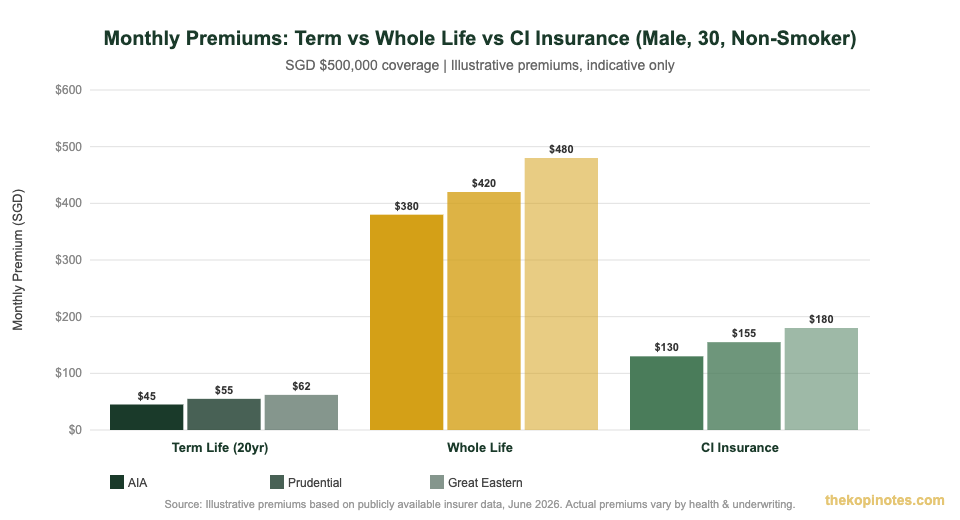
Why this makes sense: A 30-year-old male non-smoker can get $500,000 of coverage for roughly $45–$62/month with AIA, Prudential, or Great Eastern. The same $500,000 through a whole life plan would cost $380–$480/month. The difference — around $300–$400/month — can be invested in an ETF or S-REIT portfolio to build wealth independently.
Popular term life plans in Singapore include AIA Secure Flexi Term, Prudential PRULife Multiplier, and Great Eastern GREAT Term Assurance. Most can be enhanced with riders for CI, TPD, and disability income — letting you customise coverage to your exact needs without paying the whole life premium.
Best for: Young working adults, parents with mortgages, those prioritising maximum coverage at minimum cost, and investors who prefer to keep insurance and investing separate.
Whole Life Insurance: Coverage + Savings
Whole life policies combine death/TPD coverage with a savings or investment component. Part of your premium goes into a participating fund managed by the insurer — this is the “cash value” that grows over time and includes non-guaranteed bonuses.
The LIA’s benchmarks suggest participating fund policies returned around 3.25–4.75% p.a. historically — but these are not guaranteed. The guaranteed portion of the cash value grows much more slowly, typically reaching meaningful levels only after 15–20 years.
Here’s the honest trade-off: whole life is expensive for the coverage amount. For the $380–$480/month you’d pay for $500,000 whole life coverage, you could buy the same $500,000 of term coverage for $50/month and invest the remaining $330–$430/month into a diversified portfolio. Over 20 years at a 5% annual return, that investment pot could grow to over $250,000 — potentially outperforming the whole life cash value.
That said, whole life isn’t without advantages. The savings element forces discipline. The cash value is not subject to creditor claims in bankruptcy. And for estate planning purposes, life insurance proceeds paid directly to nominees are not subject to estate duty in Singapore.
Best for: Those who struggle to save separately, high-income earners using it as part of estate planning, or parents buying coverage for children (leveraging lower premiums at young age).
Critical Illness Insurance: The Gap Filler
This is the most misunderstood type of life insurance in Singapore. Many people assume their death-and-TPD policy has them fully covered. It doesn’t.
Consider this: in 2024, MAS data showed that over 60% of life insurance claims in Singapore were for critical illness events — not death. Surviving a heart attack at 45 is the more likely scenario. But surviving it without adequate CI coverage can be financially devastating. Medical costs, extended recovery time, and potential loss of income can drain savings quickly.
Standalone CI policies (rather than CI riders on whole life plans) typically offer broader coverage for earlier-stage conditions. Many now cover early-stage cancer, early heart attacks, and diabetic complications. The LIA’s 37 standardised CI definitions provide a useful baseline — always check whether a plan covers “early” and “intermediate” stages, not just advanced-stage conditions.
A 30-year-old female non-smoker can get $300,000 of CI coverage for approximately $100–$140/month. Plans like AIA Power Critical Cover, Manulife CriticalCare Advantage, and Singlife Multi-Pay CI are among the most competitive options in 2026.
For deeper analysis on whether CI insurance is right for you, see our guide on universal life insurance Singapore and how whole-of-life CI coverage compares.
DPS (Dependants’ Protection Scheme): Your CPF Safety Net
Every CPF member between age 21 and 65 is automatically enrolled in DPS — a basic group term insurance scheme that provides up to $70,000 in death/TPD coverage. Premiums are deducted directly from your CPF account, so you don’t feel the cost in your monthly cash flow.
| Age Band | Annual DPS Premium | Coverage Amount |
|---|---|---|
| 21–34 | $18/year | $70,000 |
| 35–39 | $30/year | $70,000 |
| 40–44 | $60/year | $70,000 |
| 45–49 | $90/year | $70,000 |
| 50–54 | $140/year | $70,000 |
| 55–65 | $260/year | $70,000 |
Source: CPF Board, DPS premium schedule, June 2026
DPS is excellent value but provides only a safety net — $70,000 is not enough to replace income for most Singaporean families. Think of it as a floor, not a ceiling. Supplement DPS with a private term life or whole life policy for meaningful coverage.
Premium Comparison: How Much Will You Pay?
Premiums vary based on your age, gender, smoking status, health history, and the insurer you choose. The table below gives a realistic snapshot for a 30-year-old male non-smoker seeking $500,000 in coverage, based on indicative rates from major insurers as at June 2026.
| Plan Type | Insurer | Sum Assured | Monthly Premium | Coverage Period |
|---|---|---|---|---|
| Term Life (20yr) | AIA Secure Flexi Term | $500,000 | ~$45 | 20 years |
| Term Life (20yr) | Prudential PRULife Multiplier | $500,000 | ~$55 | 20 years |
| Term Life (20yr) | Great Eastern GREAT Term | $500,000 | ~$62 | 20 years |
| Whole Life | AIA Guaranteed Protect Plus | $500,000 | ~$380 | Whole life |
| Whole Life | Prudential PruLife Par | $500,000 | ~$420 | Whole life |
| CI Insurance | AIA Power Critical Cover | $300,000 | ~$130 | To age 75 |
| CI Insurance | Manulife CriticalCare Adv. | $300,000 | ~$155 | To age 75 |
| DPS (CPF) | Great Eastern / NTUC Income | $70,000 | ~$1.50 | To age 65 |
Source: Indicative premiums based on publicly available product pages, June 2026. Male, 30, non-smoker, standard health. Actual premiums subject to underwriting.
The numbers tell the story clearly. For a 30-year-old, term life delivers $500,000 of protection for around 10–12% of what whole life costs. If you’re weighing affordability, term wins every time. If you’re also building savings or want lifelong guaranteed coverage without needing to renew, whole life has its place — but you need to be honest about whether you’ll actually hold it for 20+ years.
Which Life Insurance Plan Should You Choose?
The right plan depends on your life stage, income, and financial goals. Here’s a practical framework used by many Singapore financial planners:
You’re in your 20s–30s with dependants: Start with DPS (automatic via CPF), then add a term life policy for $300,000–$500,000 coverage. Separately, get a standalone CI policy with at least $100,000 in coverage. Total monthly cost: roughly $150–$250. This protects your family without overcommitting your cash flow.
You have a mortgage: Match your term life coverage period and sum to your outstanding loan balance. If you owe $400,000 on an HDB flat, make sure your term life policy covers at least that amount for the duration of your mortgage.
You’re a high-income earner focused on estate planning: Whole life may make sense as a tax-efficient estate planning tool. Life insurance proceeds paid to nominees bypass the estate and are not subject to estate duty in Singapore — a useful structuring tool for high-net-worth families.
You’re self-employed or a freelancer: CI insurance becomes even more critical. You don’t have employer-paid sick leave or group insurance. A $200,000–$300,000 CI payout gives you 2–3 years of income replacement if you’re hit with cancer or a heart attack.
When figuring out how much coverage you need, our Singapore retirement calculator can help you model your long-term financial needs alongside insurance costs. You can also build a more complete picture of your CPF-linked benefits through our CPF investment strategy guide.
How to Buy Life Insurance in Singapore
You have three main routes to buying life insurance in Singapore:
1. Through a financial adviser (FA): FAs compare plans across multiple insurers and help you structure the right combination. They earn a commission from the insurer — so their advice is free to you, but be aware of potential bias toward higher-premium products. Always ask for a comparison of at least three plans.
2. Direct purchase plans (DPI): MAS-regulated direct-purchase platforms like LIA’s CompareFirst allow you to buy term life and whole life plans directly without adviser involvement, at a lower cost. Best for those who’ve done their research and know what they want.
3. Online aggregators and robo-advisory platforms: Platforms like Singlife, FWD, and certain robo-advisory tools now allow direct online applications. Coverage can be issued within 24–48 hours for standard-health applicants, with no medical examination required up to certain sum thresholds.
Before applying, gather these documents: NRIC, income statements (past 12 months), existing insurance policy details, and a list of current medications if any. Full disclosure is legally required — non-disclosure can void your claim.
For investment-linked products or endowment plans as part of your insurance strategy, our Endowus referral code page at Endowus referral code includes sign-up bonuses that can offset your first year’s advisory fees.
If you’re also considering passive income from investments alongside your insurance coverage, our passive income Singapore guide and best S-REITs in Singapore 2026 analysis show how to build a dividend income stream that complements your insurance safety net.
Disclaimer: The information above is for educational reference only and does not constitute financial advice. Life insurance is regulated by MAS under the Insurance Act. Always consult a licensed Financial Adviser Representative (FAR) before purchasing a policy.
Frequently Asked Questions
What is the difference between term life and whole life insurance in Singapore?
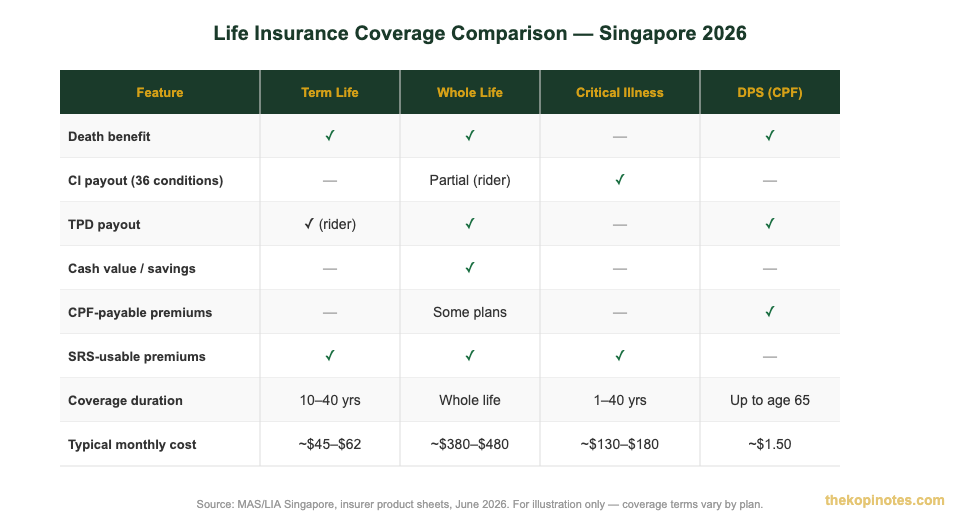
Term life covers you for a fixed period (e.g. 20 years) and pays out only if you die or become TPD within that period. There is no payout if you outlive the policy, and no cash value. Whole life insurance covers you for your entire lifetime and builds a cash value over time. Term life is significantly cheaper — roughly 7–10x lower monthly premiums for the same sum assured. For most working Singaporeans, term life plus a separate investment account outperforms whole life on a pure wealth-building basis.
Do I need critical illness insurance if I already have term life insurance?
Yes — and this is one of the most important points in Singapore insurance planning. Term life only pays out if you die or become TPD. Critical illness insurance pays on diagnosis of a major illness, even if you survive. Given that over 60% of life insurance claims in Singapore are CI-related (MAS data, 2024), and that surviving cancer or a heart attack can mean months or years of lost income and high medical costs, CI coverage fills a critical gap that term life cannot.
Which life insurance type is cheapest in Singapore?
DPS (Dependants’ Protection Scheme) is the cheapest at just $18–$260 per year depending on age, though coverage is capped at $70,000. Among private plans, term life is the most affordable — a 30-year-old non-smoker can get $500,000 of coverage for around $45–$62/month. Whole life insurance for the same coverage typically costs $380–$480/month. CI insurance sits in between, typically $100–$180/month for $300,000 of standalone coverage.
Can I use CPF or SRS to pay life insurance premiums?
DPS premiums are paid automatically from your CPF Ordinary or Special Account — you don’t need to do anything. For private life insurance, Medisave cannot be used for death or CI coverage (only for health-related Integrated Shield Plans). However, some whole life and term plans qualify for SRS (Supplementary Retirement Scheme) premium payments through SRS-registered insurers. Check with your insurer whether SRS payment is available for your specific plan.
How much life insurance coverage do I actually need in Singapore?
A common rule of thumb used by Singapore financial planners is 9–12x your annual income. For a household earning $6,000/month ($72,000/year), that means $650,000–$864,000 of life coverage. However, your personal needs depend on: outstanding mortgage amount, number of dependants and their ages, your spouse’s income and employability, and any existing group insurance from your employer. Always subtract existing DPS and employer coverage before calculating the gap your private policy needs to fill.
Is life insurance a good investment in Singapore?
Term life insurance is not an investment — it’s pure protection with no cash value. Whole life insurance has an investment component via its participating fund, which has historically returned 3.25–4.75% p.a. (LIA benchmark, non-guaranteed). Compared to a diversified ETF portfolio tracking the S&P 500 or VWRA, this return is modest. Most financial planners in Singapore advise separating insurance and investing: buy term for protection, invest the difference in low-cost ETFs or S-REITs for better long-term wealth accumulation.
What happens if I miss a life insurance premium payment in Singapore?
Most Singapore life insurers provide a 30-day grace period after the premium due date. If you miss the payment within this window, coverage continues. After the grace period, the policy lapses — meaning you lose coverage and any accumulated benefits. Whole life policies with sufficient cash value may allow an automatic premium loan (APL), where the insurer deducts the premium from your cash value. For term policies, reinstatement is usually possible within 2 years of lapse with proof of good health and back-payment of missed premiums.
Start Building Your Financial Safety Net
Compare insurance plans alongside your investment strategy. Use our tools and referral links to save on both.
Get Free Insurance Advice
Speak with a licensed insurance advisor. No obligation, no cost.
By submitting this form, you agree to our Privacy Policy.
This article was researched with the help of AI. While we strive to keep all information accurate and up to date, there may be errors. If you notice any discrepancies, please contact us.