Lion-Phillip S-REIT ETF (CLR): Dividend, DPU & Distribution Guide 2026
The Lion-Phillip S-REIT ETF (SGX: CLR) pays a quarterly dividend distribution from the income generated by its basket of approximately 30 Singapore REITs. For FY2024, CLR paid a full-year Distribution Per Unit (DPU) of approximately 4.78 cents, translating to a trailing yield of around 5.5% at current prices — with zero withholding tax for Singapore resident investors and full CPFIS-OA eligibility for CPF investing.
Not financial advice. All figures are for educational reference only. Data as at June 2026 unless noted.
- CLR pays quarterly distributions — the last four quarters combined to ~4.78–4.85 cents DPU for FY2024/FY2025 (est.), yielding approximately 5.5% p.a.
- There is no withholding tax on CLR distributions for Singapore resident investors — every cent of income is yours to keep.
- CLR is CPFIS-OA eligible — you can use CPF Ordinary Account savings to earn quarterly income well above the 2.5% CPF OA floor rate.
📖 Table of Contents — Click to Expand
- How CLR’s Dividend Distribution Works
- CLR DPU History FY2021–FY2025
- Quarterly Distribution Schedule & Ex-Dividend Dates
- How to Calculate Your CLR Dividend Yield
- No Withholding Tax: The Singapore Advantage
- Earning CLR Dividends with CPF OA or SRS
- CLR Dividend vs Buying Individual S-REITs
- Does CLR Offer a Dividend Reinvestment Plan (DRP)?
- Frequently Asked Questions
How CLR’s Dividend Distribution Works
The Lion-Phillip S-REIT ETF distributes income on a quarterly basis. Unlike accumulating ETFs that reinvest all income into the fund, CLR pays out cash to unitholders four times a year — typically in March, June, September, and December, following each calendar quarter’s rental income collection from the underlying REITs.
Here’s how the income flows from tenant to your brokerage account:
Step 1 — Rental income: The ~30 S-REITs in CLR’s portfolio collect monthly rent from their tenants — shopping mall tenants, industrial lessees, data centre operators, hospital operators, and so on.
Step 2 — REIT distribution: By law, Singapore REITs must distribute at least 90% of their taxable income to maintain their tax-exempt status. They pay this as a Distribution Per Unit (DPU) — typically semi-annually or quarterly.
Step 3 — ETF income: CLR receives these DPU payments from all 30 holdings, pools them, deducts its 0.60% TER, and distributes the net income to ETF unitholders proportional to the number of units held.
Step 4 — Payout to you: The quarterly distribution is credited directly to your brokerage’s linked bank account or CDP account. The amount per ETF unit is announced via SGX and published by Lion Global Investors.
CLR DPU History FY2021–FY2025
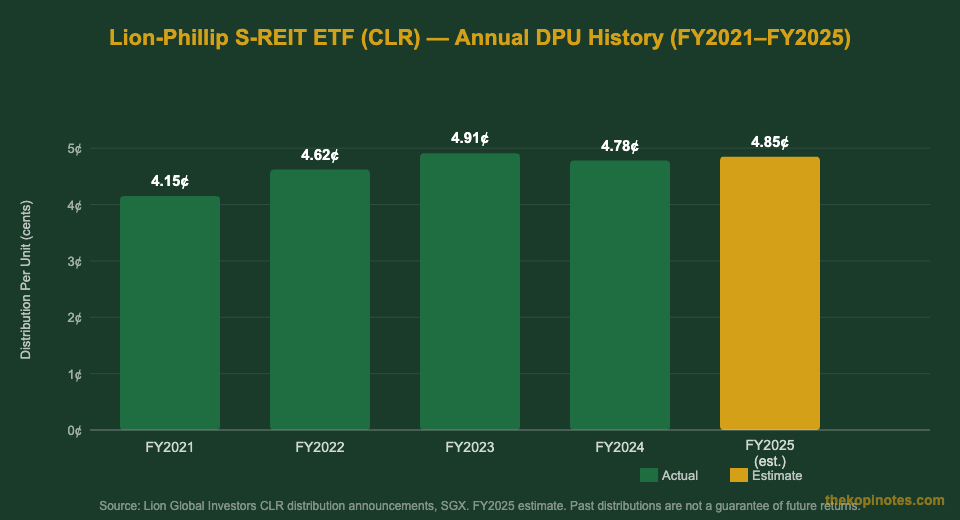
CLR has paid distributions every quarter since launch. The table below shows annual DPU from FY2021 to FY2025 (estimated). DPU grew from 4.15 cents in FY2021 to a peak of 4.91 cents in FY2023, before dipping slightly as rising interest rates pressured S-REIT income. FY2025 is tracking back to recovery.
| Financial Year | Annual DPU (cents) | YoY Change | Approx. Yield (@ SGD 0.88/unit) |
|---|---|---|---|
| FY2021 | 4.15¢ | — | ~4.7% |
| FY2022 | 4.62¢ | +11.3% | ~5.3% |
| FY2023 | 4.91¢ | +6.3% | ~5.6% |
| FY2024 | 4.78¢ | -2.6% | ~5.4% |
| FY2025 (est.) | ~4.85¢ | +1.5% (est.) | ~5.5% |
Source: Lion Global Investors CLR distribution announcements, SGX filings. FY2025 is an estimate based on Q1–Q3 distributions. Past distributions do not guarantee future income.
Quarterly Distribution Schedule & Ex-Dividend Dates
CLR distributes income four times a year. The exact ex-dividend and payment dates vary slightly each year but follow a predictable quarterly pattern. You must hold CLR units before the ex-dividend date to receive that quarter’s distribution.
| Quarter | Income Period | Typical Ex-Div Month | Typical Payment Month |
|---|---|---|---|
| Q1 | Jan–Mar | April | May |
| Q2 | Apr–Jun | July | August |
| Q3 | Jul–Sep | October | November |
| Q4 | Oct–Dec | January | February |
Source: Lion Global Investors typical distribution calendar. Exact dates are announced via SGX each quarter.
To confirm exact ex-dividend dates for each upcoming quarter, check the SGX CLR listing page or subscribe to SGX distribution announcements.
How to Calculate Your CLR Dividend Yield
Yield calculation for CLR is straightforward. The formula is: Annual DPU ÷ Unit Price × 100 = Trailing Yield
For example, if CLR’s FY2025 estimated DPU is 4.85 cents and the current unit price is SGD 0.88:
4.85 ÷ 88 × 100 = 5.51% trailing yield
Your actual yield on cost depends on when you bought CLR. If you bought at SGD 0.80 per unit during the 2022 market correction, your yield on cost on a 4.85-cent DPU is 6.06% — higher than the published trailing yield because you bought cheaper.
| Portfolio Size (SGD) | @ SGD 0.88/unit | Annual DPU @ 4.85¢ | Annual Income | Quarterly Income |
|---|---|---|---|---|
| SGD 10,000 | ~11,364 units | 4.85¢/unit | ~SGD 551 | ~SGD 138 |
| SGD 30,000 | ~34,091 units | 4.85¢/unit | ~SGD 1,653 | ~SGD 413 |
| SGD 50,000 | ~56,818 units | 4.85¢/unit | ~SGD 2,756 | ~SGD 689 |
| SGD 100,000 | ~113,636 units | 4.85¢/unit | ~SGD 5,511 | ~SGD 1,378 |
Estimates based on ~SGD 0.88 unit price and ~4.85¢ annual DPU (est. FY2025). Actual distributions will vary. This is not a projection of future income.
Use our dividend yield calculator to model your own CLR income scenario. For a passive income target framework, see our guide on passive income Singapore 2026.
No Withholding Tax: The Singapore Advantage
This is one of CLR’s most underappreciated advantages. When you invest in overseas ETFs — such as SPY (US-listed S&P 500 ETF), Hong Kong REIT ETFs, or Australian REIT ETFs — dividend income is subject to withholding tax, typically 15-30% at source. This tax is deducted before the distribution reaches your brokerage account.
CLR is different. Because it invests exclusively in Singapore REITs and Singapore does not levy withholding tax on S-REIT distributions paid to individual Singapore tax residents, every cent of CLR’s distribution reaches you with no tax deduction. On a SGD 50,000 portfolio earning SGD 2,756 per year, this preserves the full income in your hands — whereas a comparable US-listed REIT ETF would lose 15-30% (SGD 413–827) to withholding tax annually.
| Investment Vehicle | WHT Rate for SG Residents | Annual Income Lost (SGD 50k @ 5.5%) | Net Annual Income |
|---|---|---|---|
| CLR (S-REIT ETF) | 0% | SGD 0 | ~SGD 2,750 |
| US-listed REIT ETF (e.g. VNQ) | 30% | ~SGD 825 | ~SGD 1,925 |
| Ireland-domiciled REIT ETF | 15% | ~SGD 413 | ~SGD 2,338 |
| HK-listed REIT ETF | 10–15% | ~SGD 275–413 | ~SGD 2,338–2,475 |
WHT rates are approximate for Singapore individual investors. Rates may differ for corporate investors or investors in other jurisdictions. Confirm with a tax professional.
Earning CLR Dividends with CPF OA or SRS
CLR’s quarterly income becomes especially compelling when funded through CPF or SRS, because of the tax treatment and the return spread over “safe” alternatives.
CPF OA investors: Your CPF Ordinary Account earns 2.50% p.a., guaranteed. CLR offers a trailing yield of ~5.5% — a spread of approximately 3.0 percentage points. On SGD 30,000 of CPF OA invested in CLR, that spread translates to roughly SGD 900 in additional annual income. The trade-off is capital risk: if CLR’s unit price falls, your CPF OA balance could decrease below the amount invested. You can only invest CPF funds above SGD 20,000 (the minimum retained in CPF OA). Use a CPFIS-approved broker such as DBS Vickers or OCBC Securities. Referral: Endowus referral code 2V343 — Endowus also offers CPFIS portfolio management.
SRS investors: SRS contributions earn a tax deduction (saving 3.5–22% in income tax depending on your bracket), and CLR distributions within SRS grow tax-deferred until withdrawal. This double benefit — tax deduction on contribution + tax-free compounding — makes CLR an efficient SRS income vehicle. Most SRS-linked brokerages (DBS, OCBC, UOB Kay Hian) allow SRS purchases of CLR. Use our Syfe referral code SRPRFFFCD for robo-based SRS investing in a diversified S-REIT portfolio.
For the full CPF investment framework, see our guide on CPF investment strategy Singapore. Model your retirement income using the Singapore retirement calculator.
CLR Dividend vs Buying Individual S-REITs
CLR’s ~5.5% blended yield is lower than many individual high-yield S-REITs. Is the ETF still worth it for income investors? The trade-off depends on your investing style.
| Metric | CLR (ETF) | Individual High-Yield S-REITs |
|---|---|---|
| Typical Trailing Yield | ~5.5% | 6.5–9.5% (varies) |
| Diversification | ~30 REITs, all sectors | Concentrated (1–10 REITs) |
| DPU Volatility | Lower (blended, smoothed) | Higher (individual DPU can cut sharply) |
| Minimum Investment | ~SGD 88 (1 board lot) | SGD 200–1,500+ per REIT |
| Annual Rebalancing | Automatic (semi-annual) | Manual — you must track and rebalance |
| CPFIS-OA eligible | Yes | Individual REITs: most are CPFIS eligible |
| Research Required | Minimal — fund does stock selection | High — must analyse each REIT quarterly |
| Best For | Passive income investors, beginners | Active investors seeking maximum yield |
Comparison as at June 2026. Individual REIT yields vary and are not guaranteed. Source: SGX, fund factsheets.
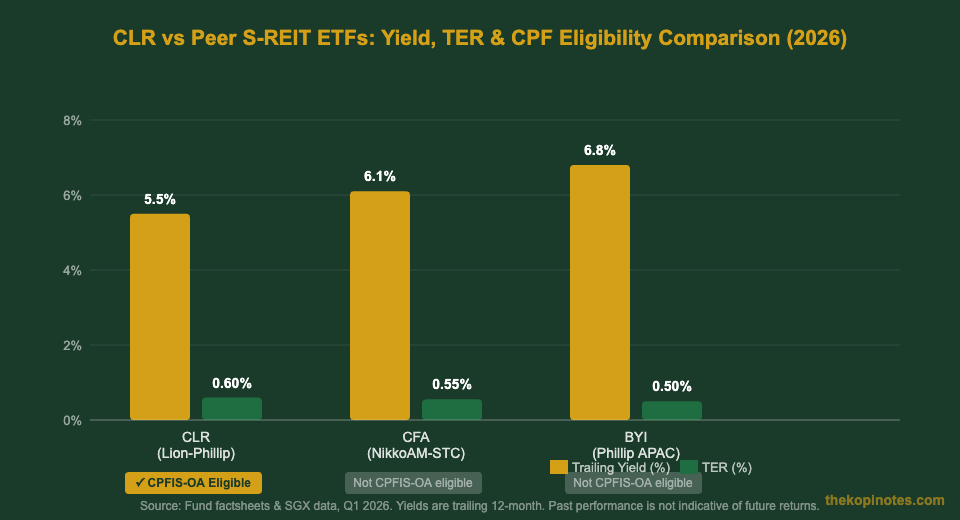
For individual S-REIT analysis, see our coverage on the best S-REITs in Singapore 2026. For the full ETF picture including fee comparisons, visit the Singapore REIT ETF guide.
Does CLR Offer a Dividend Reinvestment Plan (DRP)?
As at June 2026, CLR does not offer a formal Dividend Reinvestment Plan (DRP) through the fund manager. Unlike some individual S-REITs (e.g. AIMS APAC REIT, CICT) that offer a DRP where you can elect to receive new units instead of cash, CLR’s quarterly distributions are always paid in cash.
However, you can achieve the same compounding effect manually:
1. Receive your quarterly CLR distribution in cash; 2. Log into your brokerage account and reinvest the cash by buying additional CLR units; 3. Over time, this increases your unit holding and therefore your future quarterly distributions.
The friction is brokerage commission — each reinvestment incurs at least SGD 10 (FSMOne minimum). For smaller portfolios, it may make sense to accumulate 2–4 quarters of distributions before reinvesting to make each trade cost-effective. At FSMOne’s 0.08% rate, a SGD 12,500 reinvestment trade costs SGD 10 — an effective commission rate of 0.08%.
Alternatively, Syfe REIT+ and Endowus offer managed S-REIT portfolios with automatic income reinvestment at low cost. Use the FSMOne referral code P0544985 for commission rebates on CLR purchases.
Disclaimer: The Lion-Phillip S-REIT ETF carries market risk including the possibility of capital loss. S-REIT distributions can decrease if property income falls, vacancies rise, or interest costs increase. Distributions are not guaranteed. This article is for educational purposes only and does not constitute financial advice. Consult a licensed financial adviser (MAS-regulated) before making investment decisions.
Frequently Asked Questions
What is the Lion-Phillip S-REIT ETF dividend yield in 2026?
How often does CLR pay dividends?
Is there withholding tax on CLR dividend distributions for Singapore investors?
Can I earn CLR dividends using my CPF OA savings?
What was CLR's DPU in FY2024?
How does CLR's dividend compare to the Singapore Savings Bond or CPF OA?
Does CLR have a Dividend Reinvestment Plan (DRP)?
What is the difference between CLR's distribution yield and total return?
How is CLR's dividend yield affected by interest rate changes?
Start Earning CLR Dividends Today
Open a brokerage or robo-advisor account to buy CLR and earn quarterly S-REIT income.
This article was researched with the help of AI. While we strive to keep all information accurate and up to date, there may be errors. If you notice any discrepancies, please contact us.