Great Eastern Supreme Health P Plus Review Singapore (2026)
Coverage · Premiums · Riders · Who Should Buy
Great Eastern Supreme Health P Plus is an Integrated Shield Plan (ISP) that covers Class A ward and above at restructured and private hospitals in Singapore. It sits above MediShield Life, picking up the gap between what CPF pays and your actual bill. For 2026, P Plus remains one of the most comprehensive ISPs available — but its premiums are among the highest, especially past age 50. This guide tells you exactly what it covers, what it costs, and whether it makes sense for you.
Not financial advice. All figures are for educational reference only. Data as at June 2026 unless noted.
- GE Supreme Health P Plus covers Class A ward and private hospitals with high annual claim limits and no lifetime cap.
- Premiums are higher than mid-tier ISPs — but a single major hospitalisation can easily justify years of premiums.
- Best suited for those who want Class A or private hospital access and can afford the rider co-payment under the 2026 rules.
What Is GE Supreme Health P Plus?
Great Eastern (GE) Life is one of Singapore’s largest insurers. Its flagship integrated shield plan — Supreme Health — comes in four tiers: A Standard, P Standard, P Plus, and Private. The “P” tiers cover Class A ward at restructured hospitals and private hospitals. P Plus adds higher sub-limits and better private hospital coverage compared to P Standard.
An Integrated Shield Plan (ISP) works like a top-up over your mandatory MediShield Life coverage. MediShield Life is the base government plan from CPF that every Singapore citizen and PR holds. It only covers Class B2 and below. If you want Class A or private, you need an ISP like P Plus.
Here’s the key thing: ISP premiums are payable from your MediSave account, subject to the Additional Withdrawal Limit (AWL). For P Plus, the AWL is $600/year for those below 40, rising with age. The rest you pay in cash.
| Plan Tier | Ward Coverage | Private Hospital | Annual Claim Limit |
|---|---|---|---|
| A Standard | Class A, Restructured | Partial | $150,000 |
| P Standard | Class A, Private | Yes | $300,000 |
| P Plus | Class A, Private | Yes — higher sub-limits | $600,000 |
| Private | Class A, Private | Yes — full private | $1,200,000 |
Source: Great Eastern Life Supreme Health product summary, June 2026
What Does GE Supreme Health P Plus Cover?
P Plus covers a broad range of hospitalisation and day surgery expenses. Here’s what you get:
| Benefit | P Plus Coverage |
|---|---|
| Ward & Treatment | Class A ward at restructured, full private hospital |
| Annual Claim Limit | $600,000 per policy year |
| Lifetime Claim Limit | Unlimited (no lifetime cap) |
| Daily Ward Charges | As charged (Class A / private) |
| Surgical Fees | As charged, subject to schedule of surgical procedures |
| Specialist & Consultant Fees | Covered (subject to fee benchmarks at private hospitals) |
| Pre- & Post-Hospitalisation | 90 days before, 365 days after discharge |
| Day Surgery | Covered |
| Cancer Outpatient Treatment | Covered (chemotherapy, radiotherapy, immunotherapy) |
| Deductible (without rider) | $3,500 per policy year (Class A); $5,000 (private) |
| Co-insurance (without rider) | 10% of claimable amount |
Source: GE Life Supreme Health P Plus schedule of benefits, June 2026
One key point: the deductible and co-insurance apply per policy year. Once you hit the deductible, the plan covers the rest (minus co-insurance). If you add the SupremeHealth Plus Extra rider, your deductible drops significantly — but post-2026 MOH rules require at least 5% co-payment from you on any rider.
GE Supreme Health P Plus Premium Table 2026
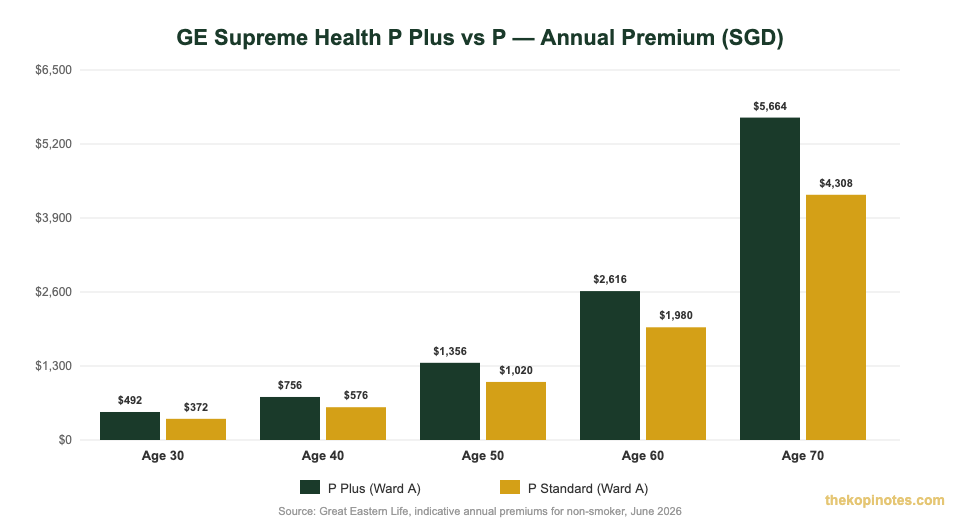
Premiums for ISPs increase significantly with age. P Plus is priced above the mid-tier ISPs, reflecting its higher annual claim limit and private hospital sub-limits. Here are the indicative annual premiums for a non-smoker in 2026:
| Age Next Birthday | Annual Premium (SGD) | MediSave AWL | Cash Top-Up |
|---|---|---|---|
| 1–20 | $228 | $228 | $0 |
| 21–30 | $360 | $360 | $0 |
| 31–40 | $492 | $492 | $0 |
| 41–50 | $756 | $600 | $156 |
| 51–60 | $1,356 | $900 | $456 |
| 61–70 | $2,616 | $1,200 | $1,416 |
| 71–80 | $5,664 | $1,800 | $3,864 |
Source: GE Life Supreme Health indicative premiums for non-smoker, June 2026. Actual premiums may vary. MediSave AWL figures per CPF Board guidelines.
Notice how premiums jump sharply after age 60. That’s why it’s important to get an ISP while you’re young — you lock in coverage and avoid exclusions for pre-existing conditions. If you wait until your 50s, you may face underwriting exclusions for conditions like hypertension or diabetes.
The Rider — SupremeHealth Plus Extra
The SupremeHealth Plus Extra is GE’s rider for the P Plus plan. A rider (also called an add-on) reduces your out-of-pocket costs at the time of hospitalisation. Without a rider, you pay the deductible ($3,500–$5,000) and 10% co-insurance yourself.
Here’s the catch: MOH updated rider rules in 2026. All ISP riders must now include at least a 5% co-payment from you — and this co-payment cannot be paid from MediSave. This is to ensure you have “skin in the game” and don’t over-consume medical services.
In practice, the SupremeHealth Plus Extra rider means:
- Your deductible is largely absorbed by the rider
- You pay 5% of the claimable amount (minimum $3,000 per policy year, capped at $5,000)
- The rider premium itself varies by age — typically $400–$900/year in your 40s
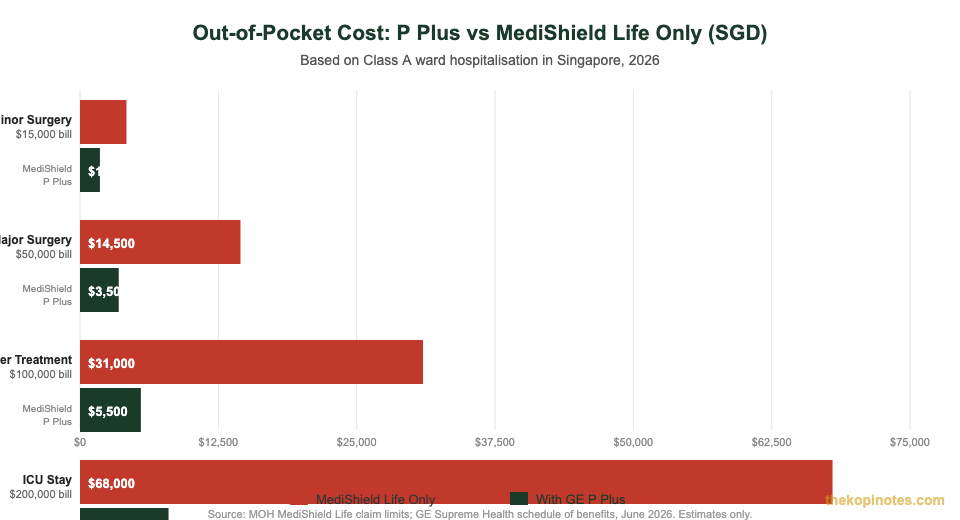
For a $50,000 hospitalisation bill, your 5% co-payment would be $2,500 — much less than the $5,350 you’d pay without a rider (deductible + co-insurance). That’s a meaningful saving.
Should you get the rider? If you want predictable, low out-of-pocket costs — yes. If you are healthy, rarely hospitalised, and comfortable paying the deductible + co-insurance yourself, you could skip it. Many financial advisers recommend getting the rider when you’re young (cheaper) and dropping it if premiums become too high later.
Read our breakdown of the 2026 ISP rider rule changes to understand exactly how the new co-payment structure works.
P Plus vs P Standard — Which Should You Pick?
The biggest question most people have: is P Plus worth the extra premium over P Standard? Let’s compare them head-to-head.
| Feature | P Standard | P Plus |
|---|---|---|
| Annual Claim Limit | $300,000 | $600,000 |
| Surgical Sub-limit | Standard | Higher |
| Private Hospital Coverage | Yes | Yes — higher limits |
| Cancer Outpatient | Covered | Covered |
| Annual Premium (Age 40) | $576 | $756 |
| Annual Premium Difference | ~$180/year at age 40; ~$636/year at age 60 | |
Source: GE Life indicative premium table, June 2026
The extra $180/year at age 40 buys you double the annual claim limit ($300k → $600k). For most people, this is worth it. A serious cancer treatment course or a major surgery at a private hospital can easily exceed $300,000.
That said, if budget is tight and you just want private hospital access, P Standard is a solid, more affordable option. The right choice depends on your health risk profile and finances.
How to Make a Claim on GE Supreme Health P Plus
The claim process is simpler than most people expect. For hospitalisation at a panel hospital (restructured or private), GE settles directly with the hospital. You only pay the deductible and co-payment at discharge — you don’t need to pay the full bill upfront and wait for reimbursement.
Here are the steps:
- Check if your hospital is a GE panel hospital — most major private hospitals in Singapore are. Check the GE GreatCare or GE website for the panel list.
- Present your NRIC and GE policy number at the hospital admissions counter — the hospital will file a Letter of Guarantee (LOG) with GE.
- GE reviews and approves the LOG — this authorises the hospital to bill GE directly.
- At discharge, you pay only the deductible and co-payment (or just the 5% co-payment if you have the Plus Extra rider).
- GE settles the rest directly with the hospital within the standard processing period.
For non-panel or overseas hospitalisation, you pay the bill first and submit a reimbursement claim to GE within 90 days of discharge. Keep all original receipts and medical reports.
Planning for retirement? Our Singapore retirement calculator can help you factor in healthcare costs over the long term.
Who Should Buy GE Supreme Health P Plus?
P Plus is not for everyone. Here’s a clear breakdown of who will benefit most:
Good fit for P Plus if you:
- Want Class A ward at restructured hospitals or access to private hospitals (Gleneagles, Mt Elizabeth, Parkway East)
- Have a family history of serious illness (cancer, heart disease) and want the higher $600k annual limit
- Are in your 20s–40s and can lock in coverage before any health conditions develop
- Value having a specific doctor of your choice without the public hospital lottery
- Prefer paying a higher premium for predictably low out-of-pocket costs (especially with the rider)
Consider alternatives if you:
- Are comfortable with Class B1 ward at restructured hospitals — a B1 ISP is significantly cheaper
- Are above 60 and find P Plus premiums too high — downgrading to P Standard or A Standard may be more sustainable
- Have limited MediSave and cannot handle the cash top-up component
For a broader look at all your ISP options, read our integrated shield plan comparison across all major insurers. If you’re comparing GE specifically with Prudential and AIA, our full shield plan comparison for 2026 covers all tiers side by side.
Also worth reading: our guide on what an integrated shield plan is if you’re newer to ISPs.
Building wealth alongside your insurance? Our guide on passive income in Singapore shows you how to grow your investment portfolio while your ISP covers your healthcare risk.
Frequently Asked Questions
Is GE Supreme Health P Plus worth buying?
Can I use MediSave to pay for P Plus premiums?
What's the difference between P Plus and the GE Private plan?
Can I switch from another ISP to GE Supreme Health P Plus?
Does GE Supreme Health P Plus cover pre-existing conditions?
What happens to my P Plus coverage when I retire?
Is there a panel of doctors I must use with GE P Plus?
This article is for general information only and does not constitute financial or insurance advice. Premiums and coverage details are indicative and subject to change. Always read the policy documents and consult a licensed financial adviser before purchasing any insurance product.
Get Free Insurance Advice
Speak with a licensed insurance advisor. No obligation, no cost.
By submitting this form, you agree to our Privacy Policy.
This article was researched with the help of AI. While we strive to keep all information accurate and up to date, there may be errors. If you notice any discrepancies, please contact us.