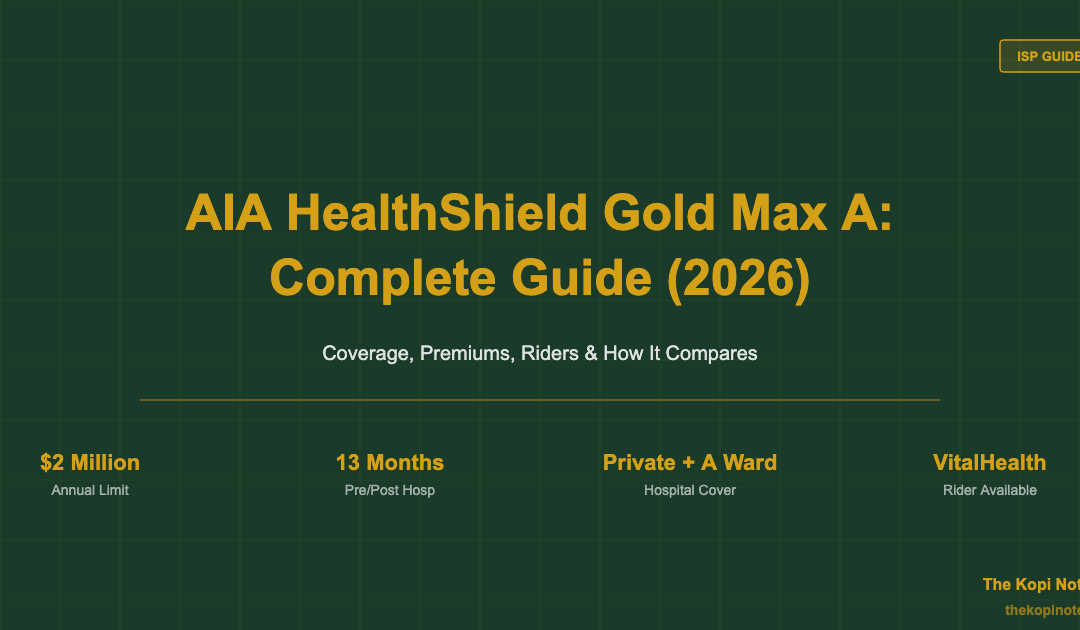
AIA HealthShield Gold Max A: Complete Guide (2026)
Coverage, Premiums, Riders & How It Compares
AIA HealthShield Gold Max A is the most comprehensive tier of AIA’s Integrated Shield Plan (ISP). It covers private hospital stays and all public hospital wards, with an annual policy limit of $2 million per policy year. For Singapore residents who want maximum hospitalisation protection — including access to private hospitals — it is one of the widest-covering ISPs on the market. Premiums are payable via MediSave, and an optional VitalHealth rider can further cap your out-of-pocket costs.
Not financial advice. All figures are for educational reference only. Data as at June 2026 unless noted.
- Gold Max A covers private hospitals AND all public hospital ward classes — the top-tier ISP from AIA.
- Annual limit is $2 million per policy year, with 13 months pre- and post-hospitalisation benefits — the longest among all Singapore ISPs.
- From April 2026, new riders can no longer cover your deductible — plan for a $3,500 out-of-pocket deductible if you go private.
What Is AIA HealthShield Gold Max A?
AIA HealthShield Gold Max A (often shortened to HSG Max A) is an Integrated Shield Plan (ISP). Every Singapore citizen and Permanent Resident automatically has MediShield Life — the national health insurance scheme run by CPF Board. An ISP “integrates” on top of that, extending your coverage to higher ward classes and private hospitals.
Gold Max A is the premium tier within the AIA range. It sits above Gold Max B and Gold Max B Lite, giving you the broadest hospital access and the highest annual claim limits available under AIA’s ISP portfolio.
You pay your Gold Max A premiums using MediSave — no cash outlay needed for the base plan itself, up to the MediSave Approved Amount (MAA). Anything above the MAA requires a cash top-up.
That $2 million limit is among the highest offered by any Singapore ISP. For most hospitalisation episodes — even complex surgery at a private hospital — you are unlikely to come anywhere close to this ceiling.
Key Coverage & Benefits
Gold Max A packs in a wide set of benefits. Here are the ones that matter most to most policyholders.
Hospital Coverage
You can claim for stays at private hospitals (e.g. Mount Elizabeth, Gleneagles, Parkway) AND all ward classes in public hospitals — including A and B1 wards. This is the key distinction between Gold Max A and the lower tiers, which are capped at public hospital A or B1 wards.
13 Months Pre- and Post-Hospitalisation
This is Gold Max A’s standout feature. AIA covers related medical expenses for up to 13 months before and after your hospital stay. That includes specialist consultations, scans, and follow-up treatments. Among all Singapore ISPs, 13 months is the longest pre/post-hospitalisation period available. Gold Max B, by contrast, covers only 6 months.
Planned Overseas Treatment
Gold Max A is one of the very few ISPs in Singapore that covers planned medical treatment overseas. If you choose to seek treatment abroad — for example, a specialist procedure not available locally — your claim is assessed based on the equivalent cost of that treatment in Singapore. This is a meaningful safety net for policyholders who may prefer overseas specialists.
Cancer & Chronic Disease Treatment (Oct 2025 Update)
From October 2025, Gold Max A covers selected outpatient and home-based treatments — including chemotherapy administered at home and certain chronic disease management programmes. The plan also covers non-CDL (non-Cancer Drug List) treatments up to $150,000 per indication per lifetime, with 10% co-insurance.
Congenital Abnormalities (Female Policyholders)
Female policyholders receive coverage for congenital abnormalities in biological children from birth — up to $20,000 per lifetime and $5,000 per child. This is an unusual benefit not widely offered in ISPs and particularly useful for young families.
| Benefit | Gold Max A |
|---|---|
| Annual Policy Limit | $2,000,000 |
| Hospital Coverage | Private + All Public Ward Classes |
| Pre/Post Hospitalisation | 13 Months |
| Planned Overseas Treatment | Yes |
| Outpatient Home Treatment (Oct 2025) | Yes (selected treatments) |
| Non-CDL Cancer Drugs | Up to $150,000 per indication/lifetime |
| Congenital Abnormalities (female) | Up to $20,000 per lifetime |
Source: AIA Singapore, June 2026
Premium Guide by Age
Gold Max A premiums are payable via MediSave. You pay nothing in cash for the base plan, provided your premium falls within the MediSave Approved Amount (MAA) — the cap set by MOH each year on how much MediSave can be used for ISPs.
Below are approximate annual premiums for the Gold Max A base plan. These are indicative figures — AIA publishes exact premium tables on their website and these can change at annual renewal.
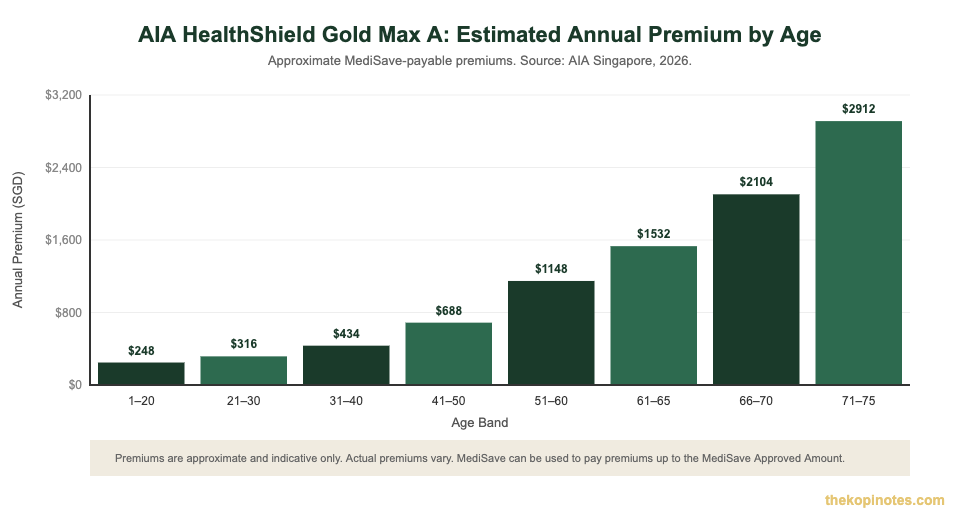
| Age Band | Approx. Annual Premium | Notes |
|---|---|---|
| 1–20 | ~$248 | Fully MediSave payable |
| 21–30 | ~$316 | Fully MediSave payable |
| 31–40 | ~$434 | Fully MediSave payable |
| 41–50 | ~$688 | Check MAA for cash top-up |
| 51–60 | ~$1,148 | Partial cash top-up likely |
| 61–65 | ~$1,532 | Partial cash top-up likely |
| 66–70 | ~$2,104 | Cash top-up required above MAA |
| 71–75 | ~$2,912 | Cash top-up required above MAA |
Source: Approximate figures based on AIA published rates. Verify with AIA for your exact premium. As at June 2026.
If you want comprehensive coverage for your parents, be aware that premiums rise steeply after age 60. At that point, the MediSave Approved Amount may not be enough to cover the full premium, and a cash top-up is needed. Factor this into your family’s healthcare planning — you can learn more about structuring your overall financial plan at our Singapore retirement calculator.
Riders: VitalHealth & Cancer Booster
Gold Max A is the base Integrated Shield Plan. On its own, you still face a deductible (the first portion of your bill you pay yourself) and co-insurance (a percentage of the remaining bill). Riders reduce these out-of-pocket costs — but as of April 2026, the rules have changed significantly.
AIA VitalHealth Rider
The VitalHealth rider is AIA’s supplementary rider for Gold Max A. It reduces your co-insurance to 5% and caps co-insurance at $3,000 per policy year. It also waives the deductible under certain conditions (see the April 2026 changes below).
VitalHealth also unlocks AIA Vitality — AIA’s wellness programme. If you maintain an active lifestyle and hit wellness targets, you can earn up to 15% off your annual premium. For a 40-year-old, that could save you over $100 per year on the rider alone.
AIA Cancer Booster Rider
The Cancer Booster is a separate add-on rider specifically for cancer treatment. It provides an extra 16x the MediShield Life limit per month for listed cancer treatments. For non-CDL (non-Cancer Drug List) drugs, you can claim up to $200,000 per policy year. This rider is worth serious consideration, as cancer treatment costs in Singapore’s private hospitals can run into hundreds of thousands of dollars.
April 2026 Rider Changes: What Changes for You?
From 1 April 2026, the Ministry of Health (MOH) implemented new design requirements for all ISP riders. This is the biggest reform to Singapore’s private health insurance market in years. Here is what it means if you hold — or are considering — Gold Max A.
Deductible Must Be Paid by You
Under the old system, riders like VitalHealth could absorb your full deductible. From April 2026, new riders sold cannot cover the minimum ISP deductible. For Gold Max A (private hospital), this deductible is typically up to $3,500. You must budget for this amount in any hospitalisation scenario.
Co-Payment Cap Raised to $6,000
The co-payment cap under new compliant riders is set at a minimum of $6,000 per policy year. This is higher than the previous arrangement. However, for most routine hospitalisations, actual co-payment under Gold Max A will be significantly lower — the cap only matters for very large bills.
Premiums Drop ~30%
The trade-off? New riders are meaningfully cheaper. MOH estimates that new private hospital IP rider premiums will be about 30% lower than the previous full-coverage riders. For a mid-aged Gold Max A policyholder, that could mean annual savings of $500–$800 on the rider premium alone.
What If You Already Have an Old Rider?
If you bought your VitalHealth rider before 1 April 2026, you can keep it — for now. Insurers must transition existing policyholders with old-style riders to the new compliant riders no later than their first renewal after 1 April 2028. You have roughly two years before any mandatory change kicks in.
AIA launched their new compliant rider suite (PRUExtra Care equivalent) from 1 April 2026. Consult an AIA financial adviser to understand whether transitioning early makes financial sense for your situation. For a comparison of how Singapore ISP riders now stack up, read our ISP rider changes 2026 guide.
Gold Max A vs B vs B Lite: Which Tier?
AIA offers three tiers within the HealthShield Gold Max range. The right tier depends on your hospital preference and budget.
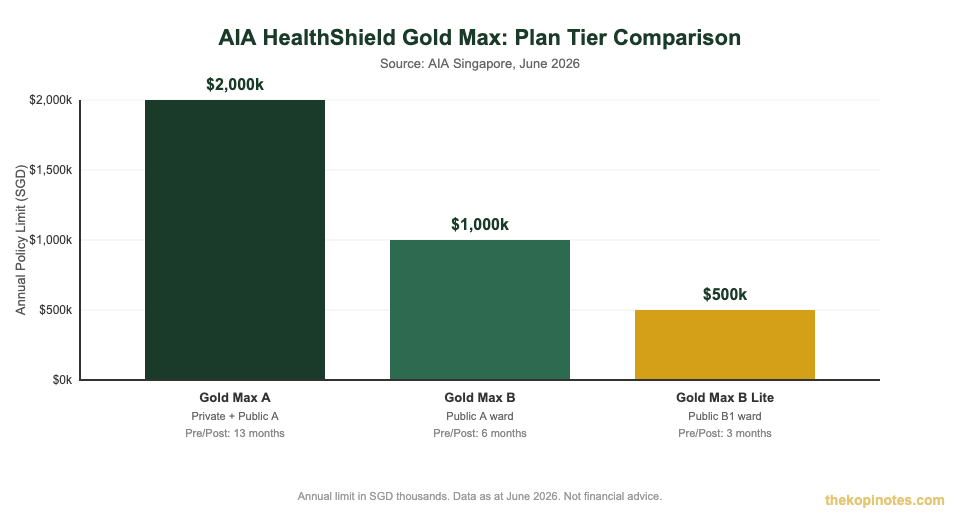
| Feature | Gold Max A | Gold Max B | Gold Max B Lite |
|---|---|---|---|
| Annual Limit | $2,000,000 | $1,000,000 | $500,000 |
| Hospital Coverage | Private + Public A Ward | Public A Ward | Public B1 Ward |
| Pre/Post Hosp. | 13 Months | 6 Months | 3 Months |
| Overseas Treatment | Yes | Yes | Yes |
| Estimated Premium (Age 35) | ~$434/yr | ~$298/yr | ~$200/yr |
Source: AIA Singapore, approximate figures, June 2026. Not financial advice.
The premium difference between Gold Max A and B is modest at younger ages. If you are in your 20s or 30s, upgrading to Gold Max A for private hospital coverage costs perhaps $1–2 extra per day. That gap widens significantly after age 50.
If you prefer public hospital care and want to keep premiums low, Gold Max B Lite is a reasonable choice. If you want the option to see any specialist in any hospital without worrying about availability, Gold Max A gives you that flexibility.
For a full side-by-side of all Singapore ISPs — not just AIA’s range — check our integrated shield plan comparison guide.
Pros and Cons of AIA HealthShield Gold Max A
Pros
- $2 million annual limit — one of the highest available among all Singapore ISPs
- 13 months pre/post-hospitalisation — the longest period in the Singapore market
- Private hospital coverage — full access to private and public hospitals
- Planned overseas treatment covered — rare feature among ISPs
- AIA Vitality premium discount — up to 15% off premiums for staying healthy
- Cancer Booster rider available — meaningful protection against high-cost cancer drugs
Cons
- Higher premiums at older ages — costs rise steeply after 60, requiring cash top-ups above the MAA
- Deductible-based system — from April 2026, you cannot fully eliminate out-of-pocket deductible costs via riders
- Private hospital bills can still be large — even with rider, co-insurance and deductible apply. Budget for $3,500–$6,000 per hospitalisation
- Not all overseas treatment covered equally — only at “Singapore equivalent” cost, which may be lower than actual overseas costs
The bottom line: Gold Max A is worth the premium step-up if you genuinely want the flexibility of private hospital care and the peace of mind of a $2 million annual limit. It is less necessary if you are comfortable with public A-ward care, where Gold Max B does the job at a lower annual cost.
Who Should Get AIA HealthShield Gold Max A?
Gold Max A is a strong fit if you match one or more of these profiles.
You want private hospital access. If you value being able to see any specialist in a private hospital without a referral and without worrying about availability, Gold Max A is the plan for you. Private specialist waiting times are typically shorter than at public hospitals.
You have complex medical needs or a chronic condition. The 13-month pre/post-hospitalisation window is especially valuable if your treatment involves long-term follow-up care — chemotherapy cycles, post-surgery physiotherapy, or specialist monitoring. Gold Max B’s 6-month window may simply not be enough.
You travel frequently or plan to seek overseas treatment. Gold Max A’s overseas treatment clause makes it the logical choice for frequent travellers or those who may seek specialist care in countries like Malaysia, Thailand, or the UK.
You are buying for young children. At young ages, the premium difference between A and B is small — sometimes less than $150 per year. Locking in Gold Max A early means your child has private hospital access from birth, with no medical underwriting concerns as they age.
That said, Gold Max A is not for everyone. If your priority is public hospital care, you can get excellent coverage from Gold Max B at a meaningfully lower premium — particularly relevant for older policyholders who face steep premium increases above age 60. Regardless of which tier you pick, make sure you pair it with a financial plan. Our CPF investment strategy guide covers how to optimise your MediSave alongside broader CPF planning.
If you are looking to compare AIA Gold Max A against plans from Prudential, Great Eastern, Singlife and others, see our full integrated shield plan guide and our best integrated shield plan Singapore 2026 ranking.
Need Help Choosing the Right Shield Plan?
The right ISP depends on your age, health history, budget, and hospital preferences. If you’re not sure whether Gold Max A is worth the premium over Gold Max B, speak to an AIA-licensed financial adviser for personalised advice.
Meanwhile, if you’re building your overall wealth plan, check out Endowus referral code (code: 2V343) for fee-free investment of your CPF and SRS funds, or Syfe referral code (code: SRPRFFFCD) for cash investments.
Frequently Asked Questions
What is AIA HealthShield Gold Max A?
How much does AIA HealthShield Gold Max A cost?
What is the difference between Gold Max A and Gold Max B?
Can I use MediSave to pay for Gold Max A?
How does the April 2026 rider rule change affect Gold Max A?
Does AIA HealthShield Gold Max A cover cancer treatment?
Is Gold Max A worth the extra cost over Gold Max B?
Get Free Insurance Advice
Speak with a licensed insurance advisor. No obligation, no cost.
By submitting this form, you agree to our Privacy Policy.
This article was researched with the help of AI. While we strive to keep all information accurate and up to date, there may be errors. If you notice any discrepancies, please contact us.