Best Critical Illness Insurance Singapore 2026: Complete Comparison Guide
Compare term CI, whole life CI, and multipay critical illness plans from AIA, Prudential, Great Eastern, and Singlife — with real premium data for Singapore residents.
The best critical illness insurance in Singapore for most people is a standalone term CI plan with at least SGD 300,000 coverage — it gives you maximum payout at the lowest premium. Top picks include AIA Power Critical Care, Great Eastern LIVE Great Critical Cover, and Singlife Multipay Critical Illness. If you want lifelong cover or multiple payouts for recurring conditions, a whole life CI or multipay CI plan makes more sense — but expect to pay 3–5x the premium.
Not financial advice. All figures are for educational reference only. Premiums are illustrative and based on insurer illustrations as at June 2026.
- For most Singaporeans: term CI (SGD 300k-500k sum assured) is the best value — premiums from ~$700/year at age 35.
- Add early CI rider if budget allows — it pays out at Stage 1 cancer or minor heart conditions before things get serious.
- Multipay CI is worth considering if cancer runs in your family — it lets you claim multiple times for recurring or new conditions.
Table of Contents
Contents — Click to expand
- What Is Critical Illness Insurance?
- How Much CI Coverage Do You Need?
- Types of CI Plans in Singapore
- Best Critical Illness Insurance Plans 2026
- Premium Comparison Table
- Multipay CI vs Standard CI: Which Is Better?
- Should You Get Early Critical Illness Cover?
- How to Buy Critical Illness Insurance in Singapore
- Frequently Asked Questions
What Is Critical Illness Insurance?
Critical illness (CI) insurance pays you a lump sum if you are diagnosed with a serious medical condition covered by your policy — think cancer, heart attack, or stroke. You get the cash directly, not reimbursed to a hospital. That means you can use it however you need: pay off your mortgage, cover income loss while you recover, or fund treatment not covered by MediShield Life or your Integrated Shield Plan.
The Life Insurance Association of Singapore (LIA) standardises 37 severe-stage critical illnesses that all CI policies must cover. On top of this base list, insurers add their own early-stage and special condition riders.
Here is what makes CI insurance different from health insurance:
| Feature | Critical Illness Insurance | Integrated Shield Plan (ISP) |
|---|---|---|
| What it pays | Lump sum — you keep the cash | Hospital bills reimbursed |
| When it pays | On diagnosis of covered illness | On hospitalisation / treatment |
| Covers income loss | Yes — indirectly (flexible lump sum) | No |
| Covers home loan | Yes — you decide how to spend payout | No |
| Covers childcare expenses | Yes | No |
Source: Life Insurance Association Singapore (LIA), June 2026
How Much CI Coverage Do You Need?
The standard recommendation is 3 to 5 years of your annual income in CI coverage. That covers the time you might be unable to work while undergoing treatment and recovery.
For a Singaporean earning SGD 5,000 per month (SGD 60,000/year), that works out to roughly SGD 234,000 — so a SGD 300,000 sum assured is a sensible round number to aim for.
Your CI payout may need to cover: income replacement for 3 to 5 years, your remaining mortgage balance, out-of-pocket medical costs not covered by your ISP, childcare or caregiver costs, and long-term medication or rehabilitation. Use our Singapore retirement calculator to model how a CI event would affect your long-term plan.
Types of CI Plans in Singapore
1. Term CI Insurance
A standalone term CI plan covers you for a fixed period — typically to age 65, 70, or 85. Premiums are lowest here. You are insured for severe-stage CIs (the standard LIA 37 conditions). When the term ends, cover stops. There is no cash value. Best for: younger Singaporeans who want maximum coverage at the lowest cost.
2. Whole Life CI Insurance
Whole life CI covers you for life and builds up cash value over time via a participating fund component. Premiums are 3 to 5 times higher than term CI. At age 65, most policies let you stop paying premiums while staying covered. Best for: those who want lifelong protection and can afford higher premiums.
3. Multipay CI Insurance
Standard CI pays out once, then the policy ends. Multipay CI lets you claim multiple times — for different conditions, or for recurring diagnoses of the same illness like cancer recurrence. Best for: those with a family history of cancer or heart disease, or who want the most comprehensive payout structure available.
4. Early CI (ECI) Coverage
Early critical illness (ECI) pays out at Stage 1 or Stage 2 cancer, minor heart attacks, and other early-stage conditions — before they become life-threatening. Often added as a rider on top of a base CI policy. Best for: anyone who wants peace of mind from catching and treating illness early without financial stress.
Best Critical Illness Insurance Plans 2026
Here are the top CI plans in Singapore in 2026, assessed on coverage breadth, premium competitiveness, and payout structure. All cover the standard LIA 37 severe CIs.
1. AIA Power Critical Care — Best Overall Term CI
AIA Power Critical Care is one of the most competitively priced term CI plans in Singapore. It covers the 37 standard severe CIs plus an optional early CI rider (AIA Power Early Critical Care). Coverage available up to age 85.
- Coverage: SGD 50,000 to SGD 3,000,000
- Policy term: To age 65, 70, 75, or 85
- Early CI rider: Available
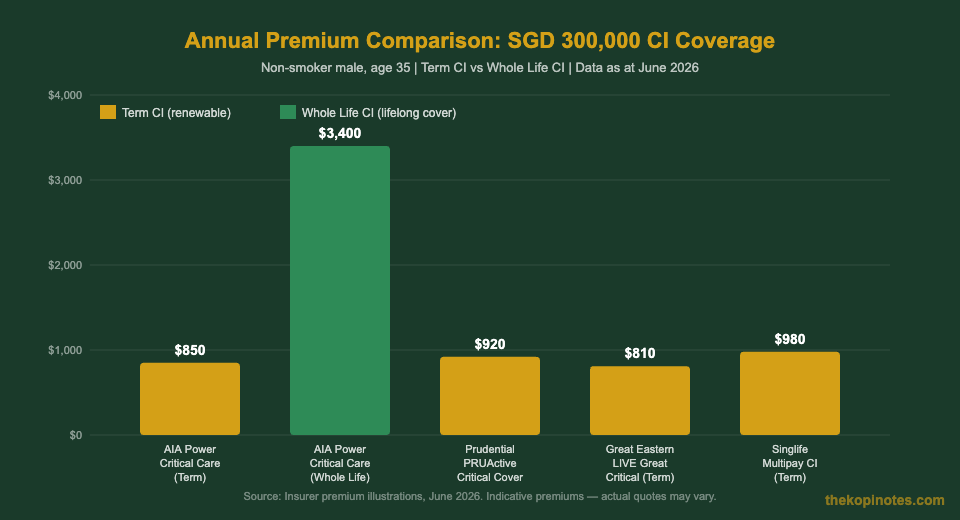
- Annual premium (SGD 300k, male 35, non-smoker): ~SGD 850/year
- Special feature: Premium waiver on CI diagnosis; TPD benefit included
2. Great Eastern LIVE Great Critical Cover — Best for Value
Great Eastern LIVE Great Critical Cover is often the cheapest term CI option for Singaporeans under 40. It covers all 37 LIA conditions and offers a clean, no-frills structure. Great Eastern has one of the strongest claims payment histories in Singapore.
- Coverage: SGD 50,000 to SGD 2,000,000
- Policy term: To age 65, 70, or 75
- Annual premium (SGD 300k, male 35, non-smoker): ~SGD 810/year
- Special feature: Lowest premiums in the market; strong claims track record
3. Singlife Multipay Critical Illness — Best Multipay CI
If you want more than one payout, Singlife Multipay CI is the standout choice in Singapore. It pays out up to 900% of sum assured across multiple claims — for different CIs, or for the same CI recurring. The plan covers 132 conditions including early, intermediate, and severe stages. For more context on comprehensive financial planning, see how passive income strategies in Singapore work alongside protection planning.
- Coverage: Up to 900% of sum assured across claims
- Conditions covered: 132 (including early and intermediate stages)
- Annual premium (SGD 300k, male 35, non-smoker): ~SGD 980/year (term version)
- Special feature: Recurring cancer payouts; no waiting period between claims for different conditions
4. Prudential PRUActive Critical Cover — Best Whole Life CI
Prudential PRUActive Critical Cover is the market-leading whole life CI plan. It covers you for life with a participating component that grows cash value over time. Premium payments typically stop at age 70 while cover continues to age 100.
- Coverage: Lifelong (to age 100)
- Premium payment term: To age 70 (coverage continues after)
- Annual premium (SGD 300k, male 35, non-smoker): ~SGD 3,400/year
- Special feature: Cash value accumulates over time; reversionary bonuses possible
Premium Comparison Table
The table below compares indicative annual premiums for SGD 300,000 of CI coverage for a non-smoking male aged 35, based on insurer illustrations as at June 2026. Your actual quote will vary based on health declaration, occupation, and policy structure.
| Plan | Insurer | Type | Conditions | Est. Annual Premium | Cover To |
|---|---|---|---|---|---|
| Power Critical Care | AIA | Term CI | 37 severe | ~$850/yr | Age 85 |
| LIVE Great Critical Cover | Great Eastern | Term CI | 37 severe | ~$810/yr | Age 75 |
| Multipay Critical Illness | Singlife | Multipay CI | 132 (incl. early) | ~$980/yr | Age 75 |
| PRUActive Critical Cover | Prudential | Whole Life CI | 37 severe + riders | ~$3,400/yr | Age 100 |
| Guaranteed Protect Plus | AIA | Term CI | 37 severe | ~$870/yr | Age 85 |
Source: Insurer premium illustrations, June 2026. Male, age 35, non-smoker, SGD 300,000 sum assured. Indicative only.
Multipay CI vs Standard CI: Which Is Better?
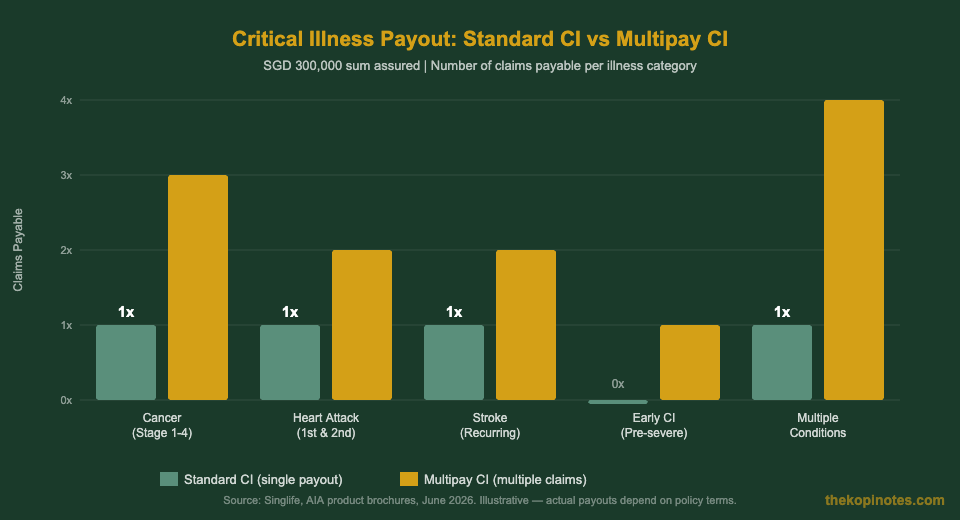
Standard CI pays once. After the payout, your policy ends. Multipay CI lets you claim more than once — for different conditions, or for the same condition recurring like cancer coming back.
| Factor | Standard CI | Multipay CI |
|---|---|---|
| Number of claims | 1 (then policy ends) | Multiple (up to 900% of SA) |
| Covers recurring illness | No | Yes (e.g. cancer recurrence) |
| Annual premium (SGD 300k) | ~$810-$870/yr | ~$980-$1,200/yr |
| Conditions covered | 37 (LIA standard) | 100-132 (incl. early stages) |
| Best for | Budget-conscious, young adults | Family history of cancer/heart disease |
Source: LIA Singapore, Singlife, AIA product brochures, June 2026.
The verdict: Go with standard CI if you are on a tight budget. Upgrade to multipay CI if cancer or heart disease runs in your family.
Should You Get Early Critical Illness Cover?
Early CI (ECI) pays out when you are diagnosed at Stage 1 or Stage 2 of cancer, before it becomes severe. Many financial advisers recommend a lower ECI sum assured (SGD 100,000-200,000) stacked on top of a larger standard CI plan (SGD 300,000-500,000).
Good CI coverage is the first line of defence before your investment portfolio kicks in. Pair it with a solid CPF investment strategy to build long-term wealth even while you are protected.
How to Buy Critical Illness Insurance in Singapore
Option 1: Through a Financial Adviser (Recommended)
An independent FA can compare plans across multiple insurers and find the best fit for your health profile and budget. There is no additional cost — the FA earns commission from the insurer. Make sure your FA holds the CHFC or CFP designation for complex insurance planning.
Option 2: Directly from Insurer Websites
AIA, Great Eastern, Prudential, and Singlife all allow indicative quotes online. However, actual premiums depend on your health declaration. Complex cases with pre-existing conditions typically require an FA.
Option 3: Through Investment Platforms
Platforms like Endowus and FSMOne offer some insurance products alongside investments. Use our Endowus referral code for a fee rebate when you sign up, and our FSMOne referral code for FSMOne cashback offers.
Key Tips When Buying CI Insurance
- Declare all pre-existing conditions honestly — non-disclosure is the top reason claims get rejected in Singapore.
- Compare at least 3 quotes before deciding — premiums for the same coverage can vary by 20-30% across insurers.
- Check the waiting period — most CI plans have a 90-day waiting period from policy start before you can claim.
- Review your CI coverage every 3-5 years as your income and dependants change.
- SRS funds can pay whole life premiums — a tax-efficient way to fund lifelong CI protection. See our guide to Singapore Savings Bonds for a full picture of tax-efficient savings options.
Not financial advice. All figures are for educational reference only. Consult a licensed financial adviser before purchasing any insurance product.
Frequently Asked Questions
What is the best critical illness insurance in Singapore?
For most Singaporeans, the best critical illness insurance is a standalone term CI plan with SGD 300,000 or more in coverage. Top picks in 2026 include AIA Power Critical Care (~$850/year) and Great Eastern LIVE Great Critical Cover (~$810/year) for competitive premiums and comprehensive coverage of the LIA standard 37 conditions. If you want multiple payouts, Singlife Multipay CI is the market leader. The best plan depends on your age, health history, budget, and whether you need lifelong cover or term protection.
How much critical illness coverage do I need in Singapore?
The Life Insurance Association Singapore (LIA) recommends at least 3.9 times your annual income in CI coverage. For a Singaporean earning SGD 5,000/month, that works out to roughly SGD 234,000 — so SGD 300,000 is the commonly recommended target. If you have a mortgage or dependants, consider SGD 400,000-500,000 to ensure your family is not financially burdened during treatment and recovery.
Is critical illness insurance the same as life insurance in Singapore?
No — they are different. Life insurance pays out when you die or become totally and permanently disabled (TPD). Critical illness insurance pays out when you are diagnosed with a serious illness like cancer, heart attack, or stroke — even if you survive. Many Singaporeans have both: life insurance to protect their family if they pass away, and CI insurance to replace income and cover costs while they are alive but unable to work.
Can I buy critical illness insurance with CPF or SRS funds?
You cannot use CPF OA or SA funds to pay CI insurance premiums — CPF funds for insurance are limited to Home Protection Scheme (HPS) and MediShield Life. However, if you have a Supplementary Retirement Scheme (SRS) account, you can use SRS funds to pay premiums for qualifying whole life or endowment insurance policies that include CI riders, giving you an effective tax deduction. Consult your financial adviser on which products qualify.
What is a multipay critical illness plan and is it worth it?
A multipay CI plan lets you claim more than once — for different critical illnesses, or for the same illness recurring such as cancer recurrence. Standard CI pays out once and the policy ends. Singlife Multipay CI allows up to 900% of sum assured across multiple claims and covers 132 conditions including early stages. Whether it is worth the higher premium (~$980/year vs ~$810/year for term CI) depends on your family history: if cancer or heart disease runs in your family, multipay CI offers significantly better protection.
What is the difference between early CI and standard CI insurance?
Standard CI (severe stage) pays out only at a severe diagnosis — for example, Stage 3 or Stage 4 cancer. Early CI (ECI) pays out at Stage 1 or Stage 2, before the illness becomes life-threatening. ECI premiums are typically 2-3x higher than standard CI for the same sum assured. Many advisers recommend combining a smaller ECI sum assured (SGD 100,000-200,000) with a larger standard CI plan (SGD 300,000+) for full-spectrum protection.
Can I get critical illness insurance with a pre-existing condition in Singapore?
Yes, but the insurer may apply exclusions, load your premium, or decline cover depending on the severity of your condition. Common pre-existing conditions that affect CI underwriting include diabetes, high blood pressure, heart conditions, and previous cancer diagnoses. You must declare all conditions honestly — non-disclosure is the main reason CI claims get rejected in Singapore. Some insurers offer guaranteed-issue or simplified underwriting products for those with difficult health histories, though these typically come with lower sum assureds and higher premiums.
Build Your Financial Safety Net
CI insurance protects your income. Combine it with smart investing to grow your wealth long-term.
Get Free Insurance Advice
Speak with a licensed insurance advisor. No obligation, no cost.
By submitting this form, you agree to our Privacy Policy.
This article was researched with the help of AI. While we strive to keep all information accurate and up to date, there may be errors. If you notice any discrepancies, please contact us.