Investing for Beginners Singapore: 2026 Step-by-Step Guide
Investing for beginners in Singapore does not have to be complicated. In simple terms, you put your money into assets like stocks or ETFs that grow in value over time. For Singaporeans, the most beginner-friendly approach is opening a brokerage account, picking a low-cost globally diversified ETF like VWRA, and investing a fixed amount every month. You do not need S$10,000 to start. Many platforms let you begin with as little as S$100.
Not financial advice. All figures are for educational reference only. Data as at June 2026 unless noted.
- Open a brokerage account (IBKR or moomoo are the cheapest for most beginners)
- Start with S$100 to S$500 per month in a single diversified ETF like VWRA or the STI ETF
- Stay invested, ignore short-term noise, and let compounding do the work
Why Should You Invest in Singapore?
Many Singaporeans keep their money in savings accounts earning 0.05% to 3.5% interest. That sounds safe. But here is the problem. Inflation in Singapore typically runs at 2% to 4% per year. If your money earns less than inflation, you are actually losing purchasing power every year.
Investing is how you beat this. Historically, a globally diversified stock ETF has returned roughly 7% to 10% per year over the long run. That is not a guarantee. Markets go up and down. But over 10, 20, or 30 years, the evidence strongly favours staying invested.
You contributed S$108,000. The rest, around S$232,000, is compound growth. That is the power of starting early and staying consistent. The earlier you start, the more time your money has to compound.
Singapore is also one of the best places in the world for individual investors. There is no capital gains tax. Dividends from overseas ETFs may be subject to withholding tax depending on the fund domicile, but there is no additional Singapore-side tax on investment gains. This makes investing here genuinely tax-efficient if you pick the right structure.
How Much Do You Need to Start Investing in Singapore?
Less than you think. Here is the reality by platform:
| Platform | Minimum to Start | Best For |
|---|---|---|
| IBKR (Interactive Brokers) | No minimum | Low-cost ETF investing |
| moomoo | No minimum | Beginners, mobile-first |
| Syfe Trade | No minimum | Zero commission first 3 trades/month |
| FSMOne | S$50 (RSP) | Regular savings plan |
| Robo-advisors (Syfe, Endowus) | S$1 to S$100 | Fully hands-off investing |
Source: Platform websites, June 2026
A practical starting point for most beginners is S$200 to S$500 per month. That is enough to buy one or two units of a diversified ETF and start building a real portfolio. You can always increase this as your income grows. The key insight: starting with S$100 per month at age 25 is far better than waiting until you have S$10,000 saved. Time in the market beats timing the market.
What Should Beginners Invest In?
For most Singapore beginners, the answer is simple: start with one broadly diversified, low-cost ETF. You do not need to pick individual stocks. You do not need to watch charts all day. Here are the top options:
1. VWRA – Vanguard FTSE All-World UCITS ETF (Accumulating)
VWRA gives you exposure to over 3,700 companies across 50+ countries in a single ETF. It is listed on the London Stock Exchange (LSE) and is structured as a UCITS fund, which means no US estate tax risk for Singapore investors. Its Total Expense Ratio (TER) is just 0.22% per year. You can buy it through IBKR, moomoo, or FSMOne.
2. STI ETF (Nikko AM or SPDR)
The Straits Times Index (STI) ETF gives you exposure to the top 30 Singapore-listed companies including DBS, OCBC, UOB, and Singtel. It is listed on SGX, so you can buy it through any local brokerage with no currency conversion. The TER is about 0.3%. It is a solid Singapore-focused option, though more concentrated than VWRA.
3. Robo-Advisors (Syfe or Endowus)
If you do not want to pick or buy ETFs yourself, the Syfe referral code and sign-up bonus gets you started on a platform that automatically manages a diversified portfolio. Syfe and Endowus referral code both handle rebalancing, reinvestment, and portfolio construction. Ideal if you want fully hands-off investing.
For most beginners, the choice is: invest yourself (pick VWRA via IBKR) or have someone manage it (Syfe or Endowus). Both work. The most important thing is to start.
How to Choose a Brokerage Account in Singapore
Your brokerage is where you buy and sell investments. For beginners, three things matter most: fees, ease of use, and the range of products available.
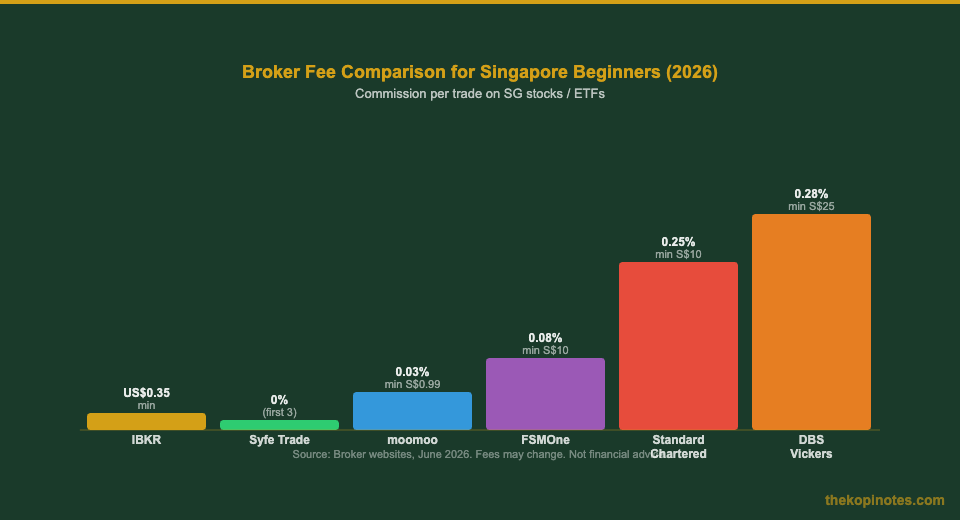
Source: Broker websites, June 2026. Fees are approximate commissions per trade for SGX-listed stocks and ETFs.
| Broker | Fee per Trade | Good For | Watch Out For |
|---|---|---|---|
| IBKR | US$0.35 min (LSE ETFs) | Global ETFs, lowest cost | Less beginner-friendly interface |
| Syfe Trade | 0% first 3 SGX trades/month | Singapore ETFs, zero cost | No LSE access for VWRA |
| moomoo | 0.03% min S$0.99 | User-friendly app, US stocks | FX spread on USD conversion |
| FSMOne | 0.08% min S$10 | RSP, bonds, funds | Slightly higher fees |
| DBS Vickers | 0.28% min S$25 | Easy DBS bank integration | Most expensive for small trades |
Source: Broker fee schedules, June 2026. Always verify current fees on broker website before investing.
Our recommendation for most beginners: Use IBKR for LSE-listed ETFs like VWRA (lowest cost globally), or Syfe Trade for SGX-listed ETFs (zero commission on first 3 trades). If you want everything handled for you, use Syfe Core or Endowus. Read the full moomoo Singapore review for an in-depth comparison.
Step-by-Step: Making Your First Investment in Singapore
Here is the exact process from zero to invested. Follow these steps and you will be done in 30 to 60 minutes, plus 1 to 3 business days for account approval.
Step 1: Open a brokerage account. Go to the IBKR website or download the moomoo app. Fill in your NRIC, bank details, and tax information. Most accounts are approved within 1 to 3 business days.
Step 2: Fund your account. Transfer money from your DBS, OCBC, or UOB bank account via PayNow or bank transfer. For IBKR, convert SGD to USD or GBP to buy LSE-listed ETFs like VWRA.
Step 3: Find your ETF. Search for “VWRA” on IBKR or “ES3” for the STI ETF on SGX. Check the current price. VWRA trades around US$100 to US$130 per unit, so you need at least that in your account.
Step 4: Place an order. A market order fills immediately at the current price. A limit order lets you set a maximum price. For beginners, a market order is simpler. Buy 1 to 3 units to start.
Step 5: Set up a monthly schedule. The best strategy for beginners is Dollar Cost Averaging (DCA) — investing a fixed amount every month regardless of price. Set a monthly reminder and repeat step 4 each month. That is it.
Common Beginner Mistakes to Avoid
These are the mistakes that cost Singaporean beginners the most money and time. Knowing them in advance puts you ahead of 80% of new investors.
Mistake 1: Waiting for the right time to invest. There is no perfect time. Markets will always look uncertain. Every year since 1900 has had some crisis or scary headline. The investors who did best were the ones who stayed invested through it all. Start now with whatever amount you have.
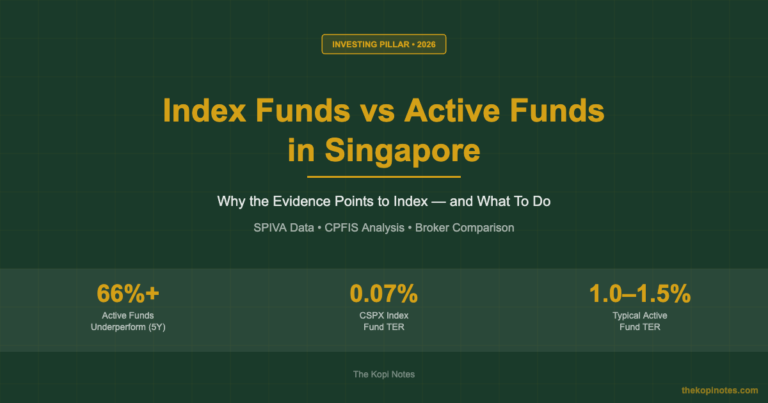
Mistake 2: Picking individual stocks before understanding the basics. Stock-picking is genuinely difficult. Professional fund managers with analyst teams consistently underperform a simple index ETF over 10+ years. A diversified ETF gives you better outcomes with less risk and less stress.
Mistake 3: Panic-selling during a market correction. When markets fall 20% to 30%, every instinct says to sell. But selling locks in your losses. Markets have always recovered and gone on to new highs. Investors who held through the Covid crash in March 2020 were up 100%+ within 18 months.
Mistake 4: Ignoring fees. A 1% annual fee might sound small. But over 30 years, it can cost you 25% of your total portfolio. Always know what you are paying. IBKR and passive ETFs keep costs near zero. Actively managed unit trusts at 1.5% annual fees are a huge drag over time.
Mistake 5: Not diversifying. Putting all your money into a single stock, sector, or country is risky. A global ETF like VWRA automatically diversifies across thousands of companies in 50+ countries. You can pair this with a passive income Singapore strategy using S-REITs for regular cash distributions alongside your ETF growth portfolio.
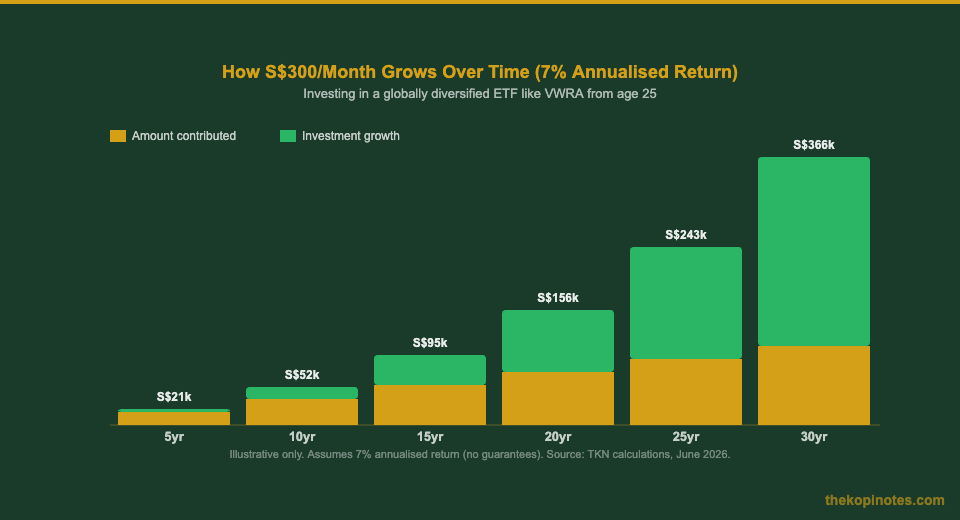
Source: TKN calculations, June 2026. Assumes 7% annualised return, compounded monthly. Illustrative only. Returns are not guaranteed.
Should You Use CPFIS to Invest?
CPFIS (CPF Investment Scheme) lets you invest your CPF Ordinary Account (OA) savings in certain stocks, ETFs, and unit trusts. But before you do, here is what you need to know.
Your CPF OA already earns 2.5% per year, guaranteed and risk-free. CPF Special Account (SA) earns 4% per year. These are very competitive risk-free returns. For CPFIS to make sense, your investment must consistently beat 2.5% after fees. That is a higher bar than it sounds given market volatility.
For most beginners, the recommendation is: max out your CPF contributions first, then invest additional savings through a brokerage. Your CPF is the foundation; your brokerage investments are the growth engine on top. Read the full CPF investment strategy guide for a detailed breakdown of when CPFIS makes sense and when it does not.
For long-term retirement planning, combine your CPF strategy with regular brokerage investing. Use the Singapore retirement calculator to model out how much you will need and whether you are on track.
What About Fixed Income? Bonds and T-Bills for Beginners
Stocks and ETFs are not the only options. Singapore offers several low-risk fixed income options that are worth knowing about as a beginner.
Singapore Savings Bonds (SSBs): Government-backed, no capital loss risk, flexible redemption anytime. Recent rates have been around 2.5% to 3.4% per year. See the Singapore Savings Bonds guide for current rates and how to apply via DBS, OCBC, or UOB.
Singapore T-bills: 6-month or 1-year government bills auctioned fortnightly. Recent cut-off yields have been around 3.0% to 3.6%. See the Singapore T-bills 2026 guide for the full application process.
As a beginner, keep 3 to 6 months of expenses in a high-yield savings account or SSBs as your emergency fund. Then invest everything else in ETFs for long-term growth. Do not invest money you might need in the next 3 years. Markets can be significantly down over any short period.
Building Your First Portfolio: A Simple Framework
You do not need a complicated portfolio to start. Here is a simple framework that works for most Singapore beginners:
| Allocation | Asset | Purpose |
|---|---|---|
| 3 to 6 months expenses | High-yield savings or SSBs | Emergency fund |
| 70 to 80% of investable savings | Global ETF (e.g. VWRA) | Long-term wealth growth |
| 10 to 20% (optional) | Singapore S-REITs or STI ETF | Local exposure plus income |
| 0 to 10% (advanced, after 1 year) | Individual stocks | Satellite growth |
Source: TKN framework, June 2026. Not financial advice. Adjust based on your own risk tolerance and timeline.
Start simple. One ETF, one platform, one monthly transfer. You can add complexity later as your knowledge grows. Once comfortable with your core ETF position, the Singapore REIT ETF guide explains how to add REIT income exposure on top.
Frequently Asked Questions
What is the best investment for beginners in Singapore?
For most Singapore beginners, a low-cost globally diversified ETF is the best starting point. VWRA (Vanguard FTSE All-World UCITS ETF, listed on the London Stock Exchange) gives you exposure to 3,700+ companies across 50+ countries with a TER of just 0.22%. It is available through IBKR, moomoo, and FSMOne. If you prefer SGX-listed options, the Nikko AM STI ETF or SPDR STI ETF are solid choices. For fully hands-off investing, Syfe Core or Endowus manages everything for you.
How much money do I need to start investing in Singapore?
You can start with as little as S$100 to S$200. Most brokerages in Singapore have no minimum account balance. The main constraint is the price of a single ETF unit. VWRA trades around US$100 to US$130 per unit, roughly S$130 to S$175. For SGX ETFs like the STI ETF, one unit costs around S$3 to S$4. Robo-advisors like Syfe let you start with S$1. The amount matters less than starting consistently. Even S$200 per month invested over 20 years compounds significantly.
Is investing safe for beginners in Singapore?
No investment is 100% safe as markets can and do fall. However, investing in broadly diversified ETFs over the long term (10+ years) has historically been very reliable for building wealth. The key risks to manage are: not diversifying, investing money you need in the short term (less than 3 years), and panic-selling during market downturns. The biggest risk for most beginners is actually not starting at all and letting inflation erode their savings over time.
Should I use a robo-advisor or buy ETFs myself?
Both approaches work well. Buying ETFs yourself through IBKR or moomoo is cheaper as you pay only a small trading commission and the ETF expense ratio (0.22% for VWRA). A robo-advisor like Syfe charges a management fee of 0.35% to 0.65% on top of underlying fund costs, but handles everything automatically including rebalancing and reinvestment. If you are comfortable making trades yourself and want the lowest possible cost, DIY ETF investing wins. If you want zero hassle, a robo-advisor is excellent for beginners.
Can I invest using my CPF in Singapore?
Yes, through the CPF Investment Scheme (CPFIS) you can invest your CPF Ordinary Account (OA) savings in approved stocks, ETFs, and unit trusts. However, your OA already earns a guaranteed 2.5% per year, so you should only invest CPF money if your investments will return more than 2.5% after fees over the long run. Most financial advisers suggest maxing out CPF contributions and investing additional cash savings first. If you do invest via CPFIS, stick to low-cost ETFs and avoid high-fee unit trusts.
What is Dollar Cost Averaging and should beginners use it?
Dollar Cost Averaging (DCA) means investing a fixed amount at regular intervals, for example S$300 every month, regardless of what the market is doing. When prices are lower, your S$300 buys more units. When prices are higher, it buys fewer. Over time, this averages out your cost per unit and removes the pressure of timing the market. It is the ideal strategy for most Singapore beginners because it is simple, disciplined, and works automatically. Set up a monthly bank transfer reminder and invest on the same day each month.
What are the tax implications of investing in Singapore?
Singapore has no capital gains tax. Profits you make from selling investments are not taxed here. However, dividends from overseas-listed ETFs may be subject to withholding tax at the fund level before they reach you. For example, a US-domiciled ETF like VOO faces 30% US withholding tax on dividends for non-US investors and also carries US estate tax risk. This is why many Singapore investors prefer UCITS ETFs like VWRA (domiciled in Ireland). They face only 15% US withholding tax at fund level and have no US estate tax exposure. Always check the fund domicile before investing.
Ready to Start Investing in Singapore?
Open a brokerage account today and make your first investment. Use these referral links to get started with a bonus:
- Syfe referral code and sign-up bonus — Code: SRPRFFFCD
- Endowus referral code — Code: 2V343
- FSMOne referral code — Code: P0544985
Disclaimer: This article is for educational purposes only and does not constitute financial advice. TKN may earn referral fees when you sign up through the links above. Always do your own research and consult a licensed financial adviser if needed. Data as at June 2026.
This article was researched with the help of AI. While we strive to keep all information accurate and up to date, there may be errors. If you notice any discrepancies, please contact us.