New ISP Rider Rules 2026: What Changes, Who’s Affected and What You Should Do Next
Your complete guide to the April 2026 Integrated Shield Plan rider changes — co-pay caps, deductibles, and your renewal options.
From 1 April 2026, new Integrated Shield Plan (ISP) riders in Singapore can no longer cover the minimum deductible. The co-payment cap has also doubled from S$3,000 to S$6,000 per year. In exchange, new rider premiums are 35–40% lower on average. If you hold an ISP — and 71% of Singaporeans do — here is exactly what changed, whether you are affected, and what to do at your next renewal.
Not financial advice. All figures are for educational reference only. Data as at June 2026 unless noted. Please consult a licensed financial adviser before making changes to your insurance coverage.
- New riders from April 2026 no longer cover your deductible (S$1,500–S$3,500). You pay that yourself.
- The annual co-payment cap doubled to S$6,000 — meaning your maximum out-of-pocket exposure is now up to S$9,500 per admission at a private hospital.
- The upside: new rider premiums are 35–40% lower. A 45-year-old on a private hospital plan could save roughly S$1,440/year in premiums.
Why MOH Changed the ISP Rider Rules
Integrated Shield Plans were built on a smart idea. MediShield Life covers basic public hospital care. An ISP tops that up so you can access higher-class wards or private hospitals. Add a rider, and your out-of-pocket cash payment drops to near zero.
That “near zero” part became the problem.
When patients bear no cost at the point of care, they tend to consume more — bigger rooms, more tests, longer stays. Doctors have less reason to moderate bills when a rider absorbs everything. According to MOH’s announcement, rider premiums climbed at an average of 17% per year over the past three years. For a 60-year-old on a private hospital plan, that adds up fast.
MOH made its first correction in 2018: a mandatory 5% co-payment, capped at S$3,000. It helped, but not enough. Premiums kept rising. So in November 2025, MOH announced a more decisive set of reforms, effective 1 April 2026.
The goal is to loosen what MOH calls the “financing knot” — where generous riders encourage over-consumption, which drives up bills, which pushes up premiums, which makes riders unaffordable. By reintroducing meaningful cost-sharing, the reforms aim to put private healthcare financing on a sustainable path.
What Exactly Changed on 1 April 2026
Two things shifted for new riders sold from 1 April 2026 onwards.
Change 1: Riders can no longer cover the deductible.
The deductible is the first slice of your hospital bill that you must pay before insurance kicks in. Under the old system, your rider covered this entirely. Under the new rules, that is no longer allowed. You must pay the deductible yourself — from cash or MediSave.
The minimum deductible amounts, set by MOH, are:
| Ward Type | Minimum Deductible (per policy year) |
|---|---|
| Private Hospital | S$3,500 |
| Class A Ward (Government Restructured Hospital) | S$2,500 |
| Class B1 Ward (Government Restructured Hospital) | S$1,500 |
Source: CPF Board / MOH, April 2026
Change 2: The co-payment cap doubles from S$3,000 to S$6,000.
After you pay the deductible, you share 5% of the remaining bill with your insurer. Your rider used to cap that 5% co-payment at S$3,000. The new cap is S$6,000. The two amounts are independent — they stack on top of each other.
The 5% co-insurance rate itself is unchanged. And the good news: new rider premiums are around 35–40% lower on average, because insurers are taking on less risk.
Which Group Are You In?
Not everyone is immediately affected. Your situation depends on when you bought your rider.
| Your Situation | What Happens | Deadline |
|---|---|---|
| Bought rider before 27 Nov 2025 (grandfathered) | You keep your existing rider terms. No forced change — yet. If you want to downgrade, you can do so voluntarily. | No immediate deadline |
| Bought rider between 27 Nov 2025 and 31 Mar 2026 | You must transition to a new rider by your first renewal after 1 April 2028. | First renewal after 1 Apr 2028 |
| Buying a new rider from 1 Apr 2026 | You can only purchase new-framework riders. No deductible coverage, S$6,000 co-pay cap, 35–40% lower premiums. | Immediate |
Source: MOH ISP rider requirements, November 2025 / April 2026
If you are in the grandfathered group, you have time. But that does not mean you should do nothing — the premium calculus may have already shifted in favour of switching.
Real Cost Impact: A Worked Example
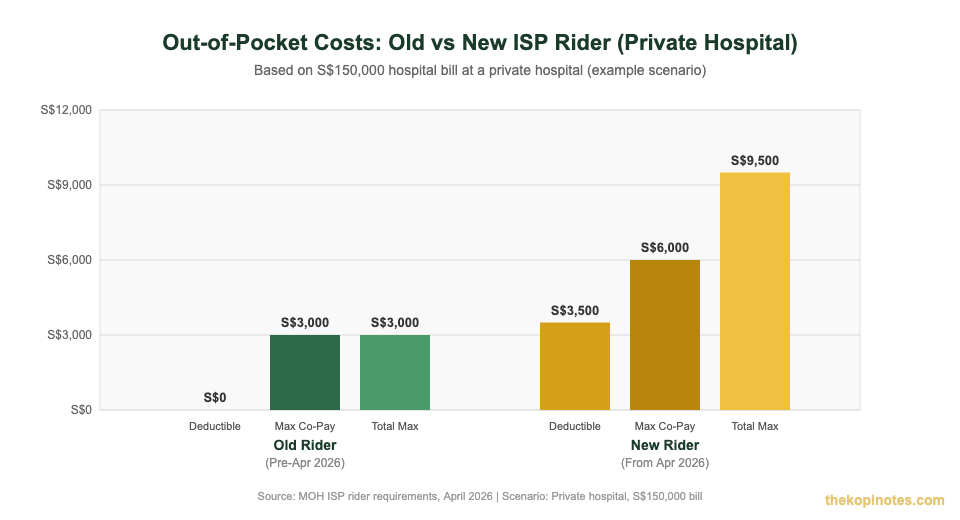
Let us use a concrete scenario: a 45-year-old Singaporean on a private hospital ISP is admitted for a planned surgery. The total hospital bill comes to S$150,000.
Here is how the numbers work out under the old rider versus the new rider:
| Cost Component | Old Rider (Pre-Apr 2026) | New Rider (From Apr 2026) |
|---|---|---|
| Deductible | S$0 (rider covers it) | S$3,500 (you pay) |
| Co-insurance (5% of remainder) | 5% × S$146,500 = S$7,325, capped at S$3,000 | 5% × S$146,500 = S$7,325, capped at S$6,000 |
| Your total out-of-pocket | S$3,000 | S$9,500 |
| Insurer pays | S$147,000 | S$140,500 |
Source: MOH ISP framework, April 2026. Example figures for illustration only.
The out-of-pocket exposure triples — from S$3,000 to S$9,500. That is a meaningful difference. However, you can use your MediSave to pay the deductible, which softens the cash impact somewhat. And as we cover below, your annual premium savings can be significant too.
The Premium Savings Explained
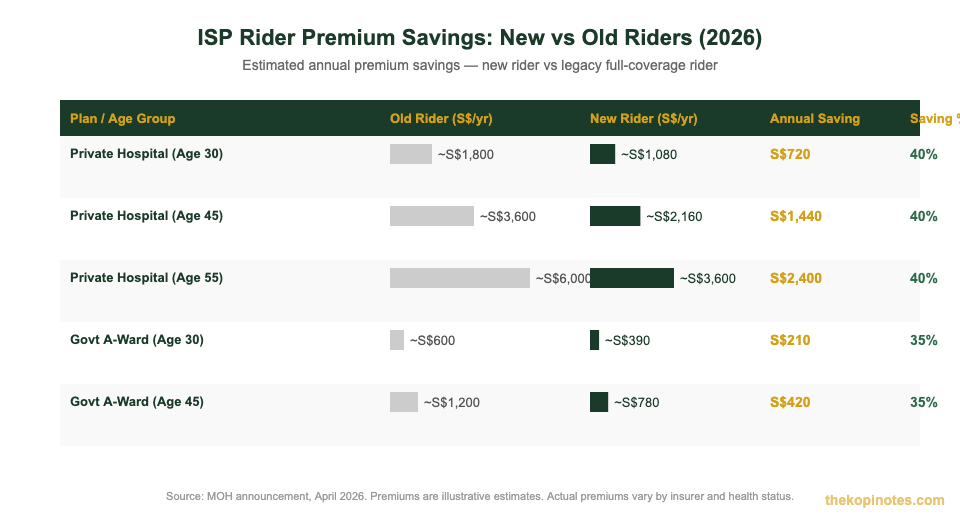
The headline number from MOH is that new rider premiums are 35–40% lower on average compared to legacy full-coverage riders. Some insurers have gone further. Prudential’s PRUExtra Preferred Care is reportedly 45–55% cheaper for certain age groups.
Why the big drop? Because the insurer is now only covering the co-insurance portion above S$6,000, not the deductible. That removes a meaningful chunk of claims risk from the insurer’s book, and they can price accordingly.
Here is an illustrative breakdown of what the savings might look like at different ages and ward types. Actual premiums vary by insurer, health status, and specific plan chosen — always check with your insurer directly.
| Plan / Age Group | Old Rider Premium (est.) | New Rider Premium (est.) | Annual Saving |
|---|---|---|---|
| Private Hospital — Age 30 | ~S$1,800 | ~S$1,080 | ~S$720 |
| Private Hospital — Age 45 | ~S$3,600 | ~S$2,160 | ~S$1,440 |
| Private Hospital — Age 55 | ~S$6,000 | ~S$3,600 | ~S$2,400 |
| Govt A-Ward — Age 45 | ~S$1,200 | ~S$780 | ~S$420 |
Source: MOH announcement, April 2026. Premiums are illustrative estimates based on ~40% reduction. Actual premiums vary by insurer. Rider premiums must be fully paid in cash — MediSave cannot be used for riders.
The key insight: if you are young and healthy, the savings from a new rider compound meaningfully over time. A 30-year-old who switches and invests the annual S$720 saving instead could build a meaningful health emergency fund over 20 years — enough to cover several deductibles and co-payments. You can explore this kind of projection with our Singapore retirement calculator.
Your Options at Renewal
Depending on which group you fall into, here are the practical choices in front of you.
Option 1: Switch to the new rider voluntarily.
If you are grandfathered but your insurer has launched a new rider, you can choose to switch. You will pay less in premiums but accept a higher out-of-pocket cap. This makes sense if you are young, healthy, have MediSave savings to buffer the deductible, or simply want lower ongoing costs. Many Singaporeans who rarely get hospitalised will come out ahead over a 10-year horizon.
Option 2: Keep your old rider (if grandfathered).
You are not forced to change if you bought before 27 November 2025. Your rider terms are protected. However, your premiums will not drop — and insurers may still increase premiums over time as the risk pool ages. Review annually.
Option 3: Downgrade your ward type.
If private hospital coverage now feels too expensive even with the new rider, consider moving to a Class A or B1 plan. Your deductible drops to S$2,500 or S$1,500. Premiums fall significantly too. You still have access to specialists at restructured hospitals like SGH, NUH, TTSH, and CGH — you just cannot choose a private hospital unless you pay the pro-ration difference.
Option 4: Remove your rider entirely.
Some Singaporeans who have built up significant MediSave balances or liquid savings may be comfortable self-insuring the co-payment and deductible. This is a high-risk approach and generally not recommended unless you have substantial financial buffers.
The right answer depends on your age, health history, MediSave balance, and how much cash flow volatility you can absorb. Speak to a licensed financial adviser before making any changes. Planning your overall retirement finances is also worth doing — a CPF investment strategy that builds up your MediSave can help cushion future healthcare costs.
What Each Insurer’s New Rider Looks Like
All seven ISP insurers in Singapore have launched new riders as required by MOH. The core structure is the same across all of them — no deductible coverage, S$6,000 co-pay cap. But each insurer has added their own differentiators.
| Insurer | New Rider Name | Key Differentiator |
|---|---|---|
| AIA | AIA Max VitalCare (new) | Extended post-hospitalisation coverage, cancer gene therapy inclusion |
| Prudential | PRUExtra Preferred Care | 45–55% cheaper for some age groups vs legacy rider; child-specific benefits |
| Great Eastern | Supreme Health Plus Rider (new) | Non-MOH listed gene therapy (CTGTP) coverage added |
| Income Insurance (NTUC) | Enhanced IncomeShield Classic (revised) | Option to remove deductible coverage from existing Classic rider pre-Apr 2026 for ~40% premium saving |
| Singlife | Singlife Shield Rider (new) | Telehealth pre-authorisation tools; digital claims workflow |
| ManuLife | ManuLife MediFirst Rider (new) | Extended pre-hospitalisation coverage of 180 days |
| HSBC Life | HSBC Life Shield Rider (new) | Enhanced day surgery coverage |
Source: MOH, individual insurer announcements, April–May 2026. Rider names and features may be updated. Verify directly with your insurer.
For a full side-by-side breakdown of the base ISP plans from each insurer — not just the riders — see our detailed shield plan comparison Singapore 2026 guide. If you are specifically reviewing AIA’s offering, our AIA Integrated Shield Plan review has the full premium table and ward class breakdown.
For those in the ISP rider transition group (bought between Nov 2025 and Mar 2026), our earlier deep-dive on ISP rider changes 2026 walks through the transition timeline in detail.
It is also worth thinking about how your ISP fits into your broader financial picture. If you are building passive income alongside your health insurance planning, our guide to passive income in Singapore covers dividend-generating strategies that can fund future healthcare costs. And if you want to explore robo-advisors that can help you grow your investment portfolio, check out our best robo advisor Singapore review.
Disclaimer: This article is for general educational purposes only and does not constitute financial or insurance advice. Please consult a licensed financial adviser representative before making any changes to your Integrated Shield Plan or rider.
Frequently Asked Questions
What is the new ISP rider rule from April 2026?
From 1 April 2026, new Integrated Shield Plan (ISP) riders sold in Singapore can no longer cover the minimum deductible — the first portion of your hospital bill before insurance pays. You must now pay the deductible yourself (S$1,500–S$3,500 depending on ward type), either from cash or MediSave. The annual co-payment cap has also doubled from S$3,000 to S$6,000. In exchange, new rider premiums are 35–40% lower on average.
Am I affected by the April 2026 ISP rider changes?
It depends on when you bought your rider. If you purchased before 27 November 2025, you are grandfathered — your existing rider terms are protected and you are not forced to change. If you bought between 27 November 2025 and 31 March 2026, you must transition to a new-framework rider by your first renewal after 1 April 2028. If you are buying a new rider from 1 April 2026 onwards, only the new framework applies.
How much more will I have to pay out-of-pocket under the new rider?
For a private hospital admission, your maximum out-of-pocket rises from S$3,000 (old rider) to S$9,500 (new rider) — comprising S$3,500 deductible plus up to S$6,000 in co-payment. For Class A ward at a restructured hospital, the maximum is S$2,500 (deductible) + S$6,000 (co-pay) = S$8,500. However, you can use MediSave to pay the deductible, which eases the cash burden.
How much will I save on premiums with the new ISP rider?
On average, new rider premiums are 35–40% lower than the old full-coverage riders. A 45-year-old on a private hospital plan might save roughly S$1,440 per year. A 55-year-old could save up to S$2,400 per year. Prudential has announced savings of 45–55% on some of their new riders. The exact saving depends on your age, insurer, and the specific plan you are comparing.
Should I switch to the new ISP rider or keep my old one?
There is no one-size-fits-all answer. If you are young, healthy, rarely hospitalised, and have MediSave savings to cover a deductible, switching makes financial sense — the premium savings over several years can outweigh the higher out-of-pocket risk. If you are older, have a chronic condition, or anticipate frequent hospital visits, retaining your old grandfathered rider may be the safer choice. Consult a licensed financial adviser to run the numbers for your specific situation.
Can I use MediSave to pay the new deductible under the ISP rider rules?
Yes. The deductible for your Integrated Shield Plan can be paid using MediSave, subject to the MediSave withdrawal limits set by CPF Board. The co-insurance portion (your 5% share) can also be paid from MediSave up to those limits. However, rider premiums themselves must be fully paid in cash — MediSave cannot be used for riders. This is an important planning consideration: maintaining a healthy MediSave balance gives you a buffer for the deductible without touching your cash savings.
What happens if I want to downgrade from a private hospital to a restructured hospital plan?
You can downgrade your ISP from a private hospital plan to a Class A or B1 ward plan at any time. Your deductible drops to S$2,500 or S$1,500 respectively, and both your base plan and rider premiums fall significantly. Be aware that if you later seek treatment at a private hospital, a pro-ration factor (typically 50–70%) applies — meaning your plan only covers that percentage of the bill. Speak to your insurer or a financial adviser before downgrading.
Build Your Financial Safety Net
Health insurance is one piece of the puzzle. Grow your wealth alongside it with these resources.
Get Free Insurance Advice
Speak with a licensed insurance advisor. No obligation, no cost.
By submitting this form, you agree to our Privacy Policy.
This article was researched with the help of AI. While we strive to keep all information accurate and up to date, there may be errors. If you notice any discrepancies, please contact us.