SRS Account Singapore: Complete 2026 Guide (Tax Savings, Rates & Best Platforms)
Everything you need to know about the Supplementary Retirement Scheme — tax relief, contribution limits, investment options, and how to pick the right platform.
An SRS account (Supplementary Retirement Scheme) is a voluntary savings account in Singapore that gives you an immediate income tax deduction on every dollar you contribute — up to $15,300 per year for Singapore citizens and PRs, or $35,700 for foreigners. You invest those savings, and only 50% of withdrawals are taxed when you retire. It is one of the simplest legal tax-saving tools available to Singapore residents.
Not financial advice. All figures are for educational reference only. Data as at June 2026 unless noted.
- Contribute up to $15,300/year (citizens/PRs) and get a dollar-for-dollar tax deduction — saving up to $3,366 in tax if you are in the 22% bracket.
- Only 50% of withdrawals after the statutory retirement age are taxable, and you can spread them over 10 years to minimise the tax hit.
- Open your SRS account with DBS, UOB, or OCBC — then transfer the funds to Syfe or Endowus for better returns than a bank savings rate.
Free download: The Singapore Money Playbook — 7 money mindset shifts written for Singapore, with the CPF-adjusted retirement number most guides get wrong (PDF + Notion).
Table of Contents
Contents — Click to expand
What Is an SRS Account?
The Supplementary Retirement Scheme (SRS) is a voluntary government scheme launched in 2001 to encourage Singaporeans to save for retirement beyond CPF. It is administered by the Ministry of Finance and operated through three banks: DBS, UOB, and OCBC.
Here is how it works at a high level. You open an SRS account at one of those three banks. You contribute cash — up to the annual cap — before 31 December each year. That contribution amount is deducted from your taxable income for that Year of Assessment. You invest the cash inside the account. When you reach the statutory retirement age (currently 63), you start withdrawing — and only half of each withdrawal is subject to income tax.
The scheme has two major tax advantages working in your favour: an upfront deduction when you contribute, and a 50% tax concession when you withdraw. Done well, you can save thousands of dollars over a working lifetime.
Contribution Limits & Tax Relief
The annual contribution cap depends on your residency status. Singapore citizens and Permanent Residents can contribute up to $15,300 per calendar year. Foreigners working in Singapore have a higher cap of $35,700 per year.
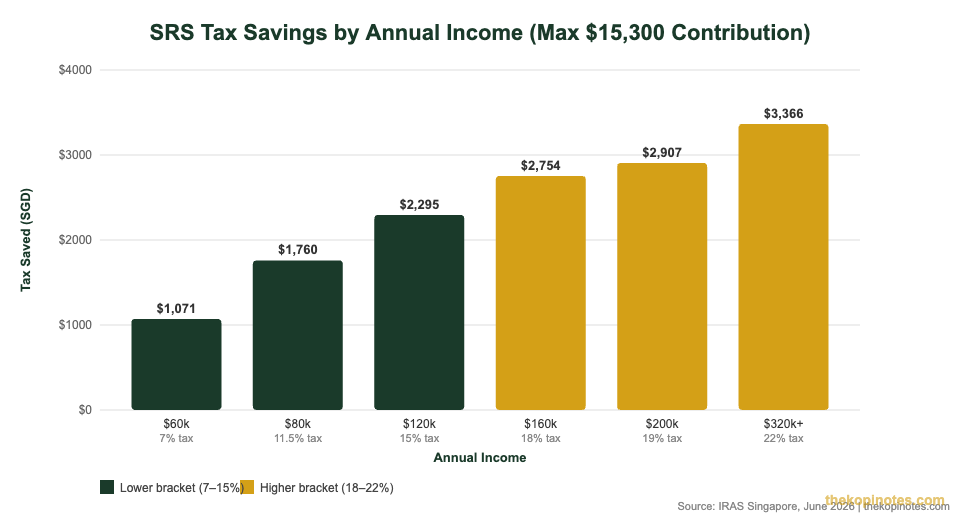
Every dollar you contribute reduces your taxable income by the same amount. So if you earn $120,000 a year and contribute $15,300, IRAS taxes you as if you earned $104,700. At Singapore’s marginal rates, this translates to real cash savings — not just a deferral.
| Annual Income | Marginal Rate | Tax Saved (Max $15,300) | Effective Return |
|---|---|---|---|
| $60,000 | 7% | $1,071 | 7.0% |
| $80,000 | 11.5% | $1,760 | 11.5% |
| $120,000 | 15% | $2,295 | 15.0% |
| $160,000 | 18% | $2,754 | 18.0% |
| $200,000 | 19% | $2,907 | 19.0% |
| $320,000+ | 22% | $3,366 | 22.0% |
Source: IRAS Singapore tax rates, June 2026. Tax saved calculated on $15,300 contribution at marginal rate.
Think of the tax saving as an instant guaranteed return on your contribution. If you are in the 15% bracket, you get a 15% return on day one — before any investment gains. No ETF or savings account can match that risk-free return.
How to Open an SRS Account
Opening an SRS account is free and takes about 10 minutes online. You can only hold one SRS account in Singapore — so choose your bank once and stick with it. The bank you choose does not have to be where you invest the money.
Step 1: Choose your bank. Pick DBS, UOB, or OCBC. All three offer identical SRS terms. Choose whichever you already bank with — fund transfers within the same bank are instant.
Step 2: Apply online. DBS, UOB, and OCBC all support SRS account opening via their mobile banking apps or internet banking portals. DBS and OCBC also accept walk-in branch applications.
Step 3: Fund your account. Transfer cash from your linked current or savings account any time before 31 December. You do not need to hit the full $15,300 in one go — partial contributions still earn proportional tax relief.
Step 4: Invest the cash. Cash sitting in SRS earns only 0.05% per year. Always invest it. You can use the bank’s brokerage to buy stocks and ETFs, or link to a robo-advisor like Syfe referral code or Endowus referral code for managed portfolio access.
Pro tip: Contribute before 31 December each year to lock in the tax deduction for that Year of Assessment. A contribution on 30 December 2026 reduces your 2026 chargeable income — IRAS will reflect this in your 2027 tax bill.
What Can You Invest With SRS?
SRS funds can go into a wide range of instruments — you are not stuck with low-rate bank deposits. Here is what is eligible as at June 2026:
| Investment Type | Examples | Available Through |
|---|---|---|
| Unit Trusts / Funds | Dimensional, PIMCO, Lion Global | Endowus, FSMOne, bank platforms |
| SGX-listed Stocks & ETFs | STI ETF, S-REITs, blue chips | DBS Vickers, UOB Kay Hian, OCBC Sec. |
| Singapore Savings Bonds | SSB (monthly issuances) | Via bank ATM or app |
| Singapore T-Bills | 6-month, 1-year T-bills | Bank non-competitive bids |
| Robo-Advisor Portfolios | Syfe Income+, Endowus Core | Syfe, Endowus (SRS-enabled) |
| Fixed Deposits | Bank FDs | DBS, UOB, OCBC |
Source: MAS SRS guidelines, June 2026. Not all brokers support SRS — confirm before opening.
Note: LSE-listed ETFs like CSPX or VWRA are generally not directly purchasable with SRS funds through most local brokers. However, you can use SRS money to buy SGX-listed ETF equivalents or invest in global funds via Endowus. For Singapore T-bills 2026, SRS funds are fully eligible — a good short-term option when markets are volatile. You can also use SRS to invest in Singapore Savings Bonds for a risk-free guaranteed return.
Best SRS Platforms: Robo vs Bank Broker
The most common mistake: people open an SRS account at DBS and leave the money earning 0.05% idle. That wipes out much of the tax benefit over time. Always invest your SRS funds.
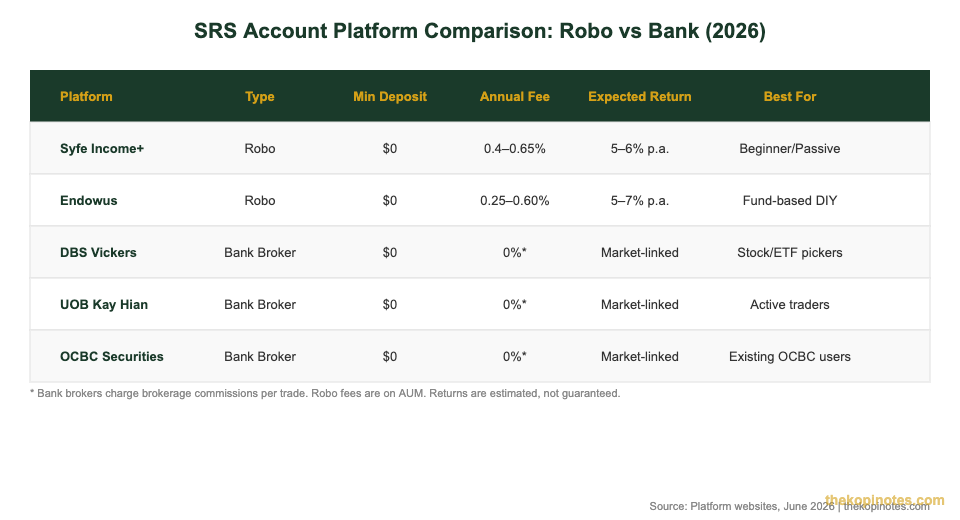
Your two main choices are a robo-advisor (Syfe or Endowus) or a bank brokerage (DBS Vickers, UOB Kay Hian, OCBC Securities). They suit very different investors.
Robo-advisors are best if you want a hands-off diversified portfolio. You link your SRS account, pick a risk level, and the robo rebalances automatically. Both Endowus and Syfe accept SRS from all three banks. Endowus charges 0.25–0.60% of AUM and gives access to institutional-class funds. Syfe’s Income+ portfolio targets 5–6% annual returns with regular income payouts. Use our Syfe vs Endowus 2026 comparison to decide between the two.
Bank brokerages suit investors who pick their own stocks and ETFs on SGX. You pay brokerage commissions per trade (typically $10–$25 minimum). This is cheaper for infrequent large trades but expensive for small or frequent ones.
For most passive investors, pairing an SRS account at DBS/UOB/OCBC with Endowus or Syfe is the simplest high-return approach. Use the Singapore retirement calculator to model how SRS contributions compound over your working years.
Withdrawal Rules & Tax Treatment
This is the most misunderstood part of SRS. Many people assume withdrawals are fully taxed — they are not.
You can start penalty-free withdrawals once you reach the statutory retirement age at the time of your first SRS contribution. Currently that is age 63. Withdraw before this age and you pay tax on 100% of the amount — plus a 5% penalty on the withdrawal sum.
After reaching the retirement age, only 50% of each withdrawal is taxable. You have a 10-year window to draw down the balance. Many retirees spread withdrawals to stay in a low tax bracket — withdrawing $40,000 a year means only $20,000 is assessable income, which falls below the personal relief threshold for most retirees.
| Scenario | Taxable Portion | Penalty |
|---|---|---|
| Withdrawal before statutory retirement age | 100% of amount | 5% of amount |
| After retirement age (within 10-year window) | 50% only | None |
| After 10-year window (remaining balance) | 100% of balance | None |
Source: IRAS SRS scheme guide, June 2026.
If you retire at 63 with little other income, your SRS withdrawals may be effectively tax-free — because the taxable 50% falls below the $20,000 income tax exemption threshold. In that scenario, SRS becomes a fully tax-sheltered retirement vehicle. See our passive income Singapore guide for strategies on structuring retirement income efficiently.
SRS vs CPF: Key Differences
SRS and CPF both reduce your tax and build retirement wealth — but they work very differently. Here is a side-by-side breakdown.
| Feature | SRS | CPF (OA/SA) |
|---|---|---|
| Contribution type | Voluntary cash | Mandatory + voluntary |
| Annual cap | $15,300 (citizens/PR) | Varies by income |
| Idle cash rate | 0.05% p.a. | 2.5–5% p.a. (guaranteed) |
| Investment flexibility | High (stocks, ETFs, funds, SSB) | Limited (CPFIS-approved only) |
| Tax on withdrawal | 50% taxable (post-retirement age) | Tax-free (CPF LIFE payouts) |
| Liquidity before retirement | Early withdrawal with 5% penalty | Locked until 55/retirement |
Source: CPF Board and IRAS, June 2026.
General guidance: maximise your CPF SA/RA top-ups first (for the guaranteed 4–5%), then use SRS for additional tax relief and investment flexibility. For a full breakdown, see our CPF investment strategy Singapore guide.
Who Should Open an SRS Account?
SRS is ideal if you:
— Earn above $60,000/year (the minimum where SRS relief is meaningful)
— Are in your 30s–50s with 10+ years until retirement
— Have already maxed out CPF SA top-ups and want additional tax relief
— Want investment flexibility beyond the CPFIS-approved list
— Are a foreigner in Singapore (higher $35,700 cap, often in higher tax brackets)
Consider alternatives if you:
— Earn below the taxable income threshold — no tax saving to unlock
— May need the cash within 5 years — early withdrawal penalties make SRS illiquid
— Have not yet maxed CPF SA top-ups — CPF’s guaranteed 4% beats SRS idle 0.05%
— Are within a few years of retirement — limited investment runway
For those who qualify, SRS is one of Singapore’s best retirement planning tools. The combination of an instant upfront tax return, tax-free compounding inside the account, and a 50% withdrawal exemption creates a powerful triple advantage. Combined with SGX-listed REITs in your SRS brokerage account, you can generate both growth and income in a tax-efficient wrapper. For context on which REITs to consider, check our guide to the best S-REITs in Singapore 2026.
Disclaimer: This article is for educational purposes only and does not constitute financial advice. SRS rules may change — always refer to the latest IRAS and MAS guidelines before making contribution or investment decisions.
Frequently Asked Questions
What is an SRS account and how does it work in Singapore?
An SRS account (Supplementary Retirement Scheme) is a voluntary savings and investment account that gives you a dollar-for-dollar income tax deduction on contributions up to $15,300/year (citizens/PRs). You invest the funds inside the account, and when you withdraw after the statutory retirement age (currently 63), only 50% of each withdrawal is taxable. Open at DBS, UOB, or OCBC — then invest via a robo-advisor or bank brokerage.
How much tax can I save with an SRS account in Singapore?
Your tax savings depend on your marginal income tax rate. At the maximum $15,300 contribution, you save $1,071 (7% bracket), $2,295 (15% bracket), or $3,366 (22% bracket) per year. The saving is immediate — it shows in your next IRAS assessment. Think of it as a guaranteed risk-free return equal to your marginal tax rate on every dollar contributed.
What is the SRS account interest rate in Singapore?
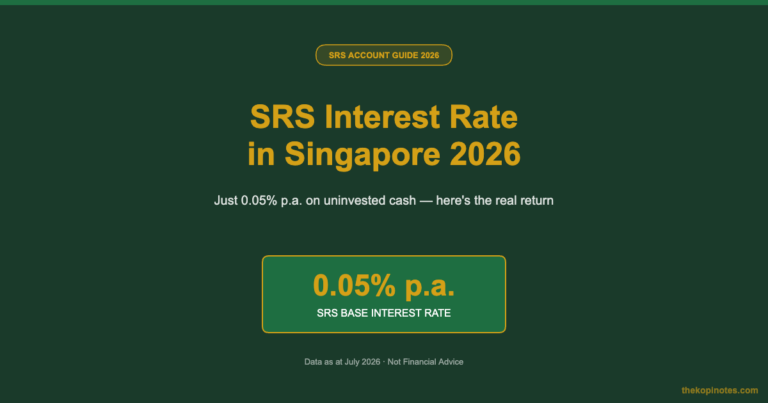
Cash sitting idle in an SRS account earns just 0.05% per year — far below regular savings rates. This is why you must always invest your SRS funds. Options include unit trusts via Endowus, managed portfolios via Syfe, SGX-listed ETFs and S-REITs via bank brokerages, Singapore Savings Bonds, and T-bills. Invested SRS money can realistically target 4–7% annual returns depending on risk profile.
Can I use SRS to buy ETFs or S-REITs?
Yes. You can use SRS funds to buy SGX-listed ETFs (such as the Nikko AM STI ETF) and S-REITs directly through a bank brokerage SRS account (DBS Vickers, UOB Kay Hian, OCBC Securities). Endowus also lets you invest SRS funds into globally diversified unit trust portfolios. Note that LSE-listed ETFs like CSPX or VWRA are generally not directly purchasable with SRS through most local brokers.
What happens if I withdraw from my SRS account early?
Early withdrawal before the statutory retirement age (currently 63) means you pay income tax on 100% of the amount — not the usual 50% — plus a 5% penalty on the withdrawn sum. For example, withdrawing $10,000 early adds $10,000 to your taxable income plus a $500 penalty. Treat SRS as a long-term retirement fund and avoid early withdrawals unless absolutely necessary.
Which bank is best for opening an SRS account — DBS, UOB, or OCBC?
All three banks offer identical SRS terms — the same 0.05% idle rate, same contribution caps, same tax treatment. The best choice is whichever bank you already use for your main account — transfers within the same bank are instant. If you plan to invest via Endowus, all three banks are supported. If you want to buy stocks via DBS Vickers, choosing DBS makes transfers instant.
Is SRS better than topping up CPF for retirement savings?
They are complementary, not competing. CPF SA/RA top-ups earn a guaranteed 4–5% per year and suit risk-averse savers who want certainty. SRS offers broader investment options and is better once you have already maxed CPF top-up relief limits. For high earners who have exhausted CPF relief, SRS is the logical next step. Ideally, use both — CPF for guaranteed returns, SRS for higher-growth investments.
Ready to Open Your SRS Account?
Open your SRS account at DBS, UOB, or OCBC — then invest with Syfe or Endowus for better returns. Use our referral links for exclusive sign-up bonuses.
This article was researched with the help of AI. While we strive to keep all information accurate and up to date, there may be errors. If you notice any discrepancies, please contact us.