Re-Employment Age Singapore 2026: What the Age 69 Rule Means for Your Career & Retirement Plan
A complete guide for Singapore workers and employers — rights, CPF contributions, salary changes, and retirement planning around the July 2026 re-employment age of 69.
From 1 July 2026, Singapore’s re-employment age rises to 69 — meaning eligible employees can request to continue working up to age 69, and employers are legally obligated to offer re-employment or pay a one-time Employment Assistance Payment (EAP). This change, under the Retirement and Re-employment Act (RRA), is part of a phased roadmap toward eventual re-employment age 70. CPF contributions continue throughout re-employment at reduced age-band rates.
Not financial advice. All figures are for educational reference only. Data as at June 2026 unless noted.
Table of Contents
Contents — Click to expand
- What Is the Re-Employment Age?
- Retirement Age vs Re-Employment Age
- What Changes from July 2026
- CPF Contribution Rates During Re-Employment
- Your Rights as a Re-Employed Worker
- Employer Obligations Under the RRA
- Salary and Benefits During Re-Employment
- Retirement Planning Around Re-Employment Age
- Frequently Asked Questions
What Is the Re-Employment Age in Singapore?
The re-employment age is the maximum age up to which an eligible employee can request continued employment with the same employer after reaching the official retirement age. It is governed by the Retirement and Re-employment Act (RRA), administered by the Ministry of Manpower (MOM).
When you turn 64 (the new retirement age from July 2026), your employer does not have to keep you on automatically. But under the RRA, they must offer you re-employment — typically on a one-year renewable contract — up to the re-employment age ceiling of 69 (from July 2026).
This system was introduced to address Singapore’s ageing workforce, extend productive working years, and ensure older workers are not abruptly cut off from income before CPF LIFE payouts begin at age 65. It also allows workers to continue building CPF savings during a period when compound interest on the Retirement Account (RA) remains meaningful.
Re-employment is not mandatory employment past retirement age — employers can decline to re-employ workers who have unsatisfactory performance, or if the job no longer exists. In those cases, the employer must pay the Employment Assistance Payment (EAP).
Retirement Age vs Re-Employment Age: Key Differences
These two ages are frequently confused. The core distinction: the retirement age triggers a legal obligation for employers to offer re-employment (or pay EAP). The re-employment age is the ceiling up to which that obligation continues.
| Feature | Retirement Age (RA) | Re-Employment Age (REA) |
|---|---|---|
| From July 2026 | 64 | 69 |
| What it means | Employer must offer re-employment or EAP at this age | Maximum age employer must offer annual re-employment |
| CPF withdrawals? | Lump-sum from age 55; CPF LIFE payouts from 65 | CPF LIFE payouts continue |
| CPF contributions | Reduced rates apply after 55 | Lowest tier rates apply (ages 65–70) |
| Employer obligation | Mandatory under RRA | Must continue annually up to this age ceiling |
Source: Ministry of Manpower, Retirement and Re-employment Act, 2026
What Changes from July 2026?
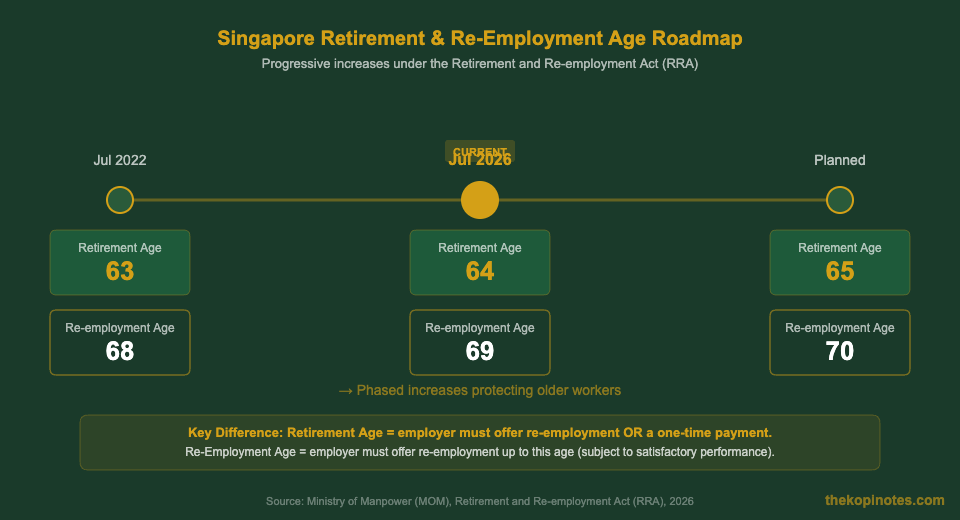
From 1 July 2026, both the retirement age and re-employment age increase by one year under Singapore’s phased roadmap. The goal is to eventually reach retirement age 65 and re-employment age 70.
| Effective Date | Retirement Age | Re-Employment Age | Status |
|---|---|---|---|
| Before Jul 2022 | 62 | 67 | Historical |
| Jul 2022 – Jun 2026 | 63 | 68 | Previous |
| From 1 Jul 2026 | 64 | 69 | Current ✓ |
| Planned (TBD) | 65 | 70 | Future |
Source: MOM Singapore, Retirement and Re-employment Act (RRA) Amendment, 2026
The practical impact: workers turning 64 in 2026 now have one additional year of legally protected employment before the re-employment ceiling. Workers aged 64–69 can request annual renewals until they reach 69. Employers must update HR policies, performance review processes, and EAP calculations to reflect the new thresholds before July 2026.
CPF Contribution Rates During Re-Employment (2026)
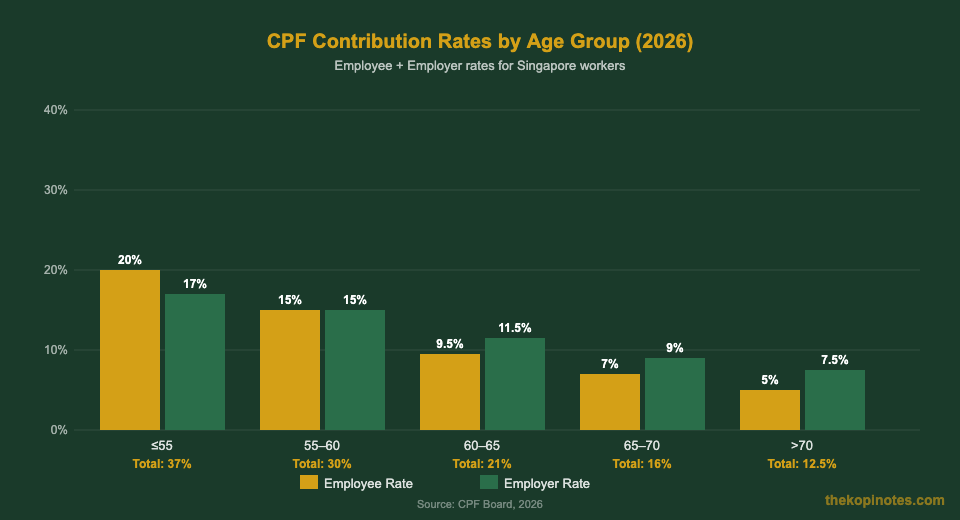
CPF contributions continue throughout re-employment, but at progressively lower rates as you age. This keeps older workers cost-competitive for employers while still building retirement savings.
| Age Group | Employee Rate | Employer Rate | Total Rate | Monthly CPF (S$5,000 wage) |
|---|---|---|---|---|
| ≤55 | 20% | 17% | 37% | S$1,850 |
| 55–60 | 15% | 15% | 30% | S$1,500 |
| 60–65 | 9.5% | 11.5% | 21% | S$1,050 |
| 65–70 | 7% | 9% | 16% | S$800 |
| Above 70 | 5% | 7.5% | 12.5% | S$625 |
Source: CPF Board, January 2026. Based on Ordinary Wages up to the S$8,000/month OW ceiling (2026).
For a re-employed worker earning S$5,000/month between ages 65–69, total monthly CPF contributions are S$800 (S$350 employee + S$450 employer). Over five years of re-employment from 64 to 69, that is approximately S$48,000 in new CPF contributions. At 4% p.a. RA interest compounded over 5 years, this translates to roughly S$53,000–S$58,000 of additional retirement savings — potentially adding S$100–S$200/month to your CPF LIFE payout for life. Use our Singapore retirement planning calculator to model your specific scenario.
Your Rights as a Re-Employed Worker
Under the RRA, eligible employees have the following rights when seeking re-employment from age 64 (effective July 2026):
Who qualifies? You must be a Singapore citizen or PR, have worked for the same employer for at least 3 years before reaching retirement age, be assessed as performing satisfactorily, and be medically fit. Part-time workers earning below S$500/month are excluded.
Right to a written offer: Your employer must offer re-employment in writing before your retirement date. If they cannot offer a suitable position, they must either find another employer to take you on (with your consent), or pay the EAP.
Employment Assistance Payment (EAP): Equivalent to 3.5 months’ salary for employees with at least 2 years of service, subject to a minimum of S$5,500 and a maximum of S$14,750. This is a one-time payment, not annual.
No forced degradation: Employers may adjust job scope and salary at re-employment, but changes must be reasonable and mutually agreed. You can seek assistance from MOM’s Tripartite Alliance for Dispute Management (TADM) if terms are unreasonable.
Performance reviews: Employers must conduct formal evaluations before each annual re-employment renewal. Satisfactory performance and business need = employer must renew.
Employer Obligations Under the RRA
From July 2026, all Singapore employers — regardless of company size — must comply with updated re-employment obligations:
| Obligation | Details |
|---|---|
| Written re-employment offer | Must offer eligible employees re-employment at age 64 in writing, before retirement date |
| Annual renewals to age 69 | Must renew re-employment contracts annually for satisfactory performers up to age 69 |
| EAP if unable to re-employ | 3.5 months’ salary (min S$5,500 / max S$14,750) where genuine re-employment is not possible |
| CPF contributions | Must continue paying employer CPF at applicable age-band rates throughout re-employment |
| Performance documentation | Must maintain records of evaluations justifying non-renewal decisions |
| No forced early exit | Cannot compel retirement before the legislated retirement age of 64 |
Source: Ministry of Manpower, Tripartite Guidelines on Re-employment, 2026
Non-compliance carries significant penalties. Employers found dismissing employees purely on grounds of age — without meeting RRA obligations — face fines and potential criminal charges. MOM and TAFEP actively investigate complaints.
Salary and Benefits During Re-Employment
Employers can restructure salary and benefits at re-employment — but within reasonable limits set by the Tripartite Guidelines on Re-employment. Any reduction must be proportionate to a changed job scope; employers cannot impose drastic pay cuts purely because a worker reached retirement age.
In practice, many employers offer a modest salary reduction (10–20%) if transitioning to a lighter role, or maintain the same salary if the role is unchanged. Benefits typically include: annual leave (pro-rated), medical benefits per company policy, CPF contributions at the applicable age-band rate, and public holiday entitlements. Re-employed workers on fixed-term contracts of 3 months or more are entitled to all Employment Act benefits.
From January 2026, the Ordinary Wage (OW) ceiling is S$8,000/month — CPF contributions are capped at this ceiling. For most re-employed workers in the S$3,000–S$6,000 range, this ceiling has no impact. Workers planning around CPF contributions and the CPF investment strategy should note that re-employment contributions go primarily into the Retirement Account (RA) and Medisave Account (MA).
Retirement Planning Around Re-Employment Age
Whether you plan to work through re-employment age or retire at 64, the new rules have meaningful implications for your financial plan.
Scenario 1 — Working to age 69: Five additional years of CPF contributions at 16% combined (ages 65–69) on S$5,000/month salary = S$800/month × 60 months = S$48,000 in new contributions. With RA compounding at 4% p.a., this grows to roughly S$53,000–S$58,000 of extra retirement savings and could increase your CPF LIFE payout by S$100–S$200/month for life.
Scenario 2 — Retiring at 64: CPF LIFE payouts begin from 65 (assuming Full Retirement Sum is met). The one-year gap between retirement age and LIFE payout can be bridged by dividend-paying S-REITs, income ETFs, or robo-advisor income portfolios. Platforms like Syfe (referral code SRPRFFFCD) and Endowus (referral code 2V343) offer income-focused portfolios suited for retirees generating regular cash flow from 64 onwards.
Passive income bridge strategy: A portfolio of best S-REITs in Singapore 2026 yielding 5–6% on S$300,000 generates S$15,000–S$18,000 per year — sufficient to cover basic expenses while CPF LIFE payouts begin. For a comprehensive strategy combining re-employment income, CPF, and dividend investing, see the passive income Singapore 2026 guide.
The Singapore retirement planning calculator lets you model whether working to 69 materially improves your outcome versus retiring at 64 with a dividend portfolio. Run both scenarios before making your decision.
Not financial advice. This article is for educational and informational purposes only. Consult a licensed financial adviser for personalised retirement planning.
Frequently Asked Questions
What is the re-employment age in Singapore from July 2026?
From 1 July 2026, Singapore’s re-employment age is 69. Eligible employees can request to continue working with the same employer up to this age. Employers are legally required under the Retirement and Re-employment Act (RRA) to offer annual re-employment contracts, or pay the Employment Assistance Payment (EAP) if they genuinely cannot provide a suitable role.
Is the re-employment age the same as the retirement age in Singapore?
No. The retirement age (64 from July 2026) is when your employer must first offer re-employment or pay EAP. The re-employment age (69 from July 2026) is the ceiling up to which your employer must continue offering annual re-employment contracts. Retirement age triggers the obligation; re-employment age determines how long it lasts.
Can my employer reduce my salary during re-employment in Singapore?
Yes, but within limits. Under the Tripartite Guidelines on Re-employment, employers may adjust salary if the job scope is revised — but any reduction must be reasonable and proportionate. Employers cannot cut pay simply because you reached retirement age. If terms are unreasonable, you can seek assistance from MOM’s Tripartite Alliance for Dispute Management (TADM) or file a complaint with TAFEP.
What is the Employment Assistance Payment (EAP) and how much is it?
The EAP is a one-time payment your employer must make if they are genuinely unable to re-employ you at retirement age. It equals 3.5 months of your last drawn salary, subject to a minimum of S$5,500 and a maximum of S$14,750. You must have worked for the employer for at least 2 years to qualify. The EAP is separate from retrenchment benefits and is specifically tied to RRA re-employment obligations.
Do CPF contributions continue during re-employment in Singapore?
Yes. CPF contributions continue throughout re-employment at lower age-band rates. For workers aged 65–70, the combined rate is 16% (7% employee + 9% employer) on wages up to the S$8,000 OW ceiling. Contributions go into your Retirement Account (RA) and Medisave Account (MA), earning 4% p.a. interest. Every year of re-employment meaningfully adds to your CPF LIFE payout from age 65.
Who qualifies for re-employment protection in Singapore?
To qualify for RRA protection, you must be: (1) a Singapore citizen or permanent resident; (2) employed by the same employer for at least 3 years before reaching retirement age; (3) assessed as performing satisfactorily; and (4) medically fit to continue. Contract workers, freelancers, and employees earning below S$500/month are not covered by the RRA.
How should I plan my retirement income if I retire at 64 without re-employment?
If you retire at 64, CPF LIFE payouts begin at 65. For the one-year gap — and beyond — you can generate income through dividend-paying S-REITs, high-yield ETFs, or income-focused robo-advisor portfolios. Platforms like Syfe Income+ (referral SRPRFFFCD) and Endowus (referral 2V343) are designed for retirees needing regular monthly income. Paired with SSBs or T-bills for capital preservation, this creates a resilient retirement income structure without requiring continued employment.
Will Singapore's re-employment age increase beyond 69?
Yes, the government has signalled plans to raise the re-employment age to 70 and the retirement age to 65, though the exact date has not been officially confirmed as at June 2026. The phased approach — raising both ages by one year at a time — gives employers and workers time to adapt. Watch for Budget announcements or MOM policy updates for the next scheduled increase.
Can my employer refuse to re-employ me after I turn 64?
Yes, but only in specific circumstances: documented unsatisfactory performance, the role no longer exists due to genuine business restructuring, or medical unfitness. In all three cases, the employer must pay EAP. They cannot dismiss workers purely because of age without triggering RRA obligations. Wrongful denial of re-employment can be reported to MOM or TADM for resolution.
Plan Your Retirement Alongside Re-Employment
Whether you work to 69 or retire at 64, start building passive income now.
This article was researched with the help of AI. While we strive to keep all information accurate and up to date, there may be errors. If you notice any discrepancies, please contact us.