Syfe for Self-Employed Singaporeans: SRS-Only Strategy Without CPF (2026)
No employer, no automatic CPF OA or SA inflow — here’s how Syfe’s cash and SRS portfolios fit into a self-employed investing plan.
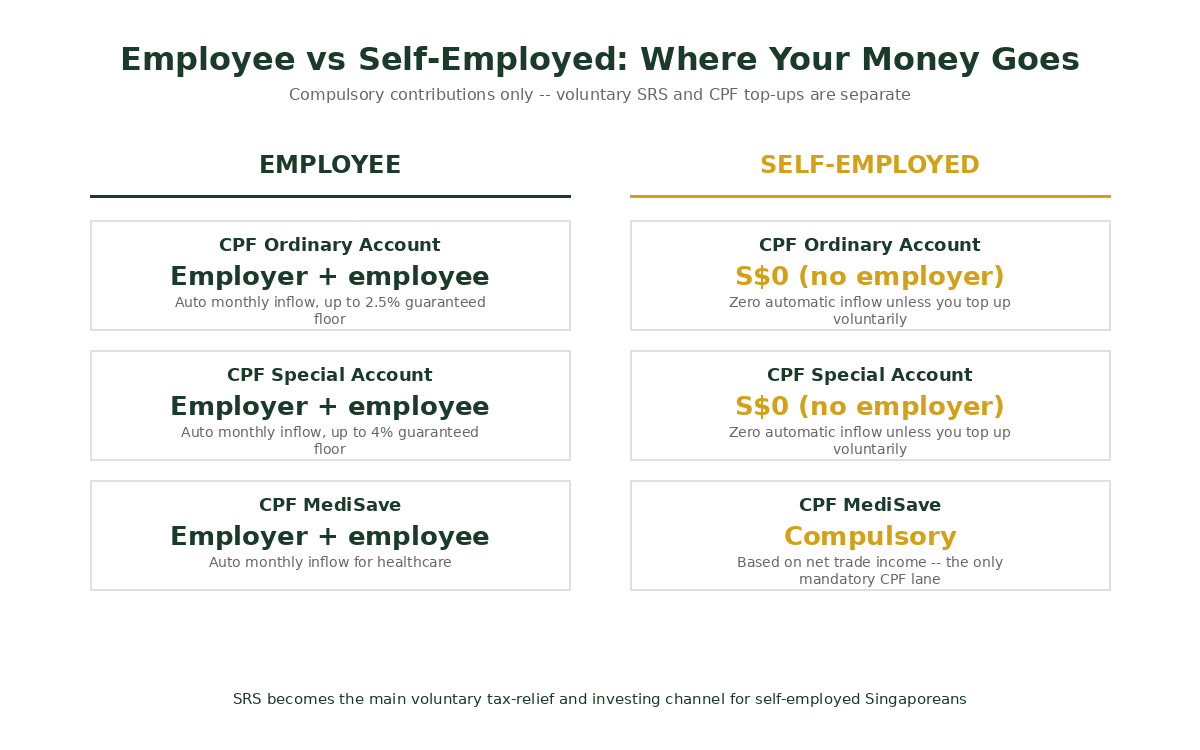
If you’re self-employed in Singapore, you get compulsory MediSave contributions only — there’s no employer CPF, so no automatic Ordinary Account or Special Account inflow. Syfe doesn’t accept CPF money at all, in any form, which makes the Supplementary Retirement Scheme (SRS) — capped at S$15,300 a year for citizens and PRs, S$35,700 for foreigners — the main voluntary channel for investing through Syfe once you’ve paid MediSave.
Not financial advice. All figures are for educational reference only. Data verified against Syfe’s official pricing, SRS and cash management pages, and IRAS sources as at November 2026.
Table of Contents
Why self-employed Singaporeans need a different Syfe strategy
Syfe cannot accept CPF money in any form
SRS: the main voluntary channel Syfe does support
Syfe's SRS-eligible portfolios compared
What's cash-only: REIT+ and the rest
Syfe's fee tiers in 2026
Syfe vs Endowus for self-employed investors
A simple self-employed Syfe strategy
FAQ
Why self-employed Singaporeans need a different Syfe strategy
An employee’s CPF contributions are split automatically every month: a slice goes to the Ordinary Account (currently floored at 2.5% p.a.), a slice to the Special Account (floored at 4% p.a.), and a slice to MediSave. A self-employed person gets none of that automatic OA or SA inflow — only MediSave contributions are compulsory, calculated on your net trade income after your annual tax assessment.
That changes what a robo advisor can actually do for you. Endowus can take your voluntary CPF OA and SA top-ups and invest them under CPFIS. Syfe can’t — it isn’t CPFIS-approved at all. So if your retirement investing plan runs through Syfe, SRS and cash are the only two levers you have, and SRS is the one that comes with a tax deduction attached.
Syfe cannot accept CPF money in any form
This is the single biggest structural difference between Syfe and Endowus for a self-employed investor. Syfe Pte. Ltd. holds Capital Markets Services Licence CMS100837 from MAS — it is not a CPFIS-approved investment administrator. That means:
- No CPF Ordinary Account investing, even on a voluntary top-up basis.
- No CPF Special Account investing.
- Cash and SRS funds only — there is no CPF pathway on Syfe at all, for employees or the self-employed.
Endowus, by contrast, is CPFIS-approved (CMS101051) and accepts CPF OA, CPF SA and SRS directly. If CPF investing matters to you, Syfe simply isn’t built for it — see our Endowus for Self-Employed Singaporeans guide for how that CPFIS pathway works.
SRS: the main voluntary channel Syfe does support
Every dollar you contribute to SRS reduces your taxable income, up to the annual cap: S$15,300 for Singapore citizens and PRs, or S$35,700 for foreigners. There’s no separate, lower cap for the self-employed — the limit is the same whether your income comes from an employer or your own business. The cap sits inside the broader S$80,000 overall personal income tax relief ceiling, shared with other reliefs.
Left uninvested in your SRS bank account, that money earns just 0.05% p.a. Syfe’s SRS-eligible portfolios are built specifically to put that idle cash to work without leaving the SRS wrapper’s tax-deferred status.
To invest SRS funds with Syfe: open an SRS bank account with DBS/POSB, OCBC or UOB (the only three approved SRS operators), fund it, then select the SRS card when adding a portfolio in the Syfe app. Funds are typically invested within 6–7 business days of your instruction.
Syfe’s SRS-eligible portfolios compared
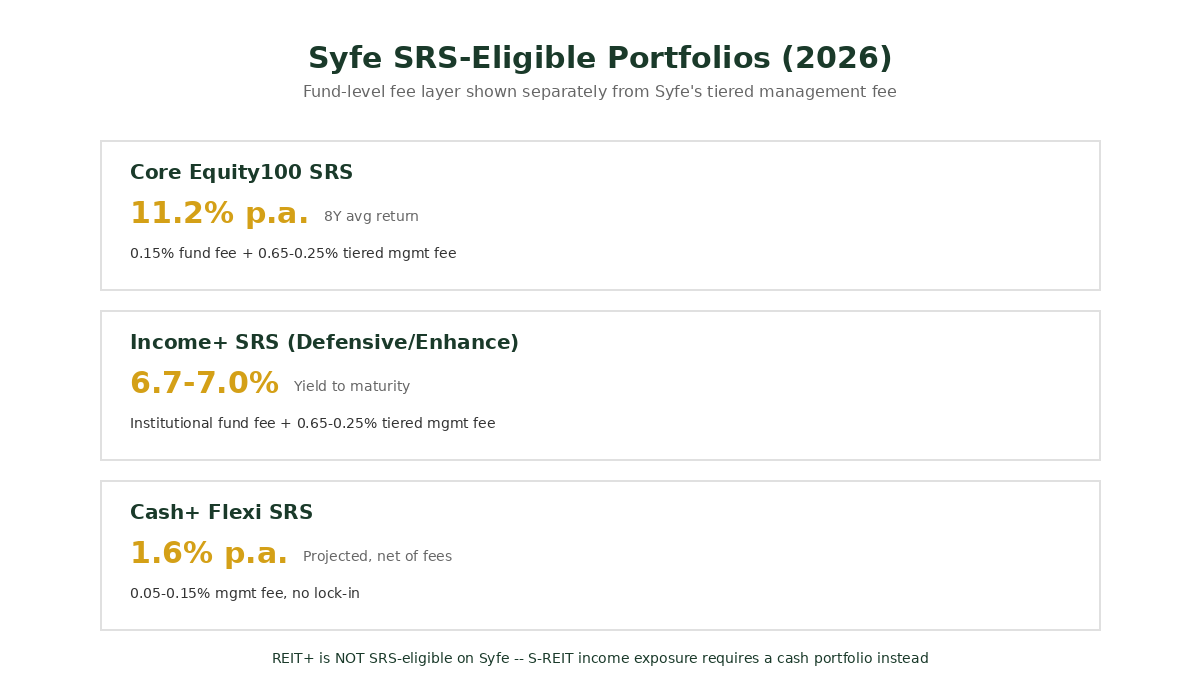
Only three Syfe products currently accept SRS funds: Core Equity100, Income+ (Defensive and Enhance), and Cash+ Flexi (SGD). Each targets a different point on the risk spectrum.
| SRS Portfolio | Return Profile | Risk | Fee Layer |
|---|---|---|---|
| Core Equity100 SRS | 11.2% p.a. (8-year average) | High | 0.15% fund-level fee + 0.65%–0.25% tiered management fee |
| Income+ Defensive/Enhance SRS | 6.7%–7.0% yield to maturity | Moderately low | Institutional fund fee + 0.65%–0.25% tiered management fee |
| Cash+ Flexi (SGD) SRS | 1.6% p.a. projected | Very low | 0.05%–0.15% management fee, no lock-in |
Past returns are not a guarantee of future performance. Figures shown reflect Syfe’s own published data as at November 2026 and are before any applicable GST on fees.
What’s cash-only: REIT+ and the rest
Syfe REIT+ — its basket of Singapore REITs — is not SRS-eligible. Neither is Core Growth, Core Balanced, Core Defensive, the Select Themes portfolios, Equity Alpha, Cash+ Guaranteed, or Cash+ Enhanced. If you want S-REIT dividend exposure through Syfe, you’ll need to fund it with cash, not SRS money. For a self-employed investor weighing where idle SRS dollars should sit versus where taxable cash savings should sit, this is a decision point worth planning around — see our Best S-REITs 2026 guide if you’re building that cash-side REIT exposure directly instead.
Syfe’s fee tiers in 2026
As of 1 January 2026, Syfe charges a single all-inclusive management fee across its managed portfolios, based on the higher of your total assets or your net invested amount:
| Tier | Threshold | All Managed Portfolios |
|---|---|---|
| Blue | No minimum | 0.65% p.a. |
| Black | S$50,000+ | 0.55% p.a. |
| Gold | S$250,000+ | 0.45% p.a. |
| Platinum | S$1,000,000+ | 0.35% p.a. |
| Diamond | S$5,000,000+ | 0.25% p.a. |
For a self-employed investor with variable income, this matters: irregular SRS contributions won’t reset your tier downward as long as your total assets or net invested amount stay above the threshold. Fees are subject to prevailing GST where applicable.
Syfe vs Endowus for self-employed investors
| Syfe | Endowus | |
|---|---|---|
| CPFIS-approved | No | Yes (CMS101051) |
| CPF OA / SA investing | Not available | Supported |
| SRS investing | Supported (3 portfolios) | Supported (flat 0.40% multi-fund / 0.30% single-fund) |
| Cash management | Cash+ Guaranteed, Flexi, Enhanced | Cash Smart Secure/Enhanced/Ultra |
| Direct S-REIT exposure | REIT+ (cash only) | Income Portfolio (broader bond/equity mix) |
For a self-employed investor who only cares about SRS and cash, the two platforms sit closer together than their CPF story suggests. The real fork in the road is whether you also want to invest voluntary CPF top-ups — only Endowus offers that pathway.
A simple self-employed Syfe strategy
- Pay compulsory MediSave first based on your net trade income — this isn’t optional and happens automatically after your tax assessment.
- Max out SRS if the tax relief outweighs the lock-in — up to S$15,300 a year (citizens/PRs), noting SRS funds are generally locked until the statutory retirement age with penalties for early withdrawal.
- Put SRS cash to work — Core Equity100 SRS for long-horizon growth, Income+ SRS for steadier yield, or Cash+ Flexi SRS if you want it liquid and low-risk while you decide.
- Keep a separate cash buffer outside SRS — self-employed income is lumpier than salaried income, so Cash+ Guaranteed or Cash+ Flexi (cash, not SRS) can hold your working-capital buffer.
- Use cash, not SRS, for REIT+ — if S-REIT income is part of your plan, remember it sits outside the SRS-eligible product list.
Ready to put your SRS funds to work with Syfe?
Frequently Asked Questions
Can self-employed Singaporeans invest CPF money with Syfe?
Is the SRS contribution cap different for self-employed people?
Which Syfe portfolios accept SRS funds?
How much does Syfe charge on SRS investments?
Should a self-employed investor use Syfe or Endowus?
What happens to SRS funds left uninvested?
This article was researched with the help of AI. While we strive to keep all information accurate and up to date, there may be errors. If you notice any discrepancies, please contact us.