Medisave Limit 2026: Fibroids & Gynaecological Surgery — What Does Your ISP Cover?
TOSP codes, Medisave withdrawal limits, and how your Integrated Shield Plan pays the rest — a complete 2026 guide.
Fibroid surgery in Singapore is Medisave-claimable, but the amount you can withdraw depends on your TOSP code — either $1,920 for a simpler procedure (Table 3C, code SI709U) or $2,610 for a more complex one (Table 5A, code SI815U). With a private hospital bill often exceeding $25,000, your Integrated Shield Plan (ISP) rider covers the remaining gap — but under the April 2026 rules, you will pay at least 5% co-payment regardless of your plan.
Not financial advice. All figures are for educational reference only. Data as at November 2026 unless noted. Always verify current limits with CPF Board and your insurer before making decisions.
Table of Contents
Contents — Click to expand
What Are Uterine Fibroids?
Uterine fibroids (also called leiomyomas or myomas) are non-cancerous growths that develop in or on the uterus. They are extremely common — studies suggest up to 70–80% of women will develop them by age 50, though many remain asymptomatic and are discovered incidentally during routine scans or investigations for other conditions.
Fibroids are classified by their location: submucosal fibroids grow inside the uterine cavity, intramural fibroids develop within the uterine wall, and subserosal fibroids grow on the outer surface of the uterus. In Singapore, women who experience symptoms — heavy menstrual bleeding, pelvic pain, difficulty conceiving, or frequent urination — are often referred for surgical treatment.
The two main surgical options are myomectomy (surgical removal of the fibroids while preserving the uterus, preferred for women who wish to maintain fertility) and hysterectomy (removal of the uterus, the definitive solution for women who do not wish to conceive). Both procedures are Medisave-claimable under Singapore’s MediShield Life and ISP framework, though the specific TOSP codes — and therefore the Medisave withdrawal limits — differ.
Is Fibroid Surgery Medisave-Claimable?
Yes. Fibroid surgery (both myomectomy and hysterectomy) qualifies as an approved surgical procedure under Singapore’s CPF Medisave scheme. All inpatient surgical procedures listed in the Ministry of Health’s Table of Surgical Procedures (TOSP) are Medisave-claimable, subject to the limits set for the specific TOSP classification.
For more context on how the TOSP classification system works and how it determines your Medisave withdrawal limit, see our TOSP surgical procedures guide. The classification of your specific procedure — determined by your surgeon and listed on your hospital bill — directly affects how much Medisave you can withdraw to offset costs.
In addition to the surgical procedure limit, Medisave also covers daily hospitalisation charges up to $1,130 per day for the first two days, and $400 per day from the third day onwards (as at November 2026, per CPF Board). These limits apply on top of the surgical procedure limit.
TOSP Codes and Medisave Withdrawal Limits for Fibroid Surgery
The Medisave withdrawal limit for your fibroid surgery depends on the TOSP code assigned to your procedure. For myomectomy (fibroid removal), the two main relevant codes are:
| TOSP Code | Procedure Description | TOSP Table | Medisave Limit (2026) |
|---|---|---|---|
| SI709U | Myomectomy — simple (fibroid <5cm or single fibroid) | Table 3C | $1,920 |
| SI815U | Myomectomy — complicated (multiple/large fibroids >5cm, or laparoscopic) | Table 5A | $2,610 |
| Source: CPF Board, as cited in TKN TOSP Guide, Nov 2026. Hysterectomy codes (SY-series) have different limits — confirm with your surgeon. | |||
Most women undergoing fibroid surgery at a private hospital in Singapore will be assigned SI815U (the complicated myomectomy code), particularly those with multiple fibroids, fibroids larger than 5cm, or those undergoing laparoscopic (minimally invasive) surgery. Your surgeon determines the TOSP code based on the complexity of your actual procedure.
On top of the surgical limit, you can claim Medisave for hospitalisation at $1,130/day for days 1–2 and $400/day thereafter. For a typical 2-night stay, that adds up to approximately $2,260 in hospitalisation coverage — bringing your total Medisave claim for surgery plus two nights’ stay to roughly $4,870 (SI815U) or $4,180 (SI709U).
Hospital Bill Ranges for Fibroid Surgery in Singapore
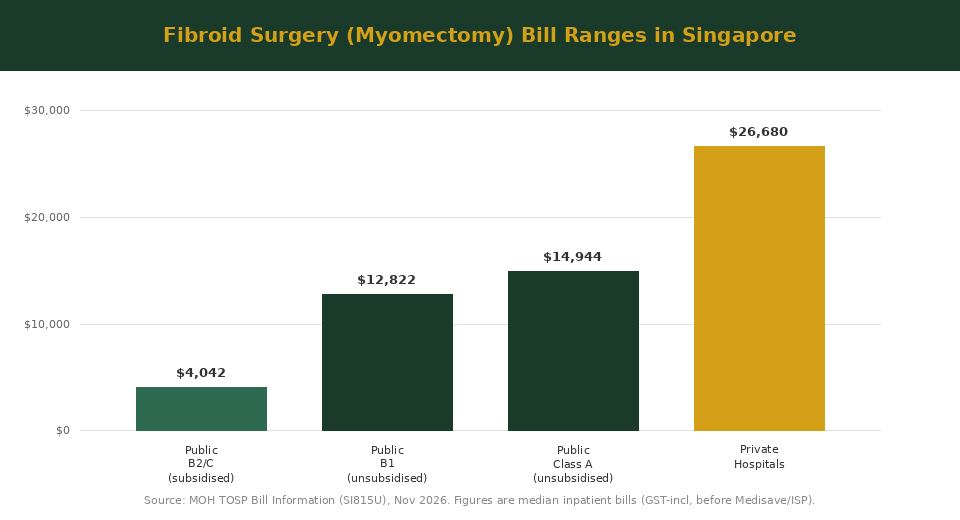
The total cost of fibroid surgery in Singapore varies significantly depending on the type of hospital, your ward class, and the complexity of your procedure. The figures below are for complicated myomectomy (TOSP code SI815U) and are drawn from MOH’s inpatient bill information data, inclusive of GST and before Medisave or ISP claims.
| Hospital Type / Ward | Bill Range (50th–75th percentile) | Notes |
|---|---|---|
| Public Hospital — Class B2/C (subsidised) | $3,496 – $5,790 | Government subsidy applies; must be Singapore citizen or PR |
| Public Hospital — Class B1 (unsubsidised) | $10,409 – $13,416 | No subsidy; can choose own doctor |
| Public Hospital — Class A (unsubsidised) | $13,313 – $15,607 | Single-bedded room; preferred doctor |
| Private Hospital | $23,451 – $35,409 | Full specialist fees; highest comfort level |
Source: MOH Inpatient Bill Information, TOSP code SI815U (complicated myomectomy), Nov 2026. Figures include professional fees, ward charges and ancillary costs (GST-inclusive). Individual bills may vary.
The wide range within private hospitals reflects differences in surgeon fees, anaesthetist charges, the number of nights hospitalised, and any complications. Even at the low end of private hospital costs ($23,451), Medisave alone — roughly $4,870 for surgery and a 2-night stay — covers only about 20% of the total bill. This is where your Integrated Shield Plan becomes critical.
How Your ISP Covers Fibroid Surgery
An Integrated Shield Plan (ISP) is a private health insurance policy that wraps around Singapore’s MediShield Life base tier. It extends coverage limits and allows you to stay in higher ward classes — including Class A wards or private hospital rooms — with significantly lower out-of-pocket costs than MediShield Life alone.
For fibroid surgery at a private hospital, the coverage chain works as follows:
- Medisave pays up to $2,610 (surgical) + hospitalisation limits first
- MediShield Life then covers a portion of the remaining bill, up to its per-day and per-claim caps (which are relatively low for private hospitals)
- Your ISP covers the remainder up to your plan’s benefit limit, minus your deductible (typically $3,500 for private hospitals) and co-payment
- Your ISP rider (if you have one) covers the deductible and reduces your co-payment to the mandatory minimum
Under the mandatory co-payment rules effective April 2026, even with the most comprehensive ISP rider, you will pay a minimum of 5% of the ISP-covered portion if you use a panel doctor, or up to 10% if you use a non-panel specialist. There are no longer any zero-co-payment riders available for new policyholders after March 2018, and the April 2026 changes raised the floor for everyone.
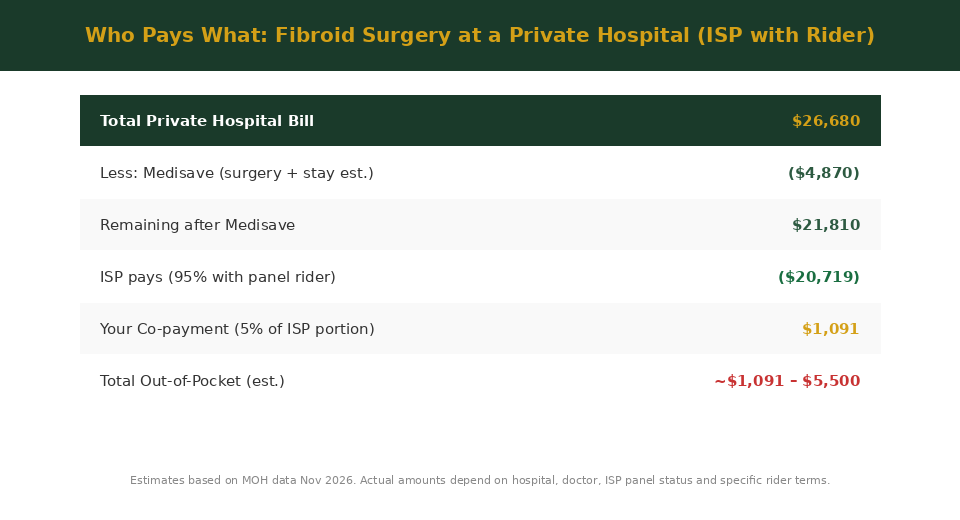
Your co-payment is calculated on the net bill after deductible, not the gross hospital bill. For a private hospital bill of approximately $26,680 (using the median), after Medisave ($4,870) and the deductible ($3,500), the ISP-covered amount is roughly $18,310. Your 5% co-payment on that would be about $916 — meaning your total out-of-pocket is approximately $3,500 (deductible) + $916 (co-pay) = $4,416, with Medisave covering the rest separately.
A Worked Example: Private Hospital Fibroid Surgery (2026)
Let us walk through a realistic example. Suppose you are a 38-year-old Singaporean woman diagnosed with multiple intramural fibroids (the largest measuring 7cm). Your gynaecologist recommends a laparoscopic myomectomy at a private hospital. Your TOSP code is SI815U. You have a comprehensive ISP covering private hospitals, with a panel rider under the April 2026 framework.
| Cost Component | Amount | Paid By |
|---|---|---|
| Total private hospital bill (incl. surgeon, anaesthetist, ward, misc.) | $26,680 | Starting point |
| Medisave — surgical (SI815U, Table 5A) | ($2,610) | CPF Medisave |
| Medisave — hospitalisation (2 nights: $1,130 × 2) | ($2,260) | CPF Medisave |
| ISP deductible (private hospital tier) | ($3,500) | You (rider may cover this) |
| Remaining bill (after Medisave, before ISP) | $18,310 | ISP covers (minus co-pay) |
| ISP co-payment (5% of ISP-covered portion, panel doctor) | ($916) | You |
| Estimated total out-of-pocket | ~$4,416 – $5,500 | You (cash/savings) |
Estimates based on median private hospital bill (MOH data, Nov 2026) and standard ISP panel rider terms. MediShield Life base tier contribution not separately itemised as it is embedded within ISP calculations. Actual amounts depend on your specific plan terms, surgeon fees, and ward choice.
The takeaway: even with a comprehensive ISP rider, you should expect to have between $4,000 and $6,000 in cash ready for a private hospital fibroid surgery after all insurance payouts. If you use a non-panel specialist, the 10% co-payment raises your out-of-pocket by roughly $900 more.
5 Tips to Manage Your Out-of-Pocket Costs
Knowing the numbers ahead of time lets you plan rather than scramble. Here are five practical steps to minimise your out-of-pocket costs for fibroid surgery in Singapore.
1. Use a panel specialist if possible. Under the April 2026 ISP rules, panel doctors attract a 5% co-payment while non-panel specialists attract up to 10%. On a $18,000 ISP-covered bill, that is a $900 difference — worth checking your insurer’s panel list before committing to a surgeon.
2. Get a pre-authorisation from your insurer. Most ISP insurers (AIA, Prudential, Great Eastern, NTUC Income, Raffles Health) require pre-authorisation for planned procedures. Submit this at least one week before your surgery date to avoid coverage disputes and to get a written estimate of what your insurer will cover.
3. Understand your deductible reset date. If you have already been hospitalised earlier in the same policy year and have met part or all of your deductible, your fibroid surgery bill in the same year benefits from a lower (or zero) remaining deductible. Timing elective procedures within the same policy year as an earlier claim can save thousands.
4. Consider public hospital Class A as a middle ground. Public hospital Class A bills for fibroid surgery ($13,313–$15,607) are significantly lower than private hospital bills, yet you still get a single-bedded room and can choose your own specialist. With the same ISP, your co-payment on a public Class A bill will be considerably smaller. The best ISP plans in Singapore cover up to Class A wards without requiring a full private hospital tier premium.
5. Build a dedicated health emergency fund. Even with the best ISP, you should have $5,000–$10,000 in liquid savings set aside for healthcare out-of-pocket costs. Consider keeping this in a high-yield cash management account so it earns interest while sitting available. If you are reviewing your overall healthcare financial planning, understanding how ISP co-payments have changed under the 2026 co-payment rules is essential context.
Frequently Asked Questions
What is the Medisave limit for fibroid surgery in Singapore in 2026?
The Medisave withdrawal limit for fibroid surgery in 2026 depends on your TOSP code. For a simple myomectomy (SI709U, TOSP Table 3C), the limit is $1,920. For a complicated myomectomy — typically for multiple or large fibroids, or laparoscopic procedures (SI815U, TOSP Table 5A) — the limit is $2,610. These surgical limits are separate from the daily hospitalisation claim ($1,130 for days 1–2, $400 from day 3). Source: CPF Board, as cited in MOH TOSP framework, Nov 2026.
Can I use my Medisave for a laparoscopic fibroid removal?
Yes. Laparoscopic myomectomy is covered under Medisave as an approved surgical procedure. Because it is considered a more complex procedure, it typically falls under TOSP Table 5A (code SI815U) with a Medisave limit of $2,610 for the surgery itself. You can claim this on top of the separate daily hospitalisation limit. If you are unsure of your TOSP code, ask your surgeon before admission — this affects both your Medisave claim and what your ISP pays.
Does my Integrated Shield Plan cover fibroid surgery at a private hospital?
Yes, if your ISP covers private hospital stays. Most comprehensive ISP plans (such as those from AIA, Prudential, Great Eastern, NTUC Income, and Raffles Health) include private hospital coverage. After Medisave is applied, your ISP covers the remaining bill minus your deductible and mandatory co-payment (at least 5% from April 2026 for panel doctors). You should request a pre-authorisation letter from your insurer before the procedure to confirm coverage and avoid disputes.
What is the co-payment for fibroid surgery under the new 2026 ISP rules?
Under the April 2026 Integrated Shield Plan co-payment rules, you must pay a minimum of 5% of the ISP-covered portion if you use a panel specialist, or up to 10% if you use a non-panel specialist. There are no longer zero-co-payment riders available for new policies. For a typical private hospital fibroid surgery where the ISP covers about $18,000 of the net bill, your co-payment would be approximately $900 (panel) to $1,800 (non-panel). The deductible is paid separately before the ISP coverage kicks in.
How much does fibroid surgery cost out-of-pocket in Singapore after Medisave and ISP?
At a private hospital, expect to pay roughly $4,000 to $6,000 out-of-pocket after Medisave and a comprehensive ISP panel rider — this covers your deductible ($3,500 typical) plus 5% co-payment on the insured portion. At a public Class A ward, the out-of-pocket cost is significantly lower, often $1,500–$3,000 with the same ISP, because the total bill is smaller. At a subsidised Class B2/C ward, your Medisave may cover a substantial portion of the subsidised bill and out-of-pocket costs can be minimal.
Do I need to file a Medisave claim myself for fibroid surgery?
No. For hospitalisation procedures in Singapore, Medisave claims are processed directly by the hospital — you do not need to file separately. The hospital’s billing department submits the Medisave claim on your behalf using your NRIC number. For ISP claims, you typically sign a discharge authorisation form at the hospital that allows the insurer to pay the hospital directly (direct billing). You will only need to pay the remaining out-of-pocket amount (deductible and co-payment) in cash or by NETS/credit card upon discharge.
Is robotic fibroid surgery covered by Medisave in Singapore?
Yes, robotic-assisted myomectomy is covered under Medisave. It is typically classified under the same TOSP codes as conventional laparoscopic myomectomy (SI815U, Table 5A, Medisave limit $2,610) for a complicated fibroid case. However, robotic surgery involves higher professional fees that are charged over and above the TOSP surgical limit — the TOSP limit only sets the floor for Medisave coverage, not a cap on surgeon fees. Your ISP covers the gap, subject to your deductible and co-payment.
Review Your ISP Before Your Next Procedure
Understanding your Integrated Shield Plan coverage before an operation means fewer surprises on your hospital bill. Use our guides to compare plans and find the right coverage for your needs.
Get Free Insurance Advice
Speak with a licensed insurance advisor. No obligation, no cost.
By submitting this form, you agree to our Privacy Policy.
This article was researched with the help of AI. While we strive to keep all information accurate and up to date, there may be errors. If you notice any discrepancies, please contact us.