Quality Factor ETF Singapore: Is IWQU Worth the 0.25% TER? (2026 Guide)
A plain-English look at the iShares Edge MSCI World Quality Factor UCITS ETF (IWQU) — what “quality” investing means, how its 0.25% fee compares to VWRA and CSPX, and whether the tilt is worth it for Singapore investors.
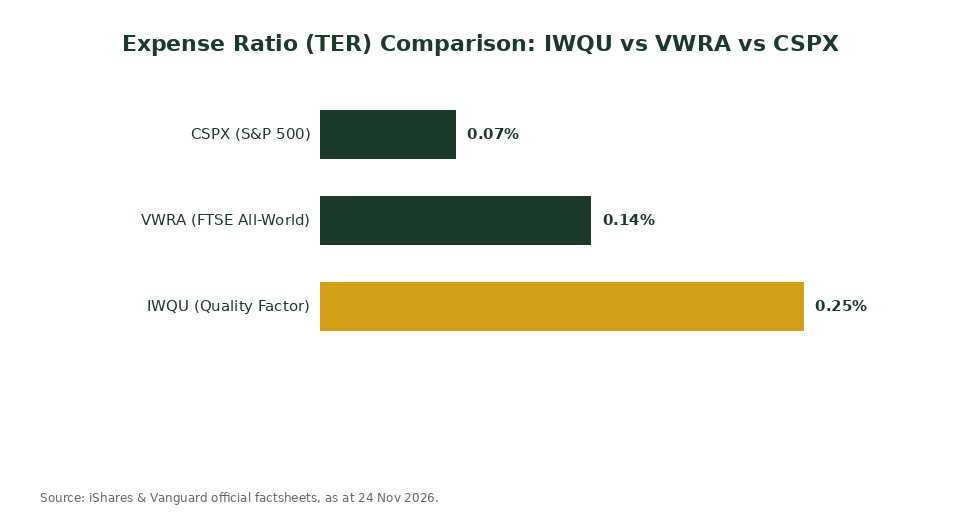
IWQU (iShares Edge MSCI World Quality Factor UCITS ETF) is an Ireland-domiciled, LSE-listed fund that tilts a global developed-market portfolio toward companies with strong, stable earnings and low debt. It charges a 0.25% TER — higher than VWRA’s 0.14% or CSPX’s 0.07% — and Singapore investors get the same 15% US withholding tax treatment as those two funds because it is also an Irish UCITS. Whether the extra cost is worth it depends on whether you want earnings-quality exposure, not just broad-market beta.
Not financial advice. All figures are for educational reference only. Data verified as at 25 November 2026 against official iShares and Vanguard sources unless noted.
- IWQU tracks the MSCI World Sector Neutral Quality Index (Net), screening for high ROE, stable earnings growth and low financial leverage across ~289 developed-market stocks
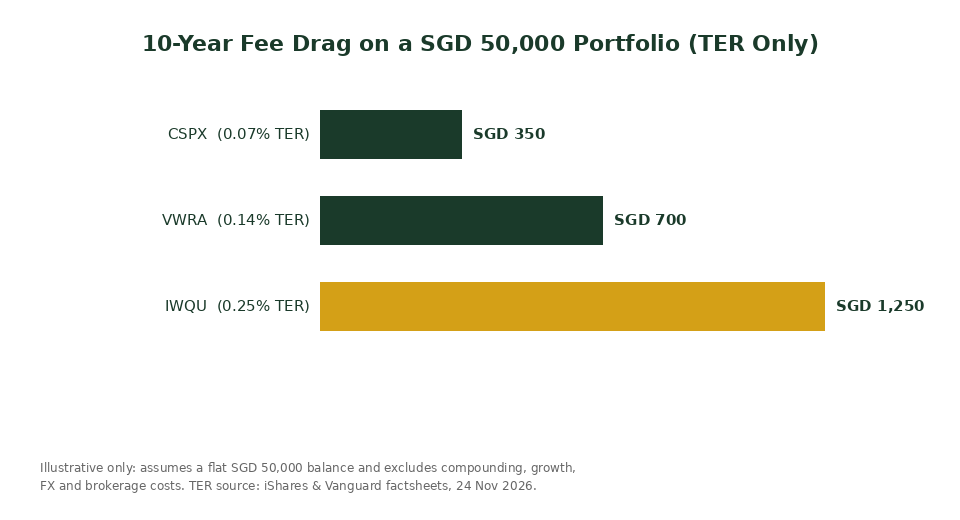
- Its 0.25% TER is nearly double VWRA’s 0.14% and over 3x CSPX’s 0.07% — on a flat SGD 50,000 holding that is roughly SGD 1,250 over 10 years versus SGD 700 for VWRA, ignoring compounding and growth
- Like VWRA and CSPX, IWQU is an Irish-domiciled UCITS ETF, so the same 15% US dividend withholding tax treaty rate applies — the fee gap is the main trade-off, not tax treatment
Table of Contents
Contents — Click to expand
- What Is the “Quality” Factor in Investing?
- What Is IWQU? Key Facts
- IWQU vs VWRA vs CSPX: Fee and Structure Comparison
- IWQU Sector Exposure: What You Actually Own
- Performance: Does Quality Actually Outperform?
- Withholding Tax and Domicile
- Where to Buy IWQU in Singapore
- Risks and Considerations
- Frequently Asked Questions
What Is the “Quality” Factor in Investing?
“Factor investing” means deliberately tilting a portfolio toward a characteristic that has historically been associated with better risk-adjusted returns, rather than simply holding every stock in a market-cap-weighted index. The quality factor specifically screens for companies with:
- High and stable return on equity (ROE) — the company consistently generates profit from shareholder capital
- Low financial leverage — the business is not overly reliant on debt
- Stable earnings growth — profits grow predictably rather than swinging wildly year to year
This is different from the momentum factor (covered in our VWRA vs Momentum ETF comparison), which chases recent price trends rather than balance-sheet strength. Quality tends to hold up better in downturns — fewer earnings disappointments, less debt stress — but can lag in speculative, high-growth rallies where unprofitable companies run hardest.
What Is IWQU? Key Facts
The iShares Edge MSCI World Quality Factor UCITS ETF (Bloomberg ticker IWQU LN, USD share class) tracks the MSCI World Sector Neutral Quality Index (Net) — “sector neutral” meaning the fund keeps roughly the same sector weights as the broad MSCI World index, it just picks the higher-quality names within each sector rather than concentrating in a few “quality” sectors.
| Key Fact | Detail |
|---|---|
| Fund name | iShares Edge MSCI World Quality Factor UCITS ETF |
| LSE ticker (USD) / (GBP) | IWQU / IWFQ |
| ISIN | IE00BP3QZ601 |
| TER | 0.25% per year |
| Domicile | Ireland |
| Replication | Physical, optimised sampling |
| Distribution policy | Accumulating |
| Benchmark index | MSCI World Sector Neutral Quality Index (Net) |
| Net assets / holdings | ~USD 6.59 billion / 289 holdings |
Source: iShares IWQU product page, as at 24 November 2026.
IWQU vs VWRA vs CSPX: Fee and Structure Comparison
All three funds are Irish-domiciled, physically replicated, accumulating UCITS ETFs listed on the London Stock Exchange — the structural wrapper is identical. The difference is scope and cost: CSPX is pure US large-cap, VWRA is the entire investable global market (large, mid and small-cap, developed and emerging), and IWQU is a developed-market quality tilt layered on top of broad diversification.
A Singapore investor holding SGD 50,000 in IWQU instead of VWRA pays roughly an extra SGD 550 in fees over 10 years on TER alone (SGD 1,250 vs SGD 700), before accounting for compounding on a growing balance — which would make the gap larger, not smaller, since fees apply to the full balance each year.
IWQU Sector Exposure: What You Actually Own
Because the index is “sector neutral,” IWQU’s sector weights broadly mirror the MSCI World index rather than piling into one or two “safe” sectors. As at 24 November 2026, the breakdown was:
| Sector | % of Fund |
|---|---|
| Information Technology | 27.56% |
| Financials | 17.40% |
| Industrials | 10.76% |
| Health Care | 10.28% |
| Consumer Discretionary | 9.42% |
| Communication | 7.48% |
| Consumer Staples | 5.57% |
| Energy | 3.66% |
| Materials | 3.12% |
| Utilities | 2.72% |
Source: iShares IWQU product page, exposure breakdown as at 24 November 2026.
This is close to VWRA’s own tech-heavy tilt, which we’ve written about in detail in our VWRA ETF Singapore guide — so IWQU is not a way to escape concentration risk in large tech names. It is a way to screen for balance-sheet quality within a similar sector mix.
Performance: Does Quality Actually Outperform?
Per the official iShares calendar-year return table, IWQU’s NAV total return has tracked its benchmark closely but not beaten the broad market every year — 2025 saw the fund return 15.4% against a 15.5% benchmark figure, essentially matching rather than beating it after fees. This is the central trade-off of factor ETFs: you are not buying guaranteed outperformance, you are buying a specific, rules-based tilt that has shown resilience characteristics historically, not a free lunch.
Withholding Tax and Domicile
Because IWQU is an Irish-domiciled UCITS ETF — the same structure as CSPX’s withholding tax treatment — US-sourced dividends inside the fund are taxed at 15% under the US-Ireland double taxation treaty, rather than the 30% rate that applies to US-domiciled ETFs held by non-US investors. This is unrelated to the quality factor itself; it is simply a function of IWQU sharing the same Irish UCITS wrapper as VWRA and CSPX. There is no additional Singapore tax on capital gains from any of these three funds, since Singapore does not tax capital gains for individual investors.
Where to Buy IWQU in Singapore
IWQU trades on the London Stock Exchange in USD (ticker IWQU) and GBP (ticker IWFQ), alongside listings on Deutsche Börse Xetra, Borsa Italiana and SIX Swiss Exchange. For Singapore investors, the LSE USD line is the most practical because it avoids an extra GBP conversion step. You can buy IWQU through:
- Interactive Brokers via our IBKR referral code — typically the lowest commission for LSE-listed ETFs
- moomoo via our moomoo referral code — good for investors who also trade SGX stocks on the same app
- Longbridge via our Longbridge referral code
If you’d rather not pick individual factor ETFs yourself, a diversified robo-advisor portfolio via Syfe’s referral code and sign-up bonus gives broad global exposure without managing a brokerage account directly — though note that most robo portfolios use broad-market funds like VWRA rather than single-factor tilts like IWQU.
Risks and Considerations
- Higher cost for unproven annual outperformance: the 0.25% TER is a certain, recurring cost; the quality premium is not guaranteed in any given year, as shown by 2025’s near-identical fund-vs-benchmark return
- Semi-annual rebalancing: the index only rebalances twice a year, so a company’s quality characteristics can change materially between rebalance dates
- Factor concentration risk: tilting toward one factor reduces diversification relative to the parent MSCI World index — you are “betting” a modest amount on quality specifically
- Currency and liquidity: IWQU has lower average daily trading volume on the LSE than CSPX or VWRA, so spreads can occasionally be wider, especially outside UK/EU market hours
As with any ETF on our why Singapore investors buy ETFs on the London Stock Exchange list, IWQU is best used as a satellite tilt on top of a core broad-market holding — not a replacement for it. If you’re mapping out a full retirement portfolio, our Singapore retirement calculator can help you see how a small factor tilt changes your long-run numbers.
Frequently Asked Questions
What is IWQU and what does it track?
IWQU is the iShares Edge MSCI World Quality Factor UCITS ETF. It tracks the MSCI World Sector Neutral Quality Index (Net), which screens developed-market stocks for high return on equity, stable earnings growth and low financial leverage, while keeping sector weights similar to the broad MSCI World index.
Is IWQU's TER higher than VWRA or CSPX?
Yes. IWQU charges a 0.25% TER, compared with 0.14% for VWRA (since its July 2026 fee cut) and 0.07% for CSPX. The quality factor tilt costs more because it requires index construction beyond simple market-cap weighting.
Does IWQU pay dividends?
No. IWQU (USD share class) is accumulating, meaning any dividends from underlying holdings are reinvested inside the fund automatically rather than paid out to unitholders. Investors who want income should look at a distributing share class or a different fund entirely.
Is IWQU subject to the same withholding tax as CSPX and VWRA?
Yes. IWQU is also an Ireland-domiciled UCITS ETF, so US-sourced dividends inside the fund are taxed at 15% under the US-Ireland tax treaty — the same rate that applies to CSPX and VWRA, and lower than the 30% rate for US-domiciled ETFs held by non-US investors.
Should I replace VWRA with IWQU?
Most Singapore investors are better served using IWQU as a smaller satellite allocation alongside a core broad-market holding like VWRA or CSPX, rather than replacing it outright. IWQU excludes emerging markets and small-caps that VWRA includes, so swapping entirely would reduce diversification, not just raise costs.
Where can Singapore investors buy IWQU?
IWQU trades on the London Stock Exchange (ticker IWQU in USD, IWFQ in GBP). Singapore investors can buy it through brokers offering LSE access, such as Interactive Brokers, moomoo or Longbridge.
This article was researched with the help of AI. While we strive to keep all information accurate and up to date, there may be errors. If you notice any discrepancies, please contact us.