CSPX Holdings & Dividends: What’s Inside the ETF (2026 Guide)
Top 10 holdings, sector weights, quarterly rebalancing, and why this Accumulating ETF never pays a cash dividend.
CSPX holdings are 35.5% weighted to technology, with Nvidia, Apple and Microsoft the three largest positions. CSPX is an Accumulating share class, so it never pays a cash dividend — dividends from its 504 underlying stocks are automatically reinvested into the fund’s net asset value instead, which changes how Singapore investors should think about income versus growth from this ETF.
Not financial advice. All figures are for educational reference only. Data as at 19–22 November 2026 unless otherwise noted.
Table of Contents
Contents — Click to expand
What’s Actually Inside CSPX?
CSPX (the iShares Core S&P 500 UCITS ETF) is domiciled in Ireland and uses full physical replication — it buys the actual underlying shares of the S&P 500 Index rather than using swaps or derivatives. That matters for a Singapore investor because physical replication removes the counterparty risk that comes with synthetic ETFs; you own, through the fund, a real slice of each of the 504 holdings it reports as at 19 November 2026 (the S&P 500 itself has 500 constituents, but several companies such as Alphabet and Fox Corp have more than one share class, which pushes the holdings count above 500).
The fund launched on 18 May 2010 and has grown into one of the largest S&P 500 ETFs listed in Europe, with net assets of roughly USD 144.6 billion as at 20 November 2026. It trades on the London Stock Exchange under the ticker CSPX (USD) and CSP1 (GBP) — if you’re unsure which of the two to use, see our CSPX vs CSP1 ticker guide for the exact difference. The total expense ratio (TER) is 0.07% a year, and BlackRock’s own securities lending disclosure shows the fund earned an additional securities lending return of 0.00% over the year to 30 September 2026 — in other words, unlike some ETFs where lending income meaningfully offsets the published fee, CSPX’s real-world cost to you is essentially its stated TER.
Key Facts at a Glance
| Metric | Detail |
|---|---|
| Full Name | iShares Core S&P 500 UCITS ETF (USD, Acc) |
| Ticker (LSE) | CSPX (USD) / CSP1 (GBP) |
| Index Tracked | S&P 500 Index |
| Domicile | Ireland |
| Replication | Physical (full replication) |
| Use of Income | Accumulating — no cash dividend |
| TER (Expense Ratio) | 0.07% p.a. |
| Net Assets | ~USD 144.6 billion (20 Nov 2026) |
| Number of Holdings | 504 (19 Nov 2026) |
| Rebalance Frequency | Quarterly |
| Inception Date | 19 May 2010 |
Source: iShares Core S&P 500 UCITS ETF factsheet, key facts as at 19–20 November 2026.
CSPX Top 10 Holdings (November 2026)
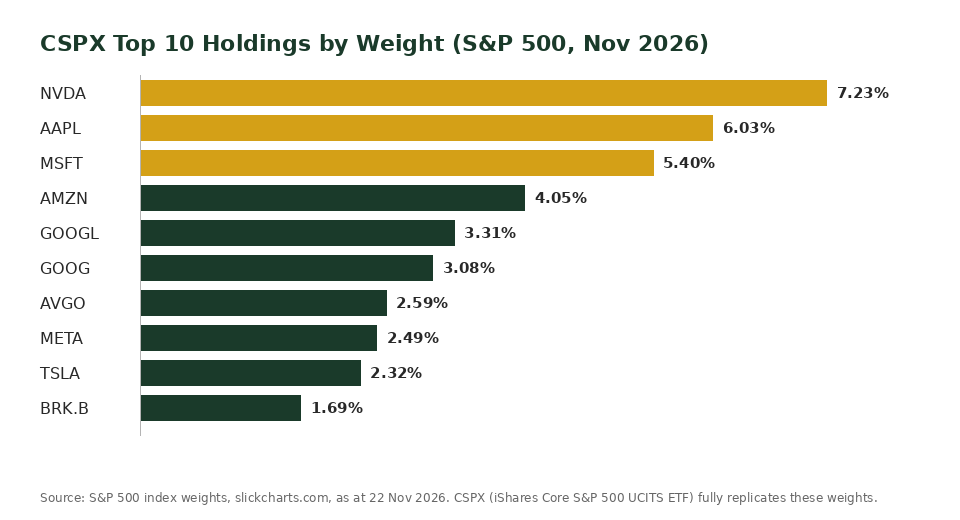
iShares doesn’t publish a simplified “top 10” list on its public factsheet page, but because CSPX fully replicates the S&P 500 Index, its holding weights track the benchmark almost exactly (quarterly rebalancing can cause small timing gaps of a few basis points). The table below shows the ten largest S&P 500 constituents by index weight, which is effectively what CSPX itself holds.
| Rank | Company | Ticker | Index Weight |
|---|---|---|---|
| 1 | Nvidia | NVDA | 7.23% |
| 2 | Apple | AAPL | 6.03% |
| 3 | Microsoft | MSFT | 5.40% |
| 4 | Amazon | AMZN | 4.05% |
| 5 | Alphabet (Class A) | GOOGL | 3.31% |
| 6 | Alphabet (Class C) | GOOG | 3.08% |
| 7 | Broadcom | AVGO | 2.59% |
| 8 | Meta Platforms | META | 2.49% |
| 9 | Tesla | TSLA | 2.32% |
| 10 | Berkshire Hathaway | BRK.B | 1.69% |
Source: S&P 500 index constituent weights, slickcharts.com, as at 22 November 2026. CSPX holds these same constituents at closely matching weights through full physical replication.
Together, these ten names make up about 38.2% of the index — and therefore about 38.2% of your CSPX holding. For a Singapore investor putting SGD 20,000 into CSPX, roughly SGD 7,640 of that is effectively riding on just ten US mega-caps, with Nvidia alone accounting for over SGD 1,400. That’s the trade-off of a market-cap-weighted index: you get the market’s winners automatically, but you also carry more concentration risk than the “500 stocks” headline suggests.
Sector Breakdown: Why Tech Dominates
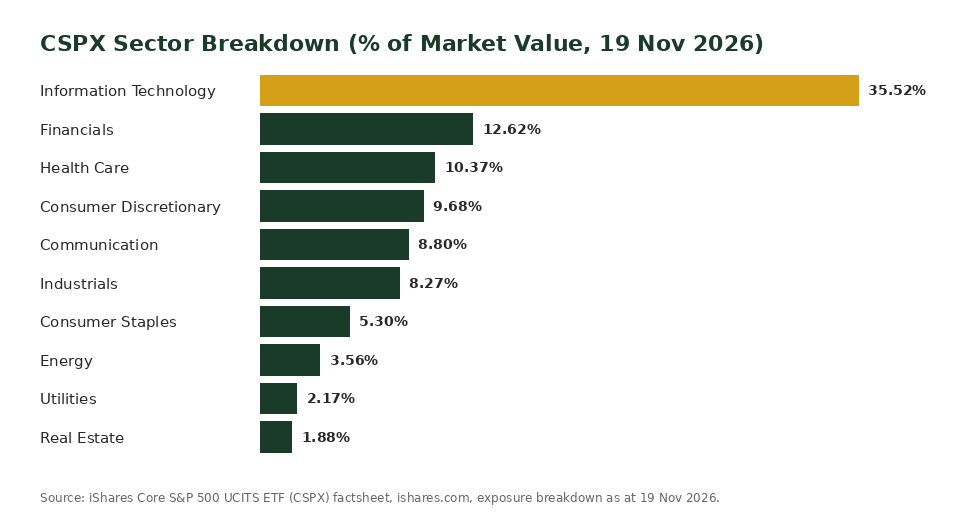
CSPX’s sector exposure mirrors the S&P 500’s own sector weights, and as at 19 November 2026 those weights are unusually concentrated: Information Technology alone is 35.52% of the fund, more than the next three sectors combined.
| Sector | % of CSPX |
|---|---|
| Information Technology | 35.52% |
| Financials | 12.62% |
| Health Care | 10.37% |
| Consumer Discretionary | 9.68% |
| Communication | 8.80% |
| Industrials | 8.27% |
| Consumer Staples | 5.30% |
| Energy | 3.56% |
| Utilities | 2.17% |
| Real Estate | 1.88% |
Source: iShares Core S&P 500 UCITS ETF factsheet, exposure breakdown as at 19 November 2026.
If you already hold a globally diversified fund such as VWRA — see our VWRA ETF Singapore guide — it’s worth knowing that VWRA’s own US allocation carries a very similar tech tilt, since the US (and the S&P 500 names within it) makes up the largest single-country slice of global market-cap indices too. Holding both CSPX and VWRA doesn’t meaningfully diversify you away from “Big Tech” risk; it mostly duplicates it.
Does CSPX Pay Dividends?
No. CSPX is the Accumulating share class of the fund — confirmed on the official factsheet as “Use of Income: Accumulating” — which means dividends paid by its 504 underlying holdings are collected by the fund and reinvested straight back into the portfolio rather than paid out to you in cash. You still benefit from those dividends; they simply show up as a higher net asset value (NAV) and share price over time, instead of a quarterly payout landing in your brokerage account.
This matters practically for two groups of Singapore investors. If you’re in the accumulation phase of building wealth, this is usually an advantage: reinvestment happens automatically and efficiently inside the fund, with no need to manually reinvest small dividend payments yourself, and no extra brokerage transaction each time. If you’re retired or semi-retired and want a visible cash income stream, CSPX on its own won’t give you one — you’d need to sell units periodically, or hold a separate distributing ETF or dividend-paying REIT ETF alongside it. iShares does offer a GBP Hedged (Distributing) share class of the same underlying fund for investors who specifically want cash payouts, but that’s a different share class from the standard CSPX/CSP1 tickers most Singapore brokers list.
For a worked comparison: on a SGD 50,000 CSPX position with a (hypothetical) 1.3% underlying dividend yield, that’s roughly SGD 650 a year that never leaves the fund and is never taxed as income in your hands — it simply compounds. Over a 20-year holding period, that automatic reinvestment is a meaningful part of total return, which is exactly why CSPX is usually recommended as a core growth holding rather than an income tool.
Quarterly Rebalancing: How CSPX Tracks the Index
CSPX rebalances quarterly, in line with the S&P 500 Index Committee’s own quarterly reconstitution schedule (effective after the close on the third Friday of March, June, September and December). When the committee adds or removes a company — for example when a smaller company outgrows a larger incumbent, or a company no longer meets index eligibility criteria — CSPX’s physical replication process buys or sells the actual underlying shares to match within days. You don’t need to do anything when this happens; it’s one of the main reasons investors pay a small TER rather than managing 500 individual stock positions themselves.
Who Should Buy CSPX?
CSPX tends to suit Singapore investors who want simple, low-cost, large-cap US equity exposure as the core of a long-term portfolio, are comfortable with meaningful concentration in US mega-cap technology, and are in the accumulation phase where automatic reinvestment (rather than cash income) is the priority. It’s commonly used inside a Supplementary Retirement Scheme (SRS) account for investors who qualify, though CSPX itself is not CPF-Ordinary-Account investable since it isn’t on the CPFIS-included list of SGX instruments.
Consider pairing it with, or choosing instead, a more globally diversified ETF if you’re uncomfortable with a 35%+ tech weighting, or a distributing ETF/REIT allocation if you need visible income now. If you’re deciding how much of your core portfolio should sit in S&P 500 exposure versus a broader world index, our Singapore retirement calculator can help you work out the growth versus income balance you’ll actually need at different life stages.
Where to Buy CSPX in Singapore
CSPX is LSE-listed, so Singapore investors buy it through a broker with UK/London Stock Exchange access rather than through SGX. The most commonly used routes are Interactive Brokers, moomoo, and Longbridge — and if you’d rather not pick individual LSE tickers yourself, a hands-off robo option like Endowus or Syfe can build a similar S&P 500 allocation for you inside a diversified portfolio. If you’re new to buying in small amounts, see our CSPX fractional shares guide for the minimum investment by broker, and our why Singapore investors buy ETFs on the LSE guide for the tax reasoning behind choosing CSPX over a US-listed equivalent.
Disclaimer: this article is for educational purposes only and is not financial advice. The Kopi Notes may earn a referral fee if you sign up through the links above, at no extra cost to you. Always do your own due diligence and consider speaking to a licensed financial adviser before investing.
Frequently Asked Questions
What are CSPX's top holdings?
CSPX’s largest holdings as at November 2026 are Nvidia (7.23%), Apple (6.03%), Microsoft (5.40%), Amazon (4.05%) and Alphabet’s two share classes (3.31% and 3.08% combined). Because CSPX fully replicates the S&P 500, its individual stock weights track the index almost exactly, with the top 10 holdings together making up around 38% of the fund.
Does CSPX pay a dividend to investors?
No. CSPX is an Accumulating share class, confirmed on the official iShares factsheet. Dividends paid by the underlying 504 stocks are automatically reinvested into the fund rather than distributed as cash, which shows up as a higher share price over time instead of a payout.
Is there a version of CSPX that does pay dividends?
Yes, if you can’t access CSPX’s exact share class. iShares also offers a GBP Hedged (Distributing) share class of the same underlying fund. Separately, Vanguard’s VUSA and several other S&P 500 UCITS ETFs are structured as Distributing, so if cash income is the priority you’d typically choose one of those rather than the standard CSPX/CSP1 tickers.
Is CSPX's dividend yield the same as the S&P 500's dividend yield?
Conceptually yes — the underlying stocks in CSPX generate roughly the same dividend yield as the S&P 500 Index itself (historically around 1.2–1.5% a year). The difference is that CSPX investors never see that yield as cash; it’s captured inside the fund’s NAV instead, which is why CSPX’s own “distribution yield” is reported as 0%.
How often does CSPX rebalance its holdings?
CSPX rebalances quarterly, in step with the S&P 500 Index Committee’s own quarterly reconstitution in March, June, September and December. When the index adds or drops a constituent, CSPX’s physical replication buys or sells the actual shares to match within a few trading days.
Is a 35% tech weighting in CSPX too risky?
It’s concentrated, but not uniquely risky for a market-cap-weighted index — this is simply how the S&P 500 itself is currently weighted. If you’re uncomfortable with a sector that concentrated, consider pairing CSPX with a more globally diversified fund, or a smaller equal-weight S&P 500 allocation, rather than avoiding US equities altogether.
Can I buy CSPX using my CPF or SRS funds in Singapore?
CSPX is LSE-listed and is not on the CPFIS-included investment list, so you cannot buy it with CPF Ordinary Account funds. It can typically be bought with Supplementary Retirement Scheme (SRS) funds if your SRS-linked broker offers LSE access — check with your specific broker, as not all SRS-approved platforms support London-listed ETFs.
Ready to Build Your Core S&P 500 Position?
Open a brokerage account and start buying CSPX today. Use our referral links for exclusive sign-up bonuses.
This article was researched with the help of AI. While we strive to keep all information accurate and up to date, there may be errors. If you notice any discrepancies, please contact us.