How to Buy Vanguard ETFs in Singapore (2026 Guide)
VWRA, VUAA and VHYL compared — which Vanguard fund fits your goal, verified 2026 fees, and the exact broker steps to buy each one.
Vanguard’s Singapore-relevant ETFs are not on SGX — they are Ireland-domiciled UCITS funds listed on the London Stock Exchange (LSE). The three that matter most are VWRA (global all-world equities), VUAA (S&P 500), and VHYL (high dividend yield). Singapore investors buy them through LSE-enabled brokers such as Interactive Brokers, Saxo, or moomoo, and benefit from a 15% US dividend withholding tax rate and zero US estate tax exposure.
Not financial advice. All figures are for educational reference only. Data verified as at 19 November 2026 against Vanguard’s own factsheets unless otherwise noted.
Table of Contents
Contents — Click to expand
- What Are Vanguard’s Singapore-Relevant ETFs?
- Key Facts at a Glance
- Why Singapore Investors Buy Vanguard ETFs on the LSE
- Which Vanguard ETF Should You Buy?
- How to Buy Vanguard ETFs in Singapore (Step-by-Step)
- Vanguard vs iShares: How the Alternatives Compare
- Who Should Buy Vanguard ETFs?
- Frequently Asked Questions
What Are Vanguard’s Singapore-Relevant ETFs?
Vanguard runs more than 100 UCITS ETFs out of its Irish-domiciled fund range, but almost none of them are listed on SGX. For a Singapore investor, “buying Vanguard” in practice means buying one of a small handful of LSE-listed funds through a brokerage account with overseas exchange access — the same way you would buy iShares’ CSPX or IWDA.
Three Vanguard funds come up repeatedly in Singapore investor searches and portfolios:
- VWRA — Vanguard FTSE All-World UCITS ETF (USD) Accumulating. A single fund covering developed and emerging market equities globally. Covered in depth in our VWRA ETF Singapore guide.
- VUAA (and its older distributing twin, VUSA) — Vanguard S&P 500 UCITS ETF, tracking the same index as iShares’ CSPX. We compare it against CSPX and SPYL in detail in our S&P 500 ETF guide.
- VHYL — Vanguard FTSE All-World High Dividend Yield UCITS ETF, a distributing fund for investors who want quarterly cash payouts rather than full reinvestment. We cover it alongside other income-focused LSE ETFs in our dividend investing ETF guide.
This guide is the decision layer that sits above all three: which one actually fits your goal, how the costs stack up side by side, and the exact broker steps to buy whichever one you pick.
Key Facts at a Glance
| Metric | VWRA | VUAA | VHYL |
|---|---|---|---|
| Full Name | FTSE All-World UCITS ETF (USD) Acc | S&P 500 UCITS ETF (USD) Acc | FTSE All-World High Dividend Yield UCITS ETF |
| Index Tracked | FTSE All-World | S&P 500 | FTSE All-World High Dividend Yield |
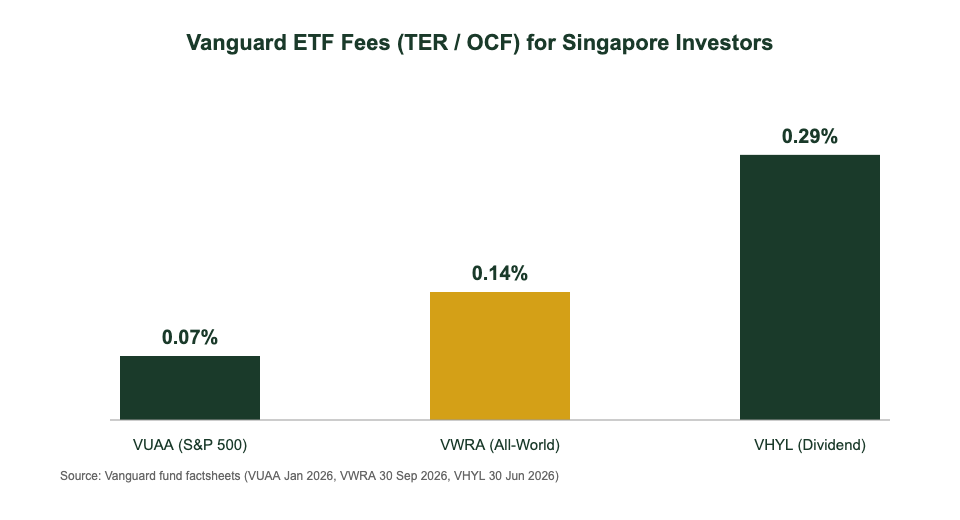
| TER / OCF | 0.14% p.a. | 0.07% p.a. | 0.29% p.a. |
| Structure | Accumulating | Accumulating (VUSA = Distributing) | Distributing (quarterly) |
| Holdings | ~3,821 | ~500 | ~1,900 |
| Domicile / Exchange | Ireland / LSE | Ireland / LSE | Ireland / LSE |
| Currency | USD | USD | USD |
Source: Vanguard fund factsheets — VWRA (30 September 2026), VUAA (31 January 2026), VHYL (30 June 2026).
Why Singapore Investors Buy Vanguard ETFs on the LSE
Vanguard’s US-listed equivalents — VT (world) and VOO (S&P 500) — trade on NYSE Arca and are usually cheaper to run on paper. For a Singapore resident, though, the LSE-listed, Ireland-domiciled versions tend to win on an after-tax basis. Two rules drive this: US dividend withholding tax (WHT) and US federal estate tax.
Under the US-Ireland tax treaty, dividends earned by an Ireland-domiciled fund on its US holdings are taxed at a 15% withholding rate before they reach the fund. A US-domiciled ETF held directly by a non-resident alien is taxed at the default 30% rate instead. Separately, non-resident aliens holding US-situs assets (which includes US-listed ETFs) above USD 60,000 at death are exposed to US federal estate tax of up to 40% on the excess — a risk that simply does not apply to an Irish-domiciled fund, regardless of position size.
| ETF Type | Domicile | US Dividend WHT | US Estate Tax Risk |
|---|---|---|---|
| Vanguard VWRA / VUAA / VHYL (LSE) | Ireland | 15% | None |
| Vanguard VT / VOO / VYM (US-listed) | USA | 30% | Yes (above USD 60k) |
Singapore itself adds no extra layer on top: there is no capital gains tax and no tax on ETF distributions received by individual investors here. For a longer walkthrough of the mechanics, see our guide to why Singapore investors buy ETFs on the London Stock Exchange.
Which Vanguard ETF Should You Buy?
The three funds solve different problems, and picking the wrong one for your goal matters more than shaving a few basis points off the fee.
VWRA is the one-fund answer if you want global diversification — developed and emerging markets, large and mid-cap, in a single accumulating ticker — and you don’t need the fund to pay you cash. It is also, at 0.14% since Vanguard’s July 2026 fee cut, now the cheaper choice compared with iShares’ developed-only IWDA (0.20%), despite covering a far broader universe.
VUAA (or its distributing twin VUSA) is the pick if you specifically want concentrated exposure to the US market at the lowest possible running cost. At 0.07%, it is priced identically to iShares CSPX, which tracks the same S&P 500 index — the two are functional substitutes, and the choice between them usually comes down to broker fractional-share support and personal preference, not cost.
VHYL is for investors who want the fund itself to generate spendable cash — it pays quarterly distributions from a basket of roughly 1,900 higher-yielding global stocks, with a trailing yield of about 2.51% as at 31 October 2026. It costs more to run (0.29%) because dividend-screening and distribution administration add overhead that an accumulating index fund doesn’t carry.
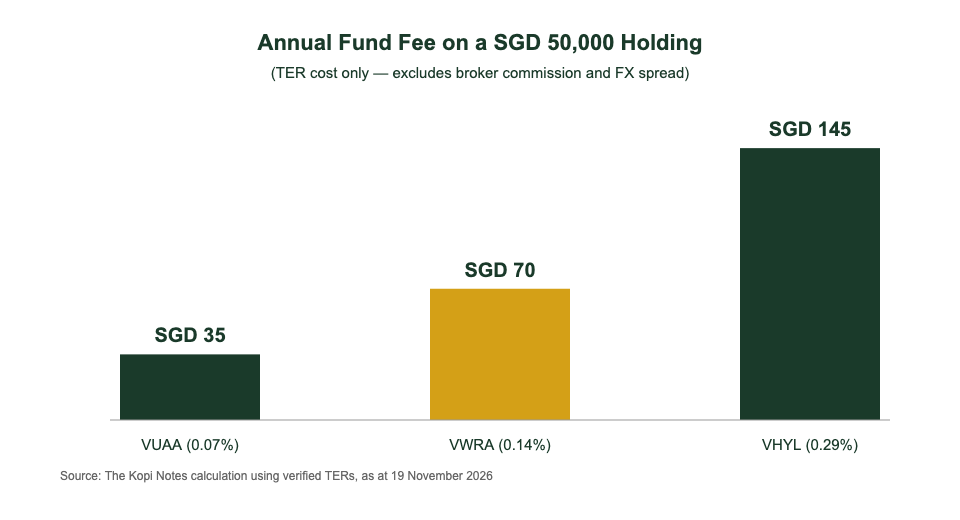
Here is what that fee difference actually costs on a SGD 50,000 position, using each fund’s verified TER and ignoring FX and brokerage costs:
| Fund | TER | Annual Fee on SGD 50,000 |
|---|---|---|
| VUAA | 0.07% | SGD 35 |
| VWRA | 0.14% | SGD 70 |
| VHYL | 0.29% | SGD 145 |
Source: The Kopi Notes calculation from verified TERs above, as at 19 November 2026.
The spread between the cheapest and most expensive fund is SGD 110 a year on a SGD 50,000 position — real money, but small next to the 15-percentage-point withholding tax gap versus a US-listed alternative, which is why the domicile decision matters more than the fund-to-fund fee difference.
How to Buy Vanguard ETFs in Singapore (Step-by-Step)
Whichever fund you choose, the mechanics are the same: fund a brokerage account that has LSE access, search for the ticker (VWRA, VUAA, VUSA, or VHYL), confirm you’re on the London Stock Exchange listing (not a US or European twin with a similar name), and place the order in USD.
Interactive Brokers (IBKR)
Open and fund an IBKR account, then search the ticker in the order entry screen and filter for the LSE exchange listing. IBKR is generally the most cost-effective option for larger, less frequent purchases thanks to its low per-trade commission and tight FX spreads. See our IBKR referral code page for current sign-up terms.
Saxo Markets
Saxo offers a similarly broad LSE universe with a cleaner mobile app, at a slightly higher commission tier than IBKR for most account sizes — a reasonable trade-off if you want simpler order entry.
moomoo Singapore
moomoo has added LSE-listed ETF access alongside its US and SGX offering, with periodic zero-commission promotions. Check current eligibility and fees on our moomoo referral code page before funding.
Longbridge Singapore
Longbridge also supports LSE trading and has run some of the more generous sign-up promotions in the broker space recently. See our Longbridge referral code page for the current offer.
Hands-off alternative: Syfe
If you’d rather not manage individual LSE tickers yourself, Syfe’s managed portfolios hold globally diversified, Ireland-domiciled ETFs (including exposure similar to VWRA) inside a single account, rebalanced for you. Check current terms on our Syfe referral code page.
For every broker, double-check three things before you place an order: the ticker is listed on the LSE (not a GBP-denominated twin or a US share class with a similar name), the order is priced in USD, and your account has the overseas-exchange permission switched on — this is usually a one-time account setting, not something enabled by default.
Vanguard vs iShares: How the Alternatives Compare
For every Vanguard fund covered here, iShares runs a near-equivalent. The honest comparison is less about which provider is “better” and more about whether the fee gap, if any, is large enough to matter.
| Fund | TER | Index | Structure | Best For |
|---|---|---|---|---|
| VWRA | 0.14% | FTSE All-World | Acc | One-fund global portfolio incl. emerging markets |
| IWDA | 0.20% | MSCI World (developed only) | Acc | Developed-market-only exposure |
| SWRD | 0.12% | MSCI World (developed only) | Acc | Cheapest developed-world tracker |
| VUAA | 0.07% | S&P 500 | Acc | Low-cost concentrated US exposure |
| CSPX | 0.07% | S&P 500 | Acc | Same cost and index as VUAA |
Source: Vanguard and iShares fund factsheets, as at the dates cited in this article’s expense ratio table and our VWRA expense ratio cut coverage.
Two things fall out of this table. VWRA now undercuts IWDA on cost despite being the broader fund, which removes the fee argument that used to favour IWDA outright. And VUAA vs CSPX is, for cost purposes, a coin flip — the S&P 500 decision should be made on broker support and personal preference, not a fee you can’t meaningfully arbitrage between two 0.07% funds.
Who Should Buy Vanguard ETFs?
Vanguard’s LSE range suits investors who want a globally diversified, low-cost, accumulating core holding (VWRA), a cheap concentrated US bet (VUAA/VUSA), or a dedicated income sleeve that pays cash quarterly (VHYL) — and who are comfortable opening an overseas-exchange brokerage account to get there, since none of these tickers sit on SGX.
One practical limitation to flag upfront: these LSE-listed funds are not approved under the CPF Investment Scheme (CPFIS), so CPF Ordinary Account funds cannot be used to buy them directly. They also sit outside the typical SRS-approved fund list offered by most banks, so in practice most investors fund these purchases from cash savings through a standard cash or margin brokerage account rather than CPF or SRS. If you specifically want to deploy CPF or SRS money into ETFs, that generally means looking at SGX-listed or CPFIS-approved alternatives instead — see our CPF investment strategy guide for that angle, and our retirement calculator to model how a Vanguard core holding fits into a longer-term plan funded with cash.
Frequently Asked Questions
What is the difference between VWRA, VUAA, and VHYL?
VWRA tracks the FTSE All-World index, covering developed and emerging market equities globally, at a 0.14% expense ratio. VUAA tracks the S&P 500 (US-only) at 0.07%. VHYL tracks the FTSE All-World High Dividend Yield index and pays quarterly cash distributions, at 0.29%. All three are Ireland-domiciled, London Stock Exchange-listed, and priced in USD.
Is VUAA the same as VUSA?
VUAA and VUSA both track the Vanguard S&P 500 UCITS ETF at the same 0.07% expense ratio. The difference is the share class: VUAA is the accumulating version, which automatically reinvests dividends inside the fund, while VUSA is the older distributing version, which pays dividends out to you in cash. Choose VUAA if you want full reinvestment and VUSA if you want cash income from this fund specifically.
Can I buy Vanguard ETFs using my CPF or SRS funds in Singapore?
Generally no. VWRA, VUAA, VUSA, and VHYL are LSE-listed funds that are not on the CPF Investment Scheme’s approved list, so CPF Ordinary Account savings cannot be used to buy them directly. They also fall outside most banks’ SRS-approved fund menus, so the typical route is funding purchases with cash through a standard brokerage account rather than CPF or SRS.
Which broker is best for buying Vanguard ETFs in Singapore?
Interactive Brokers tends to work out cheapest for larger, less frequent purchases due to low commissions and tight FX spreads. Saxo offers a similar fund range with a simpler interface at a slightly higher cost tier. moomoo and Longbridge have both added LSE access and periodically run promotional sign-up offers worth checking before you fund an account. There is no single “best” broker for every portfolio size — compare current commission schedules before committing.
Is VWRA better than VUAA for a Singapore investor?
It depends on what you’re trying to achieve, not which fund is objectively “better.” VWRA gives you one fund covering the entire global equity market, including emerging markets, which suits investors who want a single core holding. VUAA gives you concentrated, lower-cost exposure to the US market alone, which suits investors who specifically want US-heavy exposure or who are combining it with other regional funds themselves.
What are the risks of buying Vanguard ETFs on the LSE?
The main practical risks are currency exposure (the funds are priced in USD, so SGD-to-USD conversion costs and currency movements affect your returns), broker and overseas-settlement risk, and the general market risk of the underlying equities themselves. There is no capital protection and all three funds can fall in value. None of these are unique to Vanguard — the same considerations apply to any LSE-listed, Ireland-domiciled ETF, including iShares’ CSPX and IWDA.
Ready to Start Investing in Vanguard ETFs?
Open a brokerage account with LSE access and buy VWRA, VUAA, or VHYL today. Use our referral links for exclusive sign-up bonuses.
This article was researched with the help of AI. While we strive to keep all information accurate and up to date, there may be errors. If you notice any discrepancies, please contact us.