Endowment Plan Tax Treatment Singapore 2026: Are Payouts Taxable?
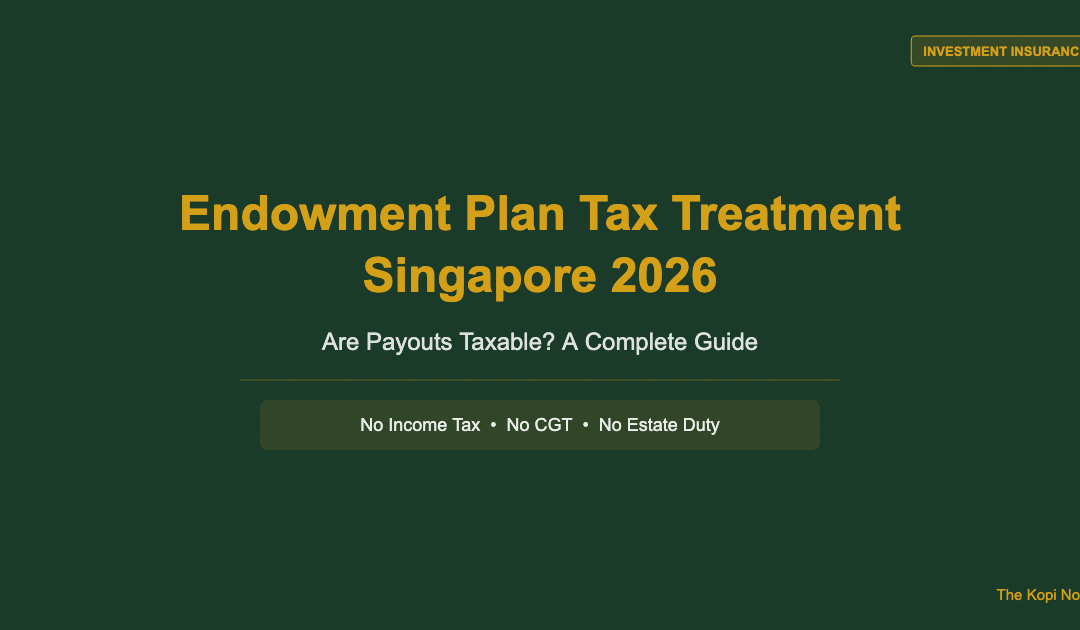
Endowment plan payouts in Singapore are not subject to income tax. Under IRAS rules, maturity proceeds, surrender values, and bonuses from participating endowment policies are capital receipts — not assessable income — so policyholders receive 100% of their payout with no tax deducted. Singapore also abolished estate duty on 15 February 2008, meaning endowment proceeds pass to beneficiaries entirely intact. This guide explains exactly how the tax treatment works in 2026, the SRS top-up strategy for an extra deduction, and how nomination affects your estate plan.
Not financial advice. All figures are for educational reference only. Data as at November 2026 unless noted.
Are Endowment Plan Payouts Taxable in Singapore?
No. IRAS does not classify endowment plan payouts as income. Here is the definitive breakdown of which amounts are tax-free:
| Payment Type | Taxable? | Reason |
|---|---|---|
| Maturity sum (guaranteed capital) | No | Return of capital, not income |
| Guaranteed reversionary bonuses | No | Part of guaranteed benefit, capital receipt |
| Non-guaranteed terminal bonus | No | Capital gain from participating fund — no CGT in Singapore |
| Surrender value (early exit) | No | Capital receipt even if less than premiums paid |
| Death benefit paid to nominee | No | Proceeds of life insurance, explicitly excluded from estate duty (abolished 2008) |
Source: IRAS e-Tax Guide on Life Insurance; Insurance Act (Cap. 142). Verified November 2026.
This treatment applies to participating (par) endowment policies — the type sold by Great Eastern, AIA, Prudential, Manulife, and similar insurers. Participating policies invest your premiums in the insurer’s participating fund, and the returns (including bonuses) flow back to you tax-free on maturity.
What about investment-linked policies (ILPs)? ILPs are different — they invest in unit trusts. Even so, gains from ILP sub-funds are also not taxable in Singapore, because Singapore has no capital gains tax. The underlying fund manager may pay withholding tax on overseas dividends (which reduces the fund’s NAV), but you as the policyholder pay no personal tax on the eventual payout.
Can IRAS change this?
IRAS has consistently maintained this position for decades. Singapore’s tax system taxes income, not capital. Because endowment plan proceeds are classified as a return of savings plus capital appreciation, they fall outside the income tax net. There is no announced plan to change this, and doing so would require an Act of Parliament to introduce a capital gains tax.
Tax Comparison: Endowment vs CPF, SSB, FD, S-REITs (2026)
To put endowment plan tax treatment in context, here is how it compares with the other savings and investment vehicles Singapore investors typically use:
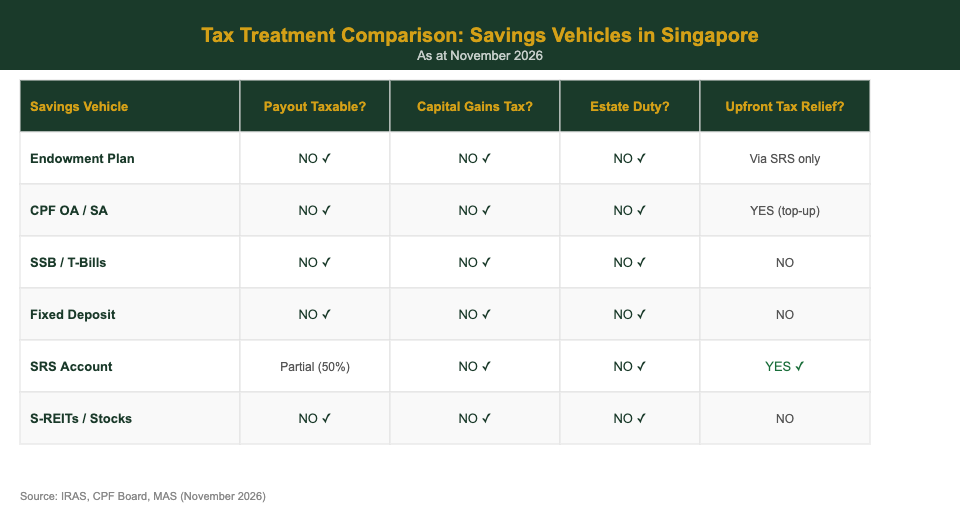
Source: IRAS, CPF Board, MAS (November 2026). “Upfront tax relief” means contributions reduce assessable income in year of contribution.
The chart above shows that endowment plans occupy a unique position: no tax on payouts, no capital gains tax, and no estate duty. The only downside versus CPF is that endowment plans offer no upfront tax relief on premiums (unless purchased through SRS, covered in the next section).
S-REITs, by comparison, pay distributions that are taxable as income for individual investors receiving them directly (the REIT itself pays no tax at the fund level under the tax transparency regime, but the investor receiving distributions typically pays personal income tax on the gross distribution unless exempted). Endowment plans have no such ongoing tax drag.
Capital Gains Tax and Estate Duty: What Investors Need to Know
No Capital Gains Tax in Singapore
Singapore does not have a capital gains tax. This applies broadly — not just to endowment plans but to all asset classes including stocks, REITs, property (with some nuance for professional dealers), and unit trusts. For endowment plans, this means the non-guaranteed terminal bonus — which can represent a significant portion of a plan’s total return — is completely tax-free.
As an illustration: if you invested S$100,000 in premiums over 15 years and received S$160,000 at maturity (a S$60,000 gain), you owe zero tax. The same S$60,000 gain from selling a property you bought and sold professionally could be assessable as trading income, but endowment plan gains never fall into this category because they are structured as insurance products.
Estate Duty Abolished Since 15 February 2008
Singapore abolished estate duty on 15 February 2008 for all deaths on or after that date. This was confirmed by the IRAS estate duty page, which states: “Estate duty was abolished with effect from 15 February 2008.” Before that date, life insurance payouts exceeding S$600,000 were subject to estate duty; this exemption limit is now irrelevant because there is no duty at all.
Practical implication: when you name a nominee on your endowment policy, the full maturity or death benefit passes to them free of any inheritance or estate tax. This makes endowment plans particularly attractive for estate planning — especially under a Section 73 trust nomination, which also bypasses probate entirely (see the nomination section below).
| Tax Type | Status in Singapore (2026) | Impact on Endowment Plans |
|---|---|---|
| Income tax on payouts | Not applicable — payouts are capital | 100% of maturity sum retained |
| Capital gains tax | Does not exist in Singapore | Bonuses and gains untaxed |
| Estate duty | Abolished 15 Feb 2008 | Full benefit passes to nominees |
| Stamp duty | Not applicable to insurance premiums | No impact |
| GST on premiums | Life insurance premiums are GST-exempt | No GST on premiums paid |
Source: IRAS, MAS Insurance Act. Verified November 2026.
SRS + Endowment Plan: Double Tax Benefit in 2026
While endowment plan premiums are not deductible from your income tax in themselves, there is a legal strategy to unlock a substantial upfront tax deduction: pay your endowment plan premiums using your Supplementary Retirement Scheme (SRS) account.
Here is how the double benefit works:
- Contribute to SRS — your contribution is deducted from your assessable income in that year of assessment, saving tax at your marginal rate.
- Buy an endowment plan inside SRS — your insurer holds the policy under your SRS account. The premiums come out of your SRS balance.
- At maturity (or SRS withdrawal age) — proceeds credited back to your SRS account, then withdrawn at a 50% concession rate, spreading the tax impact significantly.
The 2026 SRS contribution limits are: S$15,300 for Singapore Citizens and Permanent Residents, and S$35,700 for foreigners. You can find your personalised SRS withdrawal options using the Singapore retirement calculator.
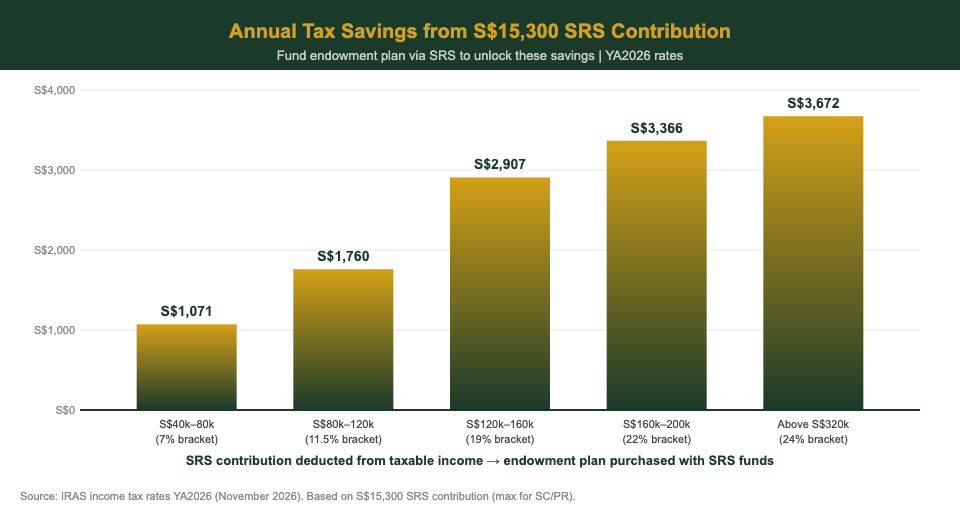
Source: IRAS income tax rates YA2026. Based on S$15,300 SRS contribution (maximum for Singapore Citizens/PRs).
As the chart shows, the annual tax savings from a maximum SRS contribution range from S$1,071 (7% bracket, income S$40k–80k) to S$3,672 (24% bracket, income above S$320k). Over a 10-year endowment plan, a taxpayer in the 19% bracket saves approximately S$29,070 in cumulative tax just from the SRS deductions — before counting the endowment plan’s tax-free returns.
SRS withdrawal tax concession: When you withdraw from SRS on or after the statutory retirement age (currently 63 for those born 1962 onwards), only 50% of each withdrawal is assessable. This means a S$160,000 maturity payout credited to SRS and withdrawn in year 1 is assessed on only S$80,000. If you spread the withdrawal over 10 years at S$16,000 per year, only S$8,000 per year is assessable — which may fall below the income tax threshold entirely.
Platforms like Endowus (referral code: 2V343) offer curated endowment plan access through their SRS investment platform, making it straightforward to link your SRS account to a suitable participating plan.
Policy Nomination and Estate Planning
Nomination is closely linked to the tax treatment question: since there is no estate duty in Singapore, the main estate planning consideration for endowment plans is speed and certainty of distribution, not tax minimisation. There are two nomination regimes under the Insurance Act:
Section 49M — Revocable Nomination
Under S.49M, you name beneficiaries who will receive the proceeds, but the payout forms part of your estate at death. This means it goes through the probate process, which can take 6–18 months. The nominee receives the money eventually, but only after the estate is administered and any debts or liabilities are settled. You can change or revoke the nomination at any time.
Section 73 — Irrevocable Trust Nomination
Under S.73, the policy is held on trust for your nominees from the moment of nomination. At death, the proceeds bypass your estate entirely — they go directly to the nominees without probate. This protects the payout from creditors and from delays in estate administration. The trade-off: you generally cannot change the nomination without the nominees’ consent (for adult nominees) once it is made. For couples using endowment plans for joint financial planning, S.73 nominations for the surviving spouse are very common.
From a tax perspective, both nomination types have identical treatment in 2026 — no estate duty under either. The choice is purely about speed, flexibility, and probate bypass. If you are unsure which to use, your financial adviser or the insurer’s nomination guide will walk you through the options. See our detailed guide on endowment plan nomination in Singapore for a full comparison.
Connecting your overall CPF investment strategy with your endowment plan nomination ensures your retirement assets are distributed efficiently, without tax surprises, to the right people at the right time.
Common Mistakes Singapore Investors Make About Endowment Plan Tax
Despite the clear rules, several misunderstandings persist. Here are the most common errors — and the corrections:
Mistake 1: Assuming payouts are taxable like dividends. Singapore dividend tax has evolved — dividends from Singapore companies under the one-tier system are tax-exempt in investors’ hands. Endowment plan payouts are categorically different from dividends and have always been tax-free as capital receipts. No declaration is required on your income tax return for endowment proceeds received.
Mistake 2: Thinking estate duty still applies. Estate duty was abolished on 15 February 2008. Some older financial planning articles from before 2008 (and even some written after) still mention the S$600,000 insurance exemption limit. This is obsolete. There is no estate duty threshold to plan around — the full payout passes to nominees untaxed.
Mistake 3: Confusing ILP unit trust gains with taxable income. Even for investment-linked policies with sub-fund allocations, your proceeds on maturity or surrender are not assessable. Singapore has no capital gains tax. The sub-fund pays withholding tax on overseas dividends (reducing NAV), but you, the policyholder, face no personal tax liability on the eventual payout.
Mistake 4: Not using SRS to buy endowment plans. Many Singaporeans contribute to SRS but leave the money in cash, earning 0.05% per annum. Purchasing an endowment plan inside SRS unlocks the upfront tax deduction and locks in a projected return (participating fund policy projections are illustrated at 4.25% and 3% under MAS guidelines). This is one of the most underused personal finance strategies in Singapore.
Mistake 5: Not making a nomination. Without a nomination, your endowment proceeds go into your estate at death, subject to probate. A simple S.49M or S.73 nomination takes 15 minutes to complete with your insurer and can save your family months of delay.
Frequently Asked Questions
Are endowment plan payouts taxable in Singapore?
Is there estate duty on endowment plan proceeds in Singapore?
Can I buy an endowment plan using SRS funds?
What is the SRS withdrawal tax concession at age 63?
What is the difference between S.49M and S.73 nomination for endowment plans?
Are reversionary and terminal bonuses from endowment plans taxable?
What happens to my endowment plan payout if I die before maturity?
Ready to Maximise Your Endowment Plan Tax Benefits?
The most effective next step is to link your SRS account to a suitable participating endowment plan — giving you an upfront tax deduction now and a tax-free lump sum at maturity. Use the tools and referral links below to get started:
- Endowus (SRS endowment plans): Endowus referral code 2V343 — access endowment plans via SRS on a fee-only platform
- Retirement planning: Singapore retirement calculator — project your SRS withdrawal schedule and tax impact
- CPF integration: Read our CPF investment strategy guide to coordinate CPF OA and SRS for maximum retirement efficiency
- Nomination: Read the full endowment plan nomination guide — S.49M vs S.73 explained
Get Free Insurance Advice
Speak with a licensed insurance advisor. No obligation, no cost.
By submitting this form, you agree to our Privacy Policy.
This article was researched with the help of AI. While we strive to keep all information accurate and up to date, there may be errors. If you notice any discrepancies, please contact us.