Sasseur REIT Complete Investor Guide 2026: EMA Model, ~9% Yield & China Outlet Portfolio (SGX: CRPU)
A complete Singapore investor’s guide to Sasseur REIT — understanding the unique EMA model, outlet mall portfolio, DPU history, yield analysis, and key risks.
Sasseur REIT (SGX: CRPU) is Singapore’s first outlet mall real estate investment trust, listed on the SGX in March 2018. It owns four premium outlet malls in China — in Chongqing (two malls), Hefei, and Kunming. Unlike traditional REITs that earn direct rental income, Sasseur REIT collects payments under a unique Entrusted Management Agreement (EMA) with its sponsor, offering Singapore income investors a distinctive yield of approximately 9% as at November 2026.
Not financial advice. All figures are for educational reference only. Data as at November 2026 unless noted.
What Is Sasseur REIT?
Sasseur REIT (SGX stock code: CRPU) is the first outlet mall REIT to be listed in Singapore and Asia. It was established in 2018 by Sasseur Group, one of China’s leading outlet mall operators with more than two decades of experience in the retail real estate sector.
The REIT holds a portfolio of four premium factory outlet malls across China — a property type that has shown resilience even as traditional shopping malls face headwinds from e-commerce. Outlet malls sell branded goods at discounts of 30–70% off retail prices, attracting both domestic Chinese shoppers and tourists looking for value deals. This experiential retail format has demonstrated consistent foot traffic and sales growth in China’s major cities.
What makes Sasseur REIT structurally different from most S-REITs is its income model. Rather than directly owning and leasing space to tenants, the REIT’s malls are entrusted to Sasseur Group for management under a structure called the Entrusted Management Agreement (EMA). The EMA defines exactly how income flows from the malls to unitholders — a mechanism we explain in detail in the EMA section below.
As of November 2026, Sasseur REIT trades at approximately S$0.61 per unit, offering an indicative trailing distribution yield of around 9.1% based on the last four quarters of DPU. The REIT has approximately 975 million units in issue, giving it a market capitalisation of roughly S$595 million. It is part of the broader universe of best S-REITs in Singapore 2026 tracked by income investors for high-yield exposure.
Key Facts at a Glance
| Metric | Detail |
|---|---|
| Full Name | Sasseur Real Estate Investment Trust |
| SGX Ticker | CRPU |
| Listing Date | 28 March 2018 |
| Asset Type | Outlet Malls (China) |
| Number of Properties | 4 outlet malls |
| Locations | Chongqing (2), Hefei, Kunming |
| Income Model | Entrusted Management Agreement (EMA) |
| DPU (FY2025, trailing) | Approx. 5.57 SGD cents p.a. |
| Indicative Yield | ~9.1% (as at Nov 2026) |
| Gearing Ratio | ~26% (well below 50% MAS limit) |
| Approx. NAV per Unit | ~S$0.76 (trading at ~20% discount) |
| Market Cap | ~S$595 million |
| Sponsor | Sasseur Group (Chongqing-headquartered) |
Source: SGX disclosures, Sasseur REIT investor presentations. Data as at November 2026. Figures are indicative.
The EMA Model Explained
The Entrusted Management Agreement (EMA) is the defining structural feature of Sasseur REIT, and understanding it is essential for any Singapore investor considering CRPU. It fundamentally changes how income flows to unitholders compared with a standard S-REIT.
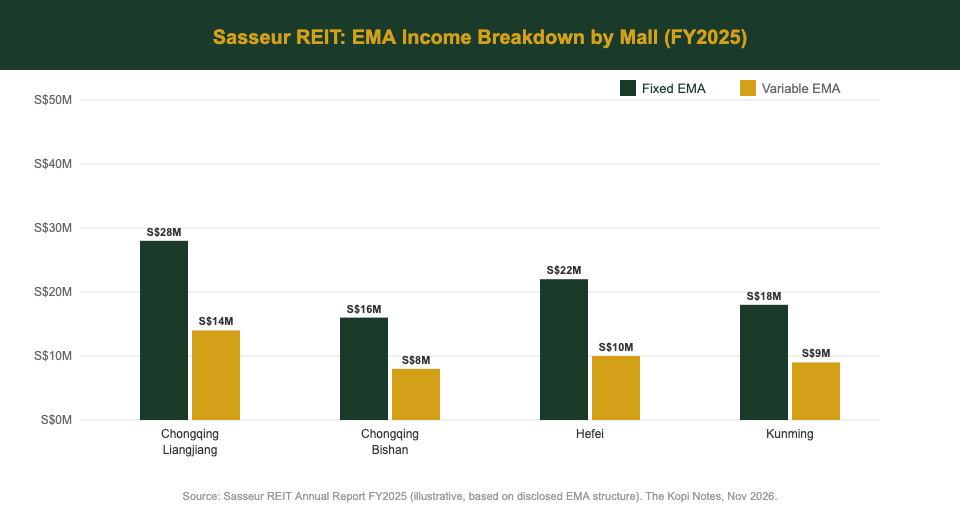
How it works: Under the EMA, Sasseur Group acts as the Entrusted Manager for each of the REIT’s four outlet malls. Rather than the REIT directly collecting rents from individual tenants and paying operating costs, Sasseur Group runs the malls end-to-end and pays the REIT a predetermined EMA income. This income has two components:
- Fixed component: A base payment to the REIT that is calculated as a fixed percentage of each mall’s total outlet sales. This provides a floor income regardless of market conditions, as long as the malls remain open and operational.
- Variable component: An additional percentage of outlet sales on top of the fixed component, calculated at a higher rate. This element links the REIT’s income to the actual sales performance of the malls — if sales grow, the variable component grows too.
In practice, the EMA means that Sasseur REIT’s income is directly tied to outlet sales performance, not rental rates or occupancy percentages. This is both a differentiator and a source of risk — if consumer spending in China slows, outlet sales decline, and EMA income falls accordingly.
EMA vs traditional rental income: A conventional S-REIT collects rents under lease agreements, usually multi-year contracts with predetermined escalation clauses. Sasseur REIT’s income is more variable quarter-to-quarter because it moves with consumer spending. However, the fixed component of the EMA provides some downside protection. For FY2025, the fixed component represented approximately 65–70% of total EMA income, with the variable component making up the remainder.
Practical implication for investors: A Singapore investor in Sasseur REIT is effectively taking exposure to Chinese consumer spending via an outlet mall operator, with Sasseur Group acting as a buffer between the REIT and individual tenants. This structure reduces tenant default risk (the REIT has one counterparty — Sasseur Group — not dozens of individual retailers) but concentrates sponsor risk. If Sasseur Group itself encounters financial difficulty, all four malls are affected simultaneously.
The 4 Outlet Malls in China
All four of Sasseur REIT’s properties are premium factory outlet malls positioned in Chinese cities with large middle-class and upper-middle-class populations. Outlet malls in China serve a growing consumer segment that wants branded goods — from international luxury and sportswear brands — at meaningful discounts.
| Mall | Location | Opening Year | GFA (sq m) | Key Characteristic |
|---|---|---|---|---|
| Chongqing Liangjiang | Chongqing | 2008 | ~105,000 | Flagship, highest sales contribution |
| Chongqing Bishan | Chongqing | 2015 | ~65,000 | Suburban catchment, growing |
| Hefei | Anhui Province | 2017 | ~90,000 | Strong luxury brands mix |
| Kunming | Yunnan Province | 2019 | ~75,000 | Tourist destination, international visitors |
Source: Sasseur REIT investor presentations, SGX disclosures. GFA figures approximate.
Chongqing Liangjiang remains the REIT’s crown jewel — it is one of the top-performing outlet malls in southwest China by gross sales and benefits from Chongqing’s status as the largest municipality in China by population. The Hefei mall has shown consistent growth driven by Anhui Province’s expanding middle class. Kunming benefits from its position as a gateway city for international tourists from Southeast Asia.
DPU History & Yield Analysis
Sasseur REIT’s DPU track record reflects the volatility inherent in its China consumer spending exposure. The COVID-19 period from 2020 to 2022 significantly impacted outlet mall sales in China due to lockdowns, dragging DPU to multi-year lows. The post-COVID recovery has been meaningful, with DPU recovering as Chinese outlet sales rebounded from 2023 onwards.
For FY2025 (the full year ending 31 December 2025), Sasseur REIT paid a total DPU of approximately 5.57 SGD cents. At a share price of S$0.61 as at November 2026, this represents a trailing yield of approximately 9.1% — one of the highest in the Singapore-listed REIT universe.
It is important to note that Sasseur REIT distributions are paid in Singapore dollars, even though the underlying income is generated in Chinese Renminbi (RMB). The REIT employs natural hedging and cross-currency arrangements to convert RMB income to SGD for distribution. This means unitholders are exposed to RMB/SGD foreign exchange movements, though the REIT partially mitigates this through its hedging policy. For a Singapore investor, monitoring the RMB exchange rate trend is a relevant factor when projecting forward DPU.
As a reference point for passive income Singapore investors: a SGD 50,000 investment in Sasseur REIT at current prices would generate approximately SGD 4,550 per year in distributions based on the trailing yield, or roughly SGD 379 per month. This compares favourably with Singapore T-bills and high-interest savings accounts. For more context on how Singapore T-bills 2026 compare as an alternative income investment, see our dedicated guide.
Sasseur REIT vs S-REIT Peers
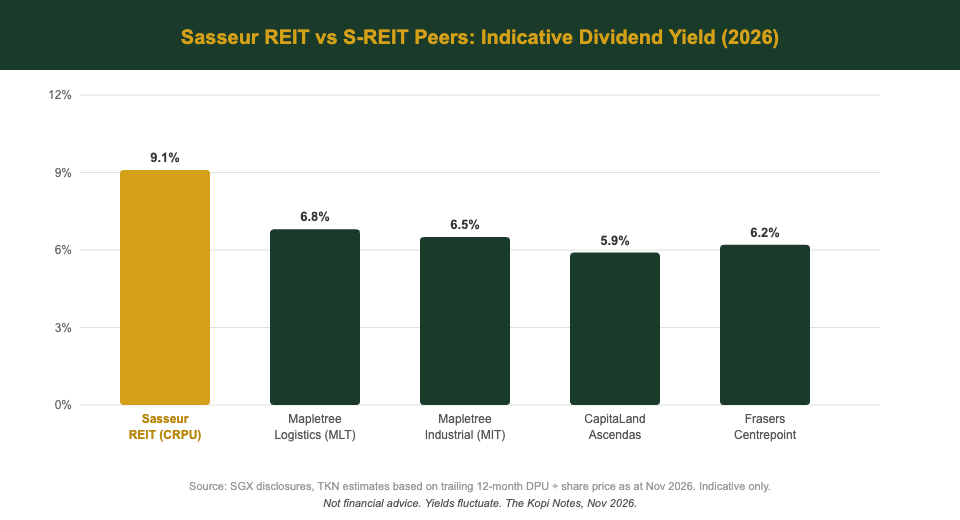
Sasseur REIT occupies a unique niche in the Singapore REIT market. Its closest peers in terms of geography (China-focused REITs) and yield profile differ significantly in asset type. The table below compares Sasseur REIT with selected S-REITs to put its yield, risk profile, and structure in context.
| REIT | SGX Code | Asset Type | Approx. Yield | Gearing | Key Risk |
|---|---|---|---|---|---|
| Sasseur REIT | CRPU | Outlet Malls (China) | ~9.1% | ~26% | China consumer / FX |
| Mapletree Logistics Trust | M44U | Logistics (Pan-Asia) | ~6.8% | ~38% | China trade / AUD/JPY FX |
| Mapletree Industrial Trust | ME8U | Industrial / Data Centres | ~6.5% | ~37% | US data centre rates |
| CapitaLand Ascendas REIT | A17U | Industrial (Multi-market) | ~5.9% | ~35% | Multi-country ops costs |
| Frasers Centrepoint Trust | J69U | Suburban Retail (SG) | ~6.2% | ~38% | Singapore consumer |
Source: SGX disclosures, TKN estimates based on trailing 12-month DPU ÷ share price as at November 2026. Indicative only. Not financial advice.
The key takeaway from this comparison: Sasseur REIT offers a materially higher yield than its S-REIT peers, but this comes with commensurately higher risk — specifically, single-country concentration in China, RMB/SGD currency exposure, and sponsor concentration risk through the EMA structure. The REIT’s low gearing ratio (~26%) is a genuine positive that provides balance sheet buffer, but it does not offset the geopolitical and macro risks of pure-China retail exposure.
Key Risks to Consider
Sasseur REIT’s high yield reflects genuine risks that any Singapore investor must weigh carefully before allocating capital. The main risk factors are:
1. China consumer spending risk: All four malls are in mainland China. EMA income is directly tied to outlet sales, meaning any broad slowdown in Chinese consumer spending — whether from economic headwinds, unemployment, or reduced household confidence — will reduce the REIT’s distributable income. Outlet malls are considered more resilient than traditional malls (consumers trade down to value-for-money options in downturns), but they are not immune.
2. RMB/SGD foreign exchange risk: The REIT earns income in Renminbi but pays DPU in Singapore dollars. A weakening RMB reduces the SGD value of the same level of outlet sales. As of November 2026, the RMB/SGD rate is approximately 0.185 (each RMB converts to roughly S$0.185). The REIT employs a partial hedging strategy, but structural FX exposure remains for unhedged portions. For a Singapore investor planning retirement income, this FX uncertainty adds another layer of variability to DPU projections. Consider using our Singapore retirement calculator to model different yield scenarios.
3. Sponsor concentration risk: The EMA structure means Sasseur REIT has a single counterparty for all four malls: Sasseur Group. If the sponsor faces financial difficulty or operational challenges, the impact on all four malls would be simultaneous rather than staggered. This is a meaningfully different risk profile from a diversified multi-tenant REIT where individual tenant defaults are isolated events.
4. Geopolitical and regulatory risk: China’s property sector regulations, geopolitical tensions between China and Western economies, and potential SGX delisting or cross-border capital movement restrictions are tail risks specific to China-focused S-REITs. While these risks have not materialised for Sasseur REIT, they warrant monitoring.
5. Valuation discount: The REIT has consistently traded at a discount to net asset value (NAV). A persistent NAV discount can limit capital appreciation potential and signals that the market demands a higher risk premium for China retail exposure. The discount partly reflects the structural factors above.
For context on how the broader Singapore REIT ETF guide treats sector diversification — an alternative way to gain S-REIT exposure without single-issuer concentration — see our dedicated ETF guide. Additionally, those considering CPF investment strategy should note that Sasseur REIT is listed on SGX and is eligible for investment using the CPFIS-OA, subject to MAS investment product classification guidelines and individual brokerage CPFIS eligibility lists — verify with your broker before transacting.
Where to Buy Sasseur REIT in Singapore
Sasseur REIT (CRPU) is an SGX-listed S-REIT, so it can be purchased through any SGX brokerage account. The options below are most commonly used by Singapore retail investors:
moomoo Singapore — a commission-competitive platform popular for SGX trades. See our moomoo Singapore review for the latest account opening bonus and commission details.
FSMOne — a local platform with straightforward SGX access. Use our FSMOne referral code for account benefits.
Hands-off alternative: If you prefer a managed approach to S-REIT investing, Syfe referral code gives access to Syfe’s REIT+ portfolio, which provides diversified S-REIT exposure across multiple REITs rather than concentrated individual holdings. This is a more suitable route for investors who want S-REIT income without the single-stock concentration risk of direct CRPU ownership. Similarly, Endowus referral code allows CPF OA and SRS funds to be deployed into diversified REIT funds.
Important note: Fees and account opening bonuses change regularly. Always verify current brokerage charges on the broker’s official website before transacting.
Frequently Asked Questions
What is Sasseur REIT and why do Singapore investors buy it?
Sasseur REIT (SGX: CRPU) is Singapore’s first outlet mall REIT, owning four premium factory outlet malls in China. Singapore investors buy it primarily for its high distribution yield of approximately 9%, which is significantly above the S-REIT sector average. The REIT pays distributions in Singapore dollars, making it accessible for local investors seeking quarterly income. Its unique EMA income model, where payments are tied to outlet sales performance, differentiates it from traditional property REITs.
What is the EMA model and how does it affect my DPU?
EMA stands for Entrusted Management Agreement. Under this structure, Sasseur Group manages all four malls and pays the REIT a combination of a fixed income component and a variable component tied to actual outlet sales. The fixed portion (roughly 65-70% of total EMA income) provides income stability, while the variable component means DPU can rise or fall with Chinese consumer spending trends. In years where outlet sales grow strongly, unitholders benefit from higher variable income; in downturns, the fixed component acts as a floor.
Is Sasseur REIT's 9% yield sustainable?
The sustainability of Sasseur REIT’s yield depends on the continued growth of outlet sales across its four Chinese malls and the stability of the RMB/SGD exchange rate. The REIT has maintained positive DPU since its 2018 listing, though DPU declined during the COVID-19 period (2020-2022) due to mall closures and reduced foot traffic. Post-COVID recovery has been strong. The low gearing ratio (~26%) reduces financial risk and supports distribution sustainability, but China macro headwinds and FX movements remain ongoing variables that investors must monitor.
Can I buy Sasseur REIT using CPF or SRS funds?
Sasseur REIT is listed on the SGX Mainboard and is generally eligible for investment via the CPF Investment Scheme (CPFIS-OA) for ordinary accounts, subject to MAS product classification and individual brokerage eligibility lists. It is also eligible for investment through Supplementary Retirement Scheme (SRS) accounts at most brokerages. You should verify CPFIS eligibility with your specific brokerage before proceeding, as eligibility lists are updated periodically by MAS.
What are the main risks of investing in Sasseur REIT?
The five main risks are: (1) China consumer spending risk — all income is from Chinese outlet malls; (2) RMB/SGD FX risk — a weaker Renminbi reduces SGD distributions; (3) sponsor concentration risk — a single counterparty (Sasseur Group) manages all four malls under the EMA; (4) geopolitical risk — China regulatory changes or cross-border capital restrictions; and (5) persistent NAV discount — the REIT has historically traded below book value, limiting capital appreciation. These risks collectively justify the premium yield relative to other S-REITs.
How does Sasseur REIT compare with other high-yield S-REITs?
Among SGX-listed REITs, Sasseur REIT offers one of the highest trailing distribution yields at approximately 9.1% as at November 2026. By comparison, most diversified industrial or logistics S-REITs yield 5.5-7.0%. The higher yield reflects the additional risks: single-country China exposure, EMA structure, and RMB currency risk. Investors seeking a high-yield diversified S-REIT alternative may prefer the iEdge S-REIT Leaders Index ETF or a managed portfolio like Syfe REIT+, which spreads risk across the broader S-REIT universe.
Start Your S-REIT Income Journey
Whether you invest directly in Sasseur REIT or prefer a diversified S-REIT portfolio, use our referral links for exclusive sign-up bonuses.
This article was researched with the help of AI. While we strive to keep all information accurate and up to date, there may be errors. If you notice any discrepancies, please contact us.