The Real Cost of Hospitalisation in Singapore: MediSave + ISP Out-of-Pocket Worked Examples (2026)
Exact out-of-pocket numbers for Class B2+, B1, and A wards — with and without an Integrated Shield Plan rider.
MediSave is the CPF savings account that pays your hospital deductible and co-insurance in Singapore. MediShield Life then covers up to 90% of your remaining eligible bill. For a typical 5-day Class B1 hospitalisation, your total out-of-pocket cost with MediSave can be as low as $2,700 without an ISP, or under $450 cash with an ISP rider. Add a rider, and that same bill can cost less than a month’s gym membership.
Not financial advice. All figures are illustrative and based on published 2026 MediShield Life claim limits. Actual amounts depend on your diagnosis, procedure code, hospital ward, and total bill. Always verify current limits at cpf.gov.sg and moh.gov.sg.
What Is MediSave?
MediSave is one of three CPF accounts every working Singaporean and PR contributes to automatically. While your Ordinary Account (OA) is for housing and education, and your Special Account (SA) is for retirement, MediSave is specifically ring-fenced for healthcare expenses.
Contributions flow from both you and your employer each month. The contribution rate depends on your age: younger workers contribute around 8–9% of wages to MediSave, while older workers contribute up to 10.5%. These rates are set by the CPF Board and reviewed periodically.
MediSave can be used for:
- Inpatient hospitalisation — the most common use, covering ward charges, surgical fees, and hospital-based specialist visits
- Day surgery — for procedures that don’t require an overnight stay
- Approved outpatient treatments — including chemotherapy, dialysis, and selected chronic disease management under the Flexi-MediSave scheme
- MediShield Life and ISP premiums — both insurance premiums deduct from MediSave automatically; you don’t need to remember to pay them in cash
- Immediate family members’ bills — you can draw on your MediSave to pay for your spouse’s, children’s, parents’, and grandparents’ hospitalisation
The critical point: MediSave does not cover the entire hospital bill. It pays within withdrawal limits, and those limits interact with what MediShield Life and your ISP (if any) cover. Understanding how these three layers work together is what tells you how much cash — if any — you’ll actually need.
Singapore’s 3-Layer Healthcare Funding System
Singapore’s healthcare finance rests on what’s informally called the “3M” framework — MediSave, MediShield Life, and Medifund (a safety net for those who cannot afford the rest). For most employed Singaporeans, the first two layers do virtually all the work, with an optional third layer from an Integrated Shield Plan:
| Layer | What It Is | What It Pays For |
|---|---|---|
| 1. MediSave | Your CPF medical savings account | Annual deductible + co-insurance (within withdrawal limits) |
| 2. MediShield Life | Mandatory national health insurance (CPF Board) | 90% of eligible bill above deductible, up to claim limits |
| 3. ISP + Rider | Optional private top-up (7 MAS-approved insurers) | Gaps above MediShield Life; riders further cut your co-payment |
Source: CPF Board, Ministry of Health Singapore, 2026
Think of it like a waterfall. Your total hospital bill flows first through MediShield Life (which pays the bulk), then MediSave fills the deductible and co-insurance gaps, and your ISP rider picks up whatever remains above the MediShield Life caps.
Many Singaporeans who craft a thorough CPF investment strategy overlook the healthcare dimension entirely — yet a single hospitalisation without an ISP can cost more than an entire year’s CPF-OA investment returns.
How MediShield Life Works: Deductible, Co-Insurance, and Claim Limits
MediShield Life is mandatory for all Singapore citizens and PRs from birth. Premiums are deducted from MediSave automatically, so you won’t feel them in your take-home pay.
Three key numbers define how much of your bill MediShield Life actually covers:
| Term | What It Means | 2026 Amount |
|---|---|---|
| Annual Deductible | Amount you pay first before MediShield Life kicks in | $2,000/year (Class B1 & above); $1,500/year (Class B2 & C) |
| Co-Insurance | Your share of the eligible amount above deductible | 10% (after deductible) |
| Claim Limits | Per-day and per-procedure caps on what MediShield Life pays | Up to $550/day (ward); procedure-specific for surgery |
Source: CPF Board MediShield Life claim limits, 2026. Deductible resets on 1 March each year. For the most current figures, visit cpf.gov.sg.
The deductible resets every policy year (1 March). If you are hospitalised twice in the same policy year, you only pay the deductible once — the second hospitalisation goes straight to co-insurance and MediShield Life coverage from the first dollar above zero.
Claim limits are where many Singaporeans get surprised. MediShield Life caps its payout per day of ward stay and per surgical procedure code. Bills in Class A wards, or at private hospitals, often exceed these caps significantly — and only an ISP covers the difference.
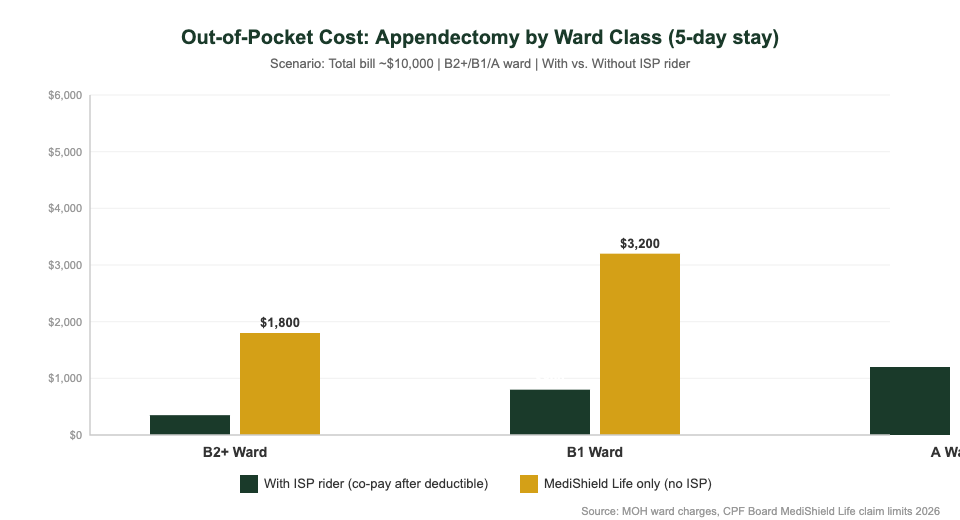
Out-of-pocket cost comparison for a 5-day hospitalisation across ward classes, with and without an ISP rider. Source: MOH/CPF Board claim limits, TKN calculations, 2026.
3 Worked Examples: Exact Out-of-Pocket Numbers
These three examples use the same scenario — appendix surgery requiring 5 days of hospitalisation — across the three main ward classes. Actual bills vary by hospital, surgeon, and medical complications, but these numbers illustrate the structure of costs you will face.
Example 1: Class B2 Subsidised Ward, 5-day Stay
| Cost Component | Amount | Paid By |
|---|---|---|
| Total subsidised bill | $4,500 | — |
| Annual deductible (Class B2) | $1,500 | MediSave / cash |
| Eligible for MediShield Life | $3,000 | — |
| MediShield Life claim (90%) | $2,700 | MediShield Life |
| Co-insurance (10%) | $300 | MediSave / cash |
| Total out-of-pocket | $1,800 | From MediSave |
| With ISP rider (5% co-pay) | ~$225 cash | Cash only |
Illustrative only. Assumes no prior hospitalisation this policy year. Class B2 subsidised rates apply; actual procedure codes affect claim limits.
Example 2: Class B1 Ward, 5-day Stay
| Cost Component | Amount | Paid By |
|---|---|---|
| Total bill (Class B1, reduced subsidy) | $9,000 | — |
| Annual deductible (Class B1) | $2,000 | MediSave / cash |
| Eligible for MediShield Life | $7,000 | — |
| MediShield Life claim (90%) | $6,300 | MediShield Life |
| Co-insurance (10%) | $700 | MediSave / cash |
| Total out-of-pocket | $2,700 | From MediSave |
| With ISP rider (5% co-pay) | ~$450 cash | Cash only |
Class B1 wards have a lower government subsidy than B2/C wards. Many B1 bills also include items not covered by MediShield Life (e.g. specialist consultation fees), which would add to your MediSave withdrawal. Actual amounts depend on the specific procedure code and Diagnostic-Related Group (DRG).
Example 3: Class A Ward (Private Hospital), 7-day Stay — Cardiac Procedure
| Cost Component | Amount | Paid By |
|---|---|---|
| Total bill (Class A, complex cardiac) | $28,000 | — |
| Annual deductible (Class A) | $2,000 | MediSave / cash |
| MediShield Life claim (capped at procedure limit) | ~$12,000 | MediShield Life |
| Your share: deductible + co-insurance + excess above caps | ~$16,000 | MediSave + cash |
| Total out-of-pocket (no ISP) | ~$16,000 | MediSave + cash |
| With ISP (Class A/private plan + rider) | ~$2,000–$3,000 cash | Cash only |
Complex cardiac procedures at private hospitals frequently exceed MediShield Life claim limits by a wide margin. The $12,000 MediShield Life claim used here is illustrative — actual limits depend on the specific procedure code. Without an ISP, a $28,000 cardiac bill requires substantial MediSave balances or significant cash outlay.
The takeaway: for Class B2 and B1 stays, MediSave plus MediShield Life usually covers the bill entirely in cash terms. For Class A stays — especially complex procedures — an ISP isn’t a luxury; it’s the difference between a manageable $2,000–$3,000 cash bill and a $16,000 drain on your savings. Use TKN’s Singapore retirement calculator to see how a large unplanned medical expense affects your long-term financial plan.
Integrated Shield Plans and Riders: What They Cover
An Integrated Shield Plan (ISP) is a private health insurance policy that sits on top of MediShield Life. All seven MAS-approved ISP providers offer plans designed around Singapore’s restructured hospitals and private hospitals. The plan itself covers eligible bills up to the ward class you choose. The rider is an optional add-on that reduces your out-of-pocket to a fixed co-payment percentage.
How riders changed from 2021: From 7 November 2020, all new and upgraded ISP riders must include a minimum co-payment of 5% (capped at $3,000 per policy year). This change was introduced to maintain cost-consciousness and discourage over-treatment. Riders sold before that date with full “as-charged” coverage were grandfathered in for existing policyholders.
Practically: even with the best available ISP rider today, you will pay at least 5% of your eligible bill in cash, up to $3,000 per year. For a $9,000 B1 bill, that’s $450 — which is what Example 2 above shows.
| Plan Tier | Covers | Approx. Annual Premium |
|---|---|---|
| Basic ISP (B1) | Class B1 ward in restructured hospitals | $200–$600 (ages 20–40) |
| Standard ISP (Class A) | Class A ward in restructured hospitals | $400–$900 (ages 20–40) |
| Premium ISP (Private) | Private hospitals (e.g. Mount Elizabeth, Parkway) | $600–$1,500+ (ages 20–40) |
| Rider (add-on) | Reduces your co-payment to 5% minimum | $200–$600 (depending on plan) |
Premiums are illustrative ranges for healthy adults aged 20–40 in 2026. Premiums rise significantly with age and medical history. Always get quotes from all 7 MAS-approved ISP providers before committing. Source: MAS, ISP provider websites, 2026.
ISP premiums can be paid entirely from MediSave up to the Additional Withdrawal Limits (AWL) set by CPF Board. For most young and middle-aged Singaporeans, the full ISP premium (including rider) stays within AWL, meaning your MediSave does the work and you pay nothing in cash for the insurance itself either.
For more context on how ISPs fit into a broader financial plan alongside passive income and investments, see TKN’s guide to passive income in Singapore — building investment returns that can eventually offset rising ISP premiums in older age is a strategy more Singaporeans should plan for explicitly.
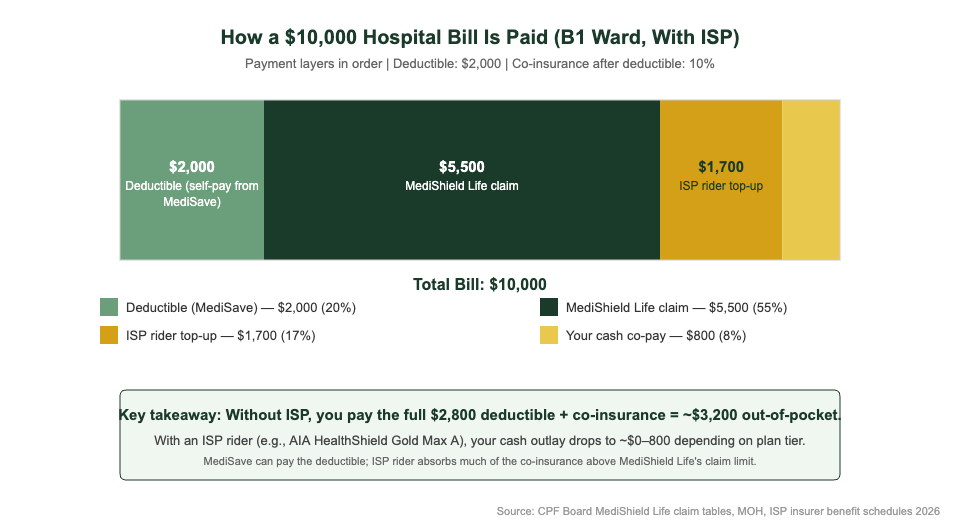
How MediSave, MediShield Life, and ISP each contribute to a hospital bill. The rider reduces your 10% co-insurance to a 5% minimum co-pay. Source: CPF Board, MOH, TKN illustration, 2026.
How to Use MediSave for Hospitalisation: Step-by-Step
Using MediSave at a Singapore hospital is largely automatic — no complex forms are needed at admission time. Here’s how the process works:
- Admission: When you’re admitted, present your NRIC and patient ID. The hospital registers your ward class, and that sets your MediShield Life deductible and claim limits for this hospitalisation.
- Assessment: The hospital submits your bill electronically to CPF Board. MediShield Life calculates its claim based on eligible procedure codes, daily ward charges, and the applicable claim limits.
- Authorisation: Before discharge, you’ll sign a CPF authorisation form confirming the MediSave withdrawal amount. This is the moment you decide how much MediSave to use versus cash.
- ISP coordination (if applicable): Your ISP insurer receives the bill automatically via the Integrated Shield Plan claims process. The insurer pays its share directly to the hospital; you pay only your 5% rider co-pay at discharge.
- Post-discharge verification: Log into the CPF member portal (my.cpf.gov.sg) to confirm that the MediSave withdrawal and MediShield Life claim have been correctly processed. Disputes are rare but can be raised with CPF Board within six months.
One practical tip: check your MediSave balance before a planned procedure. Singaporeans aged 35+ who have been contributing since young typically have $20,000–$60,000 in MediSave. But if your balance is low (after several hospitalisations or heavy premium payments), you may need to plan for cash payments. The CPF member portal shows your real-time balance.
See how your MediSave balance fits into your overall financial plan — including Singapore Savings Bonds as a low-risk cash buffer — to ensure healthcare costs never catch you unprepared.
Plan Your Healthcare Costs Alongside Your Retirement
A single hospitalisation without an ISP can undo months of careful saving. Use TKN’s Singapore retirement calculator to model how unexpected medical costs at different ages affect your FI number — and how an ISP rider changes the picture entirely.
Frequently Asked Questions
What is the MediSave annual deductible for hospitalisation in 2026?
Can I use MediSave to pay for a private hospital stay?
What happens if my MediSave balance is insufficient to pay the deductible?
How much does an Integrated Shield Plan cost per year?
Can I use my MediSave to pay for a family member's hospital bill?
What is the difference between MediShield Life and an Integrated Shield Plan?
What is the MediSave Basic Healthcare Sum (BHS) and does it affect hospitalisation?
Get Free Insurance Advice
Speak with a licensed insurance advisor. No obligation, no cost.
By submitting this form, you agree to our Privacy Policy.
This article was researched with the help of AI. While we strive to keep all information accurate and up to date, there may be errors. If you notice any discrepancies, please contact us.