Singapore Fixed Deposit Rates in 2025: From 3.05% to Under 2% — How the Rate Cycle Unfolded
Updated November 2026 · Digital Banks · 10 min read
Singapore’s best fixed deposit rates peaked at 3.05% p.a. in January 2025, then declined steadily through the year as the US Federal Reserve cut interest rates and Singapore’s money market rates normalised. By September 2026, top traditional bank 12-month FD rates sit at just 1.00–1.75% p.a. — but digital banks such as GXS Bank, Trust Bank and MariBank still offer up to 2.88% for qualifying depositors, outpacing every traditional bank in the market today.
Not financial advice. All figures are for educational reference only. Data verified as at November 2026 unless noted.
📋 Table of Contents
- 1. What Were the Best Fixed Deposit Rates in Singapore in 2025?
- 2. Why Did Singapore Fixed Deposit Rates Fall in 2025?
- 3. How Did Digital Banks Compete in 2025?
- 4. Current Deposit Rates in 2026: Digital Banks vs Traditional Banks
- 5. What Should You Do With Your Cash in 2026?
- 6. Frequently Asked Questions
What Were the Best Fixed Deposit Rates in Singapore in 2025?
If you were watching Singapore’s fixed deposit rates in 2025, you witnessed one of the sharpest rate cycles in recent memory. After peaking near 4% in mid-2023 and staying elevated through 2024, rates finally began their descent in early 2025 — triggered by the US Federal Reserve’s rate-cutting cycle that began in September 2024.
At the start of 2025, Singaporeans could still lock in 3.05% p.a. on a 12-month fixed deposit with select banks. By year-end, the best available rate had fallen to around 2.00% p.a. — a decline of over 100 basis points in a single year. Here is a month-by-month summary of the best available 12-month FD rate across major Singapore banks in 2025:
| Month | Best 12-Month FD Rate | Leading Bank(s) | Change vs Prior Month |
|---|---|---|---|
| January 2025 | 3.05% p.a. | Maybank / RHB | — |
| February 2025 | 2.90% p.a. | Maybank | ▼ −0.15% |
| March 2025 | 2.80% p.a. | Maybank | ▼ −0.10% |
| April 2025 | 2.90% p.a. | Maybank | ▲ +0.10% (promo) |
| May 2025 | 2.50% p.a. | Maybank / CIMB | ▼ −0.40% |
| June 2025 | 2.45% p.a. | CIMB | ▼ −0.05% |
| July 2025 | 2.40% p.a. | CIMB | ▼ −0.05% |
| August 2025 | 2.40% p.a. | CIMB | — (unchanged) |
| September 2025 | 2.30% p.a. | CIMB | ▼ −0.10% |
| October 2025 | 2.20% p.a. | CIMB / Standard Chartered | ▼ −0.10% |
| November 2025 | 2.10% p.a. | Standard Chartered | ▼ −0.10% |
| December 2025 | 2.00% p.a. | Standard Chartered | ▼ −0.10% |
Source: Compiled from The Independent SG, SingSaver, FinancialHorse (2025 monthly reports). Rates shown are the best available promotional 12-month FD rates across major Singapore banks in each period.
The most striking drop came in May 2025, when the best rates fell 40 basis points in a single month as Maybank withdrew its high-rate promotion. This mirrored the pattern seen in the Singapore overnight rate average (SORA), which declined from around 3.5% in early 2024 to under 2% by mid-2025.
Why Did Singapore Fixed Deposit Rates Fall in 2025?
Fixed deposit rates in Singapore do not move in isolation — they are closely tied to global interest rate conditions, particularly the US Federal Reserve’s monetary policy. Here is what drove the 2025 decline:
The Fed’s Rate-Cutting Cycle
The US Federal Reserve began cutting rates in September 2024, reducing the federal funds rate by a cumulative 100 basis points (1%) by year-end 2024. This directly lowered US dollar funding costs for Singapore banks, reducing their need to compete aggressively for deposits. The Fed continued easing into 2025, dragging global short-term rates lower.
SORA’s Decline
Singapore’s key reference rate, the Singapore Overnight Rate Average (SORA), fell from roughly 3.5% in early 2024 to under 2% by mid-2025. Since fixed deposit pricing is benchmarked to SORA-linked money market rates, Singapore banks had less economic reason to offer elevated FD rates once their own funding costs fell. CIMB, Maybank and Standard Chartered — traditionally the most aggressive FD pricers — reduced their headline offers accordingly.
Banks Competed Less Aggressively
During 2023–2024, Singapore banks competed intensely for deposits as liquidity was tight. By 2025, loan growth moderated and deposit competition eased. The major local banks (DBS, OCBC, UOB) never competed aggressively on FD rates to begin with — they relied on their existing customer base and product bundling. It was the foreign banks and digital upstarts that set the pace, and once their own cost of funds fell, they pulled back.
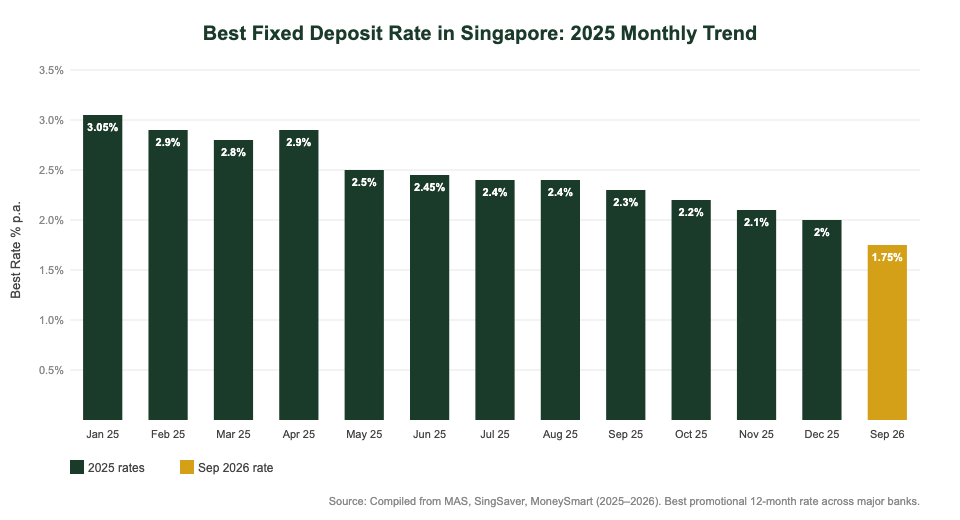
Singapore’s best 12-month fixed deposit rate by month (2025). Source: The Independent SG, SingSaver, FinancialHorse.
How Did Digital Banks Compete in 2025?
Singapore’s three full digital banks — GXS Bank (backed by Grab and Singtel), MariBank (backed by Sea/Shopee) and Trust Bank (backed by Standard Chartered and FairPrice Group) — entered the deposit market offering competitive savings rates designed to win customers away from traditional banks. In 2025, they broadly followed the same trajectory as traditional banks, trimming their rates as money market conditions eased.
As the Straits Times reported, digital banks were “trimming deposit rates, mirroring traditional lenders” — a sign that the initial acquisition-phase pricing was giving way to a more sustainable operating model. Despite the cuts, digital banks maintained a meaningful premium over the big three local banks (DBS, OCBC, UOB), whose FD rates were consistently among the lowest in the market throughout 2025.
Trust Bank
Trust Bank’s savings account peaked at 2.50% p.a. in 2025 before being trimmed to 2.40% p.a. for its Flex Plan by early 2026. This rate — which applies to balances up to S$1.2 million with no lock-in — consistently outperformed all three major local banks’ FD rates and many foreign banks’ promotional offers throughout 2025.
MariBank
MariBank, backed by Sea Limited (Shopee’s parent company), raised its savings rate to 2.88% at one point in 2025, partly as a promotional move tied to ShopeeVIP membership. This rate proved highly competitive with traditional banks’ best FD promotions. MariBank then standardised rates lower as the rate cycle turned, but maintained new-user bonuses as a customer acquisition tool.
GXS Bank
GXS Bank took a different approach with its “Boost Pockets” — term-deposit-style savings pots with rates tied to the lock-in period. At its peak in 2025, GXS Boost Pockets offered around 2.5–2.8% p.a. for 12–18 month tenors, sitting above most traditional bank FD rates for equivalent tenors. GXS also introduced promotional partnerships, including discounts on Grab rides, to incentivise deposits.
What all three digital banks had in common: no minimum deposit requirement, fully app-based management, and instant fund transfers — advantages that traditional banks’ FD products cannot match. For a Singapore saver with S$5,000 to park for 12 months, the digital bank option was consistently the better choice throughout 2025 on both rate and flexibility.
Current Deposit Rates in 2026: Digital Banks vs Traditional Banks
As of November 2026, the fixed deposit market looks very different from January 2025. Here is a full comparison of the best available deposit rates across Singapore’s major banks, covering both traditional fixed deposits and digital bank savings products:
| Bank | Type | Best Rate (% p.a.) | Tenor / Condition | Min. Deposit |
|---|---|---|---|---|
| DBS / POSB | Traditional | 1.00% p.a. | 12-month FD | S$1,000 |
| OCBC | Traditional | 1.40% p.a. | 12-month FD (online) | S$20,000 |
| UOB | Traditional | 1.45% p.a. | 12-month FD | S$10,000 |
| Maybank | Traditional | 1.65% p.a. | 12-month FD | S$20,000 |
| CIMB | Traditional | 1.75% p.a. | 12-month FD (Preferred) | S$10,000 |
| Standard Chartered | Traditional | 2.00% p.a. | 6-month FD (Priority Private) | S$25,000 |
| GXS Bank | Digital | 2.00% p.a. | 18-month Boost Pocket | S$1 |
| Trust Bank | Digital | 2.40% p.a. | Flex Plan savings (no lock-in) | S$1 |
| MariBank | Digital | 2.88% p.a. | New users, first 30 days + ShopeeVIP | S$1 |
Source: MoneySmart (Sep 2026), GrowBeanSprout (Oct 2026). Digital bank rates as at October 2026. All rates subject to change. SDIC protection applies up to S$100,000 per depositor per bank for all Singapore-licensed banks.
The table above reveals a clear pattern: even after the 2025 rate cycle, Singapore’s three digital banks offer materially better rates than DBS, OCBC and UOB, and are competitive with or ahead of foreign banks like CIMB and Standard Chartered. The key difference is that digital banks impose no minimum deposit — meaning a saver with S$2,000 can earn 2.40% p.a. with Trust Bank, while OCBC’s best FD rate requires S$20,000.
All deposits at Singapore’s MAS-licensed digital banks are protected by the Singapore Deposit Insurance Corporation (SDIC) up to S$100,000 per depositor per bank, the same coverage as traditional banks.
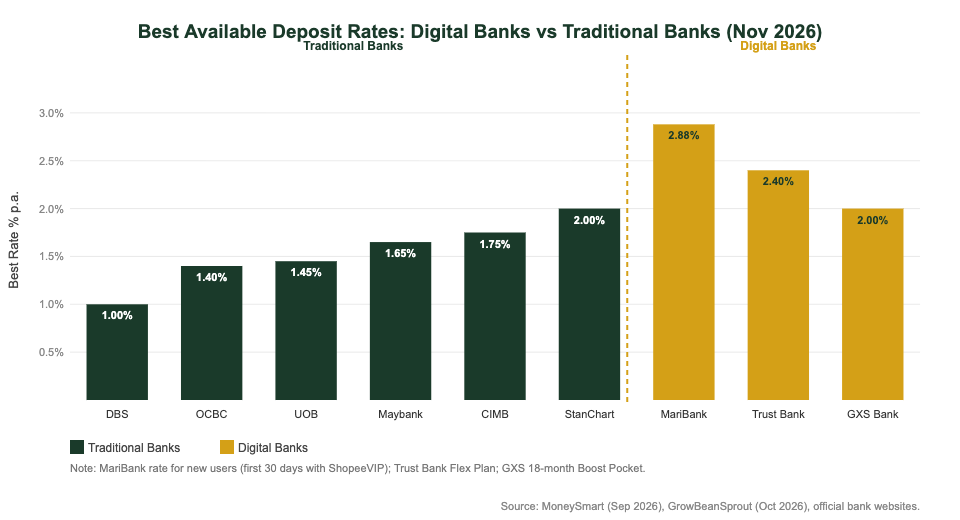
Best available deposit rates across Singapore banks, November 2026. Source: MoneySmart, GrowBeanSprout, official bank websites.
What Should You Do With Your Cash in 2026?
With rates roughly half of their 2025 peaks, Singapore savers face a more complex decision. A fixed deposit locking you in at 1.75% for 12 months is less appealing when alternatives exist. Here is how to think about your cash allocation in 2026:
Consider Digital Bank Savings Accounts Before FDs
The comparison above shows that Trust Bank’s Flex Plan savings at 2.40% p.a. with no lock-in outperforms every traditional bank’s 12-month fixed deposit rate. For cash you need flexibility with, a digital savings account is the better choice today. MariBank’s new-user bonus of 2.88% p.a. is worth capturing if you have not opened an account yet — even if the base rate falls after 30 days, you earn a meaningful premium during the bonus period.
T-Bills and Savings Bonds as Alternatives
For larger sums or longer time horizons, Singapore’s risk-free government instruments remain relevant. The Singapore T-bills 2026 guide covers how 6-month T-bill rates compare to bank FDs, and the Singapore Savings Bonds guide explains how to lock in a 10-year blended rate. Both are government-guaranteed and worth comparing before committing to any bank FD.
Plan Around Your Retirement Cash Needs
If you are building an emergency fund or pre-retirement cash buffer, the right rate matters over time. Use the Singapore retirement calculator to model how your savings rate affects your retirement timeline. Even a 1% difference in annual return on a S$100,000 buffer adds up to tens of thousands of dollars over a decade. For a broader look at generating passive income in Singapore, fixed deposits are just one piece of a diversified income strategy.
If You Must Use a Traditional Bank FD
If you are constrained to a traditional bank (for bundling with other products, estate planning, or simply preference), CIMB offers the best standard rate at 1.75% p.a. for 12 months on S$10,000 minimum. For short tenors, Standard Chartered’s 6-month rate of 1.70–2.00% p.a. is competitive for larger deposits. Keep in mind that your CPF investment strategy may also offer a guaranteed 2.5% p.a. on your Ordinary Account — meaning idle cash parked in a traditional bank FD at 1.00–1.40% earns less than your CPF’s guaranteed return.
Frequently Asked Questions: Singapore Fixed Deposit Rates 2025
What was the best fixed deposit rate in Singapore in 2025?
The highest available 12-month fixed deposit rate in Singapore in 2025 was 3.05% p.a., available in January 2025 with Maybank and RHB. By December 2025, the best available rate had fallen to around 2.00% p.a. as the US Federal Reserve’s rate-cutting cycle filtered through to Singapore’s money markets. The decline of over 100 basis points in a single year was one of the sharpest FD rate drops since the 2019–2020 period.
Why did Singapore fixed deposit rates fall so sharply in 2025?
Singapore FD rates fell in 2025 primarily because the US Federal Reserve began cutting interest rates in September 2024 and continued through 2025. Singapore’s SORA (Singapore Overnight Rate Average) tracks global short-term rates closely, and as SORA fell from around 3.5% in early 2024 to under 2% by mid-2025, banks had no economic reason to offer elevated fixed deposit rates. Banks also faced reduced pressure to compete for deposits as loan growth moderated.
Do digital banks offer better fixed deposit or savings rates than traditional banks?
Yes — as of November 2026, Singapore’s three digital banks (GXS Bank, MariBank and Trust Bank) offer significantly better rates than DBS, OCBC and UOB on comparable balances. Trust Bank’s Flex Plan savings at 2.40% p.a. with no lock-in and no minimum deposit outperforms every traditional bank’s 12-month FD rate. The digital bank advantage is especially pronounced for smaller deposits: a saver with S$5,000 earns 2.40% at Trust Bank vs 1.00% at DBS — a 140 basis point difference.
Is MariBank's 2.88% rate available to everyone?
No. MariBank’s headline rate of 2.88% p.a. applies to new users during their first 30 days after account opening, and only when combined with a Shopee VIP membership. After the 30-day bonus period, the rate drops to 1.28% p.a. for existing ShopeeVIP users, or 0.88% base for non-VIP users. Despite this structure, capturing the new-user bonus is worthwhile — earning 2.88% for one month on S$10,000 earns about S$24, with no lock-in. Existing MariBank users who want competitive ongoing rates should compare with Trust Bank and GXS Boost Pockets.
Are digital bank deposits safe in Singapore?
Yes. All three digital banks — GXS Bank, MariBank and Trust Bank — are licensed by the Monetary Authority of Singapore (MAS) under the full digital bank licence framework. Deposits up to S$100,000 per depositor per bank are protected by the Singapore Deposit Insurance Corporation (SDIC), identical to the protection offered at DBS, OCBC and UOB. Beyond the coverage limit, the same counterparty risk considerations apply as with any bank.
Should I lock in a fixed deposit now or wait for rates to change?
Rate forecasting is inherently uncertain — no one predicted the speed of the 2025 decline. If rates rise again, locking in a low 2026 rate would be costly; if they fall further, locking in now protects your return. A middle-ground approach: keep short-term cash in a no-lock-in digital savings account (Trust Bank 2.40% p.a.) to stay flexible, and allocate longer-term reserves to Singapore Savings Bonds, which allow partial redemption at any point. Avoid long-term lock-ins at today’s traditional bank rates (1.00–1.75%) when no-lock-in alternatives at 2.40% exist.
The Bottom Line
Singapore’s fixed deposit rate cycle in 2025 was a reminder that attractive cash returns are cyclical, not permanent. The best 12-month FD rate fell from 3.05% in January 2025 to 2.00% by December 2025 — and further to 1.00–1.75% at traditional banks by late 2026. The savers who adapted quickest moved into digital bank savings accounts, which today offer 2.00–2.88% p.a. with far more flexibility than a traditional fixed deposit. The same comparison logic applies as rates inevitably rise again in future cycles.
Not financial advice. Rates correct as at November 2026 and subject to change. SDIC coverage applies up to S$100,000 per depositor per bank.
This article was researched with the help of AI. While we strive to keep all information accurate and up to date, there may be errors. If you notice any discrepancies, please contact us.