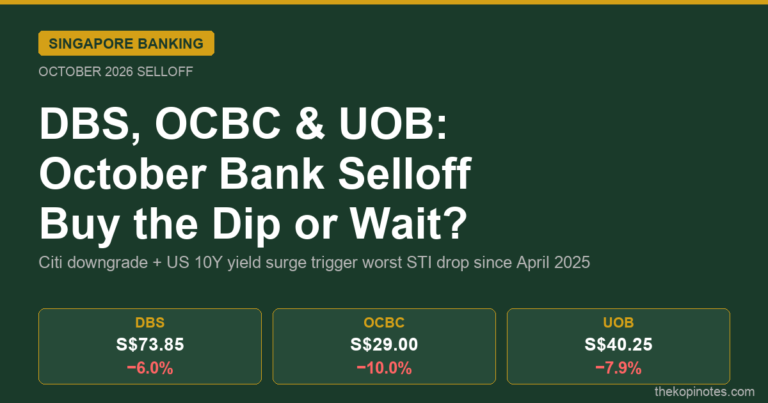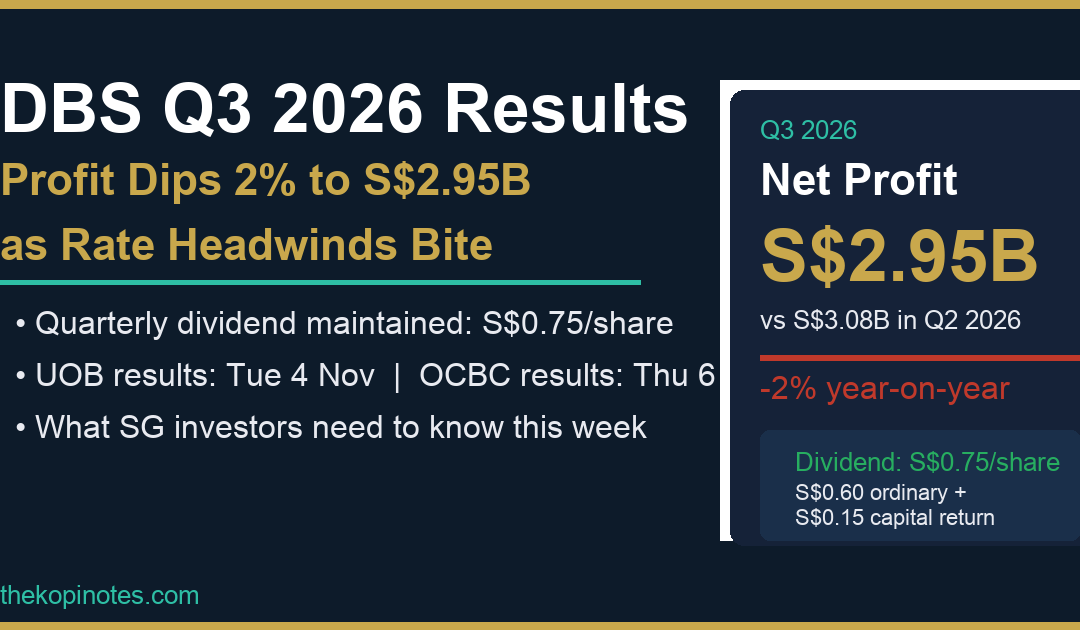
DBS just opened Singapore’s bank results season with a S$2.95 billion Q3 2026 net profit — a 2% dip from last year’s record — as falling interest rates squeeze margins despite resilient fee income. With UOB reporting on 4 November and OCBC on 6 November, this week is the most critical for Singapore bank investors in 2026. Here’s what you need to know before the results land.
Disclaimer: This article is for informational purposes only and does not constitute financial advice. Past performance is not indicative of future results. Please do your own research or consult a licensed financial adviser before making any investment decisions.
DBS Opens Bank Results Season With a Dip
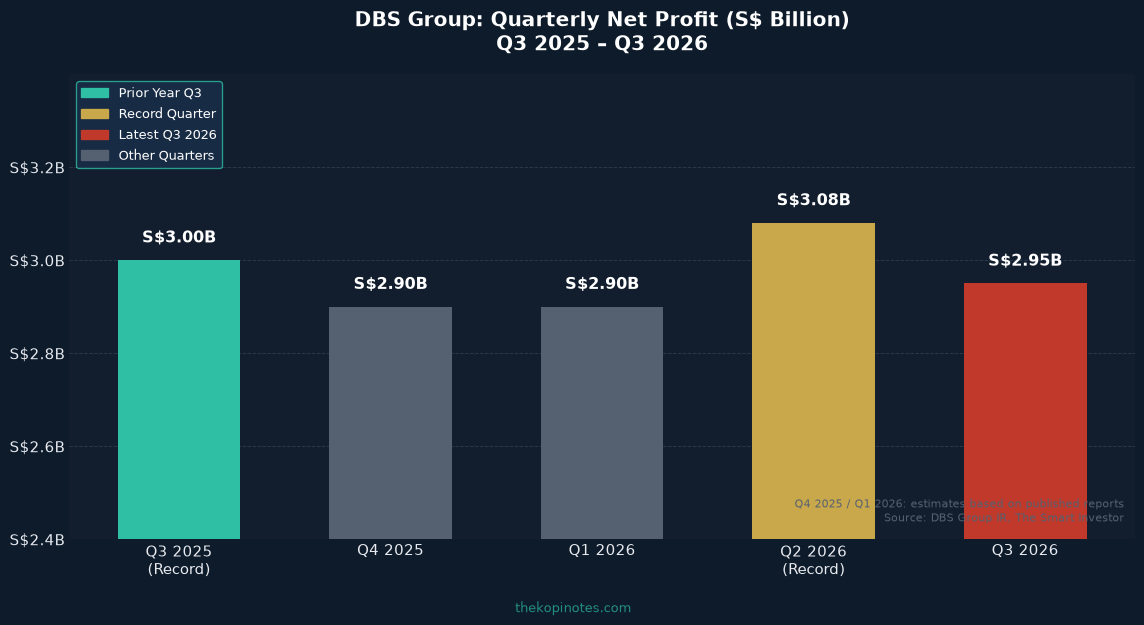
DBS Group Holdings reported its third-quarter 2026 net profit at S$2.95 billion, down 2% year-on-year from the same period in 2025 when it posted a then-record quarter of around S$3.0 billion. The dip was expected by analysts — falling global interest rates since mid-2025 have been compressing net interest margins (NIM) across all Singapore banks — but the full-year guidance cut still caught some investors by surprise.
Coming off a record S$3.08 billion in Q2 2026, the sequential decline of roughly 4% reflects continued rate headwinds. DBS raised its full-year 2026 guidance after the stellar second quarter, only to now guide for “weaker” full-year 2026 net profit. This sets the tone for what promises to be a sober, if still highly profitable, results week.
The Singapore STI’s three biggest components — DBS, UOB, and OCBC — together make up over 40% of the Straits Times Index. Investors in STI ETFs, CPF Investment Scheme accounts, and SRS portfolios are watching this week closely.
What’s Behind DBS’s 2% Profit Dip?
Three main forces drove the softer quarter:
1. Net interest margin compression. DBS’s NIM stood at 1.87% in Q2 2026 (down 18 basis points year-on-year) and is estimated to have slipped further in Q3 as the US Federal Reserve continued its easing cycle. Singapore dollar rates follow US rates with a lag, and with SORA trending lower throughout the July–September 2026 quarter, DBS’s core lending income faced persistent headwinds.
2. Global minimum tax drag. The 15% global minimum tax, introduced from FY2025, reduced net profit by an estimated S$150–200 million annually. This tax impact does not affect operating performance but mechanically reduces the bottom line compared to pre-2025 quarters.
3. Loan growth offsetting some of the pressure. DBS grew its loan book to S$469 billion in Q2 2026 (up 8% year-on-year, constant currency) and likely maintained mid-single-digit loan growth into Q3. This partially offsets NIM compression — more loans, even at lower margins, contributes to total net interest income.
On the bright side, DBS’s wealth management franchise continued to shine. Wealth management fees hit a record S$919 million in Q2 2026 (up 42%). While the Q3 breakdown hasn’t been published in full, fee income is expected to remain a key pillar supporting profitability through 2H 2026.
Dividend: S$0.75 Per Share, Capital Return Continues
For dividend investors, the headline remains constructive. DBS declared a quarterly dividend of S$0.75 per share for Q3 2026, comprising an ordinary dividend of S$0.60 and a capital return dividend of S$0.15. This matches the Q3 2025 payout and is consistent with DBS’s policy of returning excess capital to shareholders alongside its ordinary dividend.
At current DBS prices around S$40–42, the trailing yield is approximately 7%+ including the capital return component — still one of the most attractive among Singapore blue chips. You can track upcoming payouts using the Singapore dividend payout calendar.
DBS Q3 2026 Snapshot vs. Prior Periods
| Metric | Q3 2025 | Q2 2026 | Q3 2026 | YoY Change |
|---|---|---|---|---|
| Net Profit | S$3.00B | S$3.08B | S$2.95B | −2% |
| Net Interest Margin (NIM) | 1.96% | 1.87% | ~1.82%* | ~−14bp |
| Wealth Mgmt Fees | S$796M | S$919M | Strong (est.) | +YoY |
| Quarterly Dividend | S$0.75 | S$0.81 | S$0.75 | Maintained |
| Loan Book | S$437B | S$469B | Growing | +8% (H1) |
*NIM for Q3 2026 is an estimate pending full results disclosure. Sources: DBS Group IR, The Smart Investor, The Straits Times.
The chart below shows DBS’s quarterly net profit trajectory over recent quarters, illustrating the record run through Q2 2026 and the step-down in Q3 2026.
Singapore Bank Results Calendar: What to Watch This Week
The next 72 hours are packed for Singapore bank watchers. Here’s the schedule that matters:
Tuesday, 4 November 2026 — UOB (U11)
UOB releases its Q3 2026 results before market open. The bank’s Q2 2026 net income came in at S$1.48 billion, up 11% year-on-year, driven by strong fee income and improved credit quality. Watch for: NIM commentary, full-year guidance (UOB suspended guidance in Q1 2025 due to tariff uncertainty — will it be restored?), and credit costs.
Thursday, 6 November 2026 — OCBC (O39)
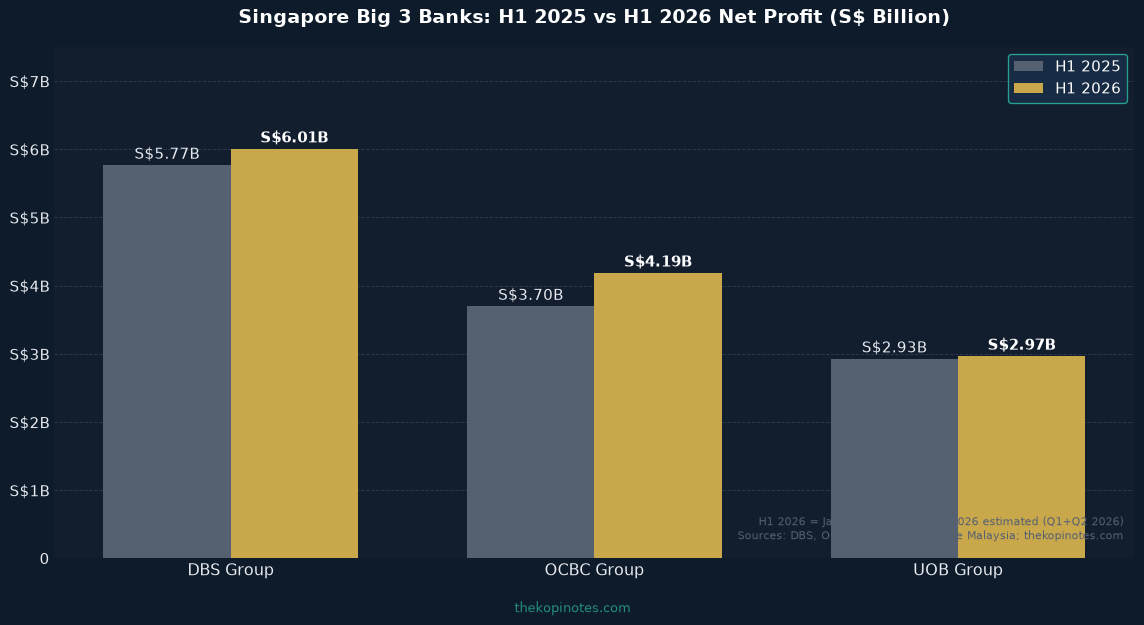
OCBC wraps up Singapore’s bank results season. The bank posted a record H1 2026 net profit of S$4.19 billion (+13%), supported by strong non-interest income and insurance contribution from Great Eastern. Q3 2026 is expected to show NIM compression but potentially resilient wealth management fees.
UOB Q3 2026 Preview: Rate Sensitivity in Focus
Of the three local banks, UOB is considered the most rate-sensitive. With its Singapore-heavy loan book and lower proportion of fee income relative to DBS, NIM movement has an outsized impact on UOB’s earnings. The good news: the year-ago Q3 2025 quarter included elevated provisions, so the year-on-year comparison for Q3 2026 could look favourable even if absolute profit is lower than Q2 2026.
Analysts will scrutinise NIM trajectory, whether credit costs have normalised after pre-emptive provisions in Q1 2025, and whether UOB reinstates its full-year guidance — suspended since Q1 2025 due to tariff uncertainty. Reinstatement would signal management confidence. UOB investors who held through the October 2026 bank selloff will be watching tomorrow’s results closely for a potential relief rally.
OCBC Q3 2026 Preview: Can the Record H1 Carry Into Q3?
OCBC entered Q3 on the back of its strongest-ever first half: S$4.19 billion net profit for 1H 2026, a 13% year-on-year improvement. The interim dividend of 47 cents per share was declared alongside these results. OCBC completed its privatisation of Great Eastern Holdings in 2025, and insurance income is now fully consolidated, providing a meaningful buffer against NIM headwinds.
Key items to watch on 6 November: NIM (already down ~25bp in 1H 2026), non-interest income momentum from Bank of Singapore (wealth management), whether OCBC upgrades its full-year guidance, and any capital management announcements such as special dividends or share buybacks.
What This Means for STI ETF and Dividend Investors
If you hold the SPDR STI ETF (ES3) or the Nikko AM Singapore STI ETF (G3B), the banks’ results directly affect your portfolio. DBS, OCBC, and UOB together account for roughly 43–45% of the STI. This results week, coming after the October 2026 bank selloff, is pivotal for near-term index direction.
For long-term dividend investors, the key question is not whether Q3 profits beat or miss by a few million dollars — it’s whether the banks can sustain their dividend commitments as rates normalise. DBS has answered that question positively with its maintained S$0.75/quarter payout. UOB and OCBC’s verdict comes this week. For context on Singapore’s highest dividend-yielding stocks, all three banks remain top-tier income plays even with NIM compression. Track their payments via the dividend payout calendar.
Bottom Line for SG Investors
DBS’s S$2.95 billion Q3 2026 net profit keeps it firmly in “solid, not spectacular” territory. The 2% year-on-year dip is primarily mechanical — global minimum tax and rate normalisation — rather than a sign of franchise weakness. The S$0.75 quarterly dividend is intact and the wealth management engine continues firing. What changes the narrative is Wednesday’s UOB and Thursday’s OCBC results. If both banks hold their dividends and guide for stable 2027 prospects, the October selloff will look like an opportunity missed. If margins disappoint further, expect renewed pressure on bank share prices. Either way, for Singapore investors with a multi-year horizon, the banks remain foundational holdings in any dividend-focused portfolio.
Key dates to watch:
- 4 November 2026 (Tue): UOB Q3 2026 results — before market open
- 6 November 2026 (Thu): OCBC Q3 2026 results
Why did DBS Q3 2026 net profit fall 2% despite a record Q2 2026?
Is DBS's S$0.75 quarterly dividend safe?
When does UOB report Q3 2026 results?
When does OCBC report Q3 2026 results?
How do falling interest rates affect Singapore bank profits?
What is the DBS share price and dividend yield after Q3 2026 results?
Should I buy Singapore bank stocks before or after results?
This article was researched with the help of AI. While we strive to keep all information accurate and up to date, there may be errors. If you notice any discrepancies, please contact us.