MediSave Limit 2026: How to Use MediSave to Pay Your ISP Deductible
Your complete guide to using CPF MediSave to cover your Integrated Shield Plan deductible and co-payment under Singapore's 2026 ISP rider rules.
From 1 April 2026, all new Integrated Shield Plan (ISP) riders come with a mandatory deductible — up to S$3,500 for Class A and private hospital stays. Your CPF MediSave can be used to pay this deductible and the 5% co-payment directly, reducing the cash you need to pay out of pocket. However, the amount you can withdraw is subject to daily and annual limits.
Not financial advice. All figures are for educational reference only. Data as at November 2026 unless noted.
What Is the ISP Deductible in 2026?
A deductible is the fixed amount you must pay before your Integrated Shield Plan insurer covers the rest of your hospital bill. Under Singapore's MOH April 2026 ISP rider reforms, all new riders purchased on or after 1 April 2026 must include a mandatory deductible. This cannot be reduced or waived by the rider.
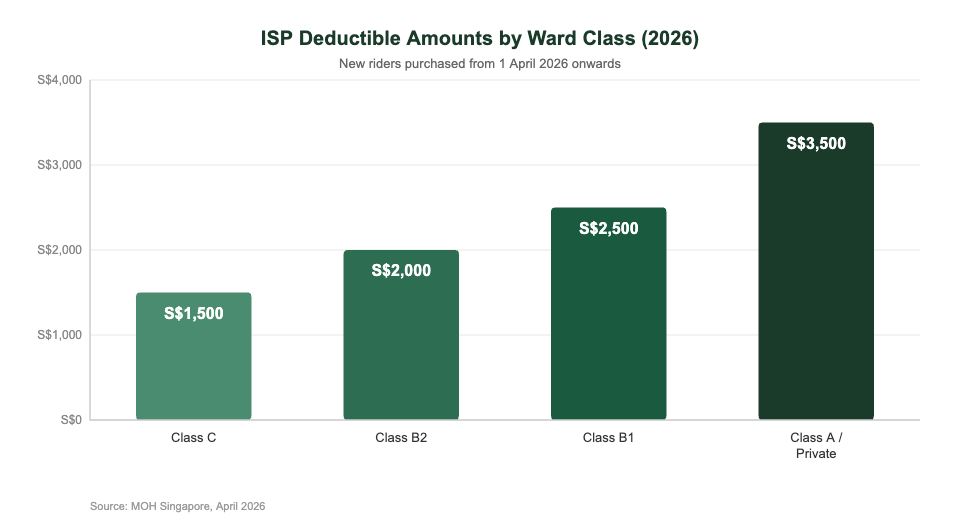
The deductible amount depends on your ward class at admission:
| Ward Class | ISP Deductible (2026) |
|---|---|
| Class A / Private Hospital | S$3,500 |
| Class B1 | S$2,500 |
| Class B2 | S$2,000 |
| Class C | S$1,500 |
Source: MOH Singapore, April 2026. Day surgery deductibles: S$2,000 (non-subsidised), S$1,500 (subsidised).
These deductibles apply once per policy year, not per admission. If you are hospitalised twice in the same policy year, you only pay the deductible once — subsequent claims in the same year are not subject to a new deductible.
Can You Use MediSave to Pay Your ISP Deductible?
Yes. CPF MediSave can be used to pay your ISP deductible and co-payment for eligible hospitalisation and day surgery claims. This is a common source of confusion — many policyholders assume the deductible must be paid in cash, but MediSave withdrawals are specifically designed for hospital bills.
Here is exactly what MediSave can and cannot cover under your ISP:
| Expense | MediSave Can Pay? |
|---|---|
| ISP deductible (e.g. S$3,500 for Class A) | ✓ Yes |
| 5% mandatory co-payment on remaining bill | ✓ Yes |
| ISP rider premium (up to ISP AWL) | ✓ Yes (within annual limit) |
| ISP rider premium above the annual withdrawal limit | ✗ Cash only |
| Non-medical expenses (e.g. administrative fees, TV, phone) | ✗ Not claimable |
Source: CPF Board, MediSave Guidelines, 2026.
The key mechanism: when you are discharged from hospital, the hospital sends a final itemised bill to your insurer. The insurer then applies your rider (less the deductible and co-payment). The net amount claimable is then deducted from your MediSave automatically — you do not need to log in to CPF separately. The deductible and co-payment portions are also drawn from MediSave up to the applicable daily withdrawal limits.
MediSave Withdrawal Limits for Hospitalisation (2026)
MediSave withdrawals for hospitalisation are not unlimited. CPF Board sets two categories of limits you need to know:
1. Hospitalisation Daily Withdrawal Limit
The Hospitalisation Limit governs how much MediSave can be used per day of hospital stay for room, board, and surgical fees:
| Day of Hospitalisation | Max MediSave Per Day (2026) |
|---|---|
| Days 1–2 | Up to S$1,130/day |
| Day 3 onwards | Up to S$400/day |
Source: CPF Board, Hospitalisation Limit, 2026.
These limits apply to the sum of MediSave withdrawn across all claims in the same hospital stay. If your bill exceeds these limits, you pay the shortfall in cash.
2. ISP Annual Withdrawal Limit (AWL) for Premiums
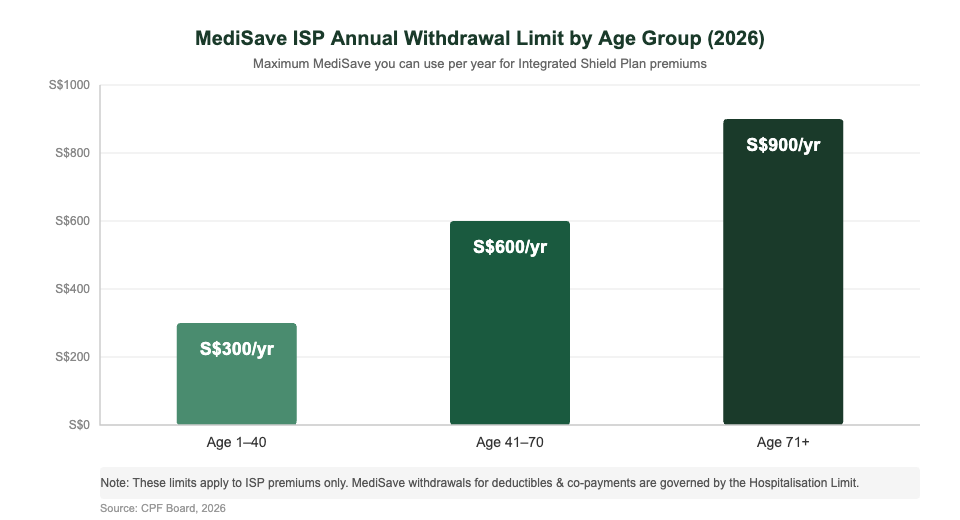
A separate limit applies specifically to ISP rider premiums — the ISP Annual Withdrawal Limit (AWL). This governs how much MediSave you can use each year to pay your ISP rider premium, and varies by age:
| Age Group | ISP MediSave Annual Withdrawal Limit |
|---|---|
| Age 1–40 | S$300/year |
| Age 41–70 | S$600/year |
| Age 71 and above | S$900/year |
Source: CPF Board, ISP Annual Withdrawal Limit, 2026.
Note: The ISP AWL applies only to rider premiums. It does not cap the MediSave you can withdraw for your hospital bill's deductible and co-payment — those are governed by the Hospitalisation Limit instead.
Real Example: Using MediSave for a Class A Hospital Stay (2026)
Let's walk through a concrete example. Suppose a 45-year-old Singapore citizen is admitted to a Class A ward at a private hospital for a knee replacement. The total eligible bill is S$30,000. He has an ISP with a new-generation rider (purchased after 1 April 2026).
Here's how his bill is settled, using MediSave and his rider:
| Bill Component | Amount | Paid By |
|---|---|---|
| Total eligible hospitalisation bill | S$30,000 | — |
| Mandatory deductible (Class A/Private) | S$3,500 | MediSave / Cash |
| Remaining after deductible | S$26,500 | — |
| 5% mandatory co-payment | S$1,325 | MediSave / Cash |
| Insurer pays (ISP rider covers remainder) | S$25,175 | ISP Insurer |
| Total out-of-pocket (deductible + co-pay) | S$4,825 | MediSave / Cash |
Example only. Actual bills vary by hospital, insurer, and plan tier. Source: MOH ISP framework, 2026.
In this example, the policyholder pays S$4,825 in total (deductible + co-payment). This amount can be drawn from MediSave — subject to the Hospitalisation daily withdrawal limits. For a 3-day stay with S$4,825 total, MediSave can cover the full amount provided the account has sufficient balance: days 1–2 at up to S$1,130/day, and day 3 onwards at up to S$400/day.
To check your MediSave balance before a planned hospitalisation, you can log in to the CPF Member Portal. For a step-by-step guide, read our article on how to check your MediSave remaining balance in 2026.
The 5% Co-Payment Rule: What You Still Owe After MediSave
The 5% mandatory co-payment is the second layer of your cost-sharing obligation under new ISP riders. After the insurer deducts your deductible, you are required to pay at least 5% of the remaining eligible claim amount. This co-payment cannot be covered by the rider — it must come from MediSave or your own cash.
The good news: the co-payment is capped at S$6,000 per year across all claims under the same policy year. Once you have paid S$6,000 in co-payments within a single policy year, the 5% co-payment obligation resets — subsequent claims in that policy year are covered fully by your insurer (after any applicable deductible).
What Counts Towards the S$6,000 Co-Payment Cap?
The S$6,000 cap accumulates across all claims under your ISP rider in the same policy year. This includes:
- Inpatient hospital admissions (all ward classes)
- Day surgery claims
- Pre- and post-hospitalisation outpatient claims (if covered by your rider)
Claims under a different insurer's ISP or under MediShield Life alone do not count towards this cap — it is specific to each rider policy. For frequent hospitalisations (e.g. cancer treatment, dialysis), the cap provides meaningful protection against runaway co-payment costs within a single year.
For a practical illustration of how real hospital bills look under the new rider rules — including the deductible, co-payment, and MediSave deductions — see our detailed walkthrough of real hospital bill examples with ISP riders in 2026.
5 Tips to Maximise MediSave for ISP Claims in 2026
With the new mandatory deductibles in place, it pays to be strategic about your MediSave balance. Here are five practical steps to make the most of your MediSave account:
1. Check Your MediSave Balance Before Planned Admissions
Log in to the CPF Member Portal and check how much remains in your MediSave before any scheduled surgery or admission. Knowing your balance lets you plan whether you need to top up (up to the Basic Healthcare Sum of S$79,000 for 2026) or prepare cash as backup.
2. Understand Your Ward Class Entitlement
Choosing a higher ward class (e.g. Class A vs Class B2) means a higher deductible. If your ISP rider covers Class A, consider whether the private ward premium is worth S$1,000 more in deductible exposure. For routine procedures, a Class B1 admission may offer the best balance of comfort and cost.
3. Ask the Hospital for a Pre-Admission Estimate
Most restructured hospitals and many private hospitals offer a pre-admission cost estimate. Request this before any planned surgery — it shows a breakdown of the likely bill, how much your ISP covers, and how much MediSave will be drawn. This prevents post-discharge surprises.
4. Track Your Co-Payment Towards the S$6,000 Cap
If you or a family member (whose MediSave you are using) faces recurring hospitalisation in a single policy year, keep track of how much co-payment has been paid. Once cumulative co-payments hit S$6,000, subsequent admissions in the same year should have zero co-payment obligations — contact your insurer to confirm the running total.
5. Optimise Your Remaining CPF Savings Separately
While MediSave covers healthcare costs, your Ordinary Account and Special Account savings can be invested for retirement. If you are looking to make the most of your CPF Ordinary Account, our CPF investment strategy guide covers the key rules and approved instruments for 2026. You can also model your retirement health costs using our Singapore retirement calculator.
Frequently Asked Questions
Can I use my family member's MediSave to pay my ISP deductible?
What happens if my MediSave balance is not enough to cover the deductible?
Does the ISP deductible apply every time I'm admitted to hospital?
Can I top up MediSave before a planned surgery to cover the deductible?
Does the mandatory co-payment also apply to pre- and post-hospitalisation outpatient claims?
What is the MediSave Basic Healthcare Sum (BHS) in 2026?
The Bottom Line
Under Singapore's 2026 ISP rider rules, you will need to cover a mandatory deductible of up to S$3,500 and a 5% co-payment on every hospitalisation. MediSave can pay both — directly from your CPF account — but is subject to daily withdrawal limits. The key steps are to check your MediSave balance in advance, request a pre-admission estimate, and track your co-payments towards the S$6,000 annual cap.
For a deeper look at how to optimise your CPF savings beyond healthcare, explore our CPF investment strategy guide and run the numbers on your retirement healthcare costs with our free Singapore retirement calculator. Both tools are updated for 2026 figures.
If you found this guide useful, consider using our Syfe referral code and sign-up bonus when you invest your savings — Syfe is one of Singapore's most popular robo-advisors for building a long-term investment portfolio alongside your MediSave and CPF protection strategy.
Get Free Insurance Advice
Speak with a licensed insurance advisor. No obligation, no cost.
By submitting this form, you agree to our Privacy Policy.
This article was researched with the help of AI. While we strive to keep all information accurate and up to date, there may be errors. If you notice any discrepancies, please contact us.