Singapore Life Insurance 2026: Types, Costs & How to Choose the Right Plan
From term insurance to whole life and endowment plans — here's what every Singaporean needs to know before buying.Singapore life insurance provides a lump-sum payout to your dependants if you pass away or suffer total permanent disability (TPD) during the policy term. The three main types are term insurance (pure protection, lowest premiums), whole life insurance (lifelong cover with cash value), and endowment plans (savings-focused, fixed tenure). Most financial advisers recommend covering at least 10× your annual income. According to LIA Singapore’s 2024 data, the average Singaporean working adult faces a protection gap of approximately S$382,000 — meaning most people remain significantly underinsured.
Not financial advice. Premiums and figures are for educational reference only. Data verified as at 2 November 2026 unless noted. Always consult a licensed financial adviser before purchasing any insurance product.
What Is Life Insurance in Singapore?
Life insurance in Singapore is a contract between you (the policyholder) and an insurer. You pay regular premiums, and in return, the insurer pays a agreed-upon sum — called the sum assured — to your nominated beneficiary if you die or become totally and permanently disabled (TPD) within the policy term.
Life insurance in Singapore is regulated by the Monetary Authority of Singapore (MAS) under the Insurance Act. All insurers must be MAS-licensed, giving policyholders a layer of protection. Additionally, life insurance policies (and the policyholders’ funds) are protected under the Policy Owners’ Protection (PPF) Scheme, administered by the Singapore Deposit Insurance Corporation (SDIC).
Key terms you need to know:
- Sum Assured: The guaranteed payout to your beneficiary
- Premium: The amount you pay monthly or annually
- Policy Term: How long the coverage lasts (e.g. 20 years, or whole life)
- Cash Value: The savings component in whole life and endowment plans that grows over time
- TPD: Total Permanent Disability — most policies cover both death AND TPD
- Nomination: Who receives the payout; you can nominate under the Insurance Act (s.49M) or create a statutory trust (s.73)
You can also use your CPF Ordinary Account (OA) or MediSave to pay premiums for certain approved policies — a uniquely Singapore advantage that makes life insurance more affordable when structured correctly.
Types of Life Insurance in Singapore
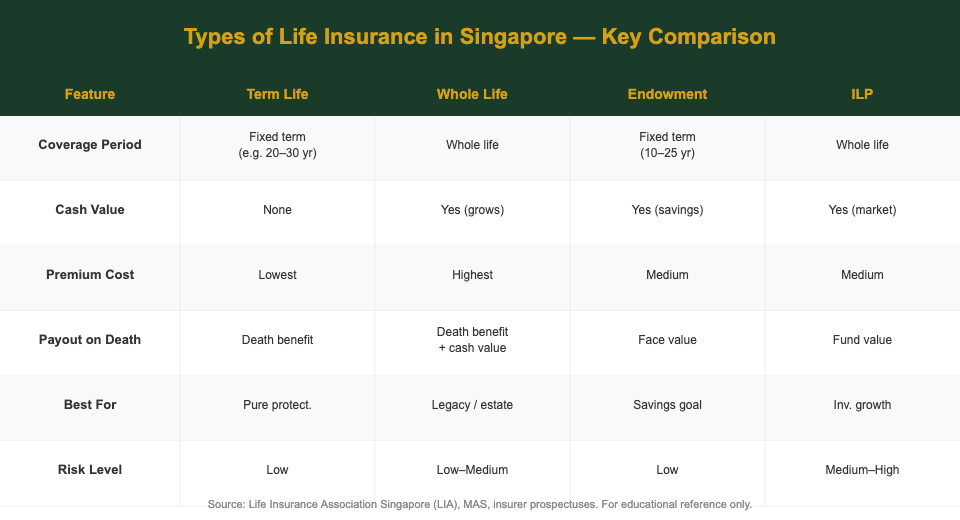
Singapore’s life insurance landscape offers four main product categories. Choosing the right one depends on your goals: pure protection, legacy building, or a combination of savings and coverage.
1. Term Life Insurance
Term life is the simplest and most affordable form of life insurance. You pay premiums for a fixed period — typically 10, 20, or 30 years — and if you die during that period, your family receives the sum assured. If you outlive the policy, there is no payout and no cash value returned.
Who it’s for: Young families, those with a mortgage, or anyone who needs maximum coverage at the lowest cost. A 30-year-old non-smoker male can get S$500,000 coverage for roughly S$400–S$550/year with major Singapore insurers.
You can compare best term life insurance Singapore options to find the most competitive rates.
2. Whole Life Insurance
Whole life insurance provides coverage for your entire life. Premiums are significantly higher than term insurance but the policy builds a cash value over time. This cash value can be surrendered (for a payout) or borrowed against in an emergency.
Who it’s for: Those with estate planning needs, parents looking to leave a financial legacy, or individuals who want guaranteed coverage after retirement when term policies would have expired.
3. Endowment Plans
Endowment plans blend life insurance with disciplined savings. You pay premiums for a set term (typically 10–25 years) and receive a lump-sum payout at maturity — or a death benefit if you pass away before maturity. Returns are modest but guaranteed (for the non-participating portion) making them popular for goals like children’s education or retirement funding.
Learn more about how life insurance policy Singapore structures work across different product types.
4. Investment-Linked Policies (ILPs)
ILPs combine life insurance with an investment component. Part of your premium buys insurance cover; the rest is invested in sub-funds (similar to unit trusts) of your choice. Returns are market-linked — meaning they can be higher than endowments in a bull market, but can also lose value. According to LIA data, ILPs capture roughly 44% of total weighted new business premiums in Singapore, making them the most popular product by premium volume.
Who it’s for: Investors comfortable with market risk who also want insurance coverage. ILPs are complex — always read the Product Summary and Benefit Illustration before signing.
How Much Life Insurance Do You Need in Singapore?
The most common starting point is the “10× annual income” rule of thumb — covering your family’s needs for roughly 10 years if your income disappeared overnight. But the right amount depends on your unique situation.
A more precise calculation:
Life Insurance Need = Outstanding Liabilities + Income Replacement − Existing Assets
- Outstanding liabilities: Mortgage balance, car loans, credit card debt, business loans
- Income replacement: Annual income × number of years until youngest child is financially independent (usually 20–25 years for a family with young children)
- Minus existing assets: CPF, savings, existing policies, investments
According to LIA Singapore’s 2024 Protection Gap Study, the average Singaporean working adult has a protection gap of approximately S$382,000 — meaning most people would leave their families that much short if they passed away today. The protection gap is especially acute for those aged 30–45 with young children and a mortgage.
| Life Stage | Recommended Coverage | Key Reason |
|---|---|---|
| Single, no dependants | S$200,000 – S$300,000 | Cover debts, funeral costs, family obligations |
| Married, no children | S$400,000 – S$700,000 | Mortgage, joint expenses, spouse support |
| Married with young children | S$800,000 – S$1,500,000+ | Mortgage + 15–20 yrs income replacement + education |
| Pre-retirement (50s) | S$500,000 – S$800,000 | Legacy, spouse income, reduced debts |
Source: LIA Singapore Protection Gap Study 2024; standard financial planning guidelines. Figures are indicative only.
Use our Singapore retirement calculator to model your future income needs and see how life insurance fits into your overall financial plan.
Life Insurance Costs in Singapore 2026
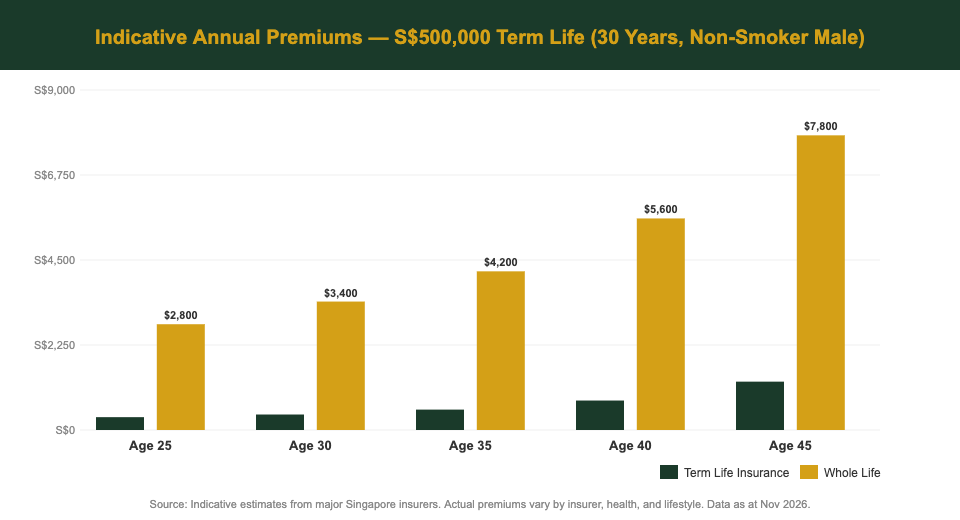
Premiums vary significantly by age, health status, smoking habit, sum assured, and product type. The chart below shows indicative annual premiums for a S$500,000 sum assured, 30-year term life policy vs whole life policy, for a non-smoker male in good health.
Key takeaways from the premium comparison:
- Buy early: A 25-year-old pays roughly half the premium of a 40-year-old for the same coverage. Every year you delay increases your premium
- Term is 5–10× cheaper than whole life for the same sum assured — but whole life builds cash value and never expires
- Female premiums are typically 10–20% lower than male premiums at the same age due to longer average life expectancy
- Smokers pay 50–200% more in premiums compared to non-smokers
| Factor | Impact on Premium | Notes |
|---|---|---|
| Age at application | +ve (older = higher) | Apply as young as possible |
| Smoking status | Smokers: +50%–200% | Quitting for 12 months can reclassify you |
| Health conditions | Loading or exclusion | Pre-existing conditions may be excluded |
| Sum Assured | Proportional increase | Higher coverage = higher premium |
| Payment mode | Annual saves ~3–5% | Annual > monthly payment |
Source: Indicative estimates from major Singapore insurers; actual premiums vary. Data as at November 2026.
Best Life Insurance Companies in Singapore
Singapore has a well-developed and competitive life insurance market with over 15 licensed life insurers. The major players you’ll encounter most often:
| Insurer | Known For | Key Strength |
|---|---|---|
| AIA Singapore | Term & CI plans | Wide product range, wellness rewards (Vitality) |
| Prudential Singapore | Whole life, CI | Strong brand, comprehensive policy options |
| Great Eastern Life | Endowments, term | Oldest Singapore insurer; reliable OCBC backing |
| Income Insurance | Affordable term plans | Competitive premiums, direct purchase online |
| Manulife Singapore | ILPs, term life | Strong investment product range |
| FWD Singapore | Direct-to-consumer | Digital-first, competitive term premiums |
| Singlife | Term, accident plans | Digital-first, competitive pricing |
| Tokio Marine Life | Whole life, endowments | Japanese-backed stability, niche products |
Source: MAS Register of Insurers 2026. All insurers are MAS-licensed and covered by the PPF Scheme (SDIC) for applicable policy types.
There is no single “best” insurer — the right choice depends on your specific coverage needs, budget, and whether you want pure protection or a savings component. Always compare at least 3 quotes and consider working with an MAS-licensed financial adviser.
How to Buy Life Insurance in Singapore
Buying life insurance in Singapore is a straightforward process, but it pays to be thorough. Here’s a step-by-step guide:
Step 1: Calculate Your Coverage Need
Use the formula above (liabilities + income replacement − existing assets). A good rule of thumb: S$500,000–S$1,000,000 sum assured for most working Singaporeans with a mortgage and young children.
Step 2: Choose Your Product Type
Decide between term (maximum coverage, lowest cost) or whole life / endowment (if you also want savings or legacy planning). For most young families on a budget, term life insurance is the recommended starting point per MoneySense Singapore’s financial planning guidelines.
Step 3: Get Multiple Quotes
Compare at least 3–5 quotes. You can do this through:
- CompareFIRST — the MAS-backed comparison portal at comparefirst.mas.gov.sg (covers life insurance, CareShield Life supplements, and more)
- Direct insurer websites — AIA, Prudential, Income, FWD, Singlife all allow online quotes
- Independent financial advisers (IFA) — can access products from multiple insurers
Step 4: Undergo Medical Underwriting
For higher sum assureds (typically above S$500,000), insurers require medical underwriting — a health declaration and possibly a medical examination. Be honest on your application; non-disclosure can void your policy at claim time.
Step 5: Set Up Nomination
Nominate your beneficiary immediately upon policy issuance. Singapore allows two types of nomination:
- Revocable (s.49M) nomination: You can change beneficiaries later; payout goes through estate if nominated person dies first
- Statutory trust (s.73) nomination: Irrevocable; payout goes directly to nominee, bypasses probate — ideal for protecting spouse and children
For more on how life insurance interacts with estate planning and CPF nominations, read our complete life insurance policy Singapore guide.
Frequently Asked Questions — Singapore Life Insurance
Is life insurance compulsory in Singapore?
Life insurance is not compulsory in Singapore. However, the government provides a basic safety net: the Dependants’ Protection Scheme (DPS) automatically covers CPF members aged 21–65 with up to S$46,000 (reduced to S$23,000 for ages 60–65). Most financial planners consider DPS a bare minimum — it is far below what most families with a mortgage and young children would need to maintain their standard of living.
What is the average life insurance payout in Singapore?
There is no single “average” payout — it depends on the policy’s sum assured. However, industry data suggests many Singaporeans are underinsured. The LIA’s 2024 Protection Gap Study found the average working adult faces a protection gap of approximately S$382,000. This means on average, a death in a typical Singapore household would leave the family roughly S$382,000 short of what they would need to maintain their financial security.
Can I use CPF to pay for life insurance in Singapore?
Yes, for certain approved policies. Your CPF Ordinary Account (OA) can be used to pay premiums for whole life insurance and endowment plans that are approved under the CPF Investment Scheme (CPFIS), subject to limits. However, you cannot use CPF to pay for term insurance premiums. MediSave can be used for certain shield plans and riders. For the specific rules, refer to the CPF Board website.
What happens to my life insurance if I can't pay premiums?
For term insurance, if you miss premiums, the policy typically lapses (terminates) after a grace period of 30 days. For whole life and endowment policies that have built up a cash value, most insurers offer an automatic premium loan feature — the insurer lends you the missed premium from your policy’s cash value, keeping the policy active. You can also apply for a premium holiday (common in endowment plans) which allows you to pause premium payments temporarily. Always check your policy’s specific terms.
Do I need life insurance if I'm single with no dependants?
You may not need a large life insurance payout, but some coverage is still useful to: (1) cover funeral expenses (~S$5,000–S$15,000 in Singapore); (2) pay off personal debts like a car loan or credit card; (3) provide a gift to ageing parents who may depend on you. Additionally, buying life insurance while young and healthy locks in low premiums — premiums only increase with age. If you plan to start a family in the future, buying early is almost always financially advantageous.
What is the difference between life insurance and critical illness insurance?
Life insurance pays out on death or TPD. Critical illness (CI) insurance pays out when you are diagnosed with a specified critical illness (such as cancer, heart attack, or stroke) — even if you survive. These are two separate types of coverage addressing different risks. Most financial planners recommend having both: life insurance to protect your family after you’re gone, and CI insurance to cover the financial impact of a serious illness during your lifetime. The typical guideline is 3.9× annual income in CI coverage (per LIA).
How do I claim life insurance in Singapore?
A nominated beneficiary can make a claim by: (1) Notifying the insurer of the death within the policy’s specified timeframe; (2) Submitting the original policy document, death certificate, and the claimant’s ID/proof of relationship; (3) Completing the insurer’s claim form. Claims are typically processed within 2–4 weeks for straightforward cases. If a statutory trust nomination (s.73) was made, the payout goes directly to nominees without going through probate, significantly speeding up the process.
Get Free Insurance Advice
Speak with a licensed insurance advisor. No obligation, no cost.
By submitting this form, you agree to our Privacy Policy.
This article was researched with the help of AI. While we strive to keep all information accurate and up to date, there may be errors. If you notice any discrepancies, please contact us.