RETIREMENT GUIDE 2026
Retirement Planning in Singapore: The Complete 2026 Guide
CPF LIFE, SRS, T-bills and exactly how much you need — a step-by-step framework for Singaporeans at every stage of life.
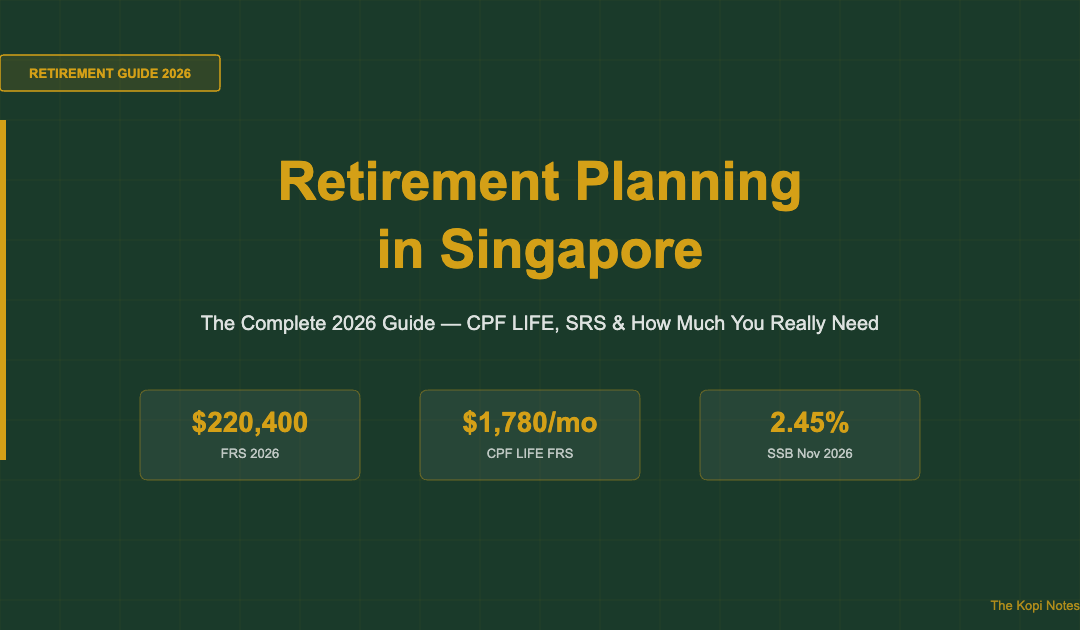
Retirement planning in Singapore means combining three distinct pillars: the CPF system (with payouts from CPF LIFE), tax-advantaged investing through SRS, and your own investment portfolio. The 2026 Full Retirement Sum (FRS) is $220,400 — enough to generate roughly $1,780 per month for life under the Standard Plan. Most Singaporeans will need significantly more than CPF alone to maintain their pre-retirement lifestyle.
Not financial advice. All figures are for educational reference only. Data as at November 2026 unless noted. Always consult a licensed financial adviser before making retirement decisions.
Why Retirement Planning in Singapore Is Different
Singapore’s retirement landscape is unlike anywhere else in the world. Unlike countries that rely purely on voluntary savings or employer pensions, Singaporeans have the CPF system — a mandatory, government-managed savings scheme that funds healthcare, housing and retirement simultaneously. This is both a safety net and a constraint: your CPF savings are locked up until specific ages and can only be withdrawn under set conditions.
The statutory retirement age is now 64 (raised from 63 on 1 July 2026), with re-employment protection up to 69. CPF LIFE payouts begin at age 65 for most members. This means the typical Singaporean may have a one-year gap between stopping work and receiving CPF income — and a potentially much longer gap if they choose to retire early.
There are also three key layers to build: CPF (your foundation), SRS (tax-deferred investing), and an independent investment portfolio. A complete retirement plan addresses all three and answers one critical question: how much passive income do you actually need each month?
CPF: Your Retirement Foundation
Understanding the Retirement Sums (2026 Cohort)
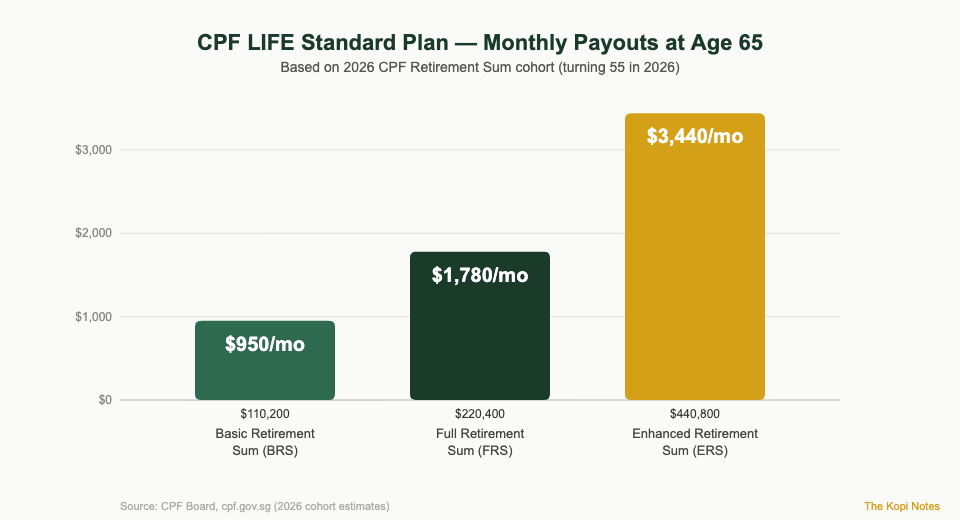
Members turning 55 in 2026 face these retirement sum benchmarks:
| Retirement Sum | Amount (2026) | CPF LIFE Payout/Month | Notes |
|---|---|---|---|
| Basic (BRS) | $110,200 | ~$950 | Must own property pledged to CPF |
| Full (FRS) | $220,400 | ~$1,780 | The default target for most members |
| Enhanced (ERS) | $440,800 | ~$3,440 | For those who want maximum CPF income |
Source: CPF Board, cpf.gov.sg (2026 cohort estimates — payouts are for the Standard Plan starting at age 65)
CPF Interest Rates
Your CPF savings earn government-guaranteed interest: the Ordinary Account (OA) earns 2.5% p.a. and the Special Account (SA), MediSave (MA) and Retirement Account (RA) all earn 4.0% p.a. This makes the SA especially powerful for growing your retirement sum — it’s a risk-free 4% return with zero volatility. Maximising your SA balance before the Retirement Sum Shielding window at age 55 is one of the most effective, lowest-risk retirement moves a Singaporean can make.
For investors who want higher long-term returns and are comfortable with market risk, the CPF Investment Scheme (CPFIS) allows you to invest OA funds in unit trusts, ETFs and selected instruments. However, given the OA’s guaranteed 2.5% return, investing OA funds only makes sense if you are reasonably confident of beating that hurdle rate after fees.
Which CPF LIFE Plan Should You Choose?
CPF LIFE offers three plan options: Standard (highest monthly payout), Basic (lower payout but leaves a bequest for your estate), and Escalating (payouts increase 2% each year to hedge inflation). For most members, the Standard Plan maximises lifetime income and is the default recommendation. The Escalating Plan suits those particularly worried about long-term inflation eroding their purchasing power.
SRS: Tax-Advantaged Investing for Retirement
The Supplementary Retirement Scheme (SRS) is Singapore’s voluntary, tax-deferred retirement savings account — and one of the most underused tools in a local investor’s arsenal. Every dollar you contribute to SRS is deducted from your assessable income in that year, reducing your income tax bill immediately.
SRS Contribution Limits (2026)
| Tax Status | Annual SRS Cap | Tax Saved at 15% Bracket |
|---|---|---|
| Singapore Citizen / PR | $15,300 | ~$2,295 |
| Foreigner (Employment Pass holder) | $35,700 | Up to ~$8,925 |
Source: IRAS, iras.gov.sg (FY2026 contribution limits)
The catch: when you withdraw from SRS at or after age 63, only 50% of withdrawals are taxable. Spread over a 10-year period, most retirees end up paying zero or minimal tax on their SRS savings. This makes the effective tax benefit very significant — a citizen in the 15% bracket who maxes SRS for 20 years saves roughly $45,900 in tax contributions alone, plus earns investment returns on the full amount throughout.
Inside your SRS account, you can invest in Singapore stocks, ETFs, unit trusts, bonds, fixed deposits and endowment plans. For long-term growth, many Singaporeans use their SRS to invest through platforms like Endowus (referral code: 2V343) which offers low-cost fund portfolios and direct market access with no additional platform fee on CPF and SRS funds. Syfe (referral code: SRPRFFFCD) similarly accepts SRS investments with automated portfolio management.
Beyond CPF and SRS: Building Your Investment Portfolio
CPF and SRS together form a powerful tax-efficient base, but they are not enough on their own for most retirement plans. Building a separate, liquid investment portfolio gives you flexibility, inflation protection and the ability to retire before CPF payouts begin at 65.
Short-Term: T-Bills and SSBs
For the capital preservation and liquidity portion of your retirement pot, Singapore government instruments are currently attractive. The 6-month T-bill cut-off yield was 1.95% at the October 2026 auction, while the Singapore Savings Bond (SSB) for November 2026 offers a 2.45% 10-year average return — both risk-free and backed by the Singapore government. The Singapore T-bills 2026 guide and Singapore Savings Bonds guide cover application mechanics in detail.
Long-Term: Equities and REITs
For the growth engine of your retirement portfolio, global equity ETFs — particularly broad market instruments listed on the London Stock Exchange that avoid US estate tax exposure — and Singapore REITs provide long-term capital appreciation and dividend income. A Singapore investor targeting passive income through S-REITs can realistically target 5–7% distribution yields, supplementing CPF LIFE payouts substantially.
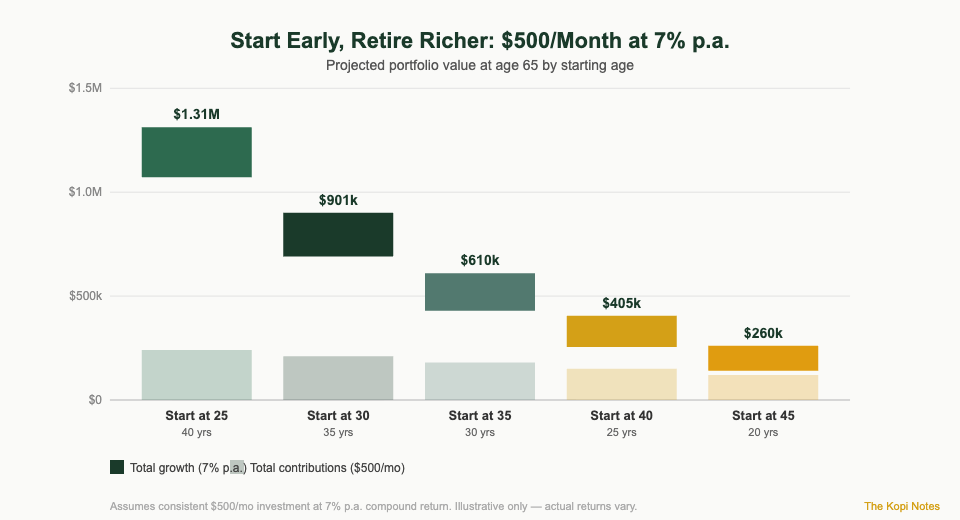
The most important insight in the chart below is the compounding effect of time. An investor who starts at 25 and invests $500 per month at 7% per annum will accumulate roughly $1.32 million by age 65. The same investor starting at 40 accumulates only $324,000 — a quarter of the amount — despite investing for 20 fewer years. Starting early isn’t just better; it’s the dominant variable in retirement wealth.
For brokerage access, Interactive Brokers (IBKR, referral code: jianxiong368) offers the lowest commissions for buying global ETFs from Singapore, while FSMOne (referral code: P0544985) is popular for regular savings plan-style investing. Trust Bank (referral code: HTWYQP95) offers competitive cash management returns for your emergency fund and short-term cash.
How Much Do You Actually Need to Retire in Singapore?
The million-dollar question — quite literally. There is no single answer, but a practical framework helps: start with your desired monthly retirement income, subtract your expected CPF LIFE payout, and calculate how large a portfolio you need to generate the remaining income.
The 4% Rule — Adapted for Singapore
The classic “4% rule” suggests that a retiree can withdraw 4% of their portfolio per year with a high probability of not running out of money over 30 years. This implies a portfolio 25× your annual expenses. For Singapore, where CPF LIFE already covers a baseline, the rule applies to the gap between CPF and your target income:
- Target monthly income: $5,000
- CPF LIFE (FRS Standard Plan): −$1,780/month
- Portfolio gap: $3,220/month = $38,640/year
- Portfolio needed: $38,640 × 25 = ~$966,000
Use the Singapore retirement calculator to personalise this based on your current savings, expected CPF LIFE payout and target retirement age.
Singapore Retirement Cost Benchmarks (2026)
| Lifestyle | Monthly Need | Annual Need | Portfolio Target |
|---|---|---|---|
| Basic (HDB, simple lifestyle) | $2,500 | $30,000 | $750,000 |
| Comfortable (travel, dining, activities) | $4,500 | $54,000 | $1,350,000 |
| Affluent (frequent travel, condo, private healthcare) | $8,000 | $96,000 | $2,400,000 |
Portfolio target assumes 4% withdrawal rate and CPF LIFE FRS payout of $1,780/month ($21,360/year) already subtracted. Illustrative only.
Retirement Planning Timeline by Age
Retirement planning is not a single decision — it is a sequence of actions taken across decades. Here is what to focus on at each life stage:
| Life Stage | Key Actions |
|---|---|
| 20s | Open an SRS account (even $1 to lock in the lower annual limit). Start investing in global equity ETFs. Let compounding work for 40 years. |
| 30s | Maximise SRS contributions annually — the tax savings compound too. Build a 6-month emergency fund. Continue equities with a long horizon. |
| 40s | Model your expected CPF LIFE payout. Assess whether you’re on track for FRS or ERS by 55. Consider voluntary top-ups to Special Account (while available) or Retirement Account. Begin adding REITs for income. |
| 50s | At 55: Retirement Account is created, BRS/FRS locked in. Review CPF LIFE plan selection. Gradually shift portfolio toward income-generating assets. Draw down SRS strategically from age 63. |
| 60s+ | CPF LIFE payouts start at 65. SRS withdrawals (50% taxable). Rebalance portfolio to 60–70% income-focused. Review healthcare coverage and Medisave sufficiency. |
This is a general framework. Individual circumstances vary — consult a licensed financial adviser for personalised planning.
Ready to Start Your Retirement Plan?
Use our free calculator to see how much you need — and whether you’re on track.
Frequently Asked Questions
How much do I need to retire comfortably in Singapore in 2026?
A comfortable retirement in Singapore — covering housing, healthcare, dining, travel and leisure — typically requires $4,000–$5,000 per month for a couple, or $2,500–$3,500 as an individual. Using the 4% withdrawal rule, a single person targeting $4,000/month and receiving $1,780/month from CPF LIFE (FRS Standard Plan) needs a portfolio of approximately $1 million to cover the $2,220/month gap. Higher lifestyle costs require proportionally larger portfolios. Use the retirement calculator to model your specific situation.
What is the CPF Full Retirement Sum (FRS) for 2026?
The Full Retirement Sum (FRS) for the 2026 cohort — members turning 55 in 2026 — is $220,400. This is the amount that needs to be in your CPF Retirement Account to qualify for the standard CPF LIFE monthly payout of approximately $1,780 under the Standard Plan. The Basic Retirement Sum (BRS) is $110,200 and the Enhanced Retirement Sum (ERS) — the maximum — is $440,800. These figures increase each year; members turning 55 in 2027 will face a higher FRS.
What is the retirement age in Singapore in 2026?
The statutory retirement age in Singapore is 64, raised from 63 effective 1 July 2026. Employers cannot ask employees to retire before this age. The re-employment age — the age up to which employers must offer re-employment to eligible employees — is 69. CPF LIFE payouts begin at age 65 for most members, regardless of when they stop working.
Should I top up my CPF SA or invest in ETFs for retirement?
This depends on your risk tolerance and time horizon. The CPF Special Account earns a guaranteed 4% per annum with zero risk — hard to beat with comparable safety. However, a globally diversified ETF portfolio has historically returned 7–10% p.a. over long periods, offering higher expected growth at the cost of volatility. A common approach: top up CPF SA to maximise the risk-free 4% base, then invest surplus savings in low-cost global ETFs for higher growth. The CPF investment strategy guide covers the trade-offs in detail.
Is SRS worth it for retirement planning in Singapore?
Yes, for most working Singaporeans earning above $50,000 per year, SRS offers a compelling immediate tax benefit. Contributing $15,300 per year (the citizen/PR cap) saves roughly $2,295 in tax for someone in the 15% bracket — an immediate guaranteed return of 15% on the contribution, before any investment growth. The key is to invest your SRS funds rather than leaving them in the default SRS savings account earning minimal interest. Platforms like Endowus and Syfe accept SRS funds and offer diversified portfolios suited to retirement investing.
Can I retire early in Singapore before CPF payouts start?
Yes, but you need a bridge strategy to cover the years between stopping work and receiving CPF LIFE payouts at 65. For early retirees, this typically means building a sufficient investment portfolio — REITs, dividend stocks, bonds and cash — to cover living expenses from the target retirement age to 65. Singapore Savings Bonds (SSBs), T-bills and dividend-paying REITs are popular tools for this bridging period. Because CPF funds are not accessible before age 55 (and even then, only above the BRS/FRS threshold), early retirement requires substantial self-funded savings outside CPF.
What are the best investment platforms for retirement in Singapore?
The best platform depends on your investment approach. For SRS investing and managed portfolios, Endowus (code: 2V343) and Syfe (code: SRPRFFFCD) are popular robo-advisory options with low fees. For self-directed ETF investing with minimal commissions, Interactive Brokers (IBKR) (code: jianxiong368) is the institutional-grade choice. For Singapore-listed stocks, ETFs and REITs with a regular savings plan, FSMOne (code: P0544985) offers broad market access. The right choice depends on whether you prefer automation or direct control.
This article was researched with the help of AI. While we strive to keep all information accurate and up to date, there may be errors. If you notice any discrepancies, please contact us.