How Much Critical Illness Insurance Do I Need in Singapore? (2026 Guide)
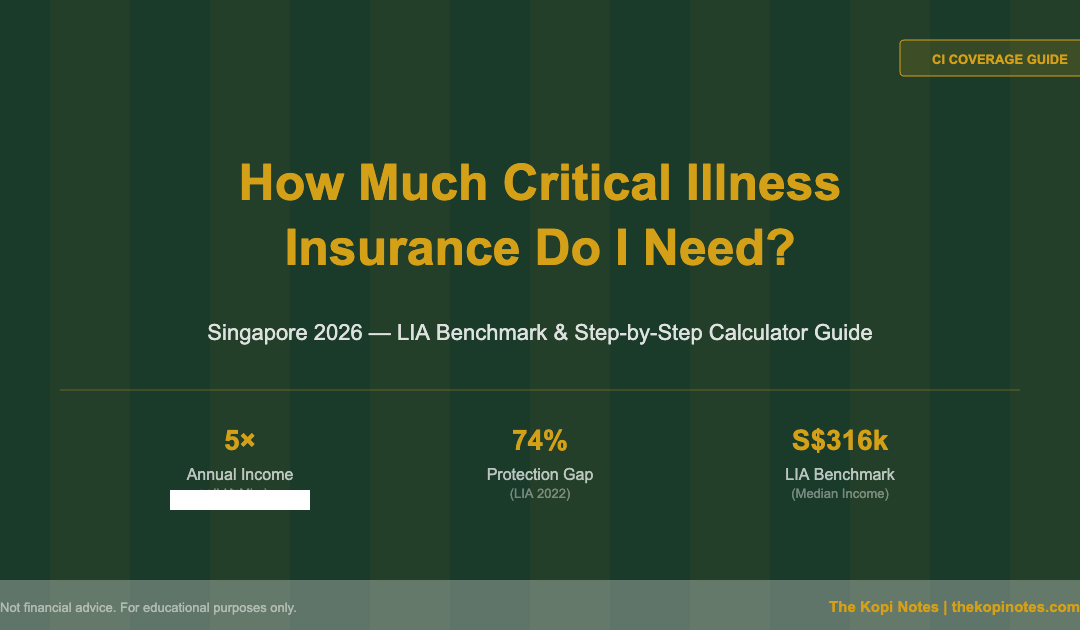
The LIA-recommended benchmark is 5× your annual income — roughly S$316,000 for a median earner — yet the average Singaporean holds only S$60,000. This guide shows you exactly how to calculate the right CI sum assured for your life stage, income, and financial obligations, using the same framework as Singapore’s financial advisers.
Most Singaporeans know they should have critical illness (CI) insurance — but few know how much. Buying too little leaves you financially exposed when you need it most; buying too much means wasted premiums. This guide cuts through the confusion using the Life Insurance Association of Singapore’s own benchmarks to give you a clear, personalised answer.
Not financial advice. All figures are for educational reference only. Data verified as at 1 November 2026.
Why the CI Coverage Amount Is More Important Than the Plan Itself
When evaluating critical illness insurance vs health insurance in Singapore, many people focus on which conditions are covered and forget the equally important question of how much the payout should be. A CI plan that pays out S$50,000 for stage 4 cancer sounds useful — until you realise that cancer treatment in Singapore’s private hospitals can run to S$100,000–S$200,000 per year, not counting the income you lose during a 12–18 month recovery.
CI insurance is designed to replace income and cover costs that MediShield Life and Integrated Shield Plans do not — including:
- Income loss during treatment and recovery (often 6–24 months)
- Out-of-pocket treatment costs above what MediShield covers
- Household expenses that continue regardless of whether you are earning
- Rehabilitation and recuperation costs not covered by hospitalisation plans
- Mortgage payments that cannot be deferred for months
If your CI payout is too small to cover all of the above for a realistic recovery period, the plan is structurally insufficient — regardless of how many conditions it covers.
The LIA Benchmark: 5× Your Annual Income
The Life Insurance Association of Singapore (LIA) sets the baseline for how much CI coverage Singaporeans should carry. According to LIA’s Protection Gap Study, the minimum recommended CI sum assured is 5 times your annual income. This figure represents the estimated cost of surviving a critical illness, accounting for:
- 5 years of income replacement (the typical recovery and treatment window for major illnesses like cancer or heart disease)
- Out-of-pocket medical expenses above what your Integrated Shield Plan covers
- Daily living and family expenses that continue during your illness
For a median Singaporean household income of approximately S$5,268 per month (based on SingStat 2024 figures), this works out to a recommended CI sum assured of approximately S$316,000. Yet LIA’s own 2022 Protection Gap Study found that the average Singapore resident carries only around S$60,000 in CI coverage — a 74% protection gap.
LIA 5× Rule: What It Means in Practice
The 5× rule is a starting point, not a ceiling. Depending on your obligations — mortgage, dependants, business liabilities — you may need 7× or even 10× your annual income. Conversely, if you have substantial liquid savings, a spouse’s income, or an employer group CI plan, you can adjust downward.
To understand the right age and timing for buying critical illness insurance, it helps to anchor the decision to your income and obligations at each life stage.
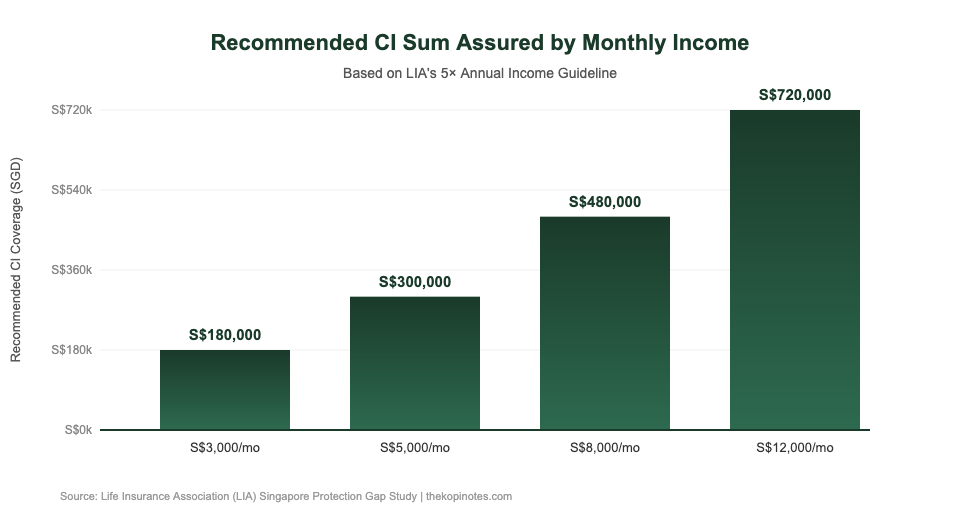
Source: Life Insurance Association (LIA) Singapore Protection Gap Study; monthly income × 12 months × 5. For educational reference only.
How to Calculate Your Critical Illness Sum Assured
Follow this four-step framework to arrive at a personalised CI coverage figure:
Step 1 — Start with the LIA Base: 5× Your Annual Income
Take your gross monthly income, multiply by 12, then by 5. This is your baseline CI sum assured.
Example: Monthly income S$7,000 → Annual S$84,000 → CI base = S$420,000
Step 2 — Add Your Outstanding Mortgage
A CI diagnosis does not pause your mortgage. If you are diagnosed with cancer, the bank still expects its monthly instalment. Add your outstanding home loan balance to your CI base, or confirm that a separate Mortgage-Reducing Term Assurance (MRTA) or Decreasing Term policy covers this.
Example (continued): Outstanding mortgage S$350,000 → New CI target = S$420,000 + S$350,000 = S$770,000
(Or confirm MRTA already covers S$350k and exclude from CI calculation)
Step 3 — Subtract Existing Coverage and Liquid Assets
Deduct any existing CI coverage you already hold — from employer group insurance, existing personal CI plans, or CPF Dependants’ Protection Scheme (DPS, which only covers death/TPD). Also deduct liquid savings that you would genuinely deploy in a crisis (typically 12–24 months of expenses in an emergency fund).
Example (continued): Existing group CI S$50,000 + emergency fund S$60,000 → Subtract S$110,000 → CI gap = S$660,000
Step 4 — Check Affordability and Adjust
CI premiums for a healthy 35-year-old typically run from S$150–S$500/month for S$200,000–S$500,000 of coverage depending on plan type (standalone term CI vs whole life CI rider). If the full gap is unaffordable, prioritise covering at least your income replacement (5× annual) before adding mortgage coverage. As income grows, increase your CI sum assured at policy renewal.
Recommended Critical Illness Coverage by Life Stage
Different life stages carry different CI coverage needs. The table below uses the LIA 5× framework adjusted for typical obligations at each stage:
| Life Stage | Typical Monthly Income | LIA Base (5× Annual) | Recommended CI Range |
|---|---|---|---|
| Early career (25–30) | S$3,000–S$5,000 | S$180k–S$300k | S$200k–S$300k |
| Married, pre-kids (30–35) | S$5,000–S$8,000 | S$300k–S$480k | S$300k–S$500k |
| With dependants & mortgage (35–45) | S$7,000–S$12,000 | S$420k–S$720k | S$500k–S$800k |
| Pre-retirement (50–60) | S$8,000–S$15,000 | S$480k–S$900k | S$300k–S$500k* |
| Post-retirement (60+) | Retirement drawdown | N/A | S$150k–S$300k* |
*Pre-retirement and post-retirement figures lower because mortgage is typically paid off, children are independent, and CI coverage is focused on treatment costs + lifestyle maintenance. Source: LIA 5× income framework adapted by The Kopi Notes for SG context. Not financial advice.
Singapore’s Critical Illness Protection Gap: Why S$60k Is Not Enough
LIA’s 2022 Protection Gap Study revealed a sobering truth: the average Singapore resident holds only S$60,000 in CI coverage — barely enough to cover a few months of treatment and income replacement. The LIA-recommended figure for a median earner is more than five times that amount.
This 74% CI protection gap is not just a statistic — it means that most Singaporeans who suffer a critical illness would exhaust their CI payout within 6–12 months and be forced to draw down savings, sell assets, or rely on family members to cover the remaining recovery costs.
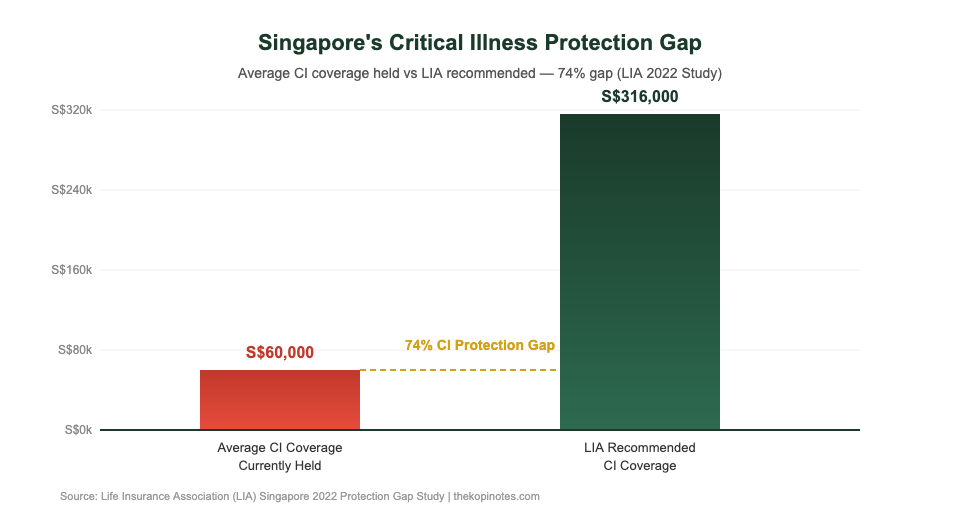
Source: Life Insurance Association (LIA) Singapore 2022 Protection Gap Study. Average CI coverage figure based on industry data.
Real Critical Illness Treatment Costs in Singapore (2026)
To understand why CI coverage needs to be substantial, it helps to ground the numbers in actual treatment costs. Cancer accounts for approximately 73% of all CI claims in Singapore, making it the most relevant reference point.
| Condition | Estimated Total Treatment Cost (18 months) | Private Hospital |
|---|---|---|
| Breast Cancer (early) | S$60,000–S$120,000 | S$80,000–S$160,000 |
| Prostate Cancer | S$80,000–S$130,000 | S$98,000–S$180,000 |
| Lung Cancer (late stage) | S$150,000–S$250,000 | S$200,000–S$273,000 |
| Heart Attack (bypass surgery) | S$50,000–S$100,000 | S$80,000–S$150,000 |
| Stroke (rehabilitation) | S$60,000–S$150,000 | S$100,000–S$200,000 |
Source: Estimates based on MOH Bill Amount data, insurer published cost guides, and SmartWealth.sg 2026 healthcare cost statistics. Figures include hospitalisation, medication, and outpatient treatment but exclude lost income during recovery. Individual costs vary significantly.
These figures do not include income loss, which for a professional earning S$7,000/month represents an additional S$84,000 per year of recovery costs. Adding 1.5 years of income to the treatment costs above, the total financial impact of a serious CI event easily reaches S$200,000–S$400,000 — before accounting for household expenses and loan obligations.
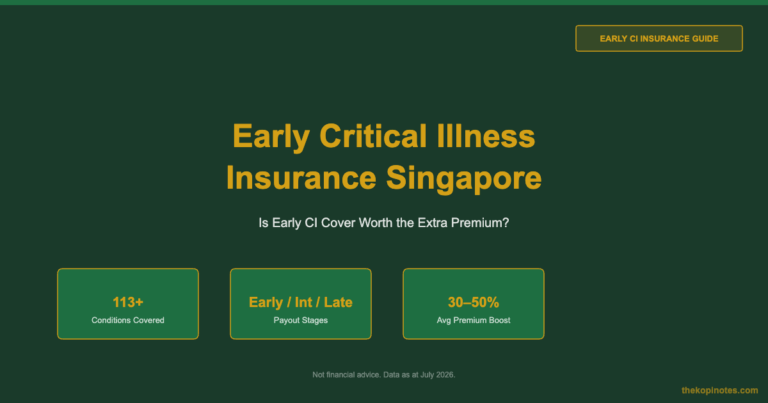
This is why choosing between early and late stage CI coverage matters: early-stage payouts let you start drawing down CI funds before costs escalate, giving you the runway to manage treatment without tapping into your retirement savings.
How to Close Your CI Coverage Gap
If you have found a significant gap between your current coverage and your target sum assured, here are the most practical ways to close it:
1. Add a Standalone Term CI Plan
Standalone term CI plans offer the highest coverage-to-premium ratio for a fixed period (typically 20–30 years). A healthy 35-year-old can obtain S$200,000 of CI coverage for roughly S$100–S$200/month, depending on the insurer and the number of conditions covered. Term CI is ideal for closing a large gap affordably during your peak earning years.
2. Layer an Early CI Rider on Your Existing Whole Life Plan
If you already have a whole life plan with a late-stage CI rider, consider adding an early critical illness (ECI) rider to the same policy. This gives you a payout at early-stage diagnosis — when treatment is most effective and costs begin escalating — without buying an entirely new policy. Read our guide on critical illness coverage for self-employed Singaporeans if your income is irregular or you lack employer group insurance.
3. Review and Update Group CI Coverage
Many employer group CI plans cap at S$50,000–S$100,000 — sufficient for early-stage but not major illness. Treat employer CI as a supplement, not your primary coverage layer. If you change jobs or become self-employed, employer CI disappears, so personal CI coverage is non-negotiable.
4. Use CPF and SRS Funds for Long-Term Planning
While CI insurance pays out as a lump sum, your broader financial resilience depends on having adequate retirement savings running in parallel. Use our Singapore retirement calculator to ensure your CPF and SRS savings stay on track even if a CI event disrupts your income for 1–3 years. If you invest through a robo-advisor, platforms like Endowus (referral code 2V343) let you invest CPF OA funds in diversified portfolios that continue growing during a recovery period.
Frequently Asked Questions
How much critical illness insurance do I need in Singapore?
Is S$100,000 of critical illness coverage enough in Singapore?
Does MediShield Life cover critical illness in Singapore?
Can I have too much critical illness insurance in Singapore?
How does CI insurance interact with DPS (Dependants Protection Scheme) in Singapore?
Should I buy term CI or whole life CI insurance in Singapore?
Get Free Insurance Advice
Speak with a licensed insurance advisor. No obligation, no cost.
By submitting this form, you agree to our Privacy Policy.
This article was researched with the help of AI. While we strive to keep all information accurate and up to date, there may be errors. If you notice any discrepancies, please contact us.