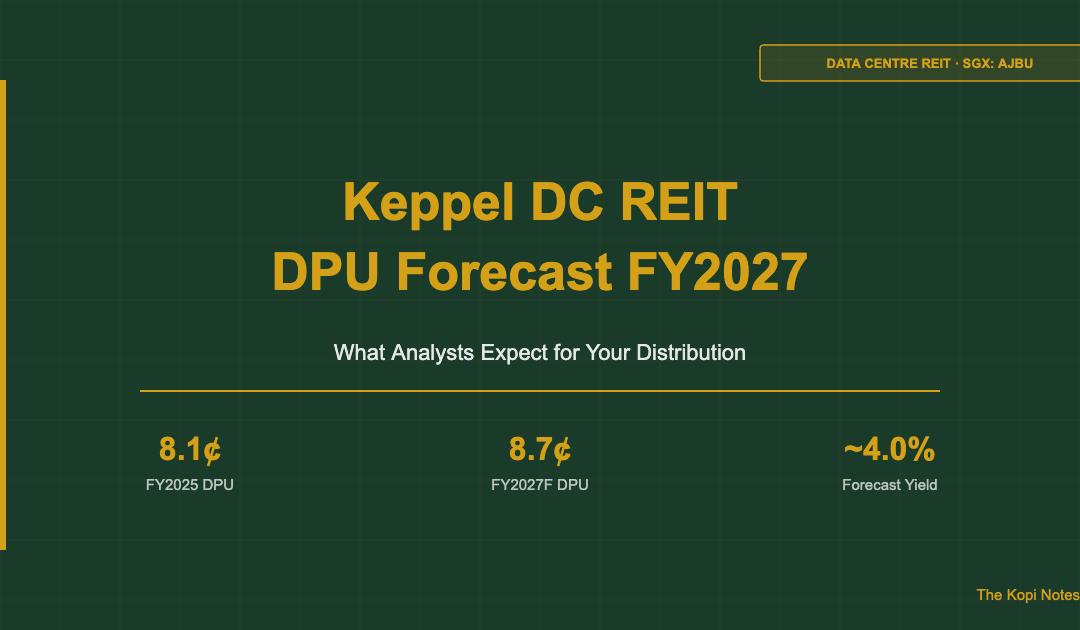
Keppel DC REIT DPU Forecast FY2027: What to Expect From Your Distribution
By The Kopi Notes · Updated October 2026 · 8 min read
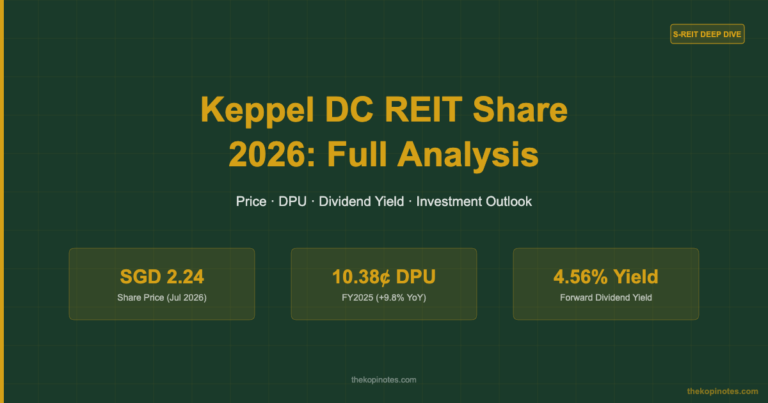
Keppel DC REIT (SGX: AJBU) is Singapore’s largest pure-play data centre REIT, distributing income to unitholders twice a year. For FY2027, analyst consensus points to a DPU of approximately 8.5–8.7 cents per unit — representing modest growth from FY2025’s 8.1 cents, driven by rate-cut tailwinds reducing financing costs, European rental uplifts, and potential Keppel Corp sponsor pipeline acquisitions. The implied distribution yield at a share price of S$2.17 is approximately 3.9–4.0%.
Not financial advice. All figures are for educational reference only and based on publicly available data and analyst estimates as at October 2026. Actual distributions may differ materially. Always do your own due diligence.
What Is Keppel DC REIT’s Current DPU?
Keppel DC REIT distributes income on a semi-annual basis — a 1H distribution (typically paid in August) and a 2H distribution (typically paid in February the following year). The total annual DPU reflects the sum of both periods.
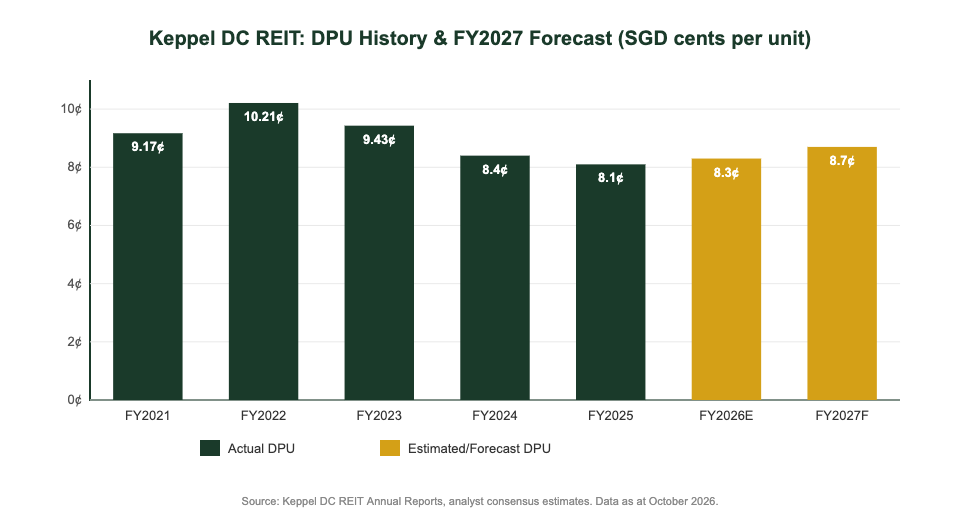
KDC’s DPU peaked in FY2022 at 10.21 cents per unit, buoyed by a combination of acquisitions in Singapore and Europe and a strong operating environment. Since then, distributions have contracted due to three key pressures: rising interest rates increasing borrowing costs, a softening in the China data centre portfolio’s rental rates, and currency headwinds as the Euro weakened against the SGD.
By FY2025, DPU had settled at an estimated 8.1 cents — still representing a yield of approximately 3.7% at current prices, and supported by a high occupancy rate above 97% across KDC’s global portfolio of 23 data centres in 9 countries.
| Financial Year | Total DPU (¢) | YoY Change | 1H DPU (¢) | 2H DPU (¢) |
|---|---|---|---|---|
| FY2021 | 9.17 | +5.3% | 4.36 | 4.81 |
| FY2022 | 10.21 | +11.3% | 4.94 | 5.27 |
| FY2023 | 9.43 | –7.6% | 4.76 | 4.67 |
| FY2024 | 8.40 | –10.9% | 4.11 | 4.29 |
| FY2025E | 8.10 | –3.6% | ~3.95 | ~4.15 |
Source: Keppel DC REIT Annual Reports, SGX filings. FY2025E is an estimate as at October 2026.
FY2027 DPU Drivers: Positive Catalysts
Several structural tailwinds support a higher DPU in FY2027 versus FY2025:
1. Rate-Cut Tailwind Reducing Finance Costs
KDC’s all-in interest rate on borrowings peaked around 3.5–3.8% in 2024–2025. With the US Federal Reserve and European Central Bank in easing cycles as of 2026, KDC’s refinancing of maturing debt should progressively lower the blended cost of debt. Every 50 basis points reduction in borrowing costs on KDC’s approximately S$2.8 billion in outstanding debt would boost DPU by approximately 0.05–0.06 cents per unit — a meaningful accretion on top of the base case.
2. European Organic Rental Growth
KDC’s European data centres — in Germany, the Netherlands, and the UK — benefit from indexed lease structures with built-in CPI-linked escalators. As European inflation has moderated to the 2–3% range, these escalators continue to deliver low-single-digit rental uplifts annually without requiring capital expenditure. Germany’s hyperscaler demand (from Microsoft, Google, and AWS expanding Frankfurt presence) is particularly supportive for renewal rates.
3. Sponsor Pipeline and ROFR Assets
Keppel Corp retains a significant portfolio of data centre assets that KDC holds a Right of First Refusal (ROFR) over. If KDC executes even one or two accretive acquisitions from this pipeline — at an NPI yield above its current cost of capital — the incremental DPU contribution could add 0.1–0.3 cents to the FY2027 distribution. The management team has signalled their acquisition appetite remains active for high-quality Singapore and Southeast Asian assets.
4. High Occupancy Underpinning Revenue Stability
KDC’s portfolio-wide occupancy rate has consistently remained above 95% and most recently above 97%, supported by long-term colocation contracts with blue-chip hyperscaler and enterprise tenants. A passive income Singapore investor can take comfort in the stability of KDC’s top-line revenue, which de-risks the DPU base case even in a softer macro environment.
FY2027 DPU Headwinds: Risk Factors
Investors should not assume a straight-line recovery in DPU. Several risks could constrain or reduce distributions in FY2027:
1. China Portfolio Drag
KDC’s Guangdong Province data centres (specifically in Guangdong DC 1 and Guangdong DC 3) have faced subdued rental renewals due to an oversupply of colocation capacity in tier-2 Chinese cities and ongoing geopolitical risk premiums demanded by tenants. If Chinese occupancy or rental rates decline further, the negative NPI contribution could shave 0.1–0.2 cents off total DPU.
2. EUR/SGD Currency Headwinds
Approximately 40–45% of KDC’s NPI comes from European assets denominated in EUR. KDC hedges a portion of this exposure, but residual currency risk remains. A stronger SGD versus EUR would translate European income into fewer Singapore cents at the point of distribution. Currency hedging adds cost and does not eliminate translation risk entirely.
3. Higher Debt Maturities
KDC has a cluster of debt maturities in 2026–2027. While central banks are cutting rates, refinancing at current spreads still represents a higher absolute cost than the historically low rates locked in pre-2022. The net effect on finance costs will be a gradual rather than immediate improvement.
4. Gearing Limits Acquisition Capacity
KDC’s gearing ratio stands at approximately 36% — well within MAS’s 50% limit and management’s own 40% target ceiling, but with limited headroom for large debt-funded acquisitions without equity recycling. A rights issue or private placement, if dilutive, could temporarily suppress DPU-per-unit growth even as total distributions grow.
To understand KDC’s debt profile in full detail, read our Keppel DC REIT gearing analysis.
DPU Forecast Table: FY2025–FY2028
Based on our analysis of analyst consensus estimates (ranging from 2–3 broker reports), management guidance, and macroeconomic assumptions, we present the following DPU forecast range for Keppel DC REIT:
| Year | Bear Case DPU (¢) | Base Case DPU (¢) | Bull Case DPU (¢) | Key Assumption |
|---|---|---|---|---|
| FY2025E | 7.90 | 8.10 | 8.30 | Stable occupancy, rates peaking |
| FY2026E | 8.00 | 8.30 | 8.60 | First rate-cut benefits filter through |
| FY2027F | 8.10 | 8.50 | 9.00 | Full rate-cut cycle + sponsor acquisition |
| FY2028F | 8.20 | 8.80 | 9.50 | Normalised cost of debt; acquisition DPU |
Source: The Kopi Notes analysis based on Keppel DC REIT investor presentations, broker consensus, and macroeconomic data as at October 2026. These are estimates, not guarantees.
The base case of 8.50 cents for FY2027 reflects our central scenario: two rounds of US Fed rate cuts (totalling 75–100bps) translating into lower refinancing costs, continued European organic rental growth of 2–3%, and no major acquisition disruption. The bull case of 9.00 cents requires a material acquisition to close at above-NAV accretion, while the bear case assumes China headwinds worsen and EUR weakens further.
How KDC Compares to S-REIT Peers
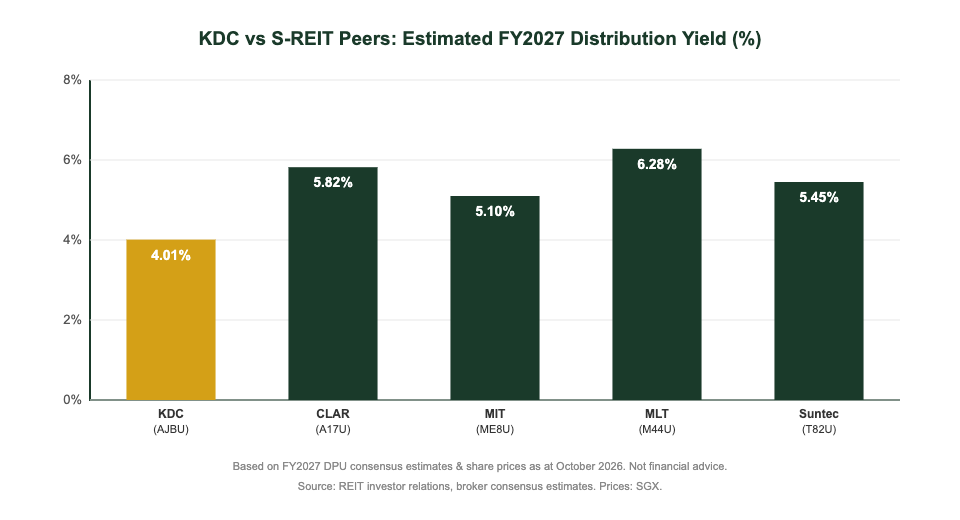
One of the most common investor questions is whether Keppel DC REIT’s distribution yield is competitive relative to other S-REITs. The short answer: KDC offers a premium data-quality and growth profile, but at a lower current yield than most diversified or industrial REITs. This is the classic “growth vs income” trade-off.
| S-REIT | SGX Ticker | FY2027F DPU (¢) | Share Price (S$) | Est. Yield | Sector |
|---|---|---|---|---|---|
| Keppel DC REIT | AJBU | 8.50 | 2.17 | 3.9% | Data Centre |
| CapitaLand Ascendas REIT | A17U | 15.20 | 2.61 | 5.8% | Industrial/Logistics |
| Mapletree Industrial Trust | ME8U | 12.10 | 2.37 | 5.1% | Industrial/Data Centre |
| Mapletree Logistics Trust | M44U | 8.40 | 1.34 | 6.3% | Logistics |
| Suntec REIT | T82U | 8.20 | 1.50 | 5.5% | Office/Retail |
Source: The Kopi Notes analysis. Share prices as at October 2026. DPU figures are consensus estimates, not guaranteed. Not financial advice.
KDC’s lower yield premium reflects its superior asset quality, pure-play data centre exposure, and the market’s pricing in of higher DPU growth relative to traditional S-REITs. For investors comparing KDC against the broader market, see our best S-REITs in Singapore 2026 guide for a full ranking across yield, gearing, and coverage.
That said, investors seeking a higher immediate income stream may find passive income strategies in Singapore using a blended REIT portfolio (KDC + MLT + CLAR) more optimal for total yield targeting above 5%.
What Does the FY2027 DPU Forecast Mean for Your Yield?
The realised yield on your investment depends on the price at which you buy. Here is the implied distribution yield at different KDC entry prices using the FY2027 base case DPU of 8.50 cents:
| Entry Price (S$) | FY2027F DPU Base (8.50¢) | Implied Yield | FY2027F DPU Bull (9.00¢) | Bull Yield |
|---|---|---|---|---|
| S$1.90 | 8.50¢ | 4.47% | 9.00¢ | 4.74% |
| S$2.00 | 8.50¢ | 4.25% | 9.00¢ | 4.50% |
| S$2.17 (current) | 8.50¢ | 3.92% | 9.00¢ | 4.15% |
| S$2.35 | 8.50¢ | 3.62% | 9.00¢ | 3.83% |
| S$2.50 | 8.50¢ | 3.40% | 9.00¢ | 3.60% |
Assumes FY2027F DPU estimates only. No guarantee of future distributions. Source: The Kopi Notes calculations, October 2026.
For context, the Singapore T-bill yield in 2026 has compressed to approximately 1.9% for the 6-month bill. This makes KDC’s 3.9% yield at current prices look more attractive on a risk-adjusted basis than 6 months ago, though investors should remember that KDC carries more risk than a risk-free government security.
If you’re weighing KDC against fixed income alternatives or building a Singapore retirement income portfolio, our Singapore retirement calculator can help you model how different yield assumptions translate into monthly income.
Investor Verdict: Is KDC’s FY2027 DPU Outlook Worth Acting On?
The FY2027 DPU outlook for Keppel DC REIT is cautiously positive — not a V-shaped recovery, but a steady improvement from the 2024 trough. The key thesis remains intact: data centres are structurally in demand, KDC’s occupancy is resilient, and the rate-cut cycle provides a meaningful tailwind to distributable income over a 12–18 month horizon.
However, investors should not chase KDC solely for yield at current prices. A 3.9% forward yield is fair compensation for a high-quality REIT, but not exceptional by S-REIT standards. The more compelling case for KDC is the combination of income + capital appreciation potential if the market re-rates data centre assets upward as the AI-driven demand narrative strengthens.
For income investors who want to accumulate KDC through a regular savings plan or robo-advisor, platforms like Syfe (use referral code SRPRFFFCD) and FSMOne (referral code P0544985) offer low-cost access to S-REIT holdings including KDC. Endowus (referral code 2V343) also offers REIT-inclusive income portfolios accessible via CPF and SRS funds.
Frequently Asked Questions
What is Keppel DC REIT's expected DPU for FY2027?
How often does Keppel DC REIT pay distributions?
What is the distribution yield on KDC at S$2.17?
Why has KDC's DPU declined since 2022?
Should I buy KDC for dividend income or capital gains?
Where can I buy Keppel DC REIT shares in Singapore?
This article was researched with the help of AI. While we strive to keep all information accurate and up to date, there may be errors. If you notice any discrepancies, please contact us.