Best Investment Returns in Singapore 2026: ETF vs REIT vs T-Bill vs CPF — Real Numbers
Verified data across every major asset class — so you know exactly what each Singapore investment is actually returning in 2026.
In 2026, Singapore investors face a clear split: capital-safe instruments like CPF and T-bills yield between 1.67% and 4.00% per year, while growth assets like S-REITs offer ~6.0–6.5% distribution yields and UCITS ETFs tracking the S&P 500 have returned ~12.7% year-to-date. Which is the best investment? It depends on your goal — but every figure here has been cross-checked against its official source before publication.
Not financial advice. All figures are for educational reference only. Data verified as at 30 October 2026 against official sources. Fact-check details: T-bill rates from MAS SGS auction results; CPF rates from CPF Board; SSB rates from MAS SSB page; S-REIT yield from TKN’s sector yield tracker (August 2026); S&P 500 YTD from FT Portfolios quarterly commentary (22 October 2026).
Looking for a broader overview? Check out our best investments in Singapore 2026 guide for a comprehensive breakdown of top asset classes.
Why Investment Returns Vary So Much in 2026
Every Singapore investor has a version of the same question: where should I put my money? The honest answer is that the “best” investment depends entirely on what you need it to do — and what you’re willing to risk to get it.
In 2026, the investment landscape looks like this: global interest rates have come down from their 2023–2024 highs but remain elevated by historical standards. The US Federal Reserve held its benchmark rate at 3.75%–4.00% as of October 2026, with two hawkish dissenters voting for an immediate hike. Singapore’s MAS has maintained a mildly appreciating SGD policy, keeping local inflation in check.
The result? A genuine bifurcation. Safe, government-backed instruments still offer decent returns by pre-2022 standards — you can earn above 1.90% in T-bills and 4.00% in CPF SA without any market risk. But equity markets have continued their climb: the S&P 500 is up approximately 12.7% year-to-date through Q3 2026, rewarding those who stayed invested.
Neither side of this split is automatically “better”. The right answer depends on three factors:
- Time horizon — money needed within 12 months belongs in capital-safe instruments; long-term savings can tolerate equity volatility for higher growth
- Risk tolerance — S-REIT unit prices and ETF NAVs fluctuate; T-bills and CPF do not
- Tax efficiency — CPF contributions are tax-deductible for Singaporeans; UCITS ETFs are more tax-efficient than US-domiciled equivalents for Singapore investors
This article gives you the actual verified numbers for each major option, then helps you figure out where each belongs in your portfolio.
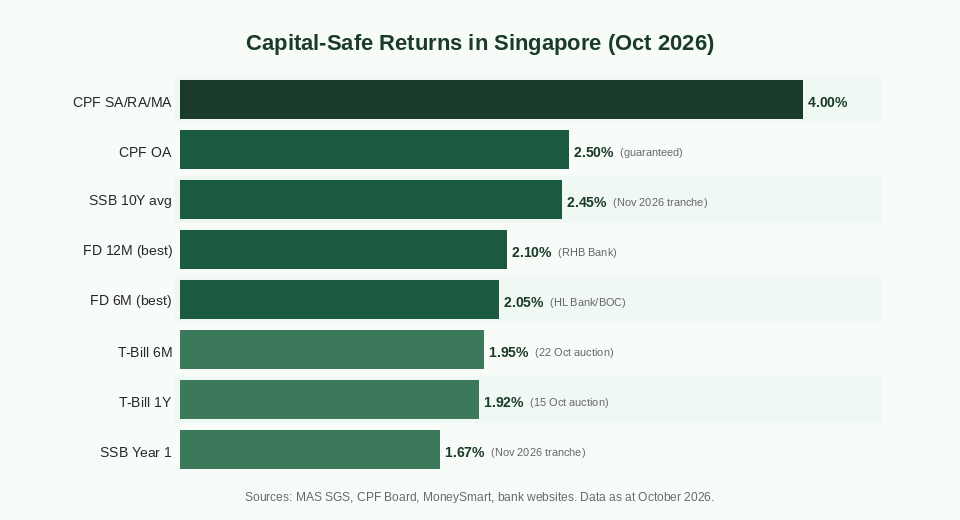
Capital-Safe Returns: CPF, T-Bills, SSBs, Fixed Deposits
Capital-safe instruments are those where your principal is guaranteed — the government, the CPF Board, or a bank backs your return. You will not lose money (in nominal terms) with these instruments. The trade-off is a lower return ceiling and, in some cases, a lock-in period.
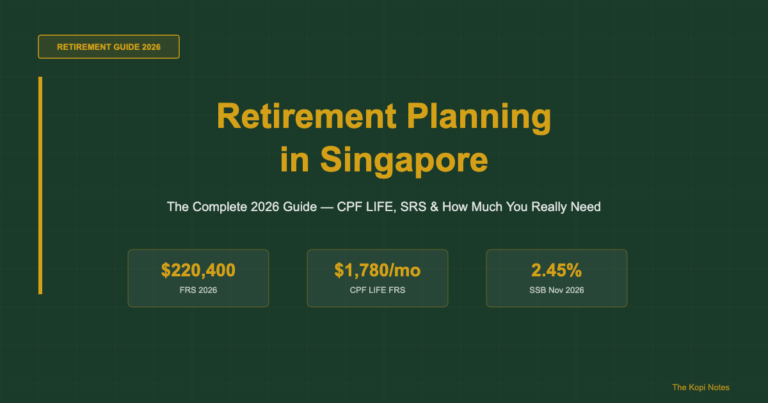
CPF Interest Rates (October 2026)
CPF remains the most generous guaranteed return available to Singapore residents. As of October 2026, the rates are:
| CPF Account | Interest Rate (p.a.) | Notes |
|---|---|---|
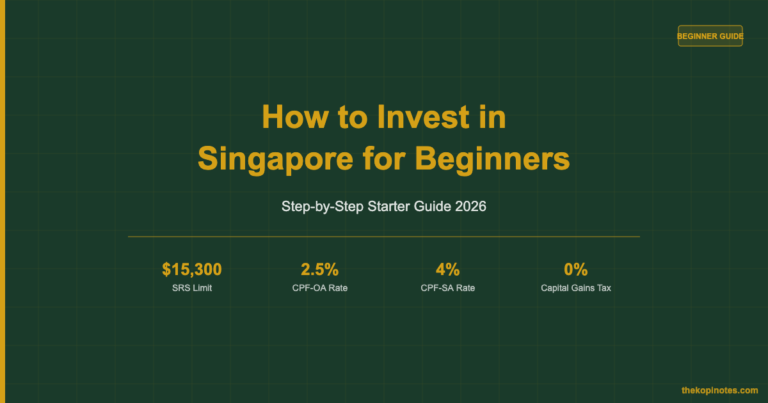
| Ordinary Account (OA) | 2.50% | Minimum guaranteed floor |
| Special Account (SA) | 4.00% | Locked until retirement |
| Retirement Account (RA) | 4.00% | Pays out via CPF LIFE |
| MediSave Account (MA) | 4.00% | For healthcare expenses |
Source: CPF Board official interest rates page, verified October 2026.
CPF members also receive an additional 1% extra interest on the first S$60,000 of combined CPF balances (with the OA capped at S$20,000 for this extra interest). For a 40-year-old with S$60,000 in CPF, that extra 1% is worth S$600 per year.
The CPF SA at 4.00% is the highest guaranteed return available in Singapore, bar none. If you’re eligible for SA voluntary top-ups under the Retirement Sum Topping-Up Scheme, maxing these out before investing elsewhere is mathematically compelling. For a comprehensive look at optimising your CPF, see our guide on CPF investment strategy Singapore.
Singapore T-Bills (Latest Auction Results)
Singapore Government Securities (SGS) T-bills are short-term bonds issued by the Singapore government via MAS. They are available in 6-month and 1-year tenures. The most recent auction results as of late October 2026:
| T-Bill Tenure | Auction Date | Cut-Off Yield | Prev. Auction |
|---|---|---|---|
| 6-Month | 22 Oct 2026 | 1.95% | 1.90% (8 Oct) |
| 1-Year | 15 Oct 2026 | 1.92% | — |
Source: MAS SGS T-bill auction results, October 2026.
T-bills are ideal for money you won’t need for exactly 6 or 12 months and want to earn a government-guaranteed rate. You can also apply for T-bills using CPF OA funds via the CPFIS, though the 1.95% T-bill yield is below the CPF OA’s own 2.50% rate — so from a pure returns standpoint, CPF OA beats T-bills for CPF money. For a step-by-step guide, read our Singapore T-bills 2026 guide.
Singapore Savings Bonds (SSB November 2026)
The November 2026 SSB tranche (GX26110X) offers the following step-up interest rates:
| Year | Annual Interest Rate | Cumulative Average |
|---|---|---|
| Year 1 | 1.67% | 1.67% |
| Years 2–5 | Stepping up | ~2.10% |
| Years 6–10 | Stepping up to 3.08% | ~2.45% |
| 10-Year Average | — | 2.45% |
Source: MAS Singapore Savings Bonds page, November 2026 tranche (GX26110X).
The SSB’s strongest feature is flexibility: you can redeem any month without penalty with one month’s notice. This makes it ideal for money you might need within the next few years but want to earn more than a savings account on in the meantime. For a full SSB strategy guide, see our Singapore Savings Bonds guide.
Fixed Deposits (Best Rates, October 2026)
Local and foreign banks continue to compete for fixed deposit customers. The best rates as of mid-October 2026:
| Tenure | Best Rate | Bank |
|---|---|---|
| 3 months | 1.75% | BOC |
| 6 months | 2.05% | HL Bank / BOC |
| 9 months | 2.00% | BOC |
| 12 months | 2.10% | RHB Bank |
Source: MoneySmart.sg fixed deposit comparison, as at October 18, 2026. Rates are promotional and subject to change; minimum deposit amounts vary by bank.
Growth Returns: S-REITs and ETFs
Unlike capital-safe instruments, growth assets carry market risk — your principal can go up or down. In exchange, they offer higher return potential over the long term. In Singapore’s investment universe, the two main growth asset classes accessible to retail investors are S-REITs (for income-oriented growth) and global UCITS ETFs (for capital growth).
S-REIT Sector Distribution Yields (2026)
Singapore REITs (S-REITs) are listed on the SGX and are legally required to distribute at least 90% of their taxable income to unitholders each year. This makes them a popular income instrument. As of August 2026, the S-REIT sector average distribution yield is approximately 6.0–6.5%, with significant variation by subsector:
| REIT Subsector | Indicative Yield Range | Examples |
|---|---|---|
| Healthcare REITs | 4.0–4.5% | Parkway Life REIT |
| Data Centre REITs | 4.8–5.5% | Keppel DC REIT |
| Retail REITs | 5.5–6.0% | CapitaLand Integrated Commercial Trust |
| Industrial / Logistics | 6.0–6.5% | CapitaLand Ascendas REIT |
| Hospitality REITs | 6.5–7.0% | CDL Hospitality Trusts |
| Office / Diversified | 7.0–8.0% | Suntec REIT |
| Sector Average | ~6.0–6.5% | All S-REITs (SGX listed) |
Source: TKN S-REIT sector yield tracker, August 2026. Yields are distribution (DPU) yield, not total return. Unit prices fluctuate and past distributions are not a guarantee of future distributions.
One important note: S-REIT distribution yields are not the same as guaranteed returns. Unit prices fluctuate — during periods of rising interest rates (2022–2023), many S-REITs saw their unit prices fall significantly, which meant total returns (capital + income) were negative even with 6%+ yields. For the full picture on selecting individual REITs, see our guide to the best S-REITs in Singapore 2026.
S-REIT ETFs like NikkoAM-StraitsTrading Asia ex Japan REIT ETF (CFA) and Lion-Phillip S-REIT ETF (CLR) offer diversified S-REIT exposure in a single trade. Our dedicated Singapore REIT ETF guide covers these in detail.
Global ETF Returns: CSPX and VWRA (2026 Data)
For Singapore investors seeking capital growth over the long term, Ireland-domiciled UCITS ETFs listed on the London Stock Exchange (LSE) are the instrument of choice. The two most popular are:
- CSPX — iShares Core S&P 500 UCITS ETF (Acc), tracks the S&P 500 Index, TER 0.07% p.a., Ireland-domiciled
- VWRA — Vanguard FTSE All-World UCITS ETF (Acc), tracks global equities across ~50 countries, TER 0.22% p.a., Ireland-domiciled
The preference for LSE-listed UCITS ETFs over US-listed equivalents (like VOO or VTI) comes down to two key tax advantages: (1) Ireland has a 15% withholding tax treaty on US dividends vs 30% for non-resident investors holding US-domiciled ETFs; and (2) there is no US estate tax exposure for non-US investors holding UCITS ETFs (versus a USD 60,000 threshold for US-domiciled ETFs that can create significant estate tax liability for Singapore investors).
CSPX 2026 year-to-date performance (through 30 September 2026): approximately +12.6%, closely tracking the S&P 500 Index total return of +12.7% (source: FT Portfolios S&P 500 quarterly commentary, 22 October 2026) minus the 0.07% TER drag. This is a strong return for 9 months — though investors should note that this follows a decade of generally positive equity markets, and past returns do not guarantee future performance.
For historical context: the S&P 500 has historically delivered an average annualised return of approximately 10–13% per year over long periods (20+ years), with significant year-to-year volatility. The 2026 YTD return of ~12.7% is broadly in line with the long-run historical average, but the index has also posted negative years (2022: -18%, 2018: -4%).
Singaporeans can buy CSPX and VWRA through brokers like Interactive Brokers (use referral code jianxiong368 when opening an IBKR account), Syfe (referral code SRPRFFFCD), FSMOne (referral code P0544985), or Endowus (referral code 2V343) for SRS-funded ETF investing.
The Full Returns Comparison Table
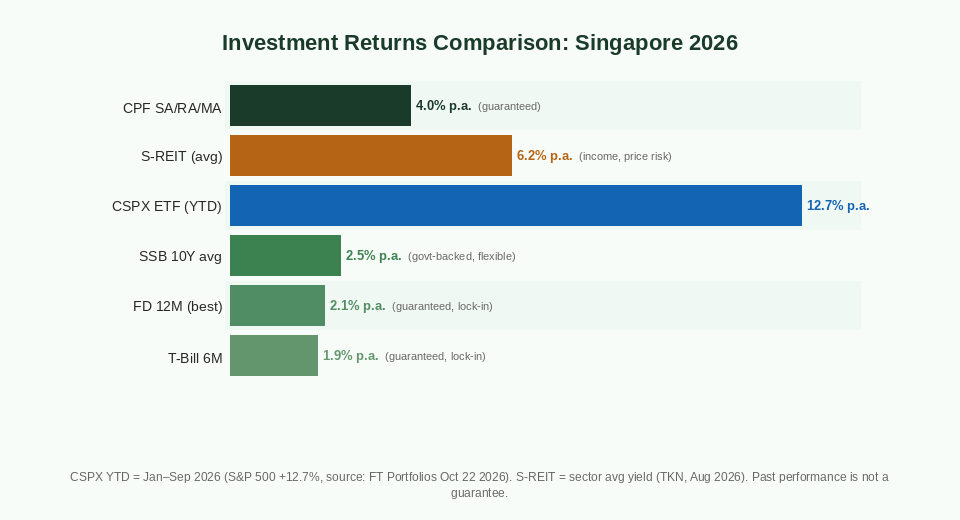
Here is a side-by-side view of all major Singapore investment options in 2026, with verified return figures:
| Investment | 2026 Return / Yield | Risk Level | Liquidity | Min. Investment |
|---|---|---|---|---|
| CPF SA / RA / MA | 4.00% p.a. | Zero (govt-guaranteed) | Locked (retirement) | N/A |
| S-REIT Sector Avg | 6.0–6.5% yield | Medium (price + credit risk) | High (SGX listed) | ~S$200+ (1 lot) |
| CSPX ETF (LSE) | ~12.6% YTD 2026 (Jan–Sep) | Medium-High (equity) | High (LSE listed) | ~USD 520 (1 share) |
| SSB (10-Year Avg) | 2.45% p.a. | Zero (govt-guaranteed) | High (1-month notice) | S$500 |
| Fixed Deposit 12M | 2.10% p.a. | Zero (SDIC-insured up to S$100k) | Low (12-month lock-in) | Varies by bank |
| T-Bill 6M | 1.95% p.a. | Zero (govt-backed) | Low (locked to maturity) | S$1,000 |
| CPF OA | 2.50% p.a. | Zero (govt-guaranteed) | Medium (via CPFIS) | N/A |
| SSB Year 1 Rate | 1.67% p.a. | Zero (govt-guaranteed) | High (1-month notice) | S$500 |
Sources: MAS, CPF Board, RHB/HL Bank/BOC, TKN S-REIT yield tracker (Aug 2026), FT Portfolios (Oct 2026). CSPX YTD reflects S&P 500 total return Jan–Sep 2026. S-REIT yield = distribution yield only, not total return. Past performance is not indicative of future results.
Building Your Investment Mix
Now that you have the verified numbers, how should you actually allocate? The answer is not to pick the “highest return” option and put everything there — it is to match each instrument to the job it is meant to do.
A practical framework for Singapore investors in 2026:
Layer 1 — Emergency Fund (3–6 months of expenses): Keep this in a high-interest savings account or split between a savings account and short-tenure SSBs (redeemable with 1-month notice). You need this to be instantly accessible without penalty.
Layer 2 — Short-Term Goals (1–3 years): T-bills and 6–12 month fixed deposits are ideal here. You’re earning a real return above inflation while keeping the capital fully safe. At current rates, a 12-month FD at 2.10% or a 6M T-bill at 1.95% beats leaving money in most savings accounts.
Layer 3 — Medium-Term / Income (3–10 years): SSBs (for flexibility) or S-REITs (for higher income with some price risk). The SSB 10-year average of 2.45% is a solid risk-free anchor; S-REITs at 6–6.5% yield offer more income but with unit price volatility. Check our guide on passive income Singapore 2026 for a deeper look.
Layer 4 — Long-Term Wealth Building (10+ years): This is where global equity ETFs like CSPX or VWRA belong. The S&P 500’s ~12.7% YTD 2026 return looks great — but investors who stayed through 2022’s -18% decline earned that 2026 return. The key is staying invested through market cycles. Use a tool like our Singapore retirement calculator to project how much you need to invest to reach your goals.
Layer 5 — CPF optimisation (ongoing): The CPF SA at 4.00% guaranteed return is a free return on money you’d have in CPF anyway. Voluntary top-ups for tax relief and SA/RA maximisation should be done before any other investment decision. Every dollar you contribute to SA/MA under the Retirement Sum Topping-Up Scheme also saves you income tax (subject to the S$8,000 annual limit for your own account and S$8,000 for family members’ accounts).
A Worked Example: S$100,000 Investment Portfolio in 2026
If a 40-year-old Singapore resident had S$100,000 to invest in late 2026, here is one way to structure it using the verified returns data above:
- S$20,000 → CPF SA voluntary top-up (if headroom exists): earns 4.00% guaranteed = S$800/year, plus income tax savings at marginal rate (e.g. S$500+ at 15% marginal rate)
- S$20,000 → SSBs (laddered): earns ~2.45% over 10 years = S$490/year, fully flexible
- S$20,000 → 12-month FD at RHB (2.10%): earns S$420/year with 12-month lock-in
- S$20,000 → S-REIT ETF (e.g. CLR or CFA): earns ~6.25% distribution yield = S$1,250/year (income), price return variable
- S$20,000 → CSPX via IBKR: long-term capital growth, historically ~10–13% p.a. but with equity volatility
This 5-layer portfolio earns a blended yield of approximately 3.2% from the safe/income layers, with significant long-term growth potential from the equity layer. It is not the “maximum return” portfolio — that would be 100% CSPX — but it balances guaranteed income, flexibility, and long-term growth in a way suited to most Singapore investors building towards retirement.
Frequently Asked Questions
What is the best investment in Singapore in 2026?
The best investment depends on your goal. For guaranteed safety, CPF SA at 4.00% is unbeatable among government-backed options. For income, S-REITs offer ~6.0–6.5% distribution yields but with price risk. For long-term wealth building, a UCITS ETF like CSPX (S&P 500, +12.7% YTD 2026) offers the highest return potential but with market volatility. Most Singapore investors benefit from a layered approach across all three tiers.
Are Singapore T-bills a good investment in 2026?
Singapore T-bills are a good investment for short-term capital parking. The October 2026 6-month T-bill cut-off yield is 1.95% p.a. — higher than most savings accounts and fully backed by the Singapore government. They are best for money you won’t need for exactly 6 or 12 months. If you need flexibility, SSBs (redeemable monthly) are a better choice; if you want higher guaranteed returns, CPF SA at 4.00% is better for CPF-eligible funds.
Can I get better returns than CPF in Singapore?
Yes, but with more risk. S-REITs offer ~6.0–6.5% distribution yields (higher than CPF OA’s 2.5%, but with unit price risk). Global equity ETFs like CSPX returned ~12.7% YTD in 2026 (well above all CPF rates), but equity markets can also lose 18–20% in a bad year. CPF SA’s 4.00% is the highest available risk-free guaranteed return in Singapore — no market instrument consistently beats it on a risk-adjusted basis over the long term.
How much can I earn from S-REITs vs T-bills?
On a S$100,000 portfolio at current rates: S-REITs (sector average ~6.25% yield) would generate approximately S$6,250/year in distributions. T-bills at 1.95% would generate S$1,950/year in interest — but with zero risk to your principal. The S-REIT income is higher, but S-REIT unit prices fluctuate and distributions are not guaranteed. The right choice depends on whether you need income stability (T-bills) or are comfortable with some price volatility in exchange for higher income (S-REITs).
Is CSPX a good investment for Singapore residents in 2026?
CSPX (iShares Core S&P 500 UCITS ETF) is the most popular S&P 500 ETF for Singapore investors due to its Ireland domicile (15% US dividend withholding tax vs 30% for US-domiciled ETFs) and no US estate tax exposure. It returned approximately +12.6% YTD through September 2026, in line with the S&P 500’s strong performance. However, equity ETFs carry market risk — they are suitable for money you won’t need for at least 5–10 years. Minimum investment is approximately USD 520 per share on the LSE.
What is the safest investment with the highest return in Singapore?
Among genuinely risk-free options in Singapore 2026, CPF SA/RA/MA at 4.00% per year is the highest return available. It is backed by the Singapore government, compounded annually, and has no market risk. The catch is that SA/RA funds are locked until retirement age. For accessible funds, SSBs (2.45% 10-year average, fully flexible) and 12-month fixed deposits (2.10%, 12-month lock-in) are the next-best options with zero default risk.
Should I invest in S-REITs or ETFs as a Singapore investor?
Both have a role, and they serve different purposes. S-REITs are income instruments — they distribute 90%+ of income quarterly or semi-annually, making them ideal for investors who want regular cash flow. ETFs like CSPX are growth instruments — they compound returns internally (if accumulating) and suit investors building wealth over 10–20 years. Many Singapore investors hold both: REITs for passive income, global ETFs for long-term capital growth. The allocation between them depends on how soon you need the income and how much price volatility you can tolerate.
Start Investing in Singapore Today
Use our referral links for exclusive sign-up bonuses when opening a brokerage or investment account.
This article was researched with the help of AI. While we strive to keep all information accurate and up to date, there may be errors. If you notice any discrepancies, please contact us.