How to Invest in Singapore: CSPX, VWRA and LSE ETFs Explained (2026)
The complete Singapore investor’s guide to Ireland-domiciled UCITS ETFs — lower withholding tax, no US estate tax risk, and step-by-step buying instructions.
The most tax-efficient way to invest in Singapore is through Ireland-domiciled UCITS ETFs like CSPX and VWRA, listed on the London Stock Exchange (LSE). These funds pay only 15% withholding tax on US dividends — half the 30% rate applied to US-domiciled ETFs like VOO or SPY — and carry zero US estate tax risk. Singapore investors can buy them through IBKR, Syfe, or FSMOne in a few simple steps.
Not financial advice. All figures are for educational reference only. Data as at October 2026 unless noted.
Table of Contents
The Hidden Tax Problem Most Singapore Investors Miss
Most Singapore investors who read about ETF investing gravitate toward the big US names: Vanguard’s VOO, BlackRock’s IVV, or SPDR’s SPY. These funds are well-known, highly liquid, and carry impressively low expense ratios. On paper, they look hard to beat.
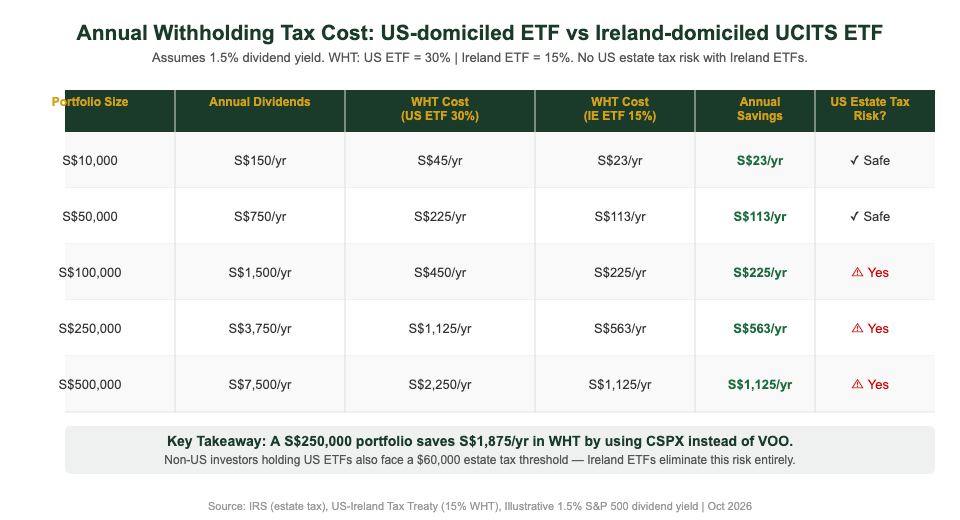
But there is a structural tax disadvantage that does not show up in any fund’s performance chart — withholding tax (WHT) on US-source dividends. The United States levies a 30% withholding tax on dividends paid to non-US residents unless a tax treaty reduces that rate. Singapore does not have a comprehensive income tax treaty with the US that covers investment income. That means every time a US-domiciled ETF like VOO distributes dividends, 30 cents in every dollar of dividend income is withheld by the US government before reaching your account.
For a Singapore investor holding a SGD 250,000 position in VOO with a 1.5% annual dividend yield, that works out to roughly SGD 1,125 lost to US withholding tax every single year — money that compounds silently against you over a 20-year investment horizon.
There is a second, less discussed risk: US estate tax. Non-US residents who hold assets “situated in the United States” — which includes shares of US-listed ETFs — face a US estate tax threshold of just USD 60,000. If a Singapore investor holding USD 300,000 in VOO were to pass away, their estate could face US estate tax on the amount above that threshold. Ireland-domiciled ETFs, by contrast, are not considered US-sited assets and carry no US estate tax exposure whatsoever.
These two factors — the 30% WHT and the USD 60,000 estate tax threshold — are the core reason why experienced Singapore investors consistently choose LSE-listed, Ireland-domiciled UCITS ETFs over their US counterparts. The solution is CSPX and VWRA.
How Ireland-Domiciled UCITS ETFs Work
UCITS stands for Undertakings for Collective Investment in Transferable Securities, the European Union’s regulatory framework for investment funds. A UCITS ETF domiciled in Ireland benefits from the US-Ireland double tax treaty, which reduces the withholding tax rate on US-source dividends from 30% to 15%. That single difference cuts your ongoing tax drag on dividends in half.
The two most popular Ireland-domiciled ETFs among Singapore investors are:
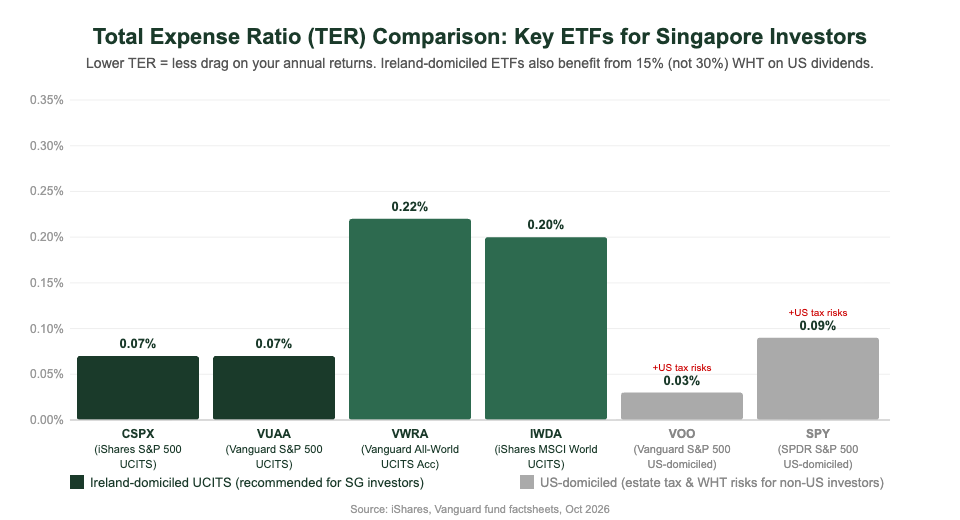
CSPX — iShares Core S&P 500 UCITS ETF (Acc): Managed by BlackRock’s iShares range, CSPX tracks the S&P 500 Index — the 500 largest US-listed companies by market capitalisation. It is structured as an accumulating fund, meaning dividends received from underlying stocks are automatically reinvested within the fund rather than distributed to you. This is highly tax-efficient for Singapore investors, as you pay no dividend tax at all. The total expense ratio (TER) is 0.07% per annum, and the fund holds around USD 80 billion in assets under management, making it one of the most liquid ETFs on the London Stock Exchange (according to iShares factsheet, Q3 2026).
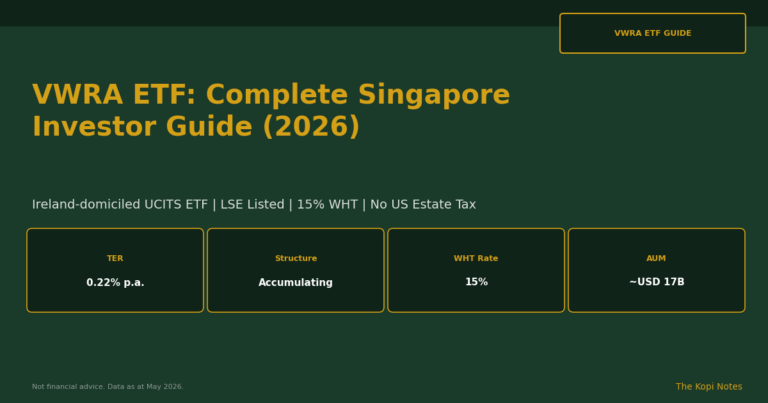
VWRA — Vanguard FTSE All-World UCITS ETF (Acc): Managed by Vanguard, VWRA tracks the FTSE All-World Index, covering approximately 3,800 stocks across 49 countries — both developed and emerging markets. Like CSPX, it is accumulating, so dividends are reinvested automatically. The TER is 0.22% per annum. VWRA gives you broad global diversification in a single fund; around 65% of its holdings are US equities, with the remainder spread across Europe, Asia, and emerging markets (according to Vanguard fund factsheet, Q3 2026).
Both funds are denominated in US dollars and listed on the London Stock Exchange (LSE) under their respective tickers. The LSE listing means you can buy and sell them through any international brokerage that provides LSE market access — including Interactive Brokers, Saxo Markets, and FSMOne.
| Metric | CSPX | VWRA |
|---|---|---|
| Full Name | iShares Core S&P 500 UCITS ETF (Acc) | Vanguard FTSE All-World UCITS ETF (Acc) |
| Index Tracked | S&P 500 (500 US large caps) | FTSE All-World (~3,800 global stocks) |
| Domicile | Ireland | Ireland |
| Structure | Accumulating | Accumulating |
| TER (p.a.) | 0.07% | 0.22% |
| US WHT on Dividends | 15% (Ireland treaty) | 15% on US portion |
| US Estate Tax Risk | None | None |
| Currency | USD (LSE) | USD (LSE) |
Source: iShares and Vanguard fund factsheets, October 2026.
The Singapore Context: Tax Advantages and SRS
Singapore investors are in an unusually favourable position when it comes to ETF investing. Three structural advantages compound the benefits of Ireland-domiciled ETFs:
No capital gains tax (CGT). Singapore does not levy capital gains tax. Every dollar of price appreciation on your CSPX or VWRA holdings is yours to keep when you eventually sell. This makes accumulating ETFs particularly powerful in Singapore: the fund reinvests dividends internally (paying only the 15% WHT before reinvestment), and your entire gain accumulates without any Singapore-side tax on growth.
No dividend tax on accumulating ETFs. For accumulating ETFs like CSPX and VWRA, there is no “distribution” event in Singapore — meaning IRAS does not tax the internal reinvestment of dividends within the fund. The 15% WHT happens at the fund level in Ireland, on US-source dividends, before the fund price increases to reflect the retained income.
The Supplementary Retirement Scheme (SRS). Singapore citizens and PRs can contribute up to SGD 15,300 per year to their SRS account and claim a full tax deduction on that contribution. Many SRS-linked brokers, including FSMOne (referral code P0544985), allow you to purchase LSE-listed ETFs like CSPX and VWRA directly using SRS funds. For a taxpayer in the 7% income tax bracket, a SGD 15,300 SRS contribution saves SGD 1,071 in tax annually — and those funds then compound in a tax-sheltered environment until retirement.
To understand how ETF investing fits into a broader retirement and CPF strategy, the CPF investment strategy guide on TKN covers how your OA and SA savings interact with your broader portfolio. LSE ETFs cannot be purchased using CPF funds directly, but they pair well with a CPF-first, SRS-second approach — use CPF’s guaranteed 2.5-4% risk-free returns as your bond allocation, and CSPX/VWRA in a cash or SRS account for equity exposure.
For a quick sense of how much you need to invest and for how long, try the Singapore retirement calculator to see your numbers in SGD terms.
CSPX vs VWRA: Which ETF Is Right for You?
The debate between CSPX and VWRA is one of the most common questions Singapore investors face when starting their LSE ETF journey. Both are excellent choices — but they serve different investment goals.
CSPX concentrates on US equities. The S&P 500 has delivered an annualised return of approximately 10.5% per year over the past 30 years (Morningstar, January 2026). Investors who believe US technology, healthcare, and consumer companies will continue to lead global growth over the next decade prefer CSPX. Its ultra-low 0.07% TER means almost none of your return is eaten by costs — for a SGD 100,000 portfolio, total annual fees are just SGD 70.
VWRA gives you the whole world. With holdings across the US (~65%), Europe (~15%), Japan (~6%), emerging markets (~8%), and other developed markets, VWRA is genuinely diversified. Investors who are concerned about US valuation concentration — the S&P 500 was trading at a cyclically adjusted P/E above 30 for much of 2024-2026 — prefer VWRA as a hedge against US underperformance. The downside is a slightly higher 0.22% TER and somewhat lower historical returns versus a US-only index, though that gap is not guaranteed to persist.
| Factor | Choose CSPX if… | Choose VWRA if… |
|---|---|---|
| Geographic Preference | You want US-only exposure | You want global diversification |
| Cost Sensitivity | Maximum cost efficiency (0.07% TER) | Comfortable with 0.22% TER |
| Risk Tolerance | Comfortable with US concentration | Prefer lower single-country risk |
| Portfolio Role | Core US equity block | All-in-one global equity fund |
| Simplicity | Pair with another fund for global coverage | One fund covers the world — maximum simplicity |
Source: TKN analysis, iShares and Vanguard factsheets, October 2026.
For most Singapore investors building a long-term passive portfolio, either CSPX or VWRA is a solid choice. If you want the simplest possible strategy — one fund, automatic rebalancing, global coverage — VWRA wins on simplicity. If you want the lowest cost and believe in US equity dominance, CSPX is the better pick. Many experienced investors hold both: CSPX for the bulk of their equity allocation, VWRA for emerging market and European exposure. For diversification beyond equities, the Singapore REIT ETF guide covers how real estate investment trusts complement a CSPX/VWRA portfolio with income and local-market exposure.
How to Buy CSPX or VWRA in Singapore (Step by Step)
Buying LSE-listed ETFs from Singapore is straightforward with the right broker. Here is the step-by-step process using the three most popular platforms:
Option 1: Interactive Brokers (IBKR) — Best for Larger Portfolios
IBKR is the go-to choice for cost-conscious Singapore investors with larger portfolios. Commission rates are as low as USD 1.70 per trade on LSE-listed ETFs under the tiered pricing plan, and the platform gives you direct access to the London Stock Exchange’s order book.
- Open an account at ibkr.com. Use referral code jianxiong368 for bonus credits on your first trades. The application process takes 1-3 business days.
- Fund your account in SGD via bank transfer. IBKR will automatically convert to USD (or GBP if you prefer to buy in sterling) at a very competitive FX spread of around 0.1-0.2%.
- Search for CSPX or VWRA in the IBKR Trader Workstation (TWS) or mobile app. When prompted to select an exchange, choose “LSE” (London Stock Exchange).
- Place a limit order during LSE trading hours (3pm–11pm Singapore time). Limit orders protect you from unexpected price moves — set your limit price near the current bid/ask midpoint.
- Monitor your holding in the IBKR portfolio view. Your CSPX/VWRA position will show in USD.
Option 2: FSMOne — Best for SRS and Automated Regular Savings
FSMOne (formerly known as Fundsupermart) is a Singapore-headquartered broker that supports SRS account investing in LSE ETFs. This makes it the best choice if you want to use your annual SGD 15,300 SRS contribution to buy CSPX or VWRA and claim the income tax deduction. Sign up with the FSMOne referral code P0544985 for a welcome bonus. FSMOne also offers a Regular Savings Plan (RSP) feature that automates monthly ETF purchases — ideal for dollar-cost averaging into CSPX or VWRA without having to remember to log in each month.
Option 3: Syfe — Best for Hands-Off Investors
Syfe offers a brokerage account that is particularly beginner-friendly, with a clean mobile-first interface and no minimum balance requirements. Use the Syfe referral code SRPRFFFCD for a cash bonus on your first deposit. You can search for CSPX or VWRA in the Syfe brokerage app and place market or limit orders on the LSE. Syfe also offers robo-managed ETF portfolios if you’d prefer a completely hands-off approach, though these come at a higher annual fee than direct ETF ownership.
Option 4: Endowus — Best for Cash and CPF Investing
Endowus is the platform to consider if you want to invest your CPF OA funds (though note that CPF OA cannot be used to buy LSE ETFs directly). Endowus uses CPF funds to invest in unit trusts and fund management portfolios. For LSE ETF exposure specifically, you’ll need a cash or SRS account. Sign up with the Endowus referral code 2V343 for a welcome gift on your first investment.
Worked Example: Monthly Investment of SGD 1,000 in CSPX via IBKR
Assume you invest SGD 1,000 per month in CSPX through IBKR, starting with SGD 10,000 as an initial lump sum, at an assumed 8% per annum long-term return.
- Year 1: ~SGD 23,200 (initial SGD 10,000 + 12 months × SGD 1,000, compounding at 8%)
- Year 5: ~SGD 85,000
- Year 10: ~SGD 198,000
- Annual IBKR cost: 12 trades × USD 1.70 ≈ USD 20 (SGD ~27), plus 0.07% TER on the portfolio
By comparison, the same investment through a US-domiciled ETF like VOO would lose an additional ~SGD 300-500 per year in WHT drag at portfolio sizes above SGD 100,000 — a difference that compounds meaningfully over 10+ years. Use our Singapore retirement calculator to run your own numbers and see how ETF investing fits into your retirement timeline.
Important: The above projections are illustrative only and do not account for market fluctuations, currency movements, or changes in tax law. Past performance of the S&P 500 does not guarantee future results.
Frequently Asked Questions
How do I invest in Singapore using ETFs as a beginner?
The simplest approach is to open a brokerage account (IBKR, FSMOne, or Syfe), deposit funds, and buy either CSPX (S&P 500, US-focused) or VWRA (global diversification) on the London Stock Exchange. Both are Ireland-domiciled, which means you pay 15% withholding tax on US dividends instead of 30%, and you have zero US estate tax exposure. Start with whichever fund matches your preference — you can always add the other later. Many beginners find VWRA simpler because it provides global coverage in a single fund without needing to build a multi-fund portfolio.
Is CSPX safe to invest in from Singapore?
CSPX is a UCITS-regulated fund managed by BlackRock, one of the world’s largest asset managers with over USD 10 trillion in AUM. It holds physical shares of all 500 S&P 500 companies. As a Singapore investor, you are exposed to US equity market risk — the S&P 500 can and does fall significantly in bear markets — but you face no counterparty risk with the fund manager, no US estate tax risk, and no currency restriction risk. Your CSPX shares are held in your broker account in your name, not commingled with other clients’ assets.
What is the difference between CSPX and VOO?
Both CSPX and VOO track the S&P 500 and have near-identical underlying holdings and returns before taxes and costs. The critical difference is domicile: CSPX is Ireland-domiciled (15% US dividend WHT, zero US estate tax risk), while VOO is US-domiciled (30% WHT for Singapore investors, USD 60,000 US estate tax threshold for non-US persons). VOO has a lower TER of 0.03% vs CSPX’s 0.07%, but the 15% WHT saving on dividends easily outweighs this small TER difference for Singapore investors. CSPX is the better choice for Singapore investors in almost every case.
Can I buy CSPX or VWRA using SRS funds?
Yes, certain brokers allow you to buy LSE-listed ETFs like CSPX and VWRA using your Supplementary Retirement Scheme (SRS) funds. FSMOne is one of the most popular platforms for SRS-linked ETF investing in Singapore. You contribute up to SGD 15,300 per year to your SRS account (citizens/PRs), claim a full income tax deduction on that contribution, and then invest the funds in CSPX or VWRA through your FSMOne SRS brokerage account. Withdrawals after age 62 are taxed at 50% of the amount withdrawn, at prevailing income tax rates — making the SRS most beneficial for investors in higher income tax brackets during their earning years.
What is the US estate tax risk and how do Ireland ETFs avoid it?
The US imposes an estate tax on assets “situated in the United States” when a non-US person passes away. For non-US residents, this tax applies to US-sited assets above USD 60,000 — a threshold that is easily exceeded by even a modest investment in a US-listed ETF like VOO. Ireland-domiciled ETFs like CSPX and VWRA are not considered US-sited assets under US tax law, because they are funds registered and domiciled in Ireland. Your estate therefore has no US estate tax exposure regardless of how large your CSPX or VWRA holding grows. This is one of the most significant but underappreciated reasons to use LSE-listed ETFs.
How much does it cost to buy CSPX or VWRA through IBKR in Singapore?
IBKR charges approximately USD 1.70 per trade on LSE-listed ETFs under its tiered pricing structure (exact commission depends on trade size and monthly volume). There is no custody fee for holdings below a certain threshold, and no inactivity fee since IBKR removed that charge. The only ongoing cost is CSPX’s 0.07% TER or VWRA’s 0.22% TER, deducted automatically from the fund’s net asset value. For a monthly investor making 12 trades per year, total trading costs through IBKR are approximately USD 20 per year — making it one of the lowest-cost routes to LSE ETF investing available in Singapore.
Should I choose CSPX or VWRA for a long-term passive portfolio?
Both are excellent for a long-term passive strategy. Choose CSPX if you want maximum cost efficiency (0.07% TER), concentrated US equity exposure, and a track record closely tied to global technology and consumer sector leadership. Choose VWRA if you prefer a single-fund all-in-one portfolio with global diversification and lower concentration in any single country. Many Singapore investors use a split — holding CSPX as their core US equity position and supplementing with VWRA or a Singapore REIT ETF for broader diversification and local income. There is no single right answer; consistency of investment matters more than which fund you pick.
Start Investing in CSPX or VWRA Today
Open a brokerage account and buy your first LSE ETF in under an hour. Use our referral links for welcome bonuses.
This article was researched with the help of AI. While we strive to keep all information accurate and up to date, there may be errors. If you notice any discrepancies, please contact us.