SRS vs CPF Cash Top-Up: Which Saves More Tax in Singapore (2026 Guide)?
A side-by-side breakdown of both tax relief schemes — limits, returns, flexibility, and which strategy suits your income level in 2026.
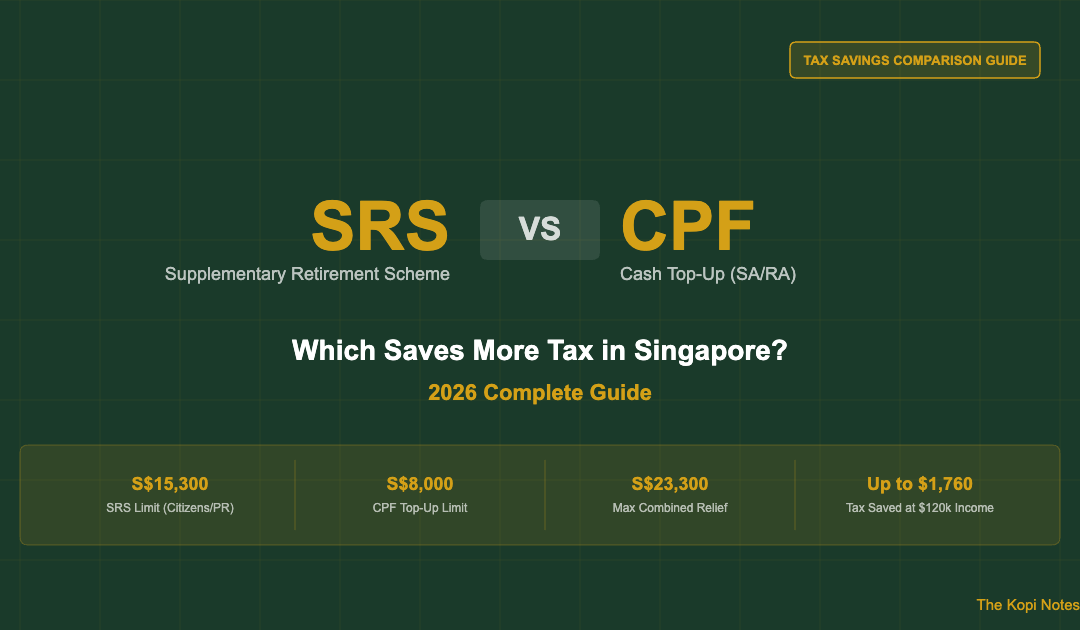
Both the Supplementary Retirement Scheme (SRS) and CPF Cash Top-Up offer direct income tax relief for Singapore residents in 2026. SRS lets citizens and PRs contribute up to S$15,300 per year (foreigners: S$35,700), while CPF Cash Top-Up gives up to S$8,000 relief per recipient account — with contributions earning a guaranteed 4% p.a. in your Special or Retirement Account. Combined, you can claim up to S$23,300 in annual tax relief by using both schemes.
Not financial advice. All figures are for educational reference only. Data as at October 2026 unless noted.
Quick Comparison: SRS vs CPF Cash Top-Up
Before diving into the details, here is a side-by-side snapshot of both schemes for Singapore citizens and PRs in 2026:
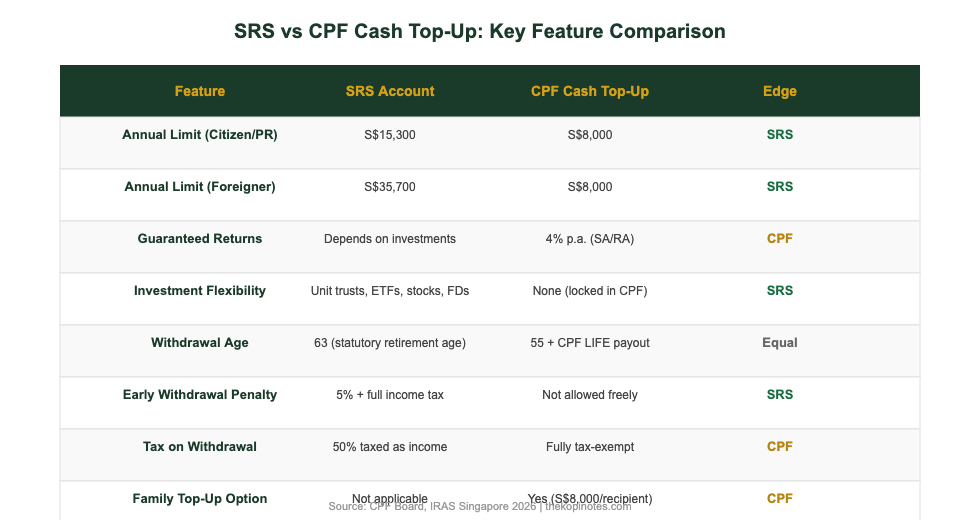
| Feature | SRS Account | CPF Cash Top-Up |
|---|---|---|
| Annual Limit (Citizen/PR) | S$15,300 | S$8,000 (own acct) |
| Annual Limit (Foreigner) | S$35,700 | S$8,000 (own acct) |
| Guaranteed Returns | Depends on investments | 4% p.a. (SA) / 4% p.a. (RA) |
| Investment Flexibility | Unit trusts, ETFs, stocks, FDs | None — earns CPF interest |
| Penalty-Free Withdrawal Age | 63 (statutory retirement age) | 55+ via CPF LIFE payouts |
| Tax on Withdrawal | 50% of withdrawal taxed as income | Fully tax-exempt |
| Top-Up for Family Members | Not available | Yes — up to S$8,000 per recipient |
Source: CPF Board, IRAS Singapore, October 2026
How the SRS Account Works
The SRS is a voluntary savings scheme run by the Ministry of Finance and administered through three local banks: DBS, OCBC, and UOB. It was designed to encourage Singaporeans to save beyond their CPF for retirement, while providing a meaningful tax incentive to do so.
Every dollar you contribute to your SRS account reduces your chargeable income by the same amount. If you earn S$120,000 per year and contribute the full S$15,300, your taxable income drops to S$104,700 — saving you S$1,760 in income tax based on Singapore’s 2026 tax rates.
Unlike CPF, your SRS balance does not earn a guaranteed interest rate. Instead, you invest it through your SRS account in a range of eligible instruments approved by the Monetary Authority of Singapore (MAS), including:
- Singapore-listed shares (SGX)
- Unit trusts and ETFs (including those on FSMOne’s SRS platform)
- Singapore Government Securities (SGS bonds, T-bills)
- Fixed deposits at SRS-approved banks
- Endowment policies and annuities
If you invest wisely, SRS can generate returns significantly higher than CPF’s 4% guarantee. However, with higher potential returns comes market risk — your SRS balance can fall if your investments underperform.
SRS Withdrawal rules: From the statutory retirement age of 63 (as at 2026), you can withdraw your SRS balance over a 10-year period. Only 50% of each withdrawal is added to your chargeable income, meaning the tax rate on SRS withdrawals is effectively halved. If you withdraw before 63, a 5% penalty applies and the full amount counts as chargeable income — not the 50% concession.
For a deeper dive into how SRS investments work, Endowus and Syfe both offer SRS-compatible portfolios. You can open an Endowus account with referral code 2V343 or a Syfe account with referral code SRPRFFFCD to access SRS investing.
How CPF Cash Top-Up Works
A CPF Cash Top-Up means voluntarily putting extra cash from your own bank account into either your CPF Special Account (SA, for those below 55) or Retirement Account (RA, for those 55 and above). This is separate from your mandatory CPF contributions deducted from your salary — it is a deliberate, voluntary boost to your retirement savings.
The tax relief for CPF Cash Top-Ups is straightforward: you can claim up to S$8,000 per year for topping up your own SA or RA. Additionally, you can claim another S$8,000 for topping up a family member’s account (spouse, siblings, parents, parents-in-law, or grandparents), bringing the total possible relief to S$16,000 per year.
The interest rate advantage is significant. Your SA earns 4% p.a., with an additional 1% paid on the first S$60,000 of combined CPF balances. This 4–5% risk-free return is considerably higher than Singapore fixed deposits (around 1.8–2.2% p.a. in 2026) and competitive with Singapore Savings Bonds (SSB). For details on risk-free alternatives, see our guide on Singapore T-bills 2026.
Important caveat: CPF top-ups are irreversible. Once you top up your SA or RA, you cannot withdraw that money outside of standard CPF withdrawal rules. This means you are locking the funds away until retirement. Unlike SRS, there is no investment flexibility — your top-up simply earns CPF interest rates.
The SA has a balance cap: once your SA balance reaches the Full Retirement Sum (FRS) — set at S$213,000 for those turning 55 in 2026 — you can no longer top up the SA. Contributions would then go to your MA (MediSave Account) instead, which earns the same 4% but is restricted to medical use.
Tax Savings by Income Bracket
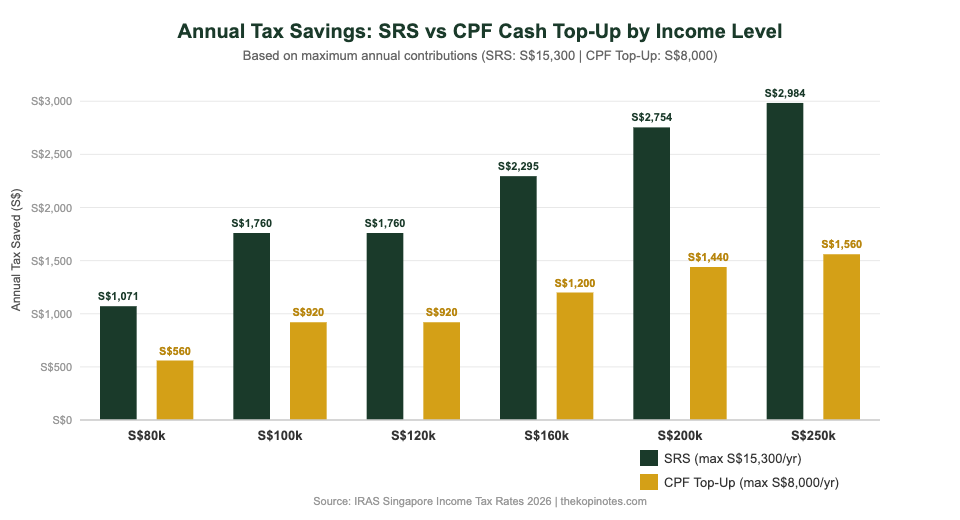
The actual dollars you save depend on your marginal income tax rate — the rate applied to the last portion of your income. When you contribute to SRS or top up CPF, you are effectively removing that amount from your highest-taxed income bracket. Here is how the math works for different income levels in 2026, assuming maximum contributions:
| Annual Income | Marginal Tax Rate | SRS Tax Saved (S$15,300) | CPF Top-Up Saved (S$8,000) | Combined Saving |
|---|---|---|---|---|
| S$80,000 | 7% | S$1,071 | S$560 | S$1,631 |
| S$100,000 | 11.5% | S$1,760 | S$920 | S$2,680 |
| S$120,000 | 11.5% | S$1,760 | S$920 | S$2,680 |
| S$160,000 | 15% | S$2,295 | S$1,200 | S$3,495 |
| S$200,000 | 18% | S$2,754 | S$1,440 | S$4,194 |
| S$250,000 | 19.5% | S$2,984 | S$1,560 | S$4,544 |
Source: IRAS Singapore income tax rates 2026. Figures assume maximum annual contributions and that the full contribution falls within the stated marginal tax bracket. Individual results may vary.
Key insight: SRS consistently saves more tax than CPF Cash Top-Up in absolute dollar terms because its annual contribution limit is nearly double — S$15,300 vs S$8,000. However, the CPF top-up compounds at a guaranteed 4% p.a., while SRS returns depend on your investment choices. For a Singapore resident earning S$200,000, using both schemes together saves S$4,194 per year — the equivalent of paying zero income tax on S$23,300 of income.
Which Is More Flexible?
Flexibility is where SRS and CPF Cash Top-Ups differ most sharply. Here is an honest assessment for Singapore investors in 2026.
SRS is more flexible for investments. Your SRS account can hold Singapore equities, unit trusts, ETFs, T-bills, and fixed deposits. You are not locked into a single product — you can diversify, rebalance, and even switch to lower-risk instruments as you approach retirement. Platforms like FSMOne (referral code P0544985) offer SRS-compatible ETF investing at low fees.
CPF Cash Top-Ups are simpler but rigid. There is no investment decision involved — the money earns a government-backed 4% p.a. once deposited. This is an advantage for investors who do not want to actively manage money, but a limitation for those who want to pursue higher returns through equities. Critically, CPF top-ups cannot be reversed. Once contributed, the funds follow CPF withdrawal rules and form part of your retirement payouts via CPF LIFE.
Withdrawal flexibility: SRS allows a full lump-sum withdrawal from age 63 (with the 50% taxable concession). CPF works differently — SA/RA balances are drawn down via CPF LIFE monthly payouts that start from age 65, not as a lump sum at will. If you anticipate needing access to a meaningful retirement nest egg before 65, SRS gives you more control.
For retirement planning context, our Singapore retirement calculator can help you model how much you need to accumulate across both CPF and SRS to hit your target monthly income in retirement.
Can You Use Both Schemes?
Yes — and for most working Singaporeans earning above S$80,000, using both is the optimal strategy. There is no restriction on contributing to SRS and making a CPF Cash Top-Up in the same calendar year. The reliefs stack.
A Singapore resident earning S$150,000 could, for example:
- Contribute S$15,300 to SRS → saves approximately S$2,115 in income tax (at ~13.8% blended marginal rate)
- Top up SA with S$8,000 cash → saves approximately S$1,104 in income tax
- Top up spouse’s RA with S$8,000 → saves another S$1,104
- Total tax saved: ~S$4,323 per year, on a combined cash outlay of S$31,300
That outlay also grows: the S$15,300 in SRS earns investment returns, and the S$16,000 CPF top-up earns 4–5% p.a. guaranteed. Your effective “yield” on the tax savings alone, before investment returns, is meaningful.
One important note: the CPF Cash Top-Up relief applies only to top-ups made to the current-year SA/RA within the annual limit. Topping up MediSave (MA) does not attract the same S$8,000 personal relief (it falls under the MediSave top-up relief instead, which is a separate S$2,730 cap). Check your current relief utilisation via the IRAS myTax Portal to ensure you are not double-counting.
Who Should Prioritise Which?
The right priority depends on your income level, investment confidence, and proximity to retirement.
Prioritise SRS if you:
- Earn above S$80,000 and are in a meaningful tax bracket (7% or above)
- Have a long time horizon (10+ years before retirement at 63)
- Are comfortable managing investments and want exposure to equities, ETFs, or unit trusts
- Are a foreigner working in Singapore — the SRS limit of S$35,700 offers significantly larger tax relief
- Want more control over how your retirement savings are invested
Prioritise CPF Cash Top-Up if you:
- Have not yet reached the SA Full Retirement Sum cap (S$213,000 in 2026)
- Value a guaranteed, risk-free 4% return above market-linked returns
- Want to top up a family member’s account (spouse, parents) for additional tax relief
- Prefer a simple “set and forget” approach — no investment decisions required
- Are within 5–10 years of 55 and want to boost your retirement payout amount
For a comprehensive comparison of passive income approaches beyond just retirement accounts, see our guide on passive income Singapore 2026.
Frequently Asked Questions
What is the SRS account contribution limit in Singapore for 2026?
For Singapore citizens and Permanent Residents, the SRS contribution limit in 2026 is S$15,300 per year. For foreigners working in Singapore, the limit is S$35,700 per year. Every dollar contributed reduces your chargeable income by the same amount, so the tax saving equals your contribution multiplied by your marginal income tax rate.
Is SRS better than CPF Cash Top-Up for tax savings?
SRS saves more tax in absolute dollar terms because its contribution limit (S$15,300) is nearly double the CPF Cash Top-Up limit (S$8,000) for citizens and PRs. At a marginal rate of 15%, SRS saves S$2,295 vs S$1,200 from a CPF top-up. However, CPF Cash Top-Up earns a guaranteed 4% p.a., while SRS returns depend on your investment choices. Most high-income earners use both schemes to maximise total tax relief.
Can I top up both my SRS and CPF in the same year?
Yes. There is no restriction on contributing to SRS and making a CPF Cash Top-Up in the same tax year. The reliefs are separate and cumulative. By contributing the maximum to both, a Singapore resident can claim up to S$23,300 in annual tax relief (S$15,300 SRS + S$8,000 CPF top-up to own account), plus a further S$8,000 for topping up a qualifying family member’s CPF account.
What happens to my SRS account when I reach retirement age?
From age 63 (the statutory retirement age as at 2026), you can withdraw from your SRS account without the 5% early withdrawal penalty. Crucially, only 50% of each withdrawal is added to your chargeable income — meaning the effective tax rate on your SRS withdrawals is roughly halved compared to when you earned the money. To minimise tax, most financial planners recommend spreading SRS withdrawals over the maximum 10-year withdrawal window.
Can I invest my SRS funds in ETFs or unit trusts?
Yes. SRS funds can be invested in a wide range of instruments approved by the Monetary Authority of Singapore, including Singapore-listed ETFs, unit trusts, stocks on the SGX, Singapore Government Securities (SGS bonds and T-bills), and fixed deposits with SRS-approved banks. Platforms like Endowus and Syfe offer SRS-compatible portfolios that allow you to invest in global ETFs through your SRS account. Unlike CPF funds, SRS money is not restricted to the CPF Investment Scheme (CPFIS) approved list.
What is the penalty for early withdrawal from SRS?
If you withdraw from your SRS account before reaching the statutory retirement age of 63, a 5% penalty is imposed on the withdrawn amount. In addition, the full withdrawal amount (not the 50% concession) is added to your chargeable income for that year. This double penalty makes early SRS withdrawal expensive. In contrast, if you face a genuine financial emergency, you cannot access CPF Cash Top-Up funds at all outside of standard CPF rules — making SRS slightly more accessible in extreme circumstances, even with the penalty.
Ready to Open Your SRS Account or Start Investing?
Use our referral links to open an SRS-compatible investment account and start maximising your tax relief today.
This article was researched with the help of AI. While we strive to keep all information accurate and up to date, there may be errors. If you notice any discrepancies, please contact us.