5 Things Singapore Investors Should Watch This Week (26–30 Oct 2026)
Your weekly market preview — the five events that will move your portfolio this week, translated for Singapore investors.
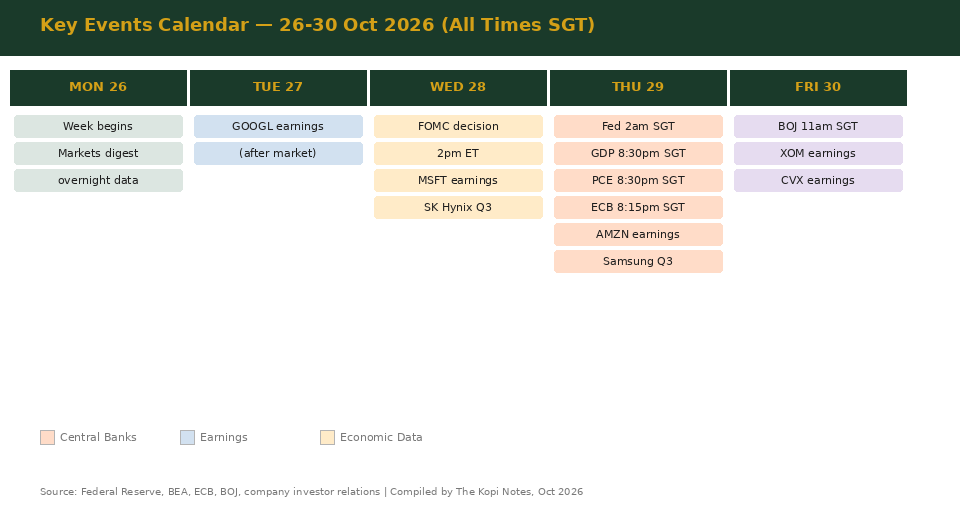
The week of 26–30 October 2026 is one of the busiest of the year for global markets — and every event on the calendar has a direct line to Singapore investors’ wallets. The Fed decides on rates (Thursday 2 AM SGT), Big Tech reports earnings, the US releases GDP and PCE inflation data, and both the ECB and Bank of Japan announce policy decisions. Here is what to watch and what it means for your T-bills, ETFs, and FX rates.
Not financial advice. All figures are for educational reference only. Data as at October 2026 unless noted.
TL;DR — This Week at a Glance
- Fed Decision (Thu 29 Oct, 2 AM SGT) — Hold expected. Watch for December hike signals → impacts T-bill yields, SSB rates, SGD
- Big Tech Earnings (Tue–Thu) — GOOGL, MSFT, AMZN report. AI spend and cloud growth drive XUS/XND ETFs on SGX
- US GDP & PCE (Thu 29 Oct, 8:30 PM SGT) — GDP forecast ~3.6%. Hot inflation = higher-for-longer rates in Singapore
- ECB & BOJ Decisions (Thu–Fri) — Both seen on hold. Guidance matters for EUR/JPY travel FX rates
- Big Oil Earnings (Fri 30 Oct) — ExxonMobil, Chevron report. Impacts Singapore petrol prices and energy S-REITs
Table of Contents
Contents — Click to expand
1. Fed Decision — Thursday 29 Oct, 2 AM SGT
What’s happening: The Federal Open Market Committee (FOMC) concludes its two-day meeting on Wednesday 28 October at 2:00 PM Eastern Time — that’s Thursday 29 October, 2:00 AM Singapore time. The current federal funds rate stands at 3.75–4.00% after a 25-basis-point hike in September 2026.
What markets expect: As of late September, the CME FedWatch tool showed roughly 63% probability of a hold and 37% odds of another 25bp hike. The market consensus has since shifted further toward a hold, though year-end pricing still implies at least one more hike before December. This is not a projections meeting, so the focus will be entirely on the statement language and Chair Powell’s press conference — particularly any signals about the December 16–17 meeting.
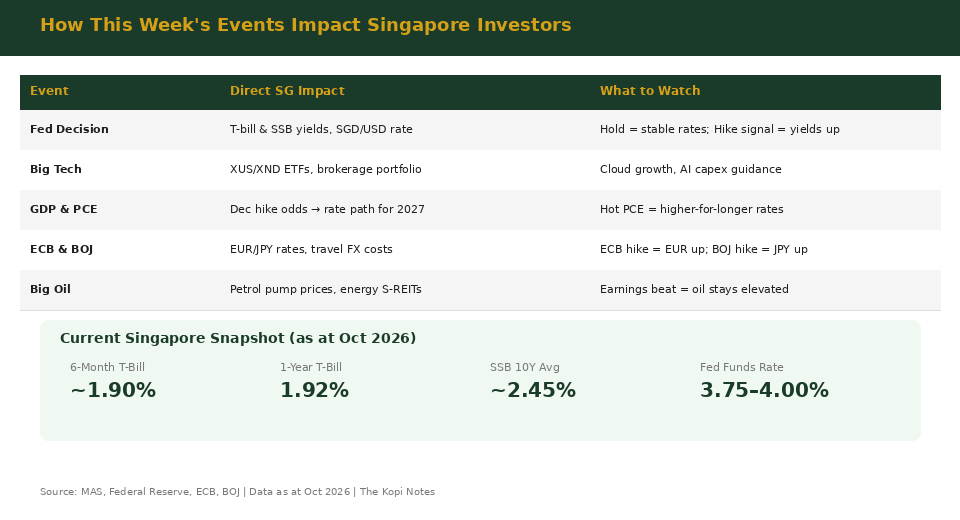
Why it matters for Singapore investors: The Fed’s rate path has a direct pipeline to Singapore’s fixed-income instruments. When the Fed held rates at its last meeting, the 6-month T-bill cut-off yield edged down to around 1.90%. The 1-year T-bill hit a 2026 high of 1.92% at the 15 October auction — there are no more 1-year auctions scheduled for 2026. Meanwhile, the November Singapore Savings Bonds offer an average 10-year return of approximately 2.45%. A hawkish Fed statement could push these yields higher in the next auction cycle, while a dovish hold would keep them stable or compress them further.
The SGD/USD exchange rate is also in play. A hold typically weakens the US dollar, which means a stronger Singapore dollar — good for overseas purchasing power but potentially negative for investors holding USD-denominated ETFs when they convert returns back to SGD.
What to do: If you’re deciding between the next Singapore T-bill auction and an SSB application, wait for the Fed statement before committing. A surprise hike (unlikely but possible) would likely push the next T-bill cut-off above 2.00%.
2. Big Tech Earnings — Tuesday to Thursday
What’s happening: Three of the world’s largest companies report quarterly earnings this week. Alphabet (GOOGL) reports around Tuesday 27 October, Microsoft (MSFT) on Wednesday 28 October (fiscal Q1 2027), and Amazon (AMZN) on Thursday 29 October. Together with Meta and Apple (reporting the following week), roughly 36% of the S&P 500’s market capitalisation reports in this two-week window.
What to watch: The dominant theme is AI infrastructure spending and whether it’s translating into revenue. Amazon’s AWS division grew revenue 36.7% year-on-year in Q2 2026, and the company has raised its full-year 2026 capital spending estimate to approximately USD 220 billion — driven largely by AI compute and higher memory chip costs. Microsoft’s Azure and Google Cloud are expected to show similar acceleration. Investors will scrutinise whether cloud revenue growth is keeping pace with capex, or whether the AI investment cycle is running ahead of monetisation.
Why it matters for Singapore investors: If you hold Ireland-domiciled ETFs tracking the S&P 500 (such as CSPX on the LSE) or Nasdaq-100 (like EQQQ), your portfolio is heavily exposed to these three stocks. Closer to home, the SGX-listed NikkoAM-StraitsTrading MSCI USA ETF (ticker: XUS) and the Lion-OCBC Securities Nasdaq-100 ETF (ticker: XND) give Singapore investors direct exposure in SGD. Strong earnings typically push these higher in the following session — which hits Asia markets on Wednesday to Friday morning.
If you trade US stocks directly through moomoo Singapore or Longbridge, expect elevated volatility around the after-hours earnings releases.
3. US GDP & PCE Inflation — Thursday 29 Oct, 8:30 PM SGT
What’s happening: The Bureau of Economic Analysis (BEA) releases two major reports on Thursday 29 October at 8:30 AM Eastern — that’s 8:30 PM Singapore time, conveniently right after dinner. The Q3 2026 advance GDP estimate is forecast at approximately 3.6% annualised, and the September Personal Consumption Expenditures (PCE) price index — the Fed’s preferred inflation gauge — is expected to show core PCE around 3.1% year-on-year.
Why it matters for Singapore investors: This data drops just hours after the Fed decision, and if the numbers surprise on either side, markets will reprice the December meeting odds rapidly. Hot inflation (core PCE above 3.2%) would raise the probability of a December hike, which flows directly into the interest rate environment Singapore investors navigate for T-bills, SSBs, fixed deposits, and endowment plans. A soft reading, conversely, could signal the Fed is done hiking — which would compress Singapore yields over the following months.
| Data Release | Forecast | Previous | SG Impact if Hot |
|---|---|---|---|
| Q3 GDP (Advance) | ~3.6% | ~2.0% (Q2) | USD strengthens, T-bill yields up |
| Core PCE (Sep YoY) | ~3.1% | ~3.3% (Aug) | Dec hike odds jump, SSB rates rise |
| Personal Income | ~0.4% MoM | ~0.3% | Consumer spending resilience signal |
Source: BEA, consensus forecasts from economic calendars, October 2026
What to do: If you’re comparing fixed deposit rates with SSB yields for your emergency fund, this week’s data will help clarify whether Singapore rates are headed higher or stabilising. Use the Singapore retirement calculator to model how different rate scenarios affect your long-term plan.
4. ECB & BOJ Decisions — Thursday and Friday
What’s happening: The European Central Bank (ECB) announces its rate decision on Thursday 29 October at 2:15 PM CET — that’s 8:15 PM SGT. The current deposit facility rate is 2.50% after a September hike from 2.25%. As of late September, futures priced roughly a 60% chance of another 25bp hike to 2.75%, though a Reuters poll from 22 October suggests the ECB will hold at 2.00%. Euro-area inflation stood at 3.2% year-on-year in August 2026, well above the ECB’s 2% target.
The Bank of Japan (BOJ) concludes its two-day meeting on Friday 30 October, with the decision expected around 11:00 AM SGT. The BOJ raised its policy rate to 1.25% at its September meeting — the highest since 1995. This is a quarterly meeting that includes an updated Outlook Report, making the forward guidance especially important.
Why it matters for Singapore investors: These decisions move currencies. An ECB hike strengthens the euro, which means your YouTrip balance buys less in Europe. A BOJ hike strengthens the yen — relevant if you’re planning a Japan trip or investing in Japanese equities through NISA-eligible funds.
| Central Bank | Current Rate | Decision Time (SGT) | Market Expectation |
|---|---|---|---|
| US Federal Reserve | 3.75–4.00% | Thu 29 Oct, 2:00 AM | Hold (~63%) |
| European Central Bank | 2.50% | Thu 29 Oct, 8:15 PM | Hold / Hike (~60%) |
| Bank of Japan | 1.25% | Fri 30 Oct, ~11:00 AM | Hold expected |
Source: Federal Reserve, ECB, BOJ, CME FedWatch, market consensus, October 2026
For longer-term investors, the BOJ’s tightening cycle is gradually narrowing the interest rate differential between Japan and the rest of the world. This has already driven the yen stronger from its 2024 lows. If you’ve been considering Japanese equity exposure, a stronger yen means your entry point in SGD terms is getting more expensive.
5. Big Oil Earnings — Friday 30 Oct
What’s happening: ExxonMobil (XOM) has confirmed its Q3 2026 earnings call for Friday 30 October at 8:30 AM Central Time. Chevron (CVX) is expected to report the same day, though the date is not yet formally confirmed. BP’s report may follow the week after (around 3 November).
Why it matters for Singapore investors: Oil prices have a direct impact on daily life in Singapore. Higher crude prices flow through to petrol pump prices at Shell, Caltex, and SPC stations. They also affect utility costs and, by extension, energy-exposed S-REITs and infrastructure trusts. If you hold broad market ETFs, energy is a meaningful sector allocation — about 3.5% of the S&P 500 and a larger share of value-oriented indices.
Strong oil earnings could signal sustained elevated energy costs, which feeds into inflation expectations and makes central banks less likely to ease. Weak earnings — perhaps from lower refining margins — could signal softening demand, which would be deflationary and positive for rate-sensitive assets like REITs and bonds.
For a deeper look at income-generating Singapore assets, see our guide to best S-REITs in Singapore 2026.
Asia Chip Watch — SK Hynix & Samsung
Bonus for Asia-focused investors: Two of the world’s most important semiconductor companies report this week, and their results are a direct read on the AI infrastructure boom.
SK Hynix reports Q3 earnings around Wednesday 28 October. In Q2 2026, the company posted record results — net profit of ₩94 trillion (up 1,242% year-on-year) and operating profit of ₩60 trillion, driven by surging demand for high-bandwidth memory (HBM) used in AI training and inference workloads. The question for Q3 is whether this demand is sustained or peaking.
Samsung Electronics reports around Thursday 29 October. Samsung’s Q2 operating profit surged approximately 1,800% from a year earlier as it ramped up HBM4 and HBM4E supply to Nvidia. Analysts expect combined quarterly operating profit for SK Hynix and Samsung to have exceeded ₩150 trillion for the first time. Samsung is also deepening its AI chip partnership with Google.
For Singapore investors, these results matter because memory chip revenue growth validates the AI spending thesis that underpins Big Tech valuations — and by extension, the S&P 500 and Nasdaq-100 ETFs in your portfolio. If chip earnings disappoint, expect a ripple effect through tech stocks globally.
What This Means for Your Portfolio
Here’s a practical framework for Singapore investors navigating this week:
If you hold T-bills or SSBs: Watch the Fed decision and PCE data closely. A hold with dovish language suggests rates have peaked — lock in current yields. A hawkish surprise means the next T-bill auction could offer better rates, so waiting may pay off.
If you hold US equity ETFs (CSPX, VWRA, XUS, XND): Big Tech earnings will drive short-term volatility. Don’t trade around individual earnings reports — these are long-term holdings. If you’re dollar-cost averaging through a platform like Syfe or FSMOne, stick to your schedule regardless of this week’s noise.
If you’re planning overseas travel: The ECB and BOJ decisions will move EUR and JPY rates. If you’re heading to Europe or Japan in the coming months, consider locking in FX rates through YouTrip or Wise before the announcements — or wait for a favourable move if you think the central bank will hold.
If you’re building passive income: Oil earnings and the rate environment both affect S-REITs. Higher-for-longer rates are a headwind for leveraged REITs, but energy infrastructure REITs benefit from elevated commodity prices. For a balanced approach, see our guide to passive income in Singapore.
This article is part of The Kopi Notes’ weekly Market Watch series — a Monday preview of the five events Singapore investors should pay attention to each week. Not financial advice. All data sourced and date-stamped above.
Frequently Asked Questions
What time is the Fed decision in Singapore time?
The FOMC rate decision on Wednesday 28 October at 2:00 PM Eastern Time translates to Thursday 29 October, 2:00 AM Singapore time (SGT). The press conference with Chair Powell follows 30 minutes later. Most Singapore investors will see the headline when they wake up on Thursday morning.
How does the Fed decision affect Singapore T-bill and SSB rates?
Singapore T-bill yields and SSB rates are influenced by global interest rates, particularly US Treasury yields. When the Fed hikes rates, US Treasury yields tend to rise, which pulls Singapore Government Securities (SGS) yields — and therefore T-bill and SSB rates — higher. A Fed hold typically keeps these rates stable. The 6-month T-bill yield was approximately 1.90% at the October 8 auction, and the 1-year T-bill hit 1.92% on 15 October 2026.
Which SGX-listed ETFs are most affected by Big Tech earnings this week?
The two main SGX-listed ETFs with heavy Big Tech exposure are the NikkoAM-StraitsTrading MSCI USA ETF (ticker: XUS) and the Lion-OCBC Securities Nasdaq-100 ETF (ticker: XND). Microsoft, Alphabet, and Amazon are among the largest holdings in both. If you hold Ireland-domiciled CSPX or VWRA through an overseas broker, these earnings also affect your portfolio directly.
Should Singapore investors trade around earnings announcements?
For most Singapore investors using a buy-and-hold or dollar-cost averaging strategy, trading around individual earnings reports is unnecessary and risky. Earnings-driven moves are unpredictable — even strong results can lead to sell-offs if guidance disappoints. The better approach is to maintain your regular investment schedule and avoid reacting to short-term volatility.
How do ECB and BOJ rate decisions affect Singapore investors?
The ECB and BOJ decisions primarily affect Singapore investors through currency movements. An ECB rate hike strengthens the euro against the Singapore dollar, making European travel and imports more expensive. A BOJ rate hike strengthens the yen, raising costs for Japan travel. For investors using multi-currency wallets like YouTrip or Wise, these decisions may create opportunities to lock in favourable FX rates before or after the announcements.
What is PCE inflation and why should Singapore investors care?
The Personal Consumption Expenditures (PCE) price index is the US Federal Reserve’s preferred measure of inflation. Core PCE excludes volatile food and energy prices and gives the cleanest read on underlying price pressures. Singapore investors should care because this data directly influences the Fed’s rate decisions, which in turn affect global bond yields, SGD exchange rates, and the interest rate environment for Singapore’s T-bills, SSBs, fixed deposits, and endowment plans. The September 2026 core PCE is expected at approximately 3.1% year-on-year.
Start Investing Smarter
Open a brokerage account and build your portfolio with our referral links for exclusive sign-up bonuses.
Disclaimer: This article is for educational and informational purposes only and does not constitute financial advice. The Kopi Notes may earn referral fees from platforms mentioned. All data is sourced from public information and date-stamped above. Always do your own research before making investment decisions.
AI Research Disclosure: This article was researched and written with the assistance of AI tools. All facts, dates, and data points have been verified against primary sources including the Federal Reserve, BEA, ECB, BOJ, and company investor relations pages.
This article was researched with the help of AI. While we strive to keep all information accurate and up to date, there may be errors. If you notice any discrepancies, please contact us.