Best ESG ETFs for Singapore Investors (2026 Guide)
SUSW vs XZW0 vs UBS WSRI — tax treatment, costs, and how to buy ESG ETFs from Singapore in 2026.
ESG ETFs let Singapore investors hold a diversified global portfolio while screening out companies with weak environmental, social, and governance practices. Funds like the iShares MSCI World SRI UCITS ETF (SUSW) and Xtrackers MSCI World ESG UCITS ETF (XZW0) trade on the London Stock Exchange, carry a 0.19–0.20% TER, and qualify for the same 15% US dividend withholding tax and no US estate tax exposure as standard Ireland-domiciled world ETFs like VWRA.
Not financial advice. All figures are for educational reference only. Data as at August 2026 unless noted.
Table of Contents
What Is ESG Investing?
ESG investing screens companies on Environmental, Social, and Governance criteria before including them in an index or fund. Instead of buying every company in a benchmark like the MSCI World Index, an ESG ETF excludes or underweights businesses involved in thermal coal, tobacco, controversial weapons, or those with poor labour and governance records, while tilting towards companies with stronger sustainability scores. For Singapore investors, this means the same broad global diversification as a standard world ETF — thousands of listed companies across the US, Europe, and Asia — but filtered through a sustainability lens.
Most ESG ETFs available to Singapore investors on the London Stock Exchange (LSE) are built on MSCI’s SRI (Socially Responsible Investing) or ESG Screened indices. These are not niche “green energy” funds — they still hold household names like Microsoft, Apple, and Nestlé, just with the worst ESG offenders removed and sector weights adjusted. This distinguishes ESG ETFs from thematic funds such as clean energy or carbon credit ETFs, which concentrate in a single sector and carry much higher volatility.
Why ESG Investing Is Trending in Singapore in 2026
Three forces are pushing ESG ETF flows higher among Singapore investors in 2026. First, MAS continues to push sustainability disclosure requirements for Singapore-listed companies and licensed fund managers under its Environmental Risk Management guidelines, which has normalised ESG screening as a mainstream — not fringe — investment approach. Second, European regulation (MAS Environmental Risk Management guidelines locally, and SFDR Article 8 and Article 9 classifications in Europe) has forced global index providers like MSCI to standardise ESG methodologies, making these funds more transparent and comparable than the loosely-defined “sustainable” funds of a decade ago. Third, a new generation of Singapore investors in their 20s and 30s increasingly cite sustainability as a factor in where they park long-term savings, according to recent industry surveys from local brokerages and robo-advisors.
That said, ESG ETF flows remain a small fraction of total passive investing volume in Singapore compared to standard world ETFs like VWRA and CSPX — most local investors still prioritise the lowest possible TER over sustainability screening. This guide is for the minority who want both diversification and an ESG filter, and who understand the trade-offs involved.
Best ESG ETFs for Singapore Investors
Three LSE-listed, Ireland-domiciled ESG ETFs cover the bulk of what Singapore investors can access through brokers like Interactive Brokers, Saxo, and Syfe. All three track a variant of the MSCI World ESG or SRI universe, are UCITS-compliant, and carry the same tax treatment (15% US dividend withholding tax, no US estate tax exposure) as standard world ETFs.
| ETF | TER | Index | Structure | AUM (fund-level) | Best For |
|---|---|---|---|---|---|
| SUSW iShares MSCI World SRI UCITS ETF |
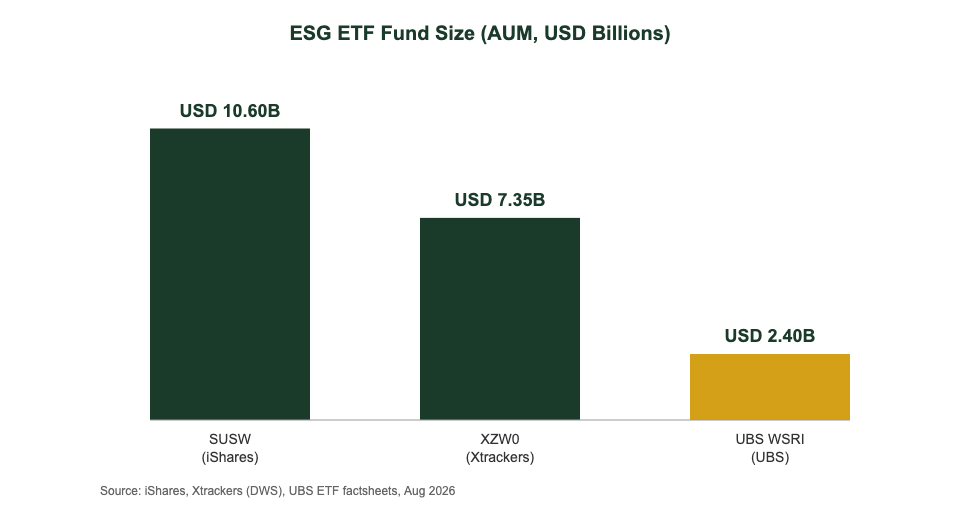
0.20% | MSCI World SRI Select Reduced Fossil Fuel | Accumulating | ~USD 10.6bn | Largest, most liquid ESG world ETF |
| XZW0 Xtrackers MSCI World ESG UCITS ETF 1C |
0.20% | MSCI World ESG Screened | Accumulating | ~USD 7.35bn | Lighter screening, closer to parent index |
| UBS WSRI UBS MSCI World Socially Responsible UCITS ETF |
0.19% | MSCI World Socially Responsible | Accumulating | ~USD 2.4bn | Lowest TER of the three |
Source: iShares SUSW factsheet, Xtrackers (DWS) XZW0 factsheet, UBS ETF WSRI factsheet — all August 2026.
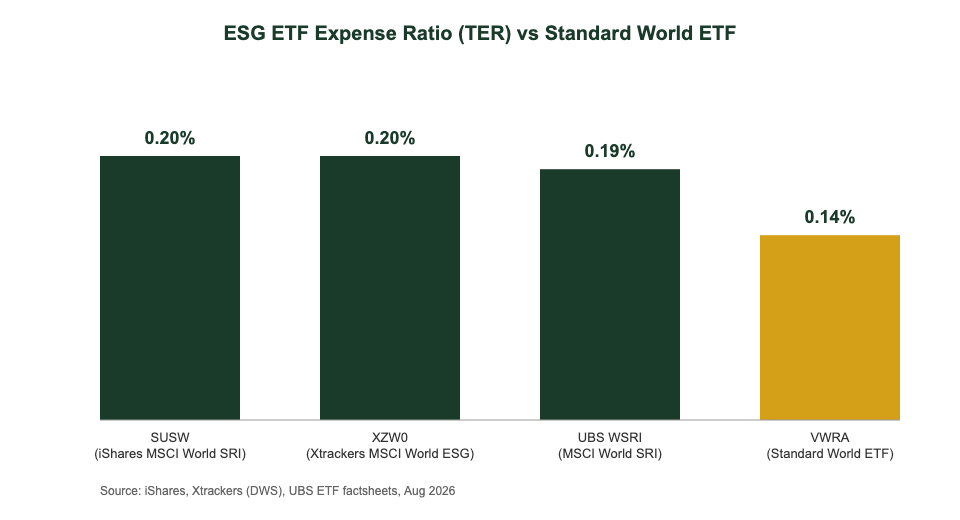
The cost gap between ESG and standard world ETFs is small but real. SUSW and XZW0 both charge 0.20% TER — roughly 0.06 percentage points above VWRA’s 0.14% TER. On a SGD 50,000 portfolio, that works out to an extra SGD 30 per year in fees, which is immaterial next to the diversification and tax benefits all three share. UBS WSRI, at 0.19% TER, is marginally cheaper but has the smallest fund size and thinnest trading volume of the three, which can mean wider bid-ask spreads for larger orders.
How to Buy ESG ETFs in Singapore
All three ESG ETFs above are LSE-listed and bought the same way as VWRA or CSPX. Fund your brokerage account in GBP or USD, search for the ticker (SUSW, XZW0, or the UBS ISIN IE00BK72HJ67), confirm the exchange is set to London (LSE) rather than a European listing, and place a limit order during LSE trading hours (roughly 4:30pm–1am Singapore time).
Interactive Brokers (IBKR): the most cost-effective for larger ESG ETF positions — low commissions and tight FX conversion spreads when funding in GBP or USD directly.
Saxo Markets: similar LSE access with a simpler interface, though commissions are slightly higher than IBKR for frequent traders.
Syfe Brokerage: the simplest option for beginners wanting to add an ESG ETF to an existing Syfe portfolio without opening a second brokerage account — see the Syfe referral code and sign-up bonus for current promotions.
For a full side-by-side comparison of fees, minimum funding, and FX spreads across platforms, see our best brokerage for ETF investing in Singapore breakdown.
Risks to Consider
ESG screening is not free diversification — it comes with trade-offs Singapore investors should understand before switching from a standard world ETF.
Tracking difference from the parent index: because SUSW and XZW0 exclude or underweight certain sectors (notably energy and some financials), their returns will diverge from a plain MSCI World ETF like VWRA in either direction depending on how those excluded sectors perform. Over 2020–2024, ESG screened indices broadly outperformed during the tech-led rally but lagged during the 2022 energy price spike, when excluded oil and gas majors rallied hard.
Concentration in mega-cap tech: ESG screening methodologies tend to favour large technology companies with strong governance disclosure over smaller industrial or resource companies, which can leave ESG ETFs more concentrated in a handful of US mega-caps than investors expect.
Greenwashing and methodology risk: “ESG” is not a single standard. SUSW, XZW0, and UBS WSRI each use different MSCI exclusion thresholds, so two funds both labelled “ESG” or “SRI” can hold meaningfully different companies. Read the index methodology document, not just the fund name, before investing.
Lower liquidity than VWRA or CSPX: even the largest ESG world ETF (SUSW, ~USD 10.6bn) is a fraction of VWRA’s size, which can mean wider bid-ask spreads on large orders — see our guide on VWRA liquidity and bid-ask spreads for how spread costs are calculated and why fund size matters.
None of these ESG ETFs are CPF-investable under the CPF Investment Scheme, which only approves a narrow list of SGX-listed and unit trust products — the same restriction that applies to VWRA and CSPX. They are SRS-compatible if purchased through a broker that supports SRS fund transfers. For a broader view of how ETFs fit into a CPF and SRS retirement strategy, see our Singapore retirement calculator and our guide on value ETFs for Singapore investors, which covers a similar factor-tilt trade-off versus plain market-cap ETFs.
Disclaimer: Not financial advice. ESG methodology, fund size, and TER figures are sourced from fund factsheets dated August 2026 and may change. Past performance of ESG screened indices does not guarantee future results. Consult a licensed financial adviser before making investment decisions.
Frequently Asked Questions
What is the best ESG ETF for Singapore investors?
The iShares MSCI World SRI UCITS ETF (SUSW) is the largest and most liquid ESG ETF accessible to Singapore investors on the LSE, with roughly USD 10.6 billion in AUM and a 0.20% TER as at August 2026. The Xtrackers MSCI World ESG UCITS ETF (XZW0) is a close second with similar costs but a lighter screening methodology. The “best” choice depends on whether you prioritise fund size and liquidity (SUSW) or the lowest TER (UBS WSRI at 0.19%).
Is an ESG ETF the same as a clean energy or green ETF?
No. ESG world ETFs like SUSW and XZW0 hold a broadly diversified global portfolio of hundreds of companies across all sectors, with the worst ESG offenders excluded. Clean energy or green ETFs concentrate in a single theme — solar, wind, and EV-related companies — and carry much higher sector concentration and volatility than a diversified ESG world ETF.
Can I buy ESG ETFs using my CPF or SRS funds?
ESG ETFs listed on the London Stock Exchange, including SUSW, XZW0, and UBS WSRI, are not approved under the CPF Investment Scheme. They are SRS-compatible if you invest through a broker that supports SRS fund transfers for overseas-listed securities, such as Interactive Brokers or Saxo via an SRS-linked account.
Do ESG ETFs underperform standard world ETFs like VWRA?
There is no consistent long-term performance gap. ESG screened indices have outperformed in periods when excluded sectors (such as energy) lagged, and underperformed when those same sectors rallied, as happened during the 2022 energy price spike. The TER difference (around 0.06 percentage points versus VWRA) is a more predictable, measurable cost than any expected return difference from screening.
Which broker is best for buying ESG ETFs in Singapore?
Interactive Brokers (IBKR) is typically the most cost-effective for larger ESG ETF positions due to low commissions and tight FX spreads. Syfe Brokerage is the simplest option for beginners who want to add an ESG ETF to an existing portfolio without managing a separate brokerage account. See our full broker comparison for exact fee breakdowns.
What is the minimum investment for an ESG ETF like SUSW?
There is no fund-imposed minimum — you can buy as little as one share. In practice, most brokers require you to buy whole shares, so the practical minimum is one share’s price (roughly GBP 55–65 for SUSW as at August 2026), plus any broker minimum commission or FX conversion fee.
Ready to Start Investing in ESG ETFs?
Open a brokerage account and buy your first ESG ETF today. Use our referral links for exclusive sign-up bonuses.
This article was researched with the help of AI. While we strive to keep all information accurate and up to date, there may be errors. If you notice any discrepancies, please contact us.