MediSave Limit 2026: Complete Pre-Admission Checklist for Planned Surgery
What to verify with your ISP, hospital, and CPF account before you check in — so there are no surprises on the bill.
Your MediSave limit 2026 allows up to $1,130 per day for the first two days of a planned inpatient surgery in Singapore, plus a TOSP-based surgical top-up of $240 to $5,290 depending on the procedure’s complexity. But whether your Integrated Shield Plan (ISP) covers the remainder — and how much you pay out of pocket — depends entirely on steps you must take before you even check in to hospital.
Not financial advice. All figures are for educational reference only. Data verified as at 21 October 2026 against MOH and CPF Board official sources.
Table of Contents
Contents — Click to expand
- How Your MediSave Limit Works for Planned Surgery
- MediSave Daily and Surgical Withdrawal Limits (2026)
- MediShield Life Deductibles You Must Meet First
- Understanding Your ISP Coverage Before Admission
- When You Need Pre-Authorisation From Your Insurer
- 12-Step Pre-Admission Checklist
- Worked Example: Estimating Your Out-of-Pocket Costs
- Frequently Asked Questions
How Your MediSave Limit Works for Planned Surgery
Unlike emergency admissions, a planned (elective) surgery gives you time to prepare. That preparation time is your greatest financial tool. MediSave does not cover your entire hospital bill — it covers a defined portion of the daily charges and the surgical fee, with MediShield Life and your ISP (if you have one) stepping in for the remainder.
The key thing to understand is that MediSave, MediShield Life, and your ISP are three separate but coordinated layers. They pay in sequence, and each layer has its own limits, deductibles, and conditions. Failing to check any one layer before admission can leave you with an unexpectedly large out-of-pocket bill on discharge.
For planned surgery specifically, the three most critical things to know before admission are:
- How much MediSave you can withdraw per day and for the surgery itself (TOSP limit)
- Whether you have met your MediShield Life deductible for this policy year
- Whether your ISP requires pre-authorisation for the procedure, and whether your surgeon is on your insurer’s panel
See the full breakdown of how MediSave is used for hospitalisation in our MediSave hospitalisation guide 2026, which covers both planned and emergency admissions in detail.
MediSave Daily and Surgical Withdrawal Limits (2026)
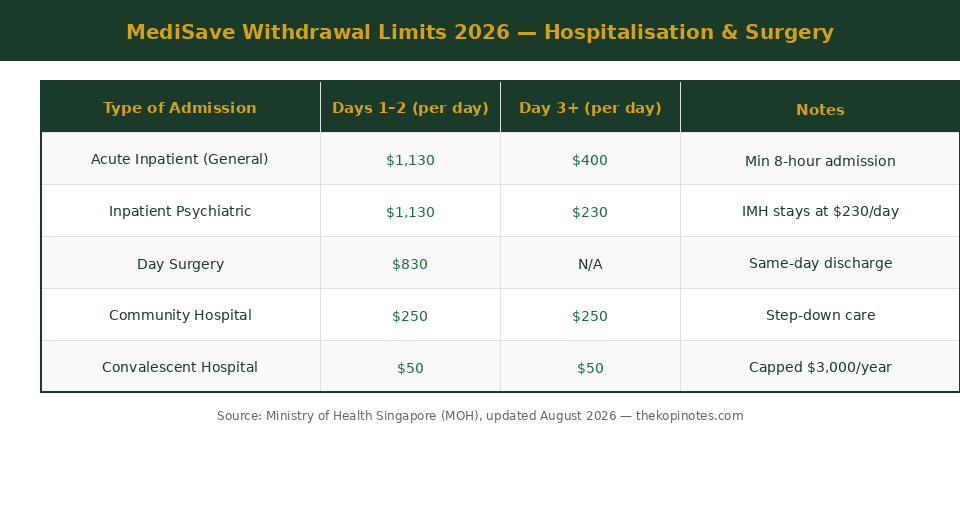
MediSave covers two components of your inpatient bill: the daily hospital charges and the surgical fee. Both are subject to separate limits.
Daily Hospital Charge Limits
For a standard acute inpatient admission (8 hours or more), MediSave covers:
- Days 1–2: Up to $1,130 per day
- Day 3 and beyond: Up to $400 per day
This limit applies regardless of ward class (A, B1, B2, or C) or hospital type. The actual hospital charge may be much higher — especially in Class A or private hospitals — in which case MediShield Life and your ISP cover the excess (subject to deductibles and co-insurance).
TOSP Surgical Limits
Your surgical fee MediSave withdrawal is capped by the Table of Surgical Procedures (TOSP), which classifies procedures by complexity from Table 1A (minor) to Table 7C (highly complex). The 2026 surgical limits range from $240 for a simple 1A procedure to $5,290 for a complex 7C procedure.
| TOSP Category | A Limit | B Limit | C Limit |
|---|---|---|---|
| Table 1 (Minor) | $240 | $420 | $490 |
| Table 2 | $760 | $1,120 | $1,120 |
| Table 3 | $1,390 | $1,740 | $1,920 |
| Table 4 | $2,380 | $2,440 | $2,540 |
| Table 5 | $2,610 | $2,660 | $2,770 |
| Table 6 | $3,260 | $3,610 | $3,960 |
| Table 7 (Highly Complex) | $4,340 | $4,830 | $5,290 |
Source: Ministry of Health Singapore (TOSP 2026), updated August 2026. Limits apply per inpatient or day surgery episode.
Before admission, ask your surgeon which TOSP table your procedure falls under. This tells you exactly how much MediSave covers the surgical fee — and how much your ISP rider (if any) must top up. For a detailed breakdown of TOSP and how surgical bills are calculated, see our MediSave for surgery Singapore 2026 TOSP guide.
MediShield Life Deductibles You Must Meet First
MediShield Life has an annual deductible — the amount you pay out of pocket before MediShield Life pays anything in that policy year. The deductible is per policy year (not per admission), so if you’ve already been hospitalised earlier this year and met your deductible, your planned surgery may have no deductible left to pay.
If this is your first hospitalisation this year, you will need to meet the full deductible. For 2026, the deductibles by ward class are:
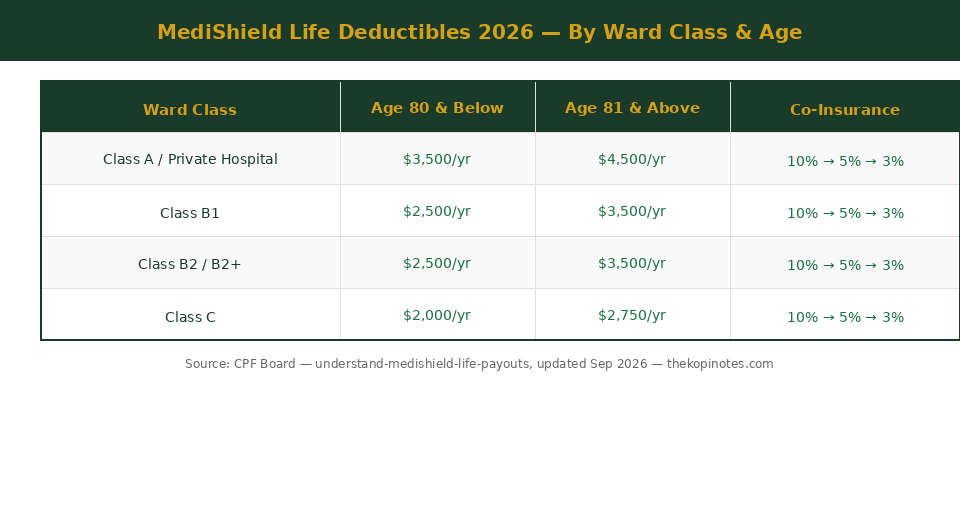
After the deductible, co-insurance kicks in at:
- 10% of the first $5,000 of claimable amount (including the deductible)
- 5% of the next $5,000
- 3% on claimable amounts above $10,000
If you have an ISP rider (specifically the new 5% co-payment rider introduced post-2021), your rider covers most of the co-insurance — but not all of it. The 5% co-payment under the new rider rules applies on top of whatever MediShield Life pays. Always verify exactly what your rider covers before admission. Read our MediShield Life deductible guide for the complete worked examples by ward class.
Understanding Your ISP Coverage Before Admission
Your integrated shield plan sits on top of MediShield Life and covers the gap between what MediShield Life pays and your actual bill. But ISP coverage is not automatic or unconditional — it depends on several factors you must confirm before admission.
Panel vs Non-Panel Surgeon
Most ISPs distinguish between panel doctors (surgeons who have agreed to fee benchmarks with your insurer) and non-panel doctors (who charge independently). If you use a panel surgeon, your ISP will typically reimburse your bill with no or reduced deductible. If you use a non-panel surgeon:
- Your full MediShield Life deductible applies
- Your insurer may apply a pro-ration factor, reducing the claimable amount significantly
- Out-of-pocket costs can be 2–4x higher than using a panel surgeon
Ward Class Must Match Your Plan
If your ISP covers Class A ward and you are admitted to Class B1, your insurer will still pay — but you will likely receive a rebate on your premiums as well. However, if you are admitted to a ward class above what your plan covers (e.g. Class A ward but only B1 coverage), the difference is entirely out of pocket. Always verify your plan’s ward entitlement before requesting a ward on admission. For a breakdown of what ISP rider costs at different plan levels, see our ISP rider real cost Singapore 2026 guide.
When You Need Pre-Authorisation From Your Insurer
Pre-authorisation (also called pre-approval) means getting written confirmation from your insurer before a procedure that the treatment is covered and the estimated claim amount is approved. It is not the same as a guarantee of payment — but it significantly reduces the risk of a disputed claim on discharge.
Pre-authorisation is typically required for:
- High-cost elective procedures (cancer surgery, joint replacement, cardiac procedures)
- Procedures where the surgeon’s fee significantly exceeds the TOSP benchmark
- Any admission where the estimated bill exceeds $5,000–$10,000 (varies by insurer)
- Specialist treatments not covered by the standard MediShield Life claim list
Contact your insurer’s 24-hour pre-authorisation hotline at least 3 business days before admission (or as soon as your surgery is scheduled). Provide: the procedure name, TOSP table, surgeon name, estimated admission date, and ward class. Your surgeon’s clinic can usually assist with this process.
12-Step Pre-Admission Checklist
Use this checklist to systematically prepare for planned surgery. Each step can save you money or prevent a claim dispute.
2 Weeks Before Admission
- Confirm your ISP ward entitlement. Log into your insurer’s portal or call them. Know your covered ward class (A, B1, B2) and whether your plan includes a rider.
- Verify your surgeon is a panel doctor. Check your insurer’s panel list or call their hotline. If your preferred surgeon is not on the panel, ask about fee benchmarks and the pro-ration factor that will apply.
- Ask your surgeon for the TOSP table. This tells you the maximum MediSave surgical withdrawal for your procedure and helps you estimate the total bill.
- Check your MediSave balance. Log into CPF Online Services. Ensure you have enough to cover the MediSave portion of the bill. If your balance is low, you can top up MediSave from cash.
1 Week Before Admission
- Submit your pre-authorisation request. Call your ISP insurer’s pre-auth hotline or submit via their portal. Have your NRIC, policy number, surgeon name, procedure name, and estimated admission date ready.
- Check your MediShield Life deductible status. If you’ve been hospitalised earlier this year, you may have already met part or all of your annual deductible. Log in to CPF Board to check your claims history.
- Request an itemised estimated bill from the hospital. The hospital billing department can provide an estimated breakdown of daily room charges, surgical fees, consumables, and anaesthesia. Use this to estimate your out-of-pocket amount.
- Decide on ward class. Confirm your intended ward class with the hospital. Admitting to a ward above your ISP coverage creates uncovered gaps.
2–3 Days Before Admission
- Bring your ISP insurance letter / Letter of Guarantee (LOG). Some insurers issue a LOG directly to the hospital. Confirm whether yours does, or whether you need to submit a claim after discharge.
- Confirm the hospital accepts your ISP. Most restructured and private hospitals accept all ISPs, but verify this — especially for day surgery centres.
Admission Day
- Bring your NRIC, insurance policy documents, and pre-authorisation reference number. The admissions counter will need these to link your MediShield Life and ISP coverage to your hospital stay.
- Elect your ward class at admissions. This is the last chance to change ward class without penalty. If you’ve been assigned a higher ward, request a downgrade to match your ISP coverage.
Worked Example: Estimating Your Out-of-Pocket Costs
Here is a worked example for a 45-year-old Singapore resident admitted for a planned laparoscopic cholecystectomy (gallbladder removal) — classified as TOSP Table 5C — in a Class B1 ward at a restructured hospital, with an ISP covering up to Class A and a standard 5% co-payment rider.
| Cost Component | Amount | Covered By |
|---|---|---|
| Daily hospital charges (3 nights B1) | ~$2,400 | MediSave + ISP |
| Surgical fee (TOSP 5C panel surgeon) | ~$2,770 | MediSave surgical limit ($2,770 max) |
| Anaesthesia + consumables | ~$1,200 | ISP / MediShield Life |
| Total estimated bill | ~$6,370 | |
| MediShield Life deductible (B1, age ≤80) | $2,500 | Patient pays (or partially met) |
| 5% co-payment (ISP rider) | ~$319 | Patient pays (5% of claimable balance) |
| Estimated out-of-pocket | ~$2,819 | Cash / MediSave |
Illustrative example only. Actual bill depends on hospital, surgeon’s fee, implants/consumables, and length of stay. Figures use 2026 MediShield Life deductible and TOSP limits from MOH/CPF Board official sources.
If the deductible had already been met from an earlier hospitalisation this year, out-of-pocket in this example drops to approximately $319. This is why checking your deductible status before admission matters enormously.
To better understand how your MediSave and ISP interact across different hospitalisation scenarios, read our complete MediSave limit 2026 guide.
Frequently Asked Questions
What is the MediSave limit per day for planned surgery in 2026?
For inpatient (overnight) admissions in 2026, MediSave covers up to $1,130 per day for the first two days, then $400 per day from day 3 onwards. For day surgery (same-day discharge), the limit is $830 per day. These daily limits are in addition to any TOSP surgical fee withdrawal, which is a separate cap based on the procedure’s complexity.
Do I need pre-authorisation for all planned surgeries?
Not all — but it’s strongly recommended for any significant procedure. Pre-authorisation is mandatory for high-cost or complex procedures under most ISPs. Even when not required, getting pre-authorisation protects you from claim disputes. Contact your insurer’s hotline at least 3 business days before admission with the TOSP table number, surgeon name, and expected admission date.
What happens if I don't check my MediSave balance before surgery?
If your MediSave is insufficient to cover the MediSave portion of the bill, you will need to pay the shortfall in cash at discharge. Hospitals will not delay discharge, but you will receive a bill for the uncovered amount. You can top up your MediSave from cash before admission to avoid this — contributions are eligible for income tax relief up to the Annual Withdrawal Limit.
Can I use my family member's MediSave for my surgery?
Yes. Under the MediSave rules, you can use MediSave from your immediate family members’ accounts — spouse, children, parents, grandparents, and siblings — to pay for your hospitalisation. The same withdrawal limits apply per account used. This can be useful if your own MediSave balance is low ahead of a planned surgery.
What if my surgeon is not on my ISP's panel?
Using a non-panel surgeon means your insurer will apply a pro-ration factor to the claimable surgical amount — effectively reducing how much your ISP pays. You may also lose any benefit of waived deductibles that panel surgeons typically confer. Your out-of-pocket costs can be significantly higher. If possible, either choose a panel surgeon or negotiate the surgeon’s fee before agreeing to proceed.
Is the MediShield Life deductible reset each year?
Yes. The MediShield Life deductible resets on 1 March each year (your MediShield Life policy anniversary is in March for most Singaporeans). If you are planning surgery and have already been hospitalised earlier in the same policy year, you may have partially or fully met your deductible — significantly reducing your out-of-pocket cost for the planned surgery. Always check your deductible balance on the CPF Board’s MyCPF portal before admission.
What documents should I bring on the day of planned surgery admission?
Bring: (1) your NRIC, (2) your ISP insurance card or policy document, (3) your pre-authorisation reference number if applicable, (4) any Letter of Guarantee (LOG) issued by your insurer, (5) your CPF/MediSave account details (your NRIC is linked to your MediSave, but having it confirmed avoids delays), and (6) any specialist referral letters. The hospital admissions team will link your MediShield Life and ISP coverage to your stay.
Get Free Insurance Advice
Speak with a licensed insurance advisor. No obligation, no cost.
By submitting this form, you agree to our Privacy Policy.
This article was researched with the help of AI. While we strive to keep all information accurate and up to date, there may be errors. If you notice any discrepancies, please contact us.