How to Invest in Singapore for Beginners: Step-by-Step Guide (2026)
To invest in Singapore, beginners should start by maximising CPF contributions for guaranteed returns of 2.5–4%, then open a brokerage account (IBKR or FSMOne RSP) to invest monthly in a low-cost global ETF like CSPX. This dollar-cost averaging approach, combined with Singapore’s tax-advantaged accounts, gives beginners a structured, low-risk path to long-term wealth.
Not financial advice. All figures are for educational reference only. Data as at October 2026 unless noted.
Singapore has one of the most investor-friendly environments in Asia — zero capital gains tax, no dividend tax, and a range of low-cost investment platforms. Yet many Singaporeans leave money sitting in bank accounts earning 0.05% interest while inflation silently chips away at their purchasing power.
This guide walks you through everything you need to know to start investing in Singapore, from understanding your options to making your very first purchase.
Why You Need to Invest (Not Just Save)
Singapore’s inflation rate has averaged around 3–4% per year over the past decade. A savings account paying 0.05% means your money is quietly losing purchasing power every single year.
Consider this: SGD 100,000 in a savings account earning 0.05% becomes $100,050 after a year. With 3% inflation, that same money can only buy the equivalent of $97,087 worth of goods in today’s terms — a real loss of nearly $3,000.
Investing doesn’t eliminate risk, but it gives your money a fighting chance against inflation. More importantly, it puts compound interest to work for you rather than against you.
The power of compounding: A monthly investment of SGD 500 at a 7% annual return grows to approximately SGD 601,000 over 30 years — versus just SGD 180,000 if you kept it in cash. That difference of SGD 421,000 is entirely the work of compounding.
If you want to model your own numbers, try the Singapore retirement calculator on TKN.
Your Investment Options in Singapore
Before opening any account, it helps to understand what you can invest in. Here is a quick overview of the main options available to Singapore investors:
| Asset Class | Expected Return | Risk Level | Liquidity |
|---|---|---|---|
| CPF Ordinary Account (OA) | 2.5% p.a. | Zero | Low (retirement) |
| CPF Special Account (SA) | 4.0% p.a. | Zero | Very Low |
| Singapore T-bills | ~1.8% p.a. | Very Low | 6-month lock-up |
| Singapore Savings Bonds (SSB) | ~2.0% p.a. | Very Low | Redeemable monthly |
| STI ETF (Singapore stocks) | 5–7% p.a. long-run | Medium | High (daily) |
| Global ETF (e.g. CSPX/VWRA) | 8–10% p.a. long-run | Medium–High | High (daily) |
Source: CPF Board, MAS, iShares, Bloomberg (as at October 2026). Past returns are not indicative of future results.
For most beginners, the best starting strategy is a two-pronged approach: secure the guaranteed high returns from CPF first, then invest surplus cash in a globally diversified ETF for long-term growth.
CPF & SRS: Your Tax-Advantaged Accounts
CPF — Your Guaranteed Foundation
Every employed Singapore citizen and permanent resident contributes to CPF automatically. The key insight most beginners miss: CPF is already an investment — and a very good one.
CPF interest rates as at October 2026:
- Ordinary Account (OA): 2.5% per annum, guaranteed by the government
- Special Account (SA): 4.0% per annum, guaranteed by the government
- MediSave Account (MA): 4.0% per annum
- Retirement Account (RA): 4.0% per annum
The first $20,000 in your OA and first $40,000 in your SA earn an additional 1% extra interest. This means a significant portion of your CPF could effectively be earning 3.5–5% with zero risk — outperforming Singapore T-bills and many fixed deposits.
Before investing your cash in stocks, consider topping up your CPF SA via the Retirement Sum Topping-Up (RSTU) scheme — you get a dollar-for-dollar tax relief on top of the 4% guaranteed return. Read our full guide to CPF investment strategy for details.
SRS — Tax-Deferred Investing
The Supplementary Retirement Scheme (SRS) lets you voluntarily contribute up to SGD 15,300 per year (Singapore citizens and PRs) or SGD 35,700 (foreigners) and deduct the full amount from your taxable income.
For someone in the 7% tax bracket, contributing SGD 15,300 to SRS saves approximately SGD 1,071 in taxes immediately — and the money can then be invested in stocks, ETFs, or unit trusts within the SRS account.
SRS withdrawals are taxed at 50% of the withdrawal amount after age 62, making it highly tax-efficient for retirement planning.
How to Choose a Brokerage Platform
Once you have decided to invest beyond CPF, you need a brokerage account. Here are the main options available to Singapore investors in 2026:
| Platform | Min. Investment | Est. Annual Cost* | Best For |
|---|---|---|---|
| IBKR (ref: jianxiong368) | ~USD 0 | ~SGD 7 | Experienced investors, LSE ETFs |
| moomoo SG | SGD 1 | ~SGD 27 | Beginners, US stocks |
| FSMOne RSP (ref: P0544985) | SGD 50/month | ~SGD 38 | Beginners, automatic DCA |
| Endowus (ref: 2V343) | SGD 1,000 | ~SGD 60 | Hands-off, CPF/SRS investing |
| Syfe Wealth (ref: SRPRFFFCD) | SGD 1 | ~SGD 72 | Robo-advisory, diversified portfolios |
*Estimated annual cost on a SGD 10,000 portfolio. Source: Broker fee schedules (October 2026).
Our recommendation for absolute beginners: Start with FSMOne’s Regular Savings Plan — set up a monthly auto-investment from SGD 50 into a global ETF like CSPX or VWRA, and the platform handles the execution automatically. Once your portfolio exceeds SGD 20,000 and you are comfortable doing it manually, consider switching to IBKR for lower costs.
Use our Syfe referral code and sign-up bonus or FSMOne referral code to get started with a bonus.
How to Make Your First Investment: A Step-by-Step Guide
Here is a practical walkthrough for a first-time Singapore investor making their first ETF purchase via IBKR or FSMOne:
Step 1: Open a Brokerage Account
For IBKR: visit ibkr.com (referral code: jianxiong368), complete the online application, upload your NRIC and proof of address. Approval typically takes 1–3 business days. Fund your account via PayNow or bank transfer.
For FSMOne RSP: register at fsmone.com (referral code: P0544985), verify your identity, and set up a Regular Savings Plan under the “ETF RSP” section.
Step 2: Choose Your ETF
For a Singapore beginner, we recommend starting with one of these two Ireland-domiciled ETFs listed on the London Stock Exchange:
- CSPX (iShares Core S&P 500 UCITS ETF) — tracks the US S&P 500; TER 0.07% p.a.
- VWRA (Vanguard FTSE All-World UCITS ETF) — tracks 3,700+ global stocks; TER 0.22% p.a.
Both are Ireland-domiciled UCITS ETFs, which means Singapore investors pay only 15% withholding tax on US dividends (versus 30% for US-domiciled ETFs like VOO or VTI) and face zero US estate tax regardless of portfolio size. This is a critical advantage that most beginners overlook.
You can find more details in our Singapore passive income Singapore and T-bills guides.
Step 3: Decide on Dollar-Cost Averaging (DCA)
Dollar-cost averaging means investing a fixed amount at regular intervals — for example, SGD 500 every month — regardless of whether the market is up or down. Over time, this smooths out the impact of market volatility.
A practical DCA example: A Singapore investor contributing SGD 500/month into CSPX for 20 years at an assumed 9.5% annual return (CSPX’s approximate 10-year historical average as at 2026) would accumulate approximately SGD 369,000 — from total contributions of only SGD 120,000. The remaining SGD 249,000 comes entirely from compounding.
Step 4: Execute the Trade
In IBKR: search for “CSPX” on the London Stock Exchange (LSE), select the GBP-denominated share class, enter the number of shares and submit a limit order slightly above the current bid price. Commission is approximately USD 1–3 per trade.
In FSMOne RSP: select CSPX or your chosen ETF, set your monthly contribution amount (minimum SGD 50), select your deduction date, and confirm. The platform handles all subsequent trades automatically.
Returns & Cost Comparison
The two charts below put the numbers in perspective. First, expected annual returns across different Singapore investment options — from the risk-free CPF to globally diversified ETFs:
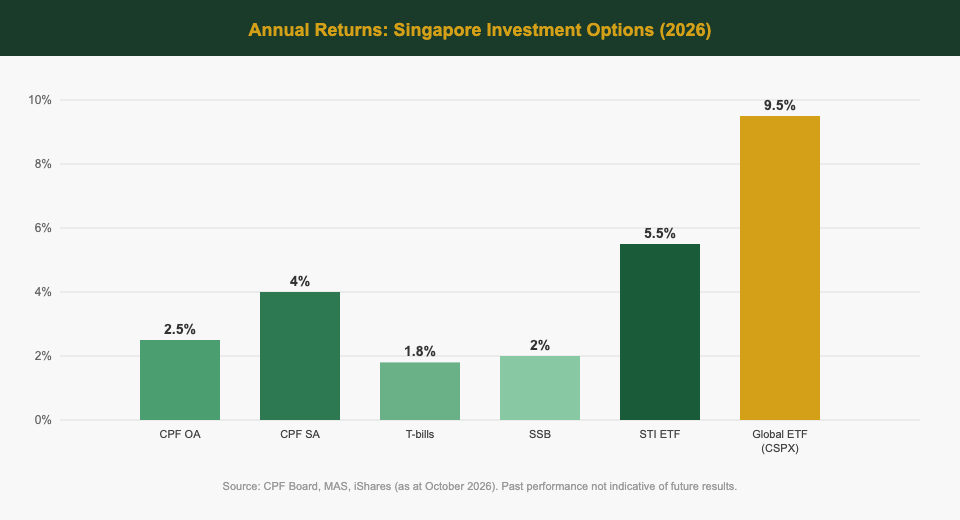
Notice how a global ETF like CSPX has delivered approximately 9.5% annually over the past decade — more than three times the return of CPF SA, and with the added benefit of compounding on a much larger base over time.
However, returns are only part of the picture. Platform costs matter significantly over a long investment horizon:
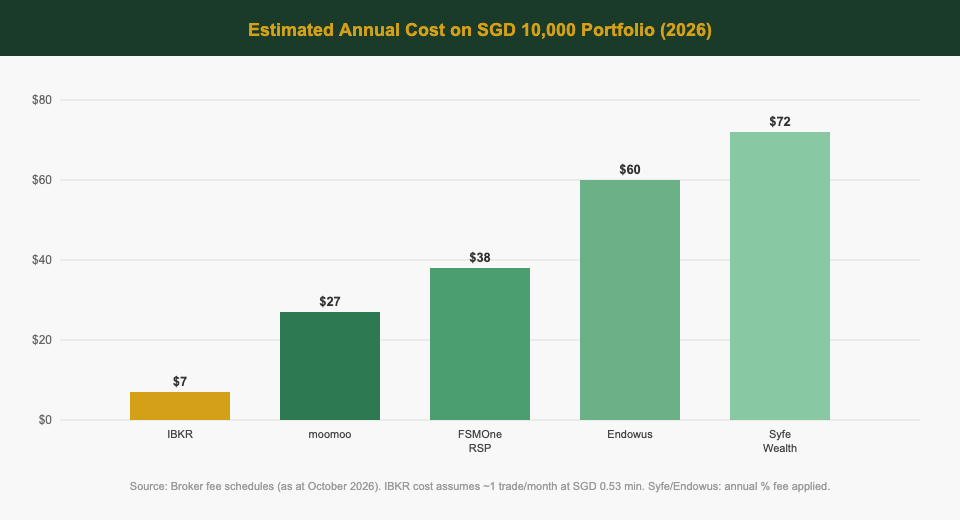
IBKR stands out as by far the cheapest option for a self-directed investor — costing just SGD 7/year on a SGD 10,000 portfolio. FSMOne’s RSP at SGD 38/year is a reasonable choice for beginners who want automation. Robo-advisors like Syfe and Endowus charge closer to 0.6–0.65% annually, which is fair for the convenience they offer but compounds into a meaningful drag over 20–30 years.
To understand your T-bill and SSB options in more detail, read our Singapore T-bills 2026 guide and Singapore Savings Bonds guide.
5 Common Beginner Investing Mistakes to Avoid
1. Trying to Time the Market
Research consistently shows that time in the market beats timing the market. Missing just the 10 best trading days in any given decade can cut your returns nearly in half. Set up a monthly DCA plan and stick to it — do not try to buy the dip or sell at the top.
2. Holding US-Domiciled ETFs
Many Singapore beginners buy VOO or VTI through moomoo or Webull because they are familiar. This is a costly mistake: US-domiciled ETFs incur 30% withholding tax on dividends (versus 15% for Ireland-domiciled equivalents like CSPX), and estates above USD 60,000 face US estate tax. Always prefer Ireland-domiciled UCITS ETFs listed on the LSE.
3. Ignoring Platform Costs
On a SGD 200,000 portfolio, the difference between IBKR (0.07% effective cost) and a robo-advisor charging 0.65% is SGD 1,160 per year — compounding over 20 years, that is over SGD 50,000 in forgone returns.
4. Not Having an Emergency Fund First
Before investing a single dollar, ensure you have 3–6 months of expenses in a liquid savings account or SSB. Investing without this buffer often leads to panic-selling at the worst moment (market downturns) just when you need the cash.
5. Under-Utilising CPF and SRS
CPF SA at 4% with zero risk is among the best “investments” available to Singaporeans, yet many do not bother with voluntary top-ups. Similarly, the SRS tax benefit is effectively a 3.5–22% immediate return on contributions, depending on your tax bracket — claiming it requires just 30 minutes of setup.
Frequently Asked Questions
How much money do I need to start investing in Singapore?
Is investing in Singapore safe for beginners?
What is the best investment for beginners in Singapore?
Do I pay tax on investment gains in Singapore?
Should I invest in the STI ETF or a global ETF like CSPX?
Can I invest in ETFs using CPF or SRS funds?
This article was researched with the help of AI. While we strive to keep all information accurate and up to date, there may be errors. If you notice any discrepancies, please contact us.