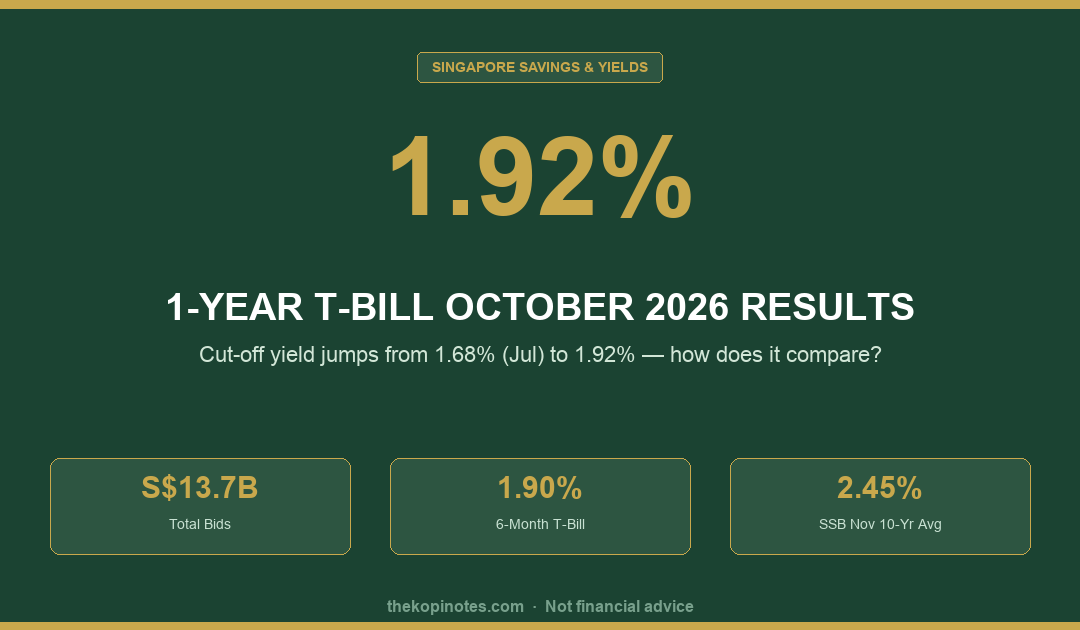
The results are in. Singapore’s October 2026 one-year Treasury Bill (T-bill) auction closed on 15 October 2026 with a cut-off yield of 1.92% per annum — the highest yield recorded for the one-year tenor in 2026, and now edging above the six-month T-bill’s 1.90% for the first time in months.
If you’ve been comparing T-bills, fixed deposits, CPF, and Singapore Savings Bonds (SSB) for your cash allocation, these results change the calculus slightly. Here’s a full breakdown of what the numbers mean and what Singapore retail investors should do next.
October 2026 One-Year T-Bill Results: Key Numbers
The Monetary Authority of Singapore (MAS) conducted the auction on 15 October 2026. The key figures:
- Cut-off yield: 1.92% per annum
- Total applications received: S$13.7 billion
- Tenor: 12 months
- Backed by the Singapore Government (AAA credit rating)
The 1.92% result represents a meaningful step up from the 1-year T-bill’s historical 2026 range of 1.65%–1.68%. The strong demand — S$13.7 billion in total bids — reflects investor appetite for safe, short-duration yield in a market where uncertainty remains elevated despite Singapore’s robust GDP growth of 5.4% in Q3 2026.
T-Bill Yield Trend in 2026: Is the Curve Normalising?
For much of 2026, one-year T-bills offered a yield discount to six-month bills — an unusual inversion that made the shorter tenor the more attractive choice for most retail investors. That gap is now closing.
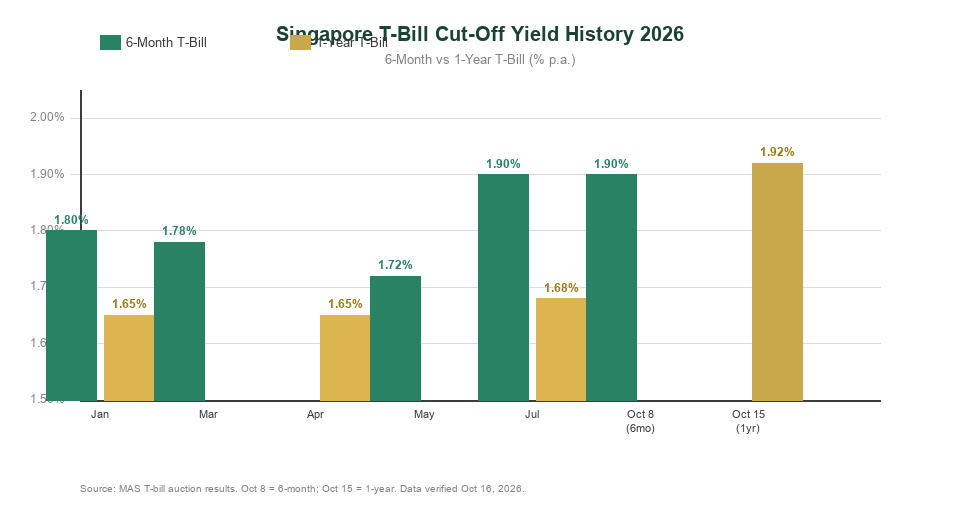
The chart above shows the yield trajectory across 2026. The one-year T-bill yield has risen from 1.65% in January 2026 to 1.92% in October, while the six-month yield moved from 1.80% to 1.90% over the same period. The gap between the two tenors has narrowed from 15 basis points (with 6-month higher) to just -2 basis points (with 1-year now higher).
This normalisation of the yield curve is consistent with MAS’s October 2026 decision to hold its current monetary policy stance — a signal that while Singapore remains vigilant about inflation, policymakers do not see the need for further tightening at this juncture. For T-bill investors, this means yields are likely to stay in a relatively stable range near-term, making the 1.92% an attractive opportunity to lock in.
For context on MAS’s latest policy stance and what it means for Singapore investors, see our earlier analysis of the MAS October 2026 monetary policy decision.
How Does 1.92% Compare to Other Cash-Parking Options?
One-year T-bills don’t exist in isolation. Retail investors have multiple competing options for their savings. Here’s the full picture as at October 16, 2026:
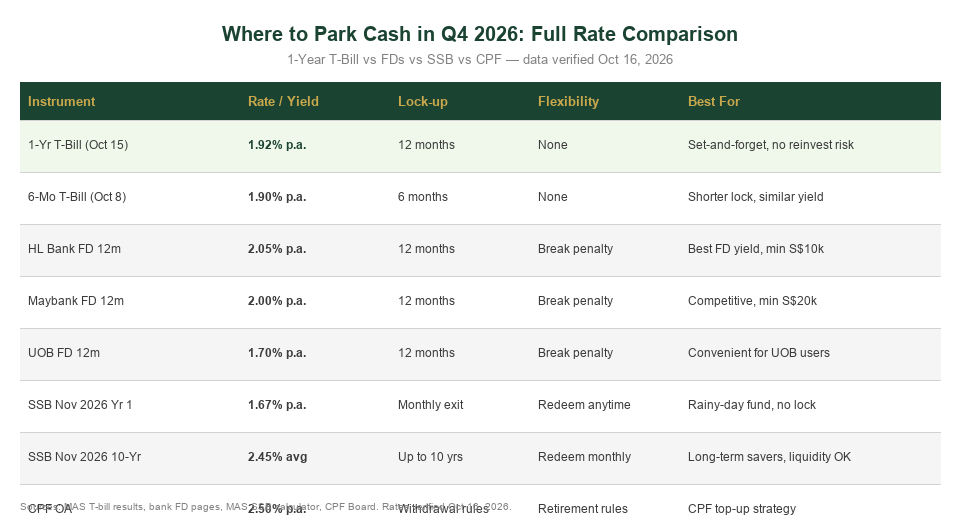
Breaking down the key comparisons:
vs Fixed Deposits: Hong Leong Finance is currently offering 2.05% on 12-month FDs, while Maybank offers 2.00%. These edge out the T-bill on pure yield. However, FDs are not tradeable on the secondary market, and you’re taking on bank counterparty risk (mitigated by Singapore Deposit Insurance Corporation (SDIC) coverage up to S$100,000 per depositor per bank). T-bills, backed by the Singapore Government, carry zero credit risk and can be sold on SGX if you need liquidity before maturity.
vs Six-Month T-Bill: The latest six-month T-bill (October 8, 2026) yielded 1.90%, just 2 basis points below today’s one-year result. If you prefer the flexibility to reassess in six months, you’re only giving up 2bp. For investors expecting rates to move significantly in the next six months, the six-month option keeps optionality alive. Our six-month T-bill results article covers this auction in detail.
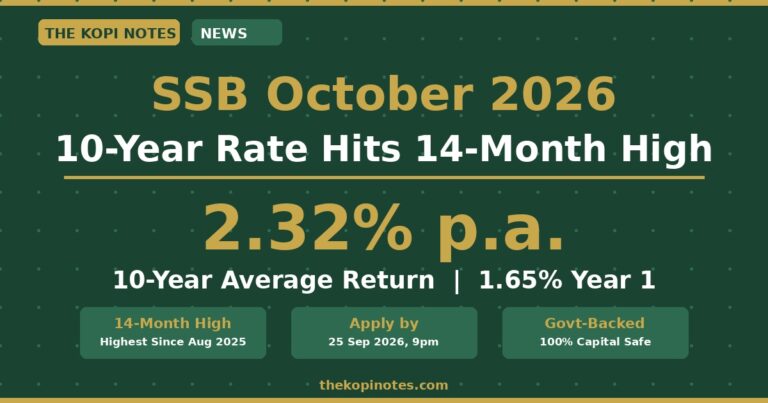
vs Singapore Savings Bonds (SSB): The November 2026 SSB offers a Year 1 rate of 1.67% — meaningfully below the T-bill. However, SSBs are uniquely flexible: you can exit in any given month with no penalty and no capital loss, subject to a small S$2 admin fee. The SSB’s 10-year average yield of 2.45% makes it the best instrument for long-term, patient capital that you want to stay protected. If you need flexible, long-duration savings exposure, SSBs remain the top pick. See our November 2026 SSB review for the full breakdown.
vs CPF OA: CPF Ordinary Account earns a guaranteed 2.50% — still the highest risk-free rate in Singapore. But your CPF funds are locked up for CPF-specific purposes (housing, education, insurance, investments under CPFIS). If you have idle CPFIS-eligible CPF funds, the T-bill question is: can you do better than the CPF’s 2.50% base rate? At 1.92%, the answer remains no. CPF remains the default choice for CPF funds.
Who Should Apply for the One-Year T-Bill?
Based on today’s results, the one-year T-bill at 1.92% is a strong fit for:
You should apply if:
- You have a defined sum set aside that you won’t need for 12 months
- You prefer government-guaranteed instruments over bank deposits
- You’re parking Supplementary Retirement Scheme (SRS) funds and want safe, higher-than-savings-account returns
- You value secondary market liquidity over the higher-rate, illiquid FD option
- You anticipate reinvesting at potentially higher rates in 12 months
Consider alternatives if:
- You want maximum yield regardless of instrument: HL Bank FD at 2.05% beats the T-bill
- You might need the money in under 12 months: the six-month T-bill at 1.90% offers more flexibility for just 2bp less
- You want long-term, flexible savings: SSB’s 10-year average of 2.45% significantly outperforms for patient capital
- The sum is under your CPF investment threshold: keep it in CPF OA at 2.50%
How to Apply for the Next One-Year T-Bill
The next one-year T-bill auction is expected to be announced in November 2026. Applications typically open about two weeks before the auction date. Here’s how to apply:
Cash (via internet banking): Log in to your DBS/POSB, OCBC, or UOB internet banking. Navigate to Invest → Singapore Government Securities → Treasury Bills. Select the upcoming 1-year auction, enter your amount (in multiples of S$1,000, minimum S$1,000), and submit. As a non-competitive bidder, you’ll receive the cut-off yield set by institutional bids.
CPF-OA: Apply via your CPF member portal under My Investments → CPF Investment Scheme → T-bills. Note that because CPF OA already earns 2.50%, investing in T-bills via CPF typically only makes sense if you believe T-bill yields will exceed 2.50% — which hasn’t happened recently.
SRS: Apply through your SRS operator’s platform (DBS, OCBC, or UOB). SRS investors benefit because T-bill interest is not subject to tax at withdrawal for Singapore tax residents.
For a complete step-by-step guide on how to invest in Singapore T-bills for the first time, check our beginner’s guide to buying Singapore T-bills.
The Kopi Notes Take
The 1.92% one-year T-bill yield is the highest we’ve seen for this tenor in 2026 and, for the first time this year, the one-year is outperforming the six-month bill. This marks a genuine inflection point worth noting.
For the typical TKN reader — a Singapore retail investor balancing CPF optimisation, ETF dollar-cost averaging, and short-term cash management — the October 2026 one-year T-bill occupies a specific niche: it’s for the cash you’re confident you won’t need for a year, and where you want zero credit risk and a clean, simple yield.
The broader context matters too. Singapore’s Q3 2026 GDP growth came in at a strong 5.4%, MAS is holding policy steady, and fixed deposit rates from local and foreign banks are still slightly ahead of T-bills on pure yield. The T-bill’s edge remains its safety, tradability, and tax efficiency for SRS and CPFIS investors.
Our allocation suggestion for most investors: keep long-term flexible savings in SSBs (10-year avg 2.45% is hard to beat with that flexibility), use T-bills for 12-month locked-in safe cash, and compare FDs when yield is your primary metric. And always — don’t neglect the 2.50% in your CPF OA.
Data verified as at October 16, 2026. Next 1-year T-bill auction expected November 2026 — bookmark this page for updates.
Frequently Asked Questions
What is the cut-off yield for the October 2026 one-year T-bill?
The October 15, 2026 one-year T-bill auction closed at a cut-off yield of 1.92% per annum. Total bids received were S$13.7 billion.
Is the one-year T-bill better than the six-month T-bill right now?
The October 2026 one-year T-bill (1.92%) is marginally higher than the October 8 six-month T-bill (1.90%). The 2 basis point difference is small, so the decision largely comes down to your investment horizon: if you’re comfortable locking in for 12 months, the one-year offers a slightly better yield. If you want flexibility to roll over sooner, the six-month remains a solid choice.
How does the T-bill compare to fixed deposits in October 2026?
Singapore banks are currently offering higher rates on 12-month FDs: Hong Leong Finance at 2.05% and Maybank at 2.00%. Both edge out the T-bill on raw yield. However, T-bills carry zero credit risk (government-backed) and can be sold on SGX before maturity. FDs are not tradeable. The right choice depends on whether you value the safety premium and secondary market access.
Can I use my CPF to invest in the one-year T-bill?
Yes. One-year T-bills are eligible investments under the CPF Investment Scheme (CPFIS) using Ordinary Account funds. However, since CPF OA earns a guaranteed 2.50%, investing in T-bills at 1.92% would mean accepting a lower return than the floor rate. This typically only makes sense in specific circumstances, such as when you’re planning to use the T-bill proceeds for CPFIS-eligible investments that require timing.
What happens to my T-bill if interest rates rise after I buy?
If you hold to maturity (12 months), rising rates don’t affect your return — you receive the 1.92% yield you locked in at auction. If you need to sell on the secondary market before maturity and rates have risen (meaning new T-bills are offering higher yields), the price of your T-bill will be slightly below par, meaning you’d receive a small capital loss. This is the main risk of early exit from T-bills.
When is the next one-year T-bill auction in Singapore?
Based on MAS’s typical issuance schedule, the next one-year T-bill auction is expected in November 2026. MAS announces upcoming auctions on the Singapore Government Securities (SGS) website at www.mas.gov.sg. Applications typically open approximately two weeks before the auction date.
This is an editorial analysis for informational purposes only. It does not constitute financial advice. Please consult a licensed financial advisor before making investment decisions. Past yields are not indicative of future results.
This article was researched with the help of AI. While we strive to keep all information accurate and up to date, there may be errors. If you notice any discrepancies, please contact us.