Endowment Plan Bonus Rates Singapore 2026: Reversionary vs Terminal Bonus Explained
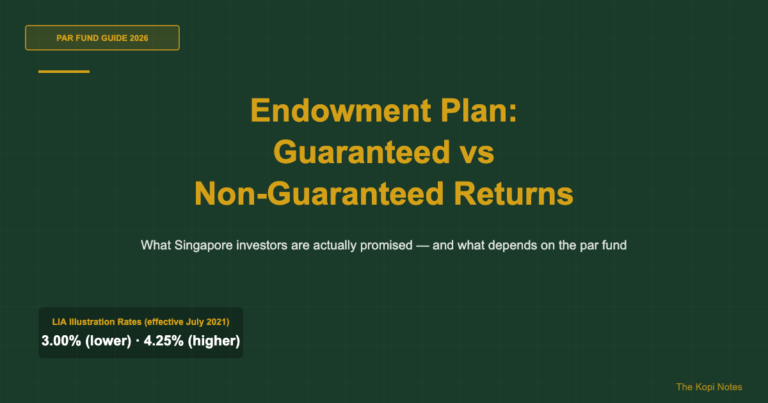
Singapore endowment plans grow through two distinct bonus types: reversionary bonuses (declared annually and guaranteed once added) and terminal bonuses (non-guaranteed, only paid at maturity, claim, or surrender). The Life Insurance Association (LIA) sets illustration caps at 4.25% upper and 3.00% lower for participating (par) fund products, and insurers must show projected payouts at both rates in every benefit illustration. Understanding how these bonuses compound over a 20-year policy can significantly affect your retirement planning outcome.
Not financial advice. All figures are for educational reference only. Data verified as at 15 October 2026.
Table of Contents
In This Guide
- What Are Endowment Plan Bonus Rates?
- LIA Illustration Rate Caps Explained
- Reversionary vs Terminal Bonus: Key Differences
- How Reversionary Bonus Accumulates Over Time
- 2026 Payout Scenarios at Both Illustration Rates
- Insurer Par Fund Performance Snapshot
- How to Evaluate Bonus Rates When Choosing a Plan
- Frequently Asked Questions
What Are Endowment Plan Bonus Rates?
An endowment plan in Singapore is a type of participating (par) life insurance policy that combines savings with protection. You pay premiums for a fixed term (typically 10–25 years), and at maturity you receive a guaranteed sum assured plus accumulated bonuses — both reversionary and terminal.
The “bonus rate” refers to how quickly the non-guaranteed portion of your policy grows. Insurers invest policyholders’ premiums in a par fund, then distribute investment returns back to policyholders as annual bonus declarations. How this par fund is managed — and how much surplus is passed back — determines your actual payout at maturity.
The Two-Component Payout Structure
Every Singapore par endowment policy has two distinct components in its total payout:
- Guaranteed benefits: The sum assured and any previously declared reversionary bonuses already attached to your policy. These are contractually protected and form your minimum payout floor.
- Non-guaranteed benefits: The terminal (or special) bonus, which is only confirmed at the point of payout. This can be substantial — sometimes 20–40% of the total maturity value — but can also decrease if par fund performance deteriorates.
This structure is also why endowment plan guaranteed vs non-guaranteed returns matter so much — the ratio between these two components tells you how much risk you’re actually taking with an endowment product marketed as “low risk.”
LIA Illustration Rate Caps Explained
The Life Insurance Association of Singapore (LIA) sets mandatory caps on the investment return rates that insurers may use when projecting policy payouts in benefit illustrations. These caps apply across all par fund products sold in Singapore and were last updated effective 1 July 2021:
- Upper illustration rate: 4.25% per annum
- Lower illustration rate: 3.00% per annum
Before July 2021, the upper cap was 5.25% and the lower was 3.75%. The LIA reduced these caps to better reflect realistic long-term expectations in a structurally lower interest rate environment.
What These Rates Actually Represent
A critical point many policyholders miss: these are illustration rates, not guaranteed returns. They represent hypothetical investment performance scenarios — the upper and lower bounds that insurers must show. Your actual payout depends on:
- The par fund’s actual investment returns over your policy term
- The insurer’s expense ratios and mortality experience
- The insurer’s bonus smoothing approach (how they distribute surpluses across years)
- The insurer’s bonus philosophy — whether they prioritise reversionary or terminal bonuses
An insurer achieving 5% par fund returns doesn’t necessarily pass all of that to policyholders — a portion covers expenses, mortality claims, and builds reserves. Typically, at least 90% of par fund surpluses are allocated to policyholders under MAS guidelines, with the remaining up to 10% retained by the insurer.
Reversionary vs Terminal Bonus: Key Differences
The single most important distinction in endowment plan bonuses is the difference between reversionary and terminal bonuses. Most policyholders conflate the two — but they have very different risk profiles.
| Feature | Reversionary Bonus | Terminal Bonus |
|---|---|---|
| Declaration frequency | Annually | At maturity / claim / surrender |
| Guaranteed once declared? | Yes — becomes part of sum assured | No — can change until paid out |
| Compounding | Compounds over policy term | Declared as a lump sum; no compounding |
| Impact of early surrender | Partial recovery via surrender value | Significantly reduced or forfeited |
| Death benefit inclusion | Included in death benefit | May or may not be included |
| Typical proportion of total payout | 15–25% above sum assured | 5–20% of total maturity value |
Source: LIA Singapore par fund product guidelines; illustrative ranges based on 20-year par endowment policies. Data as at October 2026.
The key insight: reversionary bonuses are the bedrock of your endowment plan’s security. Once declared each year, they attach permanently to your policy, growing the guaranteed floor. Terminal bonuses represent the “upside” — your share of par fund outperformance — but they are subject to revision right up to the point of payout.
This is why policyholders who surrender early often lose significantly more than they expected — their endowment plan early surrender penalty is partly a reflection of the terminal bonus being forfeited entirely.
How Reversionary Bonus Accumulates Over Time
The power of reversionary bonuses lies in their compounding nature. Once a reversionary bonus is declared and added to your policy, it becomes part of the sum insured — meaning next year’s reversionary bonus is calculated on a larger base. This creates a snowball effect over a long policy term.
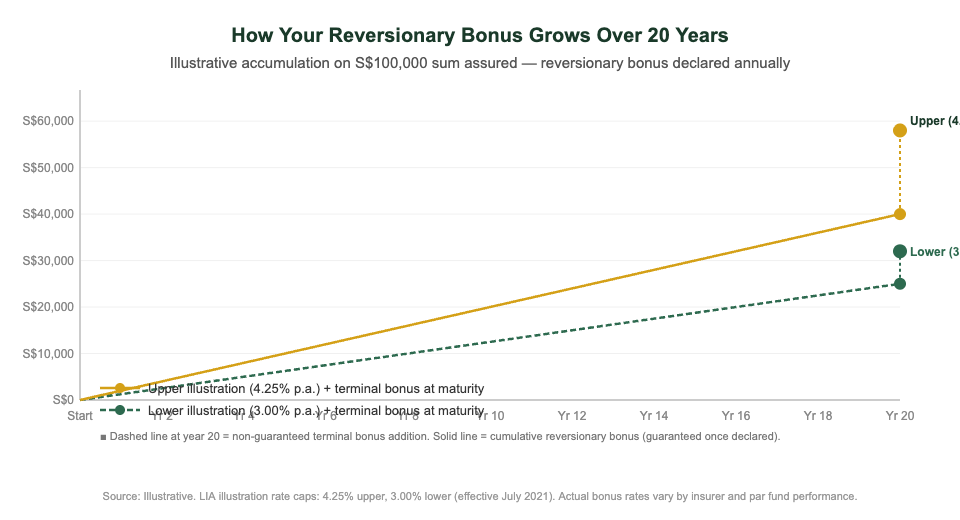
Illustrative: S$100,000 sum assured. Upper (4.25%): ~S$143,000 total at year 20 including terminal. Lower (3.00%): ~S$125,000 total. Dashed line = non-guaranteed terminal bonus addition. Source: LIA illustration rate caps; illustrative calculations. Data as at October 2026.
Looking at a S$100,000 sum assured endowment plan over 20 years:
- At the upper illustration rate (4.25%): Cumulative reversionary bonuses reach approximately S$25,000 by year 20, with a terminal bonus of around S$18,000 added at maturity — bringing total illustrated payout to approximately S$143,000.
- At the lower illustration rate (3.00%): Cumulative reversionary bonuses reach approximately S$18,000 by year 20, with a terminal bonus of S$7,000 at maturity — total illustrated payout approximately S$125,000.
The gap between upper and lower scenarios widens significantly in later policy years. This is the core reason why holding an endowment plan to full maturity matters so much — the terminal bonus is front-loaded in its nominal value, but its proportion of total payout is largest in the final years.
This compounding dynamic also informs how to use endowment payouts in retirement planning. Running the numbers through a Singapore retirement calculator alongside your CPF LIFE projections can help you understand whether your endowment maturity falls at an optimal age.
2026 Payout Scenarios at Both Illustration Rates
The chart below shows how a S$100,000 par endowment plan’s total payout breaks down across three scenarios — guaranteed only, lower illustration, and upper illustration — making the contribution of each bonus component visible.
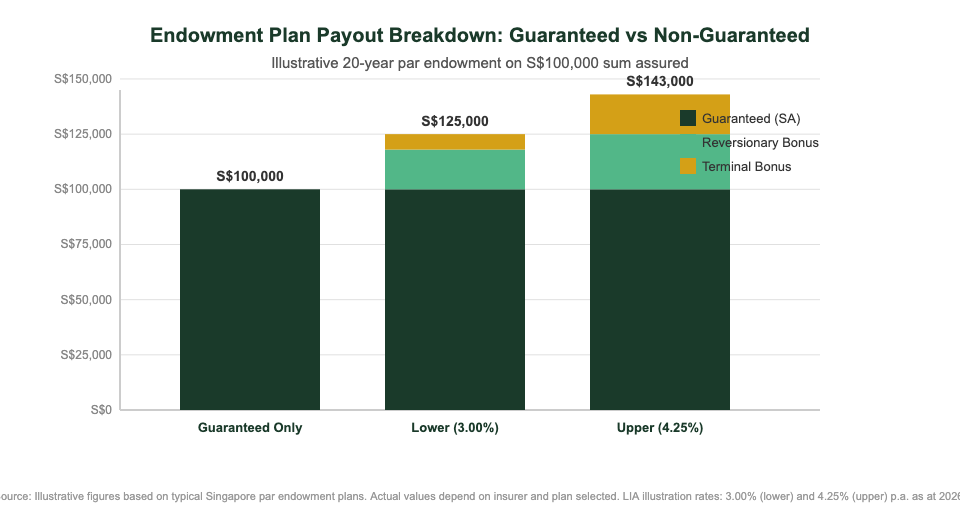
Illustrative S$100,000 sum assured 20-year par endowment. Guaranteed Only: S$100,000. Lower (3.00%): S$125,000. Upper (4.25%): S$143,000. Source: LIA Singapore illustration rate caps effective July 2021. Data as at October 2026.
2026 Insurer Bonus Declaration Update: Manulife
As one example of how 2026 bonus declarations are unfolding: Manulife Singapore — one of Singapore’s larger par fund operators with approximately S$28.5 billion in par fund assets, an AA- credit rating, and a strategic asset allocation of ~30% equities — published its 2026 Bonus Declaration confirming:
- Reversionary bonus rates maintained across most par policies — indicating the par fund’s sustainable yield is sufficient to support existing guaranteed bonus levels
- Terminal bonus rates increased for selected Par 5 medium-term plans effective July 2026 — reflecting better-than-expected par fund performance over recent years
This pattern — stable reversionary with increasing terminal — is consistent with a well-managed par fund that prioritises policyholder security while passing excess returns as terminal bonuses. It is also why policyholders nearing maturity in 2026 may see higher-than-illustrated payouts on their original benefit illustration.
At maturity, the actual endowment plan maturity payout can differ meaningfully from the original illustration — in either direction — depending on the insurer’s par fund performance over the policy term.
Insurer Par Fund Performance Snapshot
Par fund performance is not directly comparable between insurers because each discloses it differently — some report net investment yield, others report total returns. However, MAS Notice 320 requires all Singapore insurers to publish their par fund performance data. The following table provides an illustrative reference framework for evaluating par fund quality:
| Metric to Evaluate | What It Tells You | Where to Find It |
|---|---|---|
| Par fund net investment yield (5-year) | Sustained ability to generate returns above expense drag | Annual par fund disclosure / insurer website |
| Bonus fulfilment ratio | % of projected total illustrated payout actually paid at maturity; above 100% = outperformance | MAS comparison platform / insurer disclosure |
| Policyholder bonus allocation % | Share of par surplus distributed to policyholders vs retained by insurer (min 90% by MAS rule) | Annual par fund disclosure |
| SAA equity exposure | Higher equity allocation = higher growth potential but more volatility in terminal bonuses | Par fund fact sheet |
| Insurer financial strength rating | Ability to honour long-term par commitments; look for AA- or above from S&P/Moody’s | S&P / Moody’s / insurer website |
Source: MAS Notice 320 par fund disclosure framework; LIA Singapore. Data as at October 2026.
How to Evaluate Bonus Rates When Choosing a Plan
When comparing endowment plans before purchase, most buyers focus on the “total projected payout” — but this can be misleading because it blends guaranteed and non-guaranteed components. Here is a more rigorous framework:
Step 1: Identify the Guaranteed Payout Floor
Look at your benefit illustration’s “guaranteed benefits” column only. This is the absolute minimum you will receive if you hold to maturity and the par fund performs at zero above expenses. For a 20-year plan, a higher guaranteed floor (relative to total premiums paid) indicates stronger policyholder protection.
Step 2: Assess the Reversionary Bonus Track Record
Request or look up the insurer’s reversionary bonus history for the product. Has the insurer maintained or increased its reversionary bonus rates over the past 5–10 years, even through market downturns (2020, 2022)? Consistent reversionary bonuses signal a prudent par fund management approach.
Step 3: Evaluate the Terminal Bonus Proportion
Calculate what percentage of the illustrated total payout is terminal (non-guaranteed). A very high terminal bonus proportion (e.g., 30%+ of total payout) means you’re taking on meaningful investment risk in a product marketed as conservative. For a genuine low-risk profile, look for plans where terminal bonus is below 20% of total projected payout.
Step 4: Compare Bonus Fulfilment Ratios
MAS now requires Singapore insurers to publish their bonus fulfilment ratios — the actual payout at maturity vs the originally illustrated payout. A ratio above 100% means policyholders received more than illustrated; below 100% means they received less. This is the most direct measure of how conservative or aggressive each insurer’s illustrations have been.
Step 5: Check the Par Fund’s Asset Allocation
Higher equity allocation in the par fund → higher long-term growth potential → but more year-to-year bonus volatility. For retirement-focused policyholders with a 15–20 year horizon, a moderate equity allocation (25–40%) may be appropriate. For those closer to maturity or more conservative, look for par funds with higher fixed income allocations.
Frequently Asked Questions
What is the LIA illustration rate for Singapore endowment plans in 2026?
Is the reversionary bonus guaranteed in a Singapore endowment plan?
Can I lose my terminal bonus if I surrender early?
How do I find out my insurer's actual bonus fulfilment ratio?
Should I buy an endowment plan with a high or low terminal bonus proportion?
How does the par fund's asset allocation affect my bonus?
What is the difference between a reversionary bonus and a special bonus?
Get Free Insurance Advice
Speak with a licensed insurance advisor. No obligation, no cost.
By submitting this form, you agree to our Privacy Policy.
This article was researched with the help of AI. While we strive to keep all information accurate and up to date, there may be errors. If you notice any discrepancies, please contact us.