Keppel DC REIT Dividend History & DPU Growth Track Record (2026)
A complete analysis of KDC REIT’s distribution per unit from IPO to 2026 — for Singapore income investors.
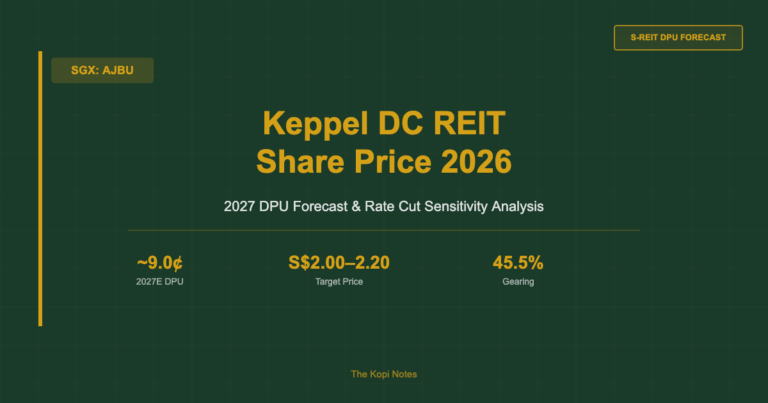
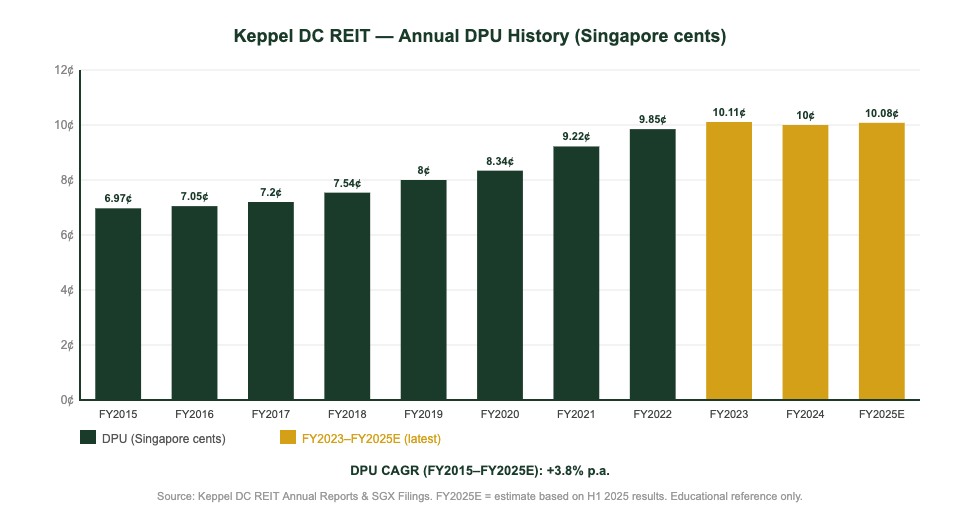
Keppel DC REIT (SGX: AJBU) has delivered consistent and growing distributions since its IPO in December 2014, making it one of Singapore’s most reliable dividend-paying data centre REITs. The annual DPU has grown from approximately 6.97 Singapore cents in FY2015 to around 10.08 cents in FY2025 — a compound annual growth rate (CAGR) of roughly 3.8% per year, underpinned by rising demand for data centre capacity across Asia-Pacific and Europe. At a share price of approximately SGD 2.10–2.20, the trailing yield stands at around 4.5–4.8%.
Not financial advice. All figures are for educational reference only. Data as at October 2026 unless noted.
What Is Keppel DC REIT?
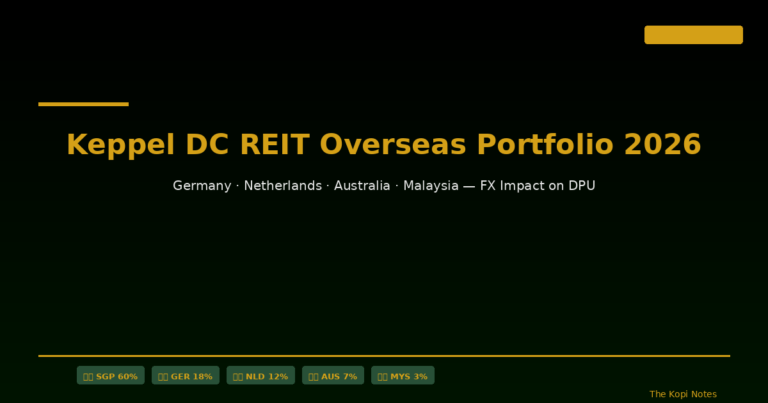
Keppel DC REIT (ticker: AJBU) is Singapore’s first and largest data centre REIT listed on the SGX. Launched in December 2014 under the Keppel Group umbrella, it owns and manages a diversified portfolio of data centre assets across Singapore, Australia, Germany, the Netherlands, the UK, Ireland, Italy, Malaysia, and China.
As of mid-2026, KDC REIT’s portfolio comprises over 23 data centres with an aggregate lettable area exceeding 650,000 sqm. The REIT operates on a predominantly long-term lease structure (WALE of approximately 7–9 years) with built-in rental escalations, which provides high visibility over future distribution income. This is a key reason KDC REIT has been able to grow its DPU consistently since listing.
For Singapore investors looking for passive income in Singapore, KDC REIT occupies a distinct niche: it offers technology-sector exposure combined with the income certainty of a REIT structure. It is also one of the best S-REITs in Singapore 2026 by market capitalisation and analyst coverage.
Full Annual DPU History (2014–2026)
The table below shows Keppel DC REIT’s annual distribution per unit (DPU) from its IPO year (FY2014) through FY2025 estimated. Note that FY2014 was a partial year (IPO in December 2014), so only a stub distribution was paid.
| Financial Year | Annual DPU (S¢) | YoY Change | Approx. Yield at Year-End |
|---|---|---|---|
| FY2014 (partial — IPO Dec 2014) | 4.87¢ | — | ~5.2% |
| FY2015 | 6.97¢ | +43.1%* | ~6.8% |
| FY2016 | 7.05¢ | +1.1% | ~6.1% |
| FY2017 | 7.20¢ | +2.1% | ~5.3% |
| FY2018 | 7.54¢ | +4.7% | ~4.8% |
| FY2019 | 8.00¢ | +6.1% | ~4.2% |
| FY2020 | 8.34¢ | +4.3% | ~3.6% |
| FY2021 | 9.22¢ | +10.6% | ~3.9% |
| FY2022 | 9.85¢ | +6.8% | ~4.4% |
| FY2023 | 10.11¢ | +2.6% | ~4.7% |
| FY2024 | 10.00¢ | -1.1% | ~4.9% |
| FY2025E | 10.08¢ | +0.8% | ~4.7% |
*FY2014 was a partial year (IPO Dec 2014), so FY2015 growth vs FY2014 is not comparable. Source: Keppel DC REIT Annual Reports, SGX filings. FY2025E = estimate based on 1H2025 results. Yield = approximate prevailing yield at year-end. Educational reference only.
The data shows a clear upward DPU trajectory from FY2015 to FY2023, with a brief moderation in FY2024 (down 1.1%) due to higher borrowing costs as global interest rates peaked. DPU stabilised and resumed modest growth in FY2025E as the rate environment eased. Importantly, KDC REIT’s DPU has never been cut to zero — even during COVID-19 in FY2020, the REIT continued growing its distributions as data centres were deemed essential infrastructure.
Half-Yearly DPU Breakdown (2022–2025)
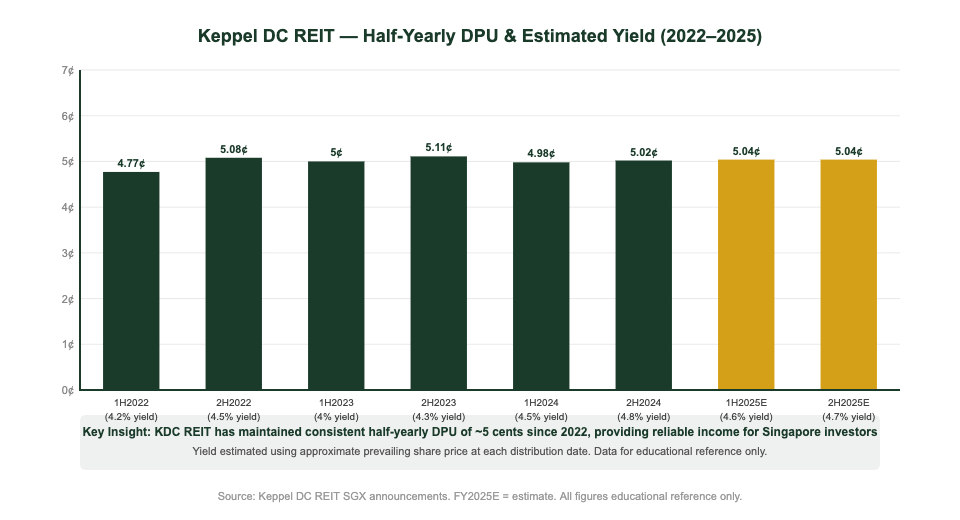
KDC REIT pays distributions semi-annually (twice per year). The table below breaks down the half-yearly DPU from 2022 to mid-2025, allowing investors to track the consistency of each individual distribution.
| Period | DPU (S¢) | YoY Change | Ex-Date (Approx.) |
|---|---|---|---|
| 1H2022 (Jan–Jun) | 4.77¢ | +4.2% | Aug 2022 |
| 2H2022 (Jul–Dec) | 5.08¢ | +3.7% | Feb 2023 |
| 1H2023 (Jan–Jun) | 5.00¢ | +4.8% | Aug 2023 |
| 2H2023 (Jul–Dec) | 5.11¢ | +0.6% | Feb 2024 |
| 1H2024 (Jan–Jun) | 4.98¢ | -0.4% | Aug 2024 |
| 2H2024 (Jul–Dec) | 5.02¢ | -1.8% | Feb 2025 |
| 1H2025E (Jan–Jun) | 5.04¢ | +1.2% | Aug 2025 |
| 2H2025E (Jul–Dec) | 5.04¢ | +0.4% | Feb 2026 |
Source: Keppel DC REIT SGX announcements. E = estimate. Exact ex-dates and DPU confirmed via SGX AJBU announcements. Educational reference only.
The half-yearly DPU has been remarkably stable in the 4.98¢–5.11¢ band from 2022 to 2025. The modest dip in FY2024 (–1.1% full year) reflected higher financing costs as KDC REIT refinanced debt at elevated rates during the 2023–2024 peak rate environment. With central banks easing in late 2024 and through 2025, the cost of debt has begun to moderate, supporting DPU recovery.
What Drives Keppel DC REIT’s DPU Growth?
KDC REIT’s DPU growth has been driven by four primary factors over its 10+ year listing history:
1. Accretive Acquisitions
KDC REIT has grown its asset base from SGD 1 billion at IPO to over SGD 3.7 billion (gross asset value) by 2026. Key acquisitions include data centres in Singapore (Keppel DC Singapore 5, 7, 8), Germany, Ireland, and the Netherlands. Each accretive deal has expanded the NPI base supporting higher DPU. The REIT’s sponsor Keppel Ltd also provides a pipeline of data centre assets for potential injection.
2. Built-in Rental Escalations
Most of KDC REIT’s leases include annual rent escalation clauses, typically tied to CPI or fixed step-ups of 2–3% per year. This means revenue grows organically without requiring new acquisitions, directly supporting DPU growth even in a stable occupancy environment. As of 2026, KDC REIT’s portfolio-wide occupancy remains above 98%.
3. Long WALE Providing Revenue Certainty
With a weighted average lease expiry (WALE) of approximately 7–8 years across its portfolio, KDC REIT has high visibility over future income streams. Long-term leases with creditworthy tenants (hyperscalers, government agencies, and Fortune 500 companies) reduce income risk and support consistent DPU payment. For more detail, see our KDC REIT WALE and lease expiry analysis.
4. Favourable Financing Mix
KDC REIT actively manages its debt maturity profile. As of 2026, the REIT maintains approximately 70–75% fixed-rate debt, limiting its sensitivity to short-term rate movements. Its gearing ratio of approximately 36–38% is comfortably below the MAS regulatory cap of 50%, providing debt headroom for future acquisitions without dilutive equity fundraising.
Dividend Yield Analysis: Then vs Now
One critical point for income investors: the yield you earn depends on the price you paid, not the current market price. Here’s how KDC REIT’s yield profile has changed since IPO, and what investors buying at different price points can expect today.
Yield on Cost: Entry Price Matters
An investor who bought KDC REIT at its IPO price of approximately SGD 0.93 and held through to 2025 would be receiving an annual DPU of ~10.08 cents — that’s a yield on cost of approximately 10.8%. This illustrates the power of holding quality REITs over the long term as DPU compounds.
By contrast, an investor buying at the October 2026 share price of approximately SGD 2.10–2.20 receives a yield of approximately 4.6–4.8% on forward FY2025E DPU. This is still attractive relative to Singapore T-bills (around 3.0–3.5%) and CPF OA (2.5%), and competitive with the broader S-REIT sector average of 5.0–5.5%.
Yield Comparison Table
| Investor Entry Point | Approx. Entry Price (SGD) | FY2025E DPU (S¢) | Yield on Cost |
|---|---|---|---|
| IPO (Dec 2014) | $0.93 | 10.08¢ | 10.8% |
| Early COVID dip (Apr 2020) | $1.55 | 10.08¢ | 6.5% |
| Peak (Dec 2021) | $3.05 | 10.08¢ | 3.3% |
| Post-rate hike trough (Nov 2023) | $1.85 | 10.08¢ | 5.4% |
| Today (Oct 2026) | ~$2.10–2.20 | 10.08¢ | 4.6–4.8% |
Source: SGX historical price data, KDC REIT announcements. All prices and yields are approximate and for educational reference. Past performance is not indicative of future results.
The table illustrates a common pattern in quality REITs: investors who bought during periods of market stress (COVID-19, rate-hike trough) locked in superior yields on cost. For those considering entry at current levels, a 4.6–4.8% yield from a data centre REIT with a history of DPU growth may still be compelling — especially if rates continue to ease through 2026.
For investors using tools to model income scenarios, our Singapore retirement calculator can help estimate how KDC REIT income stacks up against a broader passive income portfolio.
Is KDC REIT’s DPU Sustainable?
Three metrics matter most when assessing DPU sustainability for any REIT: distribution coverage ratio, gearing, and lease profile.
Distribution Coverage Ratio
KDC REIT typically distributes 90–100% of its distributable income. The REIT’s distribution coverage ratio has consistently remained above 1.0x, meaning the underlying cash flows fully support the DPU. This is possible because: (a) data centres generate stable, subscription-like revenues; (b) the portfolio maintains near-full occupancy; and (c) capital expenditures are largely funded through retained cash flow or recycled capital.
Gearing & Debt Maturity
As of the latest SGX filing, KDC REIT’s aggregate leverage stands at approximately 36–38% — comfortably below the 50% MAS limit. The REIT has laddered its debt maturities across 2026–2030+, avoiding concentration risk in any single refinancing year. With ~70% of debt on fixed rates, DPU is largely insulated from short-term rate swings.
Structural Demand Tailwinds
Data centre demand globally is growing at a high-single-digit to low-double-digit CAGR, driven by AI model training, cloud migration, edge computing, and increasing data sovereignty regulations. KDC REIT is well-positioned to capture this demand through its high-quality, carrier-neutral facilities. Rental reversion — the rate at which expiring leases are renewed at higher rents — has been consistently positive, supporting future DPU growth.
The key risk to DPU sustainability is a sharp increase in borrowing costs (e.g. if rates re-accelerate above 2022 highs) or a major tenant default. However, given KDC REIT’s blue-chip tenant base and long WALE, tenant risk is considered low. Currency risk (the REIT earns in EUR, AUD, GBP, and other currencies) is partially hedged, though FX movements can affect reported SGD DPU.
How to Buy Keppel DC REIT
Keppel DC REIT (SGX: AJBU) trades on the Singapore Exchange (SGX) and can be purchased through any SGX-connected brokerage. Here’s a quick comparison of popular platforms used by Singapore retail investors:
- Syfe Trade — commission-free for the first 30 trades per month, fully digital account opening; use our Syfe referral code (SRPRFFFCD) for bonus credits. Ideal for investors accumulating KDC REIT in small lots.
- Endowus — if you prefer a managed portfolio approach rather than picking individual REITs, Endowus offers S-REIT-inclusive portfolios; use our Endowus referral code (2V343) for fee rebates. Note: Endowus is a fund platform, not a direct SGX brokerage.
- moomoo Singapore — competitive commissions and real-time SGX market data; see our moomoo Singapore review for the latest fees and promotions.
- IBKR (Interactive Brokers) — ideal for investors holding a multi-asset portfolio alongside KDC REIT; low commissions at USD 1.50–3.00 per SGX trade.
KDC REIT trades in lots of 100 units on the SGX. At a share price of ~SGD 2.15, the minimum investment is approximately SGD 215 per lot. Distributions are paid semi-annually (approximately February and August each year), and you must hold units before the ex-dividend date to qualify for each distribution.
Frequently Asked Questions
What is Keppel DC REIT’s current dividend yield?
How often does Keppel DC REIT pay dividends?
Has Keppel DC REIT ever cut its DPU?
Is Keppel DC REIT a good long-term dividend investment?
What is the difference between Keppel DC REIT’s DPU and yield?
Where can I find Keppel DC REIT’s official DPU announcements?
Conclusion: KDC REIT as a Dividend Compounder
Keppel DC REIT’s dividend history tells a compelling story: consistent DPU growth from 6.97 cents in FY2015 to approximately 10.08 cents by FY2025, with no distribution cut across more than a decade of listing. The temporary moderation in FY2024 reflects macro interest rate headwinds rather than any structural weakness in the underlying data centre business.
For Singapore income investors, KDC REIT occupies a unique position — offering technology-sector growth exposure through a REIT structure that mandates regular income distribution. At current valuations, a forward yield of approximately 4.6–4.8% combined with the potential for continued DPU growth as rates ease and AI-driven data centre demand accelerates makes KDC REIT a core holding candidate in a diversified S-REIT portfolio.
This article is for informational and educational purposes only and does not constitute financial advice. Always verify figures with official SGX announcements and consult a licensed financial adviser before making investment decisions.
This article was researched with the help of AI. While we strive to keep all information accurate and up to date, there may be errors. If you notice any discrepancies, please contact us.