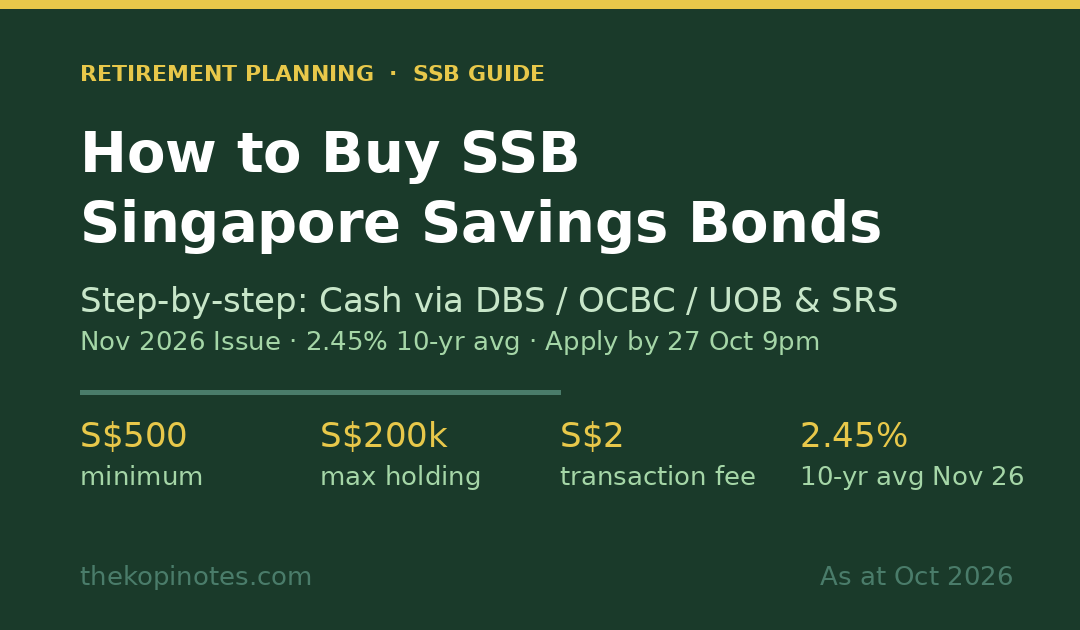
TL;DR
- Eligible buyers: Singapore Citizens and PRs with a DBS/POSB, OCBC, or UOB account.
- Cash buyers need a CDP account linked to one of those banks. SRS buyers do not.
- Minimum: S$500 per application, in multiples of S$500. Maximum: S$200,000 per person across all outstanding SSBs.
- Transaction fee: S$2 each time you apply or redeem.
- No penalty for early redemption — you can get your money back any month.
- November 2026 (SBNOV26): 10-year average 2.45%. Apply by 27 October 2026, 9pm.
Singapore Savings Bonds (SSBs) are issued monthly by the Monetary Authority of Singapore (MAS) on behalf of the Singapore Government. They offer step-up returns — interest rises each year you hold, averaging to the 10-year rate printed in the announcement — and you can redeem any time without penalty. This guide walks through the exact steps to apply, whether you are paying with cash through a bank or using your Supplementary Retirement Scheme (SRS) account.
What You Need Before You Apply
Check each item before the application deadline — missing any one of them means you cannot complete the purchase.
| Requirement | Cash Application | SRS Application |
|---|---|---|
| Singapore Citizen or PR | ✅ Required | ✅ Required |
| DBS/POSB, OCBC, or UOB bank account | ✅ Required | ✅ (must be your SRS operator) |
| CDP (Central Depository) account linked to bank | ✅ Required | ❌ Not needed |
| SRS account with your bank | ❌ Not needed | ✅ Required |
| Sufficient cash/SRS balance | ✅ S$500 minimum + S$2 fee | ✅ S$500 minimum + S$2 fee |
Opening a CDP account: Apply at sgx.com (Investor Centre → Open CDP Account). Processing takes about 1–2 business days. Once open, link your DBS/POSB, OCBC, or UOB bank account in the CDP portal before applying for SSBs.
Monthly Application Calendar
MAS issues a new SSB each month. The calendar runs like this:
| Event | Timing |
|---|---|
| Application window opens | ~1st business day of the month |
| Application window closes | 4th last business day of the month, 9pm |
| Allotment results announced | Next business day after close (via MAS, SGX) |
| Issue date (bonds credited to CDP/SRS) | 1st or 2nd of the following month |
| First interest payment | ~6 months after issue date |
For SBNOV26 (November 2026 issue), the key dates are: apply by 27 October 2026 at 9pm → allotment announced 28 October 2026 → issue date 2 November 2026.
November 2026 SSB Rates (SBNOV26 — Issue Code GX26110X)
The step-up design means your effective return grows the longer you hold. If you redeem early, you receive interest only for completed years at the rate applicable to those years — still no penalty, just a lower average.
| Year | 1 | 2 | 3 | 4 | 5 | 6 | 7 | 8 | 9 | 10 | 10-yr avg |
|---|---|---|---|---|---|---|---|---|---|---|---|
| Rate (% p.a.) | 1.67 | 2.00 | 2.19 | 2.35 | 2.49 | 2.61 | 2.70 | 2.79 | 2.91 | 3.08 | 2.45 |
Interest is paid every six months (1 May and 1 November). Rates are fixed for the life of the bond.
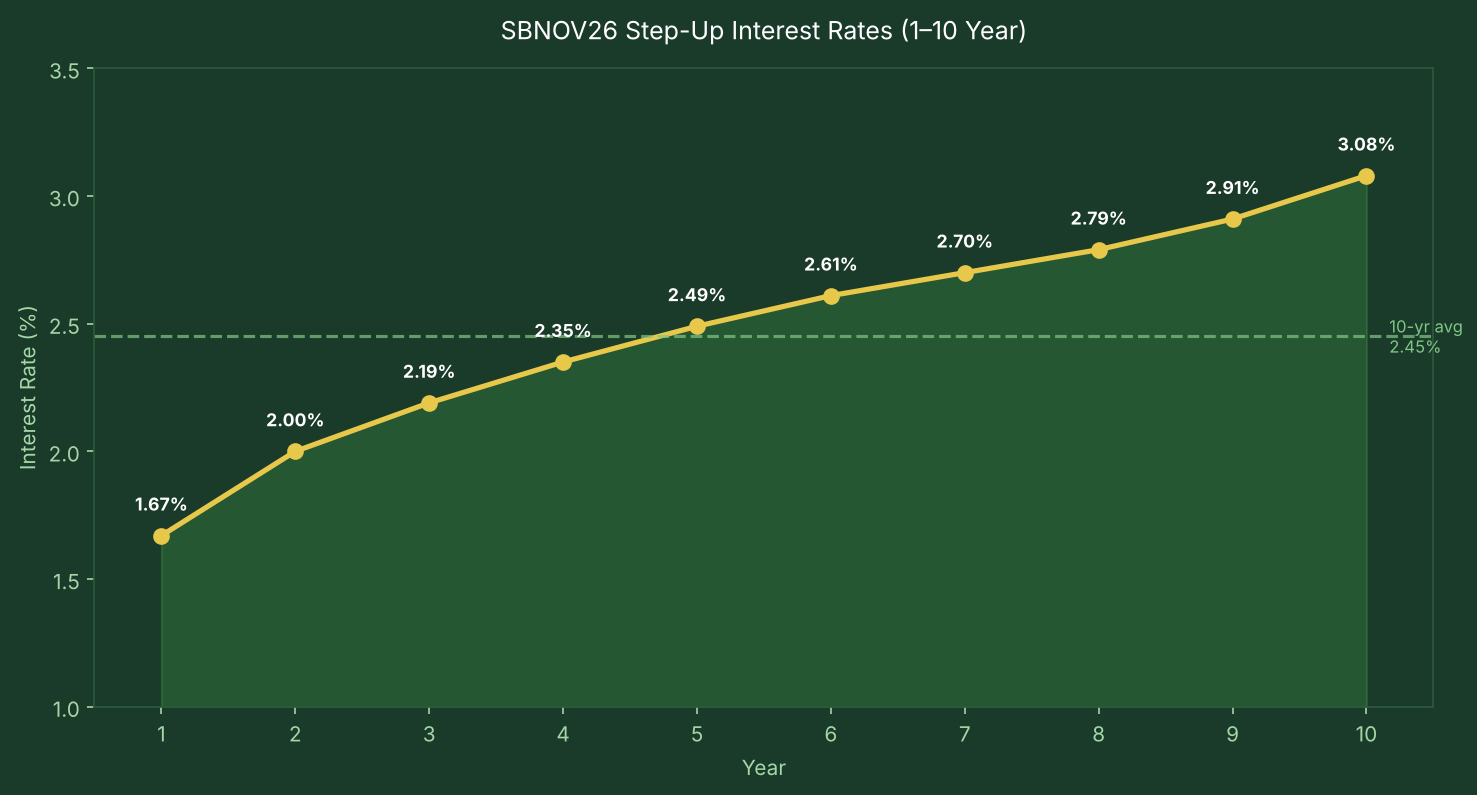
Source: MAS SSB announcement GX26110X, October 2026. Amount on offer: S$400 million.
Step-by-Step: Cash Application via Internet Banking
Internet banking is the most straightforward channel. The exact menu path differs slightly by bank, but the flow is the same for DBS iBanking, OCBC Online Banking, and UOB Personal Internet Banking / TMRW.
- Log in to your bank’s internet banking portal.
- Find SSBs — look under Invest / Investments → Singapore Government Securities, or search “Savings Bond” in the portal.
- Select the current issue — for November 2026, look for SBNOV26 or issue code GX26110X.
- Enter your application amount — minimum S$500, in multiples of S$500, up to your remaining headroom under the S$200,000 holding limit.
- Confirm CDP account details — the portal links the bank account to your CDP automatically if they are already linked.
- Review the S$2 fee and confirm the transaction. The fee and the investment amount are both deducted immediately.
- Wait for allotment — if successful, SSBs appear in your CDP account on the issue date. If the issue is oversubscribed and you are not allotted, the investment amount is refunded to your bank account within 3–4 business days.
Tip: Don’t leave it until the last hour. Many banks’ internet banking systems slow down near the 9pm deadline as applications pile in.
Step-by-Step: Cash Application via ATM
Any DBS/POSB, OCBC, or UOB ATM works. The flow is similar across banks.
- Insert your debit or credit card and enter your PIN.
- Select More Services → Investments (or equivalent, depending on ATM model).
- Choose Singapore Savings Bond and select the current issue.
- Enter the amount and confirm the S$2 transaction fee.
- Collect your reference receipt and keep it until allotment results are confirmed.
ATM applications process the same way as internet banking — no advantage or disadvantage either way.
Step-by-Step: SRS Application
If you are using SRS funds to buy SSBs, the flow runs through your SRS operator’s internet banking (DBS/POSB, OCBC, or UOB). No CDP account is required.
- Log in to internet banking with your SRS operator.
- Navigate to your SRS Account → Invest → Singapore Savings Bonds.
- Select the current SSB issue and enter the amount you wish to invest using SRS funds.
- The S$2 fee and the investment amount are deducted from your SRS balance.
- On allotment, SSBs are held in your SRS account. On redemption, the principal and accrued interest return to your SRS account.
Why use SRS to buy SSBs? SRS contributions of up to S$15,300 per year (Singaporeans and PRs) are tax-deductible. Investing those funds into SSBs keeps the money liquid (redeemable any time) while earning a risk-free government rate. See our full SRS Tax Relief guide for the tax savings by income bracket and how to open an SRS account.
How Allotment Works
SSBs are not first-come, first-served. Every valid application received before the 9pm deadline on the closing date is treated equally — the time you submit within the window does not matter.
If total applications exceed the amount on offer:
- Applications are allotted on a random ballot.
- Partial allotments may occur — you receive some but not all of what you applied for.
- Any unallotted amount is refunded to your bank account within a few business days.
- No S$2 refund on the fee for unallotted amounts.
In practice, most recent SSB issues have been undersubscribed — total applications have fallen well below the amount on offer — so full allotment has been the norm. But this changes with market conditions: when bank fixed deposit rates fall, SSB demand typically rises.
Redeeming Your SSB
One of SSBs’ key advantages for Singapore retirement savers is penalty-free early redemption. To redeem:
- Submit a redemption request through internet banking or ATM before the 4th last business day of the month at 9pm.
- Pay the S$2 redemption fee.
- Accrued interest up to the end of the completed interest period is paid to you.
- The principal is returned to your bank account (or SRS account) on the 2nd business day of the following month.
If you redeem before Year 10, the effective rate you received is the average of the year-specific rates for the years you held. Redeeming in Year 1 gives you 1.67% (for SBNOV26) — lower than the 10-year average of 2.45%, but still better than many savings accounts and fully risk-free.
To understand how SSB redemption compares with rolling T-bills in rising and falling rate environments, see our complete SSB guide.
How SSBs Fit a Singapore Retirement Plan
SSBs are not a standalone retirement vehicle — the annual holding limit of S$200,000 and the step-up rate structure mean they work best as the liquid, risk-free layer of a broader plan. They complement:
- CPF LIFE: CPF OA earns a guaranteed 2.5% floor; SA and RA earn 4%. SSBs at 2.45% (10-yr avg) sit between those two floors and offer liquidity CPF cannot. See CPF Top-Up strategies for when topping up beats holding SSBs.
- Emergency fund: The penalty-free redemption makes SSBs a useful place to park cash you might need, earning more than most bank accounts.
- Retirement income bridge: Between age 55 (CPF withdrawal) and 65 (CPF LIFE payout start), SSBs can generate interest income with no lock-in. Use our Retirement Planning Calculator to model how a S$200,000 SSB ladder fits your gap years.
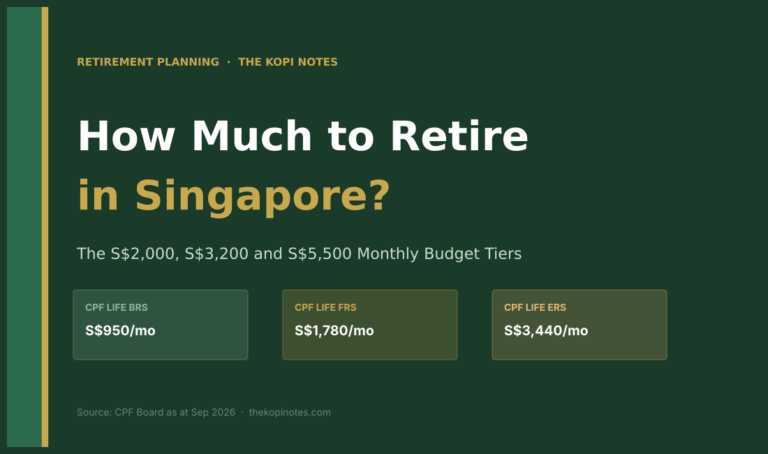
For a full picture of how much you need to retire in Singapore, including the three monthly budget tiers (S$2,000 / S$3,200 / S$5,500) and CPF LIFE income floors, see the linked guide.
Frequently Asked Questions
Do I need a CDP account to buy SSBs?
Yes, for cash applications. Your CDP (Central Depository) account is where the SSBs are held electronically. It must be linked to your DBS/POSB, OCBC, or UOB bank account before you can apply. Open one at sgx.com — it usually takes 1–2 business days to process.
If you are applying using SRS funds, no CDP account is needed. SSBs bought with SRS are held within your SRS account instead.
Can foreigners or Employment Pass holders buy SSBs?
No. SSBs are available to Singapore Citizens and Permanent Residents only. Employment Pass, S Pass, dependent pass, and long-term visit pass holders are not eligible, regardless of which bank account they hold.
What happens to the S$2 fee if my application is not allotted?
The S$2 transaction fee is non-refundable even if you are not allotted. The investment amount you applied with is returned to your bank account within 3–4 business days if you are unsuccessful. Only the S$2 fee is retained.
Can I buy SSBs through CPF funds?
SSBs cannot be bought using CPF Ordinary Account (OA), Special Account (SA), or MediSave funds. CPF funds can only be used to invest in CPF-approved instruments under the CPF Investment Scheme (CPFIS), which does not include SSBs. SSBs can be purchased with cash or SRS funds only.
If you want to put CPF OA money to work beyond the 2.5% floor, see our guide on CPF top-up strategies.
Can I submit more than one SSB application in the same month?
Only one application per individual per monthly issue is allowed. However, if you have both a cash (CDP-linked) account and an SRS account, you may submit one cash application and one SRS application for the same issue — subject to the combined S$200,000 holding limit across all outstanding SSBs.
How do I check my SSB holdings after allotment?
For cash-purchased SSBs: Log in to your CDP account via the SGX Investor Portal (investors.sgx.com) under Portfolio → Fixed Income. You can also check in your bank’s internet banking under Investments → SSB or Singapore Government Securities.
For SRS-purchased SSBs: Check your SRS account statement in your bank’s internet banking.
The MAS SSB website (mas.gov.sg/bonds-and-bills) also lets you verify current allotment status by NRIC.
Is SSB principal guaranteed? What if MAS changes the rules?
SSBs are backed by the full faith and credit of the Singapore Government — widely regarded as one of the safest issuers in the world (AAA-rated). Your principal is fully guaranteed, and the interest rates printed in the announcement are fixed for the life of that bond.
MAS can change the terms of future issues (rates, amount on offer, eligibility rules) but cannot alter the terms of bonds already issued. Bonds you currently hold are unaffected by any future rule changes.
SSB vs T-bills vs fixed deposits — which is best for short-term cash?
It depends on your horizon and need for liquidity:
- SSB: Up to 10 years, step-up rate (starts low, ends high), redeemable any month without penalty. Best if you want flexibility and don’t know exactly when you’ll need the money.
- T-bill (6-month or 1-year): Fixed rate set at auction, non-redeemable before maturity, returns cash automatically on maturity. Best if you know you won’t need the money for 6–12 months and the T-bill yield exceeds the SSB Year-1 or Year-2 rate.
- Fixed deposit: Bank product (not government-guaranteed beyond S$75,000 SDIC limit), no secondary market, usually penalises early withdrawal. Best for small amounts when the promotional rate beats SSB/T-bill.
Comparing the Nov 2026 issue: SSB Year-1 rate is 1.67%, while recent 6-month T-bill cut-off yields have been in the 2.5–3% range. For money you’re confident you won’t touch for 6–12 months, the T-bill currently offers a higher near-term rate. For genuine emergency-fund money you might need any month, SSB wins on flexibility.
Related Tools & Guides
- Singapore Savings Bond Complete Guide 2026 — rates by month, when to hold vs redeem, SSB vs T-bills comparison
- Retirement Planning Calculator — model how an SSB ladder fits your income gap between 55 and 65
- SRS Tax Relief Guide 2026 — how much tax you save at each income level, and how to use SRS to buy SSBs
- CPF Top-Up Strategies 2026 — when topping up CPF beats putting cash in SSBs
- How Much to Retire in Singapore 2026 — three monthly budget tiers and CPF LIFE income floors
- FIRE Singapore: Your Number — if you’re aiming for early retirement, how SSBs fit the liquid layer of your plan
Not financial advice. This article is for information purposes only and describes how Singapore Savings Bonds work and how to apply for them. It does not constitute financial, investment, or tax advice. Interest rates, application deadlines, and terms are subject to change. Verify details at mas.gov.sg before applying. As at October 2026.
This article was researched with the help of AI. While we strive to keep all information accurate and up to date, there may be errors. If you notice any discrepancies, please contact us.