Keppel DC REIT Share Price 2026: 5 Key Catalysts & Investment Case for Singapore Investors
SGX: AJBU | Data Centre S-REIT | Updated October 2026
Keppel DC REIT (SGX: AJBU) is Singapore’s largest pure-play data centre REIT, owning 23 facilities across Singapore, Australia, and Europe. Its Keppel DC REIT share price has attracted growing investor interest as AI-driven demand for colocation space accelerates. With a trailing yield of approximately 5.5%, a long weighted average lease expiry (WALE) of 7.6 years, and exposure to structural tailwinds in the digital infrastructure sector, KDC REIT offers a compelling long-term investment case.
Not financial advice. All figures are for educational reference only. Data as at October 2026 unless noted.
Table of Contents
Contents — Click to expand
- KDC REIT at a Glance
- Catalyst 1: Hyperscaler AI Demand Surge
- Catalyst 2: Interest Rate Tailwinds
- Catalyst 3: Singapore Data Centre Supply Constraint
- Catalyst 4: European Portfolio Expansion
- Catalyst 5: Asset Recycling & DPU Growth
- DPU History & Dividend Track Record
- KDC REIT vs S-REIT Peers
- Key Risks to Monitor
- Frequently Asked Questions
KDC REIT at a Glance (October 2026)
Before examining the five catalysts driving Keppel DC REIT’s share price outlook, it helps to understand the REIT’s current fundamentals. KDC REIT was listed on the SGX in December 2014 and has grown from a portfolio of 8 data centres to 23 facilities spanning Singapore, Australia, Ireland, Italy, Germany, the Netherlands, Malaysia, and the United Kingdom. Its sponsor is Keppel Corporation, one of Singapore’s leading conglomerates with a strong pipeline of data centre assets.
As of October 2026, KDC REIT’s key metrics are as follows:
| Metric | Value (Oct 2026) |
|---|---|
| SGX Ticker | AJBU |
| Market Cap | ~S$3.8 billion |
| FY2025 DPU | 8.784 Singapore cents |
| Distribution Yield | ~5.5% (trailing 12M) |
| Price/NAV | ~1.15x |
| Gearing Ratio | ~37% |
| WALE | 7.6 years |
| Portfolio Size | 23 data centres, 8 countries |
| Occupancy Rate | ~97.5% |
Source: Keppel DC REIT investor presentation; SGX; Bloomberg. Yield calculated using FY2025 DPU, October 2026.
Catalyst 1: Hyperscaler AI Demand Surge
The single most powerful tailwind driving the Keppel DC REIT share price in 2026 is the insatiable demand for data centre capacity from global hyperscalers — companies like Microsoft, Google, Meta, and Amazon Web Services. All four have publicly committed tens of billions of dollars in AI infrastructure spending through 2027, with Singapore designated as a key Asia-Pacific hub.
Why does this matter for KDC REIT? Data centres do not get built overnight. Singapore’s Infocomm Media Development Authority (IMDA) carefully controls new data centre supply through a certification process, meaning existing operators like KDC REIT face essentially zero new competition from greenfield projects in the near term. When a hyperscaler needs additional rack space or colocation capacity in Singapore, they knock on the doors of existing operators — and KDC REIT is the largest pure-play provider.
This demand dynamic is reflected in KDC REIT’s consistently high occupancy rates (97–98%) and its ability to negotiate positive rental reversions on lease renewals. According to Keppel DC REIT’s H1 2026 business update, new leases signed in Singapore commanded rents 8–12% above preceding contracted rates — a meaningful uplift that flows directly into future DPU growth. For investors tracking the best S-REITs in Singapore 2026, this rental reversion dynamic is a key differentiator for KDC versus traditional retail or office S-REITs.
Catalyst 2: Interest Rate Tailwinds
REITs are rate-sensitive instruments — they typically carry significant debt to fund acquisitions, and lower interest rates reduce financing costs while making their dividend yields relatively more attractive versus fixed income alternatives. After a prolonged period of elevated rates in 2022–2024, the US Federal Reserve and the Monetary Authority of Singapore shifted to easing cycles in 2025, with further cuts expected into 2027.
For Keppel DC REIT, rate cuts translate into tangible DPU improvement. The REIT’s interest coverage ratio stood at approximately 4.8x as of H1 2026 — healthy, but every 50 basis points of rate reduction on its floating-rate debt translates to approximately 0.04–0.06 Singapore cents of additional annual DPU. With ~37% gearing and a mix of fixed and floating debt, KDC REIT has structured its balance sheet to benefit meaningfully from the rate cycle turning.
Singapore investors building a portfolio for passive income in Singapore should note that rate cut cycles also tend to compress S-REIT yield spreads — meaning share prices often re-rate upward even before DPU actually improves. The combination of higher DPU (from lower financing costs) and multiple expansion (from tighter yield spreads) can create a powerful double tailwind for KDC REIT’s share price.
Catalyst 3: Singapore Data Centre Supply Constraint
Singapore’s data centre market is structurally undersupplied. The island-state’s power grid constraints and land scarcity limit how much new data centre capacity can be built. In 2019, Singapore imposed a moratorium on new data centre approvals; the government subsequently lifted the freeze in 2022 under a new Green Data Centre Roadmap, but approved projects are subject to strict power usage effectiveness (PUE) and sustainability standards that slow new supply to market.
The practical result: KDC REIT’s existing Singapore portfolio — which includes high-profile facilities such as Keppel DC Singapore 1 through 6 — sits in an exceptionally favourable supply environment. Legacy facilities with established power connections, fibre redundancy, and proven operational track records cannot easily be replicated. This structural barrier gives KDC REIT strong pricing power that should sustain above-market rental reversions well into 2027 and 2028.
For context, Singapore currently hosts approximately 70 MW of hyperscaler-grade data centre capacity under development — versus estimated demand of 200+ MW by 2028, according to estimates cited in the Monetary Authority of Singapore’s 2025 Green Finance Action Plan. This structural gap benefits incumbent operators disproportionately. Singapore investors considering CPF investment strategy allocations to S-REITs will find KDC REIT’s defensive supply moat particularly compelling.
Catalyst 4: European Portfolio Expansion
Keppel DC REIT’s European assets — located in Ireland, Germany, Italy, the Netherlands, and the United Kingdom — now account for roughly 30% of its portfolio by asset value. This geographic diversification offers two near-term catalysts: currency tailwinds and structural demand growth.
On currency: the Euro and British Pound have strengthened against the Singapore Dollar in 2025–2026, meaning KDC REIT’s European income converts to more SGD upon repatriation. While currency exposure is partly hedged, the net positive translation effect contributed an estimated 0.03–0.05 cents to FY2025 DPU. If the SGD continues weakening modestly against the EUR, this tailwind could persist.
On demand: Europe’s data centre industry is experiencing its own supply crunch, particularly in markets like Dublin (where power permits are extremely scarce) and Frankfurt (where zoning restrictions limit new builds). KDC REIT’s Intellicentre 3 East Data Centre in Ireland and its facilities across continental Europe are well-positioned to capture demand from European enterprises migrating workloads to the cloud. The REIT has indicated appetite for further European acquisitions — particularly in the Nordics and CEE region, where renewable energy availability and cooler climates reduce power costs.
Singapore investors looking to diversify beyond domestic S-REITs can use platforms like Endowus (referral code 2V343) or Syfe (referral code SRPRFFFCD) to gain exposure to KDC REIT within a managed portfolio framework.
Catalyst 5: Asset Recycling & DPU Growth
Asset recycling — the strategic sale of mature or non-core assets and redeployment of proceeds into higher-yielding acquisitions — is a core value creation lever for Keppel DC REIT. The REIT’s sponsor, Keppel Corporation, maintains a pipeline of data centre assets that KDC REIT has right of first refusal on, providing a visible path to portfolio growth without relying solely on third-party acquisitions.
In 2025, KDC REIT successfully divested Keppel DC Singapore 3 at an 18% premium to book value, recycling S$212 million into the Guangdong facility divestment and a European campus acquisition at a 7.1% NPI yield — accretive to DPU. Management has signalled that further asset recycling is under evaluation, particularly for older Singapore facilities where land lease terms are running shorter and valuations remain elevated.
For Singapore investors focused on DPU growth sustainability, KDC REIT’s asset recycling track record is an important differentiator. Unlike REITs that rely purely on organic rental growth, KDC REIT actively manages portfolio composition to maximise income per unit. Pairing this with its structural demand tailwinds, the FY2026E DPU of approximately 9.05 Singapore cents represents a ~3% improvement over FY2025 — and analysts project further DPU growth of 4–6% annually through FY2028, driven by a combination of rental reversions, rate cuts, and accretive acquisitions. To estimate how this income could support your retirement goals, try TKN’s Singapore retirement calculator.
DPU History & Dividend Track Record
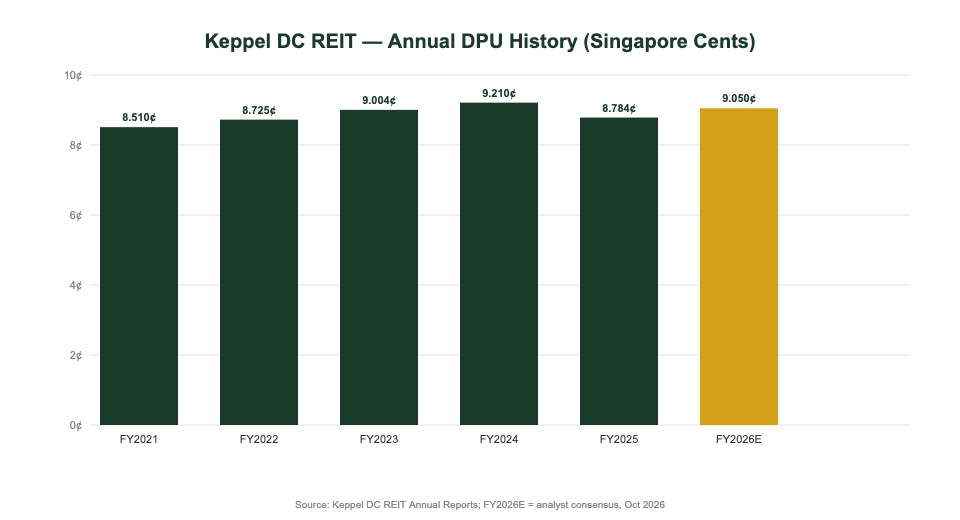
Keppel DC REIT has delivered consistent DPU growth from 8.51 Singapore cents in FY2021 to a peak of 9.21 cents in FY2024, before a modest pullback in FY2025 to 8.784 cents — largely attributable to higher financing costs during the peak rate environment. With rates now easing, consensus FY2026E DPU stands at approximately 9.05 cents, implying a recovery trajectory.
For a Singapore investor with S$50,000 invested in KDC REIT at a cost price equivalent to a 5.5% yield, the annual distribution income would be approximately S$2,750 — tax-exempt in the hands of Singapore individual investors, as REIT distributions are not subject to Singapore income tax. Compare this against Singapore Savings Bonds (currently yielding ~2.9% for a 10-year holding period) or a fixed deposit at 3.0–3.5%, and the yield premium for KDC REIT reflects both the higher risk profile and the structural growth potential of the data centre sector. For SSB alternatives, see TKN’s Singapore Savings Bonds guide.
KDC REIT Share Price vs S-REIT Peers: Yield Comparison
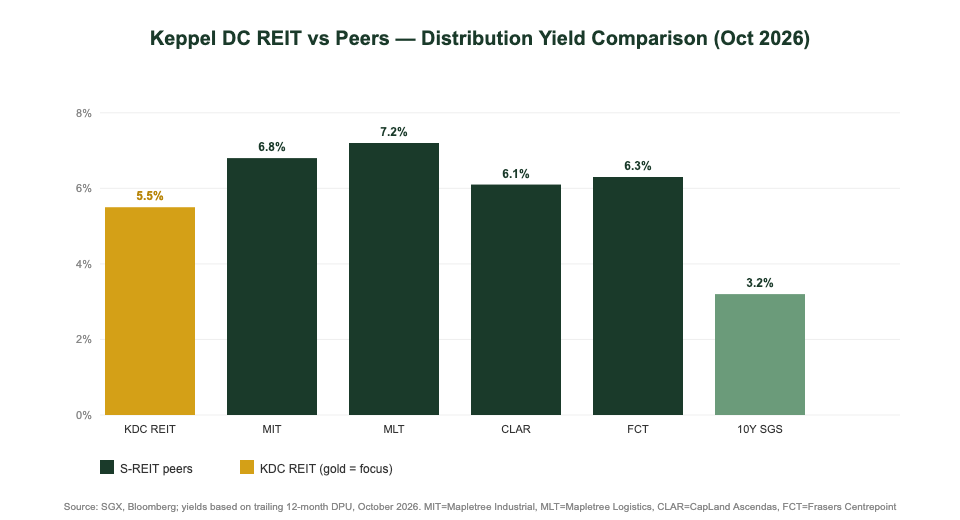
At ~5.5% trailing yield, Keppel DC REIT offers a lower yield than most industrial and logistics S-REITs — but that lower yield reflects its premium valuation (P/NAV of ~1.15x) and the market’s willingness to pay up for data centre growth. Below is a comparison against key S-REIT peers:
| S-REIT | Ticker | Yield (Oct 2026) | Sub-sector | P/NAV |
|---|---|---|---|---|
| Keppel DC REIT | AJBU | 5.5% | Data Centre | 1.15x |
| Mapletree Industrial Trust | ME8U | 6.8% | Industrial / Data Centre | 0.95x |
| Mapletree Logistics Trust | M44U | 7.2% | Logistics | 0.82x |
| CapLand Ascendas REIT | A17U | 6.1% | Diversified Industrial | 1.05x |
| Frasers Centrepoint Trust | J69U | 6.3% | Suburban Retail | 1.10x |
| 10-Year SGS Bond | — | 3.2% | Risk-free benchmark | N/A |
Source: SGX; Bloomberg; individual REIT investor presentations. Yields based on trailing 12-month DPU, October 2026. P/NAV as reported in most recent quarterly updates.
KDC REIT’s premium P/NAV reflects the data centre sector’s structural scarcity and growth premium. Investors who buy at current levels are essentially paying a modest premium for the growth embedded in the five catalysts above. Platforms like FSMOne (referral code P0544985) allow Singapore investors to buy KDC REIT with no minimum investment and competitive brokerage fees.
Key Risks to Monitor
No investment thesis is complete without a frank assessment of risks. For Keppel DC REIT share price investors, the principal risks to track are:
1. Tenant concentration risk. KDC REIT’s top 10 tenants account for a significant portion of gross rental income. While these tend to be investment-grade counterparties (hyperscalers and large enterprises), any non-renewal or downsizing by a major tenant could pressure occupancy and DPU. The REIT’s long WALE of 7.6 years mitigates near-term risk, but investors should monitor annual lease expiry schedules.
2. Power cost and energy transition risk. Data centres are energy-intensive assets. Rising electricity costs or regulatory pressure to adopt renewable energy faster than planned could compress NPI margins. KDC REIT has committed to sourcing 100% renewable energy for its Singapore portfolio by 2030, which may entail capex spend that partially offsets NPI growth.
3. Currency volatility. With ~30% of income from European assets denominated in EUR and GBP, adverse currency moves (EUR or GBP weakening against SGD) can reduce SGD-equivalent DPU. KDC REIT hedges a portion of its currency exposure, but residual risk remains.
4. Valuation risk. At ~1.15x P/NAV, KDC REIT is not cheap by historical standards. If rate cuts disappoint or AI spending growth moderates, the premium valuation could compress — impacting share price even if DPU remains stable. Investors benchmarking against Singapore T-bills 2026 yields should factor in this valuation risk premium.
Disclaimer: This article is for educational purposes only and does not constitute financial advice. Past performance of KDC REIT is not indicative of future results. Investors should conduct their own due diligence and consult a licensed financial adviser before making investment decisions.
Frequently Asked Questions
What is the Keppel DC REIT share price today?
Keppel DC REIT (SGX: AJBU) trades on the Singapore Exchange. The live share price is available on the SGX website or through any Singapore brokerage platform. As of October 2026, KDC REIT trades at approximately S$1.60, implying a trailing distribution yield of ~5.5% based on FY2025 DPU of 8.784 Singapore cents. Always check the latest price via your broker before transacting.
What is the distribution yield of Keppel DC REIT in 2026?
Based on FY2025 DPU of 8.784 Singapore cents and a share price of approximately S$1.60, KDC REIT’s trailing distribution yield is approximately 5.5% as at October 2026. Analysts project FY2026E DPU of around 9.05 cents, which would imply a forward yield of approximately 5.7% at the same price. Distributions are paid semi-annually and are tax-exempt for Singapore individual investors.
Is Keppel DC REIT a good investment in 2026?
Whether KDC REIT is suitable depends on your investment goals and risk tolerance. The REIT benefits from five structural catalysts in 2026: hyperscaler AI demand, interest rate tailwinds, Singapore supply constraints, European expansion, and asset recycling. However, it trades at a premium to NAV (~1.15x), which means it offers a lower yield (~5.5%) than some S-REIT peers. Investors who believe in the long-term data centre growth thesis and can accept valuation risk may find KDC REIT attractive. This is not financial advice — please consult a licensed adviser.
How do I buy Keppel DC REIT in Singapore?
You can buy Keppel DC REIT (SGX: AJBU) through any Singapore-registered brokerage. Popular options include Interactive Brokers (low commissions, IBKR referral code jianxiong368), FSMOne (referral code P0544985, no minimum investment in regular savings plans), and Syfe REIT+ (referral code SRPRFFFCD, which includes exposure to KDC REIT within a managed portfolio). You will need a CDP-linked brokerage account or custodian account to hold the shares. Minimum board lot size is 100 units.
What are the biggest risks of investing in Keppel DC REIT?
Key risks include: (1) tenant concentration — top tenants represent a large share of income; (2) energy/power cost pressures — data centres are energy-intensive; (3) currency risk from European assets denominated in EUR/GBP; (4) valuation risk — at 1.15x P/NAV, the share price could de-rate if rate cuts or AI spending disappoint; and (5) interest rate sensitivity — any reversal in rate cut expectations could pressure the share price. These risks should be weighed against the structural growth catalysts discussed above.
Does Keppel DC REIT pay dividends monthly or quarterly?
Keppel DC REIT pays distributions semi-annually — typically in March (for the H2 period) and September (for the H1 period). The REIT distributes at least 90% of its distributable income to maintain its REIT tax status. FY2025 total DPU was 8.784 Singapore cents (split approximately 4.40 cents for H1 and 4.38 cents for H2). Exact ex-dividend and payment dates are announced via SGX RegNet.
This article was researched with the help of AI. While we strive to keep all information accurate and up to date, there may be errors. If you notice any discrepancies, please contact us.