Mapletree Logistics Trust (MLT) 2H2026 Dividend: China & Australia Portfolio Deep Dive
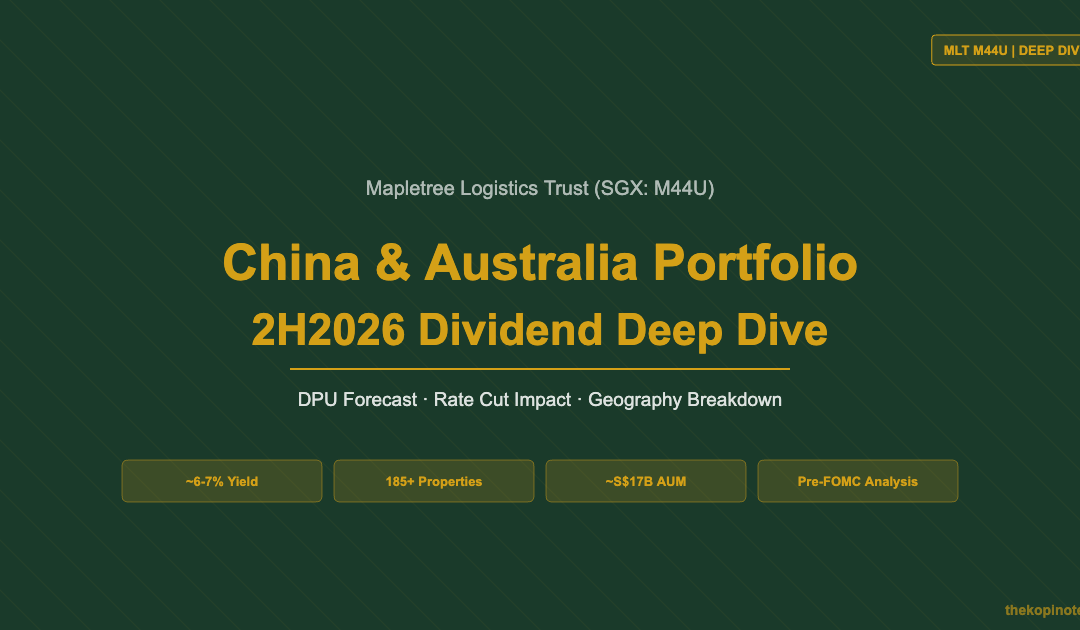
How MLT’s China and Australia logistics assets shape your 2H2026 DPU — and what the September FOMC rate cut means for Singapore investors holding M44U.
Mapletree Logistics Trust (SGX: M44U) is Singapore’s largest listed logistics REIT, with over 185 properties across nine Asia-Pacific markets. Its China portfolio (~19% of total assets) and Australia portfolio (~11%) are two markets where the upcoming September 2026 FOMC rate cut creates meaningful dividend tailwinds. This deep dive covers MLT’s China and Australia assets, occupancy trends, currency exposure, and what you can realistically expect for your 2H2026 distribution.
Not financial advice. All figures are for educational reference only. Data as at Q2 FY2025/26 unless noted.
- MLT’s China assets (~19% of AUM) face occupancy headwinds from market oversupply, but e-commerce demand is gradually recovering
- Australia (~11% of AUM) runs near 100% occupancy — a Fed rate cut flows through to lower AUD borrowing costs and potentially stronger AUD vs SGD
- Analyst consensus for H2 FY2025/26 DPU is approximately 4.10–4.20 cents per unit, implying a full-year yield of around 6–7% at current prices
Table of Contents
Contents — Click to expand
What Is Mapletree Logistics Trust?
Mapletree Logistics Trust (MLT) is a Singapore-listed REIT that owns and manages a portfolio of logistics and industrial properties across the Asia-Pacific region. Managed by Mapletree Investments, it is one of the largest logistics REITs in Asia by total assets — approximately S$17 billion as at Q2 FY2025/26.
MLT listed on the SGX in 2005 and distributes income to unitholders semi-annually. Unlike many S-REITs focused solely on Singapore, MLT operates across nine markets: Singapore, Japan, China, Hong Kong, Australia, Vietnam, Malaysia, India, and Bangladesh.
This geographic diversity is both a strength and a complexity. When the yen is weak, Japanese income converts to fewer SGD. When China logistics demand dips, occupancy and rental income follow. And when the Fed cuts rates, Australian financing costs fall — which directly benefits MLT’s bottom line and your distribution.
For a full breakdown of MLT’s base dividend history and yield profile, you can read the Mapletree Logistics Trust dividend 2026 guide. The focus here is specifically the China and Australia segments, and how they will shape H2 FY2025/26 income.
You can also compare MLT against other S-REITs in our MLT Japan portfolio deep dive, which covers how the yen recovery is affecting the largest segment of MLT’s income.
The China Portfolio: E-Commerce vs Oversupply
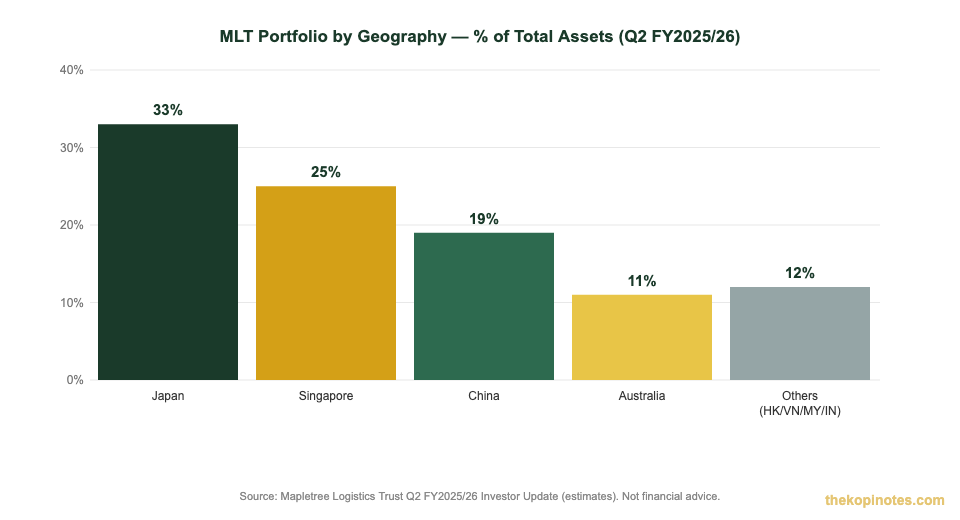
China makes up approximately 19% of MLT’s total assets, making it the third-largest geography after Japan (~33%) and Singapore (~25%). MLT owns around 30 logistics properties in China, concentrated in key manufacturing and logistics hubs including Kunshan, Wuxi, Chengdu, Guangzhou, and the Greater Shanghai corridor.
The challenge in China right now is straightforward: there is too much logistics space. China went through a massive warehouse construction boom between 2019 and 2023, driven by e-commerce expectations that outpaced actual demand. That has pushed Grade A logistics vacancy rates in many cities above 20% in 2024 and 2025.
MLT’s China portfolio occupancy has consequently dipped to approximately 88–90% over the past 12 months — below the portfolio average of around 95%. That translates to a meaningful drag on NPI (Net Property Income) from this segment.
However, there are signs of stabilisation. China’s domestic consumption recovery, driven by government stimulus in late 2024 and 2025, is gradually absorbing excess logistics supply. Cold chain demand — for pharmaceuticals, food, and e-commerce perishables — is growing faster than general warehousing and is a segment where MLT has been selectively adding capacity.
If China occupancy recovers from ~89% toward ~92% by H2 FY2025/26, the income uplift to MLT’s Singapore distribution is estimated at S$3–5 million per half-year — roughly 0.03–0.05 cents per unit of additional DPU. Small but meaningful in a low-growth environment.
Currency is the other factor. MLT receives China rental income in Renminbi (CNY) and converts it to Singapore dollars. A weaker CNY — which has been the trend since 2022 — reduces SGD-equivalent income. However, if the Fed’s September rate cut weakens the US dollar relative to Asian currencies, CNY may firm slightly, providing a modest tailwind to MLT’s China income conversion.
The Australia Portfolio: Why It Outperforms
Australia is MLT’s smallest major geography at around 11% of total assets, but it has been a consistent outperformer. MLT owns approximately 18–20 properties in Australia, concentrated in Melbourne (Truganina, Laverton North) and Sydney (Moorebank, Eastern Creek). These are modern, high-spec logistics facilities servicing last-mile delivery, cold chain, and bulk retail distribution.
The Australia portfolio runs at near-full occupancy — approximately 98–99%. This reflects the structural undersupply of premium logistics space in Sydney and Melbourne, where zoning restrictions and land cost make new development expensive and slow. Tenants here include major retailers and 3PL operators on long-term leases (WALE of 3–4 years).
Unlike China, the Australia portfolio is a straightforward income engine. The key variable for Singapore investors is the AUD/SGD exchange rate. When the Australian dollar weakens against SGD, MLT’s Australian income converts to less Singapore dollars. When the AUD strengthens, you get more.
This is where the Fed rate cut matters directly. Australia’s Reserve Bank (RBA) has been running an independent interest rate policy, but global rate cuts — led by the US Federal Reserve — create room for the RBA to ease further. The RBA began cutting in late 2025, and a September 2026 Fed cut would reinforce this easing cycle. Lower AUS rates typically support the AUD as monetary conditions ease, though currency forecasting is inherently uncertain.
More concretely, lower Australian interest rates reduce MLT’s cost on its AUD-denominated borrowings, improving net interest margins and ultimately boosting distributable income. For a REIT with ~39% gearing, every 25bp reduction in borrowing costs on the AUS loan book adds approximately S$1–2 million in annual savings.
MLT’s Australia portfolio is a good complement to the more volatile China assets. When you analyse MLT’s dividend, it helps to separate the “stable income” (Singapore + Australia) from the “growth-with-risk” segments (China, Vietnam, India).
Full Geography Breakdown & AUM Table
Here is a summary of MLT’s portfolio by geography, based on estimates from Q2 FY2025/26 investor updates and SGX disclosures:
| Market | % of AUM | No. of Properties | Occupancy (est.) | Key Currency |
|---|---|---|---|---|
| Japan | ~33% | ~60 | ~99% | JPY |
| Singapore | ~25% | ~30 | ~98% | SGD |
| China | ~19% | ~30 | ~89% | CNY |
| Australia | ~11% | ~19 | ~99% | AUD |
| Others (HK, VN, MY, IN, BD) | ~12% | ~46 | ~94% | Mixed |
Source: Mapletree Logistics Trust Q2 FY2025/26 Investor Update; estimates based on publicly disclosed data. Not financial advice.
How a Fed Rate Cut Affects MLT’s Dividend
The September 2026 FOMC meeting is on September 17–18. Markets are pricing in a 25–50bp rate cut. For a logistics REIT like MLT with significant overseas exposure, here is how the transmission works.
First, debt refinancing. MLT has approximately S$6.5–7 billion in total debt, spread across multiple currencies and markets. A portion of this is AUD-denominated (Australia portfolio loans) and some is USD-denominated or hedged using USD rates as a benchmark. When the Fed cuts, US dollar borrowing costs fall, which benefits MLT’s refinancing on US-linked facilities. This is a direct cash saving that flows to distributable income.
Second, currency effects. A Fed rate cut typically weakens the US dollar as capital seeks higher yields elsewhere. That can strengthen AUD, CNY, and JPY against SGD — though the exact magnitude is impossible to predict. Even a 1–2% appreciation in AUD vs SGD adds approximately S$1.5–2 million to MLT’s annual Australian income in SGD terms.
Third, investor sentiment. Rate cuts tend to be positive for REITs in general — lower risk-free rates make yield assets like MLT more attractive. This can push MLT’s unit price higher, which benefits you if you are still accumulating units. If you already hold, a higher unit price means a lower headline yield — but your actual distribution per unit does not change in the short term.
Here is a practical illustration. If you hold 10,000 units of MLT at S$1.50 per unit, your investment is S$15,000. A full-year DPU of 8.15 cents gives you S$815 in distributions. If a Fed rate cut saves MLT S$5 million in refinancing costs and this flows fully to DPU, the DPU uplift might be around 0.04–0.06 cents per unit — a S$4–6 gain on your 10,000 units. Not transformative, but every cent matters in a yield-focused portfolio.
For context, you may also want to compare MLT’s yield against Singapore’s fixed income alternatives. Our Singapore T-bills 2026 guide covers the current risk-free rate environment, which frames why a 6–7% yield from MLT carries a meaningful risk premium.
2H2026 DPU Forecast & What Analysts Expect
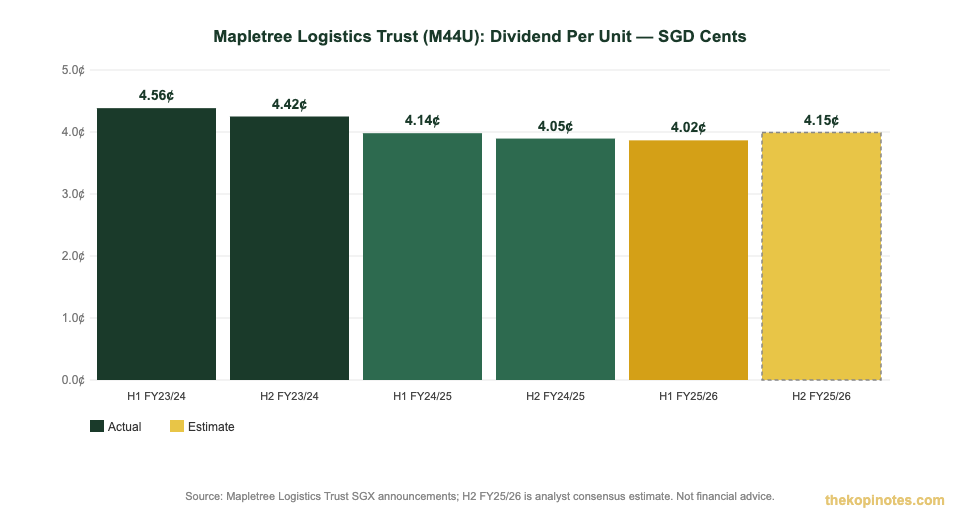
MLT distributes income semi-annually in June and December. The H1 FY2025/26 distribution (declared around October 2025) was approximately 4.02 cents per unit. The H2 FY2025/26 distribution — expected around April/May 2026 — is the next key catalyst.
Based on the factors discussed above, here is a summary of MLT’s recent DPU trajectory and what the consensus estimate looks like for the coming half-year:
| Period | DPU (SGD Cents) | Status | Key Driver |
|---|---|---|---|
| H1 FY2023/24 | 4.56 | Actual | Peak portfolio income |
| H2 FY2023/24 | 4.42 | Actual | Interest cost headwinds |
| H1 FY2024/25 | 4.14 | Actual | Weak JPY + China drag |
| H2 FY2024/25 | 4.05 | Actual | Trough period |
| H1 FY2025/26 | 4.02 | Actual | JPY recovery begins |
| H2 FY2025/26 (est.) | ~4.10–4.20 | Analyst Estimate | Rate cuts + JPY / AUD tailwinds |
Source: SGX announcements; H2 FY25/26 based on analyst consensus estimates. Not financial advice. Actual results may differ.
At a unit price of S$1.40–1.60, a full-year DPU of ~8.10–8.20 cents implies a distribution yield of approximately 5.5–5.9%. That compares to Singapore Savings Bonds yielding around 2.5–3.0% and higher-risk plays in other REIT sectors. If you are thinking about REIT exposure more broadly, our best S-REITs in Singapore 2026 guide compares MLT against peers including CICT, CLAR, and AIMS APAC REIT on yield, gearing, and WALE metrics.
You can also use our Singapore retirement planning calculator to model how a 6% logistics REIT yield fits into your passive income targets over a 10–20 year horizon.
Key Risks to Watch
MLT is not risk-free. Here are the four factors most likely to affect your 2H2026 distribution.
1. China occupancy recovery is slower than expected. If the logistics oversupply in China persists longer — particularly in the Yangtze River Delta cities — occupancy could stay below 90%, dragging NPI below forecasts. Watch MLT’s next quarterly updates for China occupancy data.
2. CNY continues to weaken against SGD. China income is converted from Renminbi to Singapore dollars. Further CNY depreciation reduces the SGD-equivalent distribution. MLT partially hedges this, but the hedge is not complete.
3. Refinancing risk on existing debt. MLT has approximately 25–30% of its debt maturing within the next 12–18 months, based on recent disclosures. If rates do not fall as expected, the refinancing cost could exceed current estimates. MLT’s interest coverage ratio (ICR) of around 3x provides a buffer, but it is worth monitoring.
4. Gearing at ~39%. MLT operates near the upper end of management’s comfortable gearing range. Singapore REITs are regulated by MAS with a statutory gearing limit of 50%, so MLT has headroom. However, any property devaluation — especially in China, where cap rates could decompress — would push gearing higher and constrain acquisition capacity.
For income investors, MLT is a long-term play on Asia-Pacific logistics infrastructure. Rate cuts and currency recovery help, but the base case return depends on China stabilising and Japan continuing to contribute strong income as the JPY recovers. If you are looking at platforms to buy MLT, both Syfe REIT+ and FSMOne offer S-REIT exposure with competitive platform costs for Singapore investors.
Frequently Asked Questions
What is the Mapletree Logistics Trust dividend for 2H2026?
Does MLT's China portfolio affect Singapore investors' distributions?
How does a US Federal Reserve rate cut help MLT?
Is MLT's Australia portfolio a good sign for the REIT?
What is MLT's current gearing and is it a concern?
How do I buy MLT as a Singapore investor?
Start Building Your S-REIT Portfolio
If MLT fits your passive income strategy, consider platforms that make S-REIT investing simple and cost-effective. Syfe REIT+ gives you diversified S-REIT exposure in one portfolio — use our Syfe referral code SRPRFFFCD for a cashback bonus. For direct share purchases, FSMOne referral code P0544985 earns you points on every transaction.
Not financial advice. Past distributions are not indicative of future results. Investing involves risk, including the possible loss of principal. Always do your own research and consult a licensed financial adviser if needed.
This article was researched with the help of AI. While we strive to keep all information accurate and up to date, there may be errors. If you notice any discrepancies, please contact us.