SRS Investment Options Singapore 2026 – Best Ways to Grow Your SRS
A complete guide to investing your Supplementary Retirement Scheme funds — unit trusts, ETFs, SSBs, REITs and more.
Your SRS account earns just 0.05% per annum if left as cash — less than inflation erodes each year. Singapore residents can invest their SRS funds in unit trusts, ETFs, Singapore Savings Bonds, fixed deposits, insurance products, and SGX-listed stocks and REITs. The best SRS investment options in 2026 combine tax efficiency, liquidity at retirement age, and returns that meaningfully outpace the idle savings rate.
Not financial advice. All figures are for educational reference only. Data as at October 2026 unless noted.
Table of Contents
Contents — Click to expand
- What Is the SRS and How Does It Work?
- Why You Must Invest Your SRS (Not Leave It Idle)
- SRS Investment Options at a Glance
- Unit Trusts and Robo-Advisors
- ETFs via SRS
- Singapore Savings Bonds (SSBs)
- Fixed Deposits
- Insurance and Endowment Products
- SGX Stocks and S-REITs
- Best Platforms for SRS Investing in 2026
- Which Option Suits You?
- Frequently Asked Questions
What Is the SRS and How Does It Work?
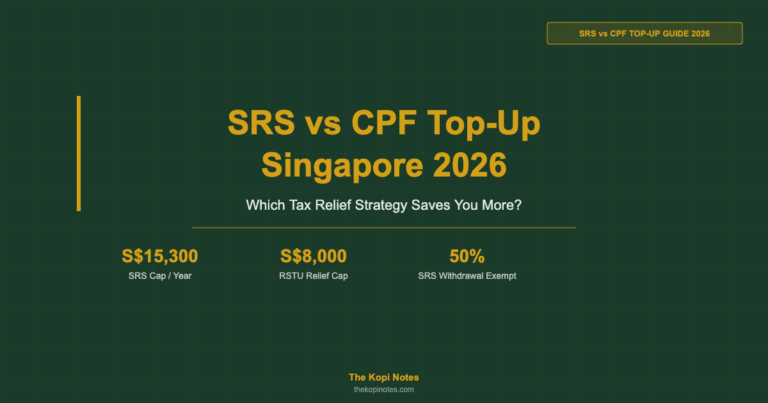
The Supplementary Retirement Scheme (SRS) is a voluntary savings programme administered by Singapore’s Ministry of Finance and operated by three banks — DBS, OCBC, and UOB. You open an SRS account with any of these banks and make voluntary cash contributions. Every dollar contributed reduces your taxable income dollar-for-dollar, delivering immediate tax savings of up to 22% (the top marginal rate for 2026).
For 2026, the annual contribution cap is S$15,300 for Singapore Citizens and Permanent Residents, and S$35,700 for foreigners. When you withdraw funds at or after the statutory retirement age (currently 63, rising to 65 by 2030), only 50% of each withdrawal is taxable. You have up to ten years post-retirement to draw down the account, spreading the tax burden across multiple lower-income years.
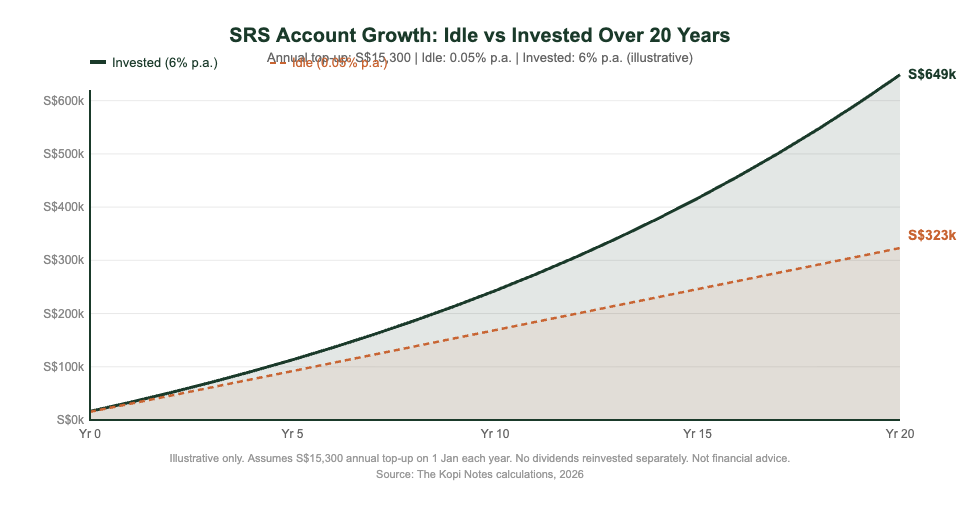
The catch: SRS cash earns only 0.05% per annum — the bank prevailing rate. Over 20 years, that gap between idle and invested becomes enormous. To get the most from your SRS, you need to invest the funds.
For a comparison of whether to prioritise SRS or CPF top-ups for tax relief, see our SRS vs CPF top-up guide. If you are planning your year-end contribution, the SRS year-end top-up guide covers deadlines and amounts.
Why You Must Invest Your SRS (Not Leave It Idle)
Leaving your SRS as cash is one of the most common — and costly — mistakes Singapore retirement savers make. At 0.05% per annum, a S$15,300 annual contribution generates roughly S$77 in interest over a full year. Over 20 years of maximum contributions, idle SRS cash compounds to approximately S$307,000 — just your contributions back with negligible growth.
Invest the same annual contributions at a modest 6% per annum (achievable through a diversified unit trust or global equity ETF portfolio), and the 20-year total climbs to approximately S$594,000 — almost double. That S$287,000 difference is the cost of inaction inside your SRS account.
Use our Singapore retirement calculator to model how your SRS investments interact with your broader retirement income projection.
SRS Investment Options at a Glance
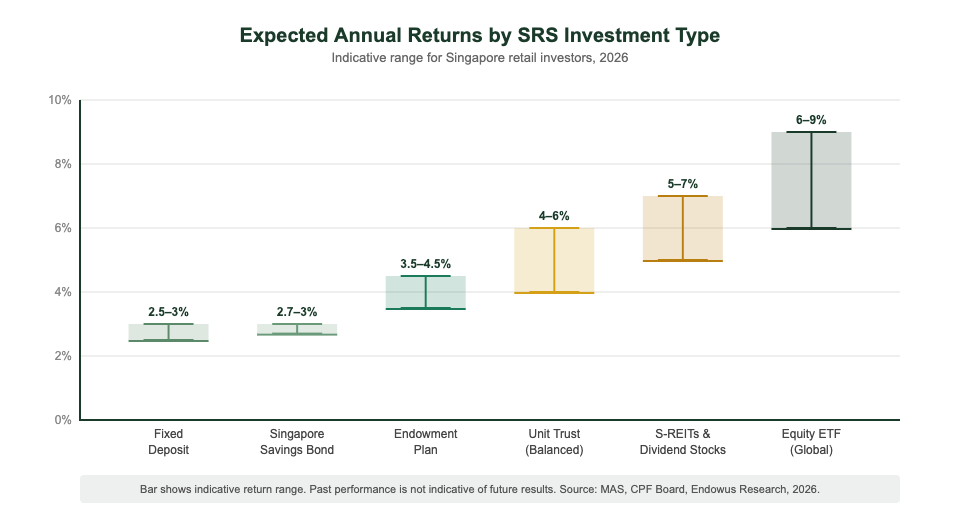
Singapore’s SRS framework permits a wide range of investments. The table below summarises the main options, their indicative return ranges, risk levels, and key considerations for 2026.
| Investment Type | Expected Return (p.a.) | Risk Level | Liquidity | Min. Amount |
|---|---|---|---|---|
| Fixed Deposit | 2.5–3.0% | Very Low | Lock-in period | S$500–S$1,000 |
| Singapore Savings Bonds | 2.7–3.0% | Very Low | Monthly redemption | S$500 |
| Endowment / Annuity | 3.5–4.5% | Low–Medium | Illiquid (tenor) | S$1,000+ |
| Unit Trusts / Balanced Funds | 4.0–6.0% | Medium | T+3 redemption | S$1 (robo-advisors) |
| S-REITs / Dividend Stocks | 5.0–7.0% | Medium–High | T+2 settlement | 1 lot (varies) |
| Equity ETFs (Global) | 6.0–9.0% | Medium–High | T+2 settlement | 1 unit (~S$5–S$500) |
Source: MAS, CPF Board, Endowus Research, fund factsheets, October 2026. Returns are indicative ranges; past performance is not a guarantee of future results.
Unit Trusts and Robo-Advisors
Unit trusts are pooled investment funds managed by professional fund managers. For SRS investors, they offer instant diversification, low minimum entry (as low as S$1 via robo-advisors), and professional rebalancing. Platforms like Endowus (referral code 2V343) are specifically designed for SRS investing — they connect your SRS account directly to a curated range of institutional-class funds at wholesale fee rates.
Endowus offers three broad SRS portfolio types: 100% Equity (growth-oriented), 60/40 Balanced (moderate), and Fixed Income (capital preservation). Their Core Portfolios are built from Dimensional, Vanguard, and iShares funds at total costs typically below 0.8% p.a. — far lower than buying the same retail funds through a bank relationship manager.
Syfe also accepts SRS funds via its Syfe brokerage platform (referral code SRPRFFFCD). Syfe’s Income+ portfolios — which blend bonds, dividend stocks, and REITs — are particularly popular among SRS investors approaching retirement age who prioritise income over pure growth.
FSMOne (referral code P0544985) is another SRS-eligible platform that offers a broad universe of unit trusts across asset classes, geographies, and fund houses. Access the full range via our FSMOne referral code page.
ETFs via SRS
Exchange-traded funds (ETFs) bought through SRS-eligible brokers are one of the most cost-efficient options. You can purchase SGX-listed ETFs — such as the Nikko AM STI ETF, Lion-OCBC Securities HSBC Asia Pacific Dividend ETF, or Phillip SGX APAC Dividend Leaders REIT ETF — directly through your SRS-linked brokerage account.
For globally diversified equity exposure, SGX-listed ETFs such as the CSOP iEdge S-REIT Leaders ETF or Lion-Phillip S-REIT ETF give broad S-REIT exposure within SRS. Note that international ETFs listed on the London Stock Exchange (e.g. CSPX or VWRA) are not directly purchasable via SRS through a standard CDP-linked broker — you would need to access them through a platform like Endowus, which wraps international ETF exposure into a unit trust structure for SRS compatibility.
Total expense ratios (TERs) for SGX-listed ETFs typically range from 0.30% to 0.65% p.a. — significantly cheaper than most actively managed unit trusts.
Singapore Savings Bonds (SSBs)
Singapore Savings Bonds are government-backed instruments issued monthly by MAS. They offer a step-up interest structure — the longer you hold, the higher your average return — with the 10-year average yield currently around 2.93% per annum (as at October 2026). SSBs are fully capital-guaranteed and can be redeemed any month with no penalty, making them the most liquid safe-haven option within SRS.
The annual SSB subscription limit is S$200,000 per person (cumulative across all outstanding SSBs). SRS investors typically use SSBs to park the portion of their SRS they expect to need in the first few years post-retirement. For a detailed comparison, see our Singapore Savings Bonds guide.
Fixed Deposits
SRS-linked fixed deposits are offered by DBS, OCBC, and UOB — the three SRS operator banks. You can typically place your SRS cash into 3-, 6-, or 12-month fixed deposits for rates between 2.5% and 3.0% per annum in October 2026. Unlike personal fixed deposits, SRS FDs can only be placed with your SRS bank and cannot be broken early without penalty.
Fixed deposits suit SRS investors with short time horizons or those awaiting a suitable investment opportunity. They are not a long-term growth strategy — their real return after 2–3% inflation is marginal.
Insurance and Endowment Products
SRS-approved endowment plans and annuities from insurers like Prudential, Great Eastern, Manulife, and Singlife can be funded with SRS dollars. Single-premium endowments typically offer guaranteed returns of 2.5–3.5% plus a non-guaranteed bonus, with tenors of 5–20 years. CPF LIFE-equivalent private annuities also accept SRS contributions and provide guaranteed monthly income from a chosen start age.
The main tradeoff: endowments and annuities are illiquid for their full tenor. Early surrender results in a loss of non-guaranteed bonuses and sometimes principal. They are best suited for SRS investors who do not need the funds until retirement and want predictable, low-risk returns.
SGX Stocks and S-REITs
SRS holders can buy and sell any SGX-listed security through their SRS brokerage account — stocks, REITs, ETFs, and business trusts. Singapore REITs (S-REITs) are particularly popular among SRS investors because their high distribution yields (typically 5–7% for diversified REITs in 2026) provide a natural income stream that can be reinvested while inside the SRS wrapper — shielding the income from immediate taxation.
S-REIT dividends received within an SRS account are not taxed at the point of distribution. They become taxable only when you withdraw from the SRS at retirement, and then only at 50% of the withdrawal amount. This tax deferral compounds significantly over a 10–20 year accumulation horizon.
For a full overview of the best S-REITs by yield and fundamentals, see our best S-REITs in Singapore 2026 guide.
Best Platforms for SRS Investing in 2026
Choosing the right platform depends on your investment style, the assets you want to access, and how hands-on you want to be.
| Platform | Best For | SRS-Eligible? | Fee (approx.) | Referral Code |
|---|---|---|---|---|
| Endowus | Hands-off fund portfolios | Yes | 0.25–0.60% p.a. | 2V343 |
| Syfe | Income-focused portfolios | Yes | 0.35–0.65% p.a. | SRPRFFFCD |
| FSMOne | DIY unit trust selection | Yes | 0.0875% per transaction | P0544985 |
| DBS Vickers / OCBC / UOB Kay Hian | SGX stocks, REITs, ETFs | Yes | Min S$25 per trade | — |
| MAS (Direct) | Singapore Savings Bonds | Yes | S$2 transaction fee | — |
Source: Platform fee schedules, October 2026. Fees subject to change — verify on each platform’s website before investing.
Which SRS Investment Option Suits You?
The right SRS investment mix depends on your time horizon to retirement, risk tolerance, and need for liquidity.
If you are 20–30 years from retirement: Maximise growth by allocating 80–100% to equity — global equity ETFs or an Endowus equity portfolio are cost-efficient choices. You have time to ride out market cycles. Avoid over-allocating to capital-protected instruments like FDs or SSBs at this stage.
If you are 10–20 years from retirement: Consider a balanced approach — 60% equity (global or regional ETFs, S-REITs) and 40% fixed income (SSBs, bond funds). Use the CPF investment strategy guide as a reference for how the CPF/SRS split interacts with your overall retirement allocation.
If you are within 5–10 years of retirement: Shift gradually toward capital preservation and income. SSBs, short-tenor endowments, and dividend-paying REITs are appropriate. Avoid locking into long-duration illiquid products you cannot exit before your retirement drawdown starts.
If you are retired or near withdrawal: Prioritise liquidity and predictable income. A ladder of SSBs (redeemable monthly) plus an SRS annuity for baseline income, supplemented by dividend stocks or REITs, gives both flexibility and steady cash flow during the 10-year drawdown window.
Frequently Asked Questions
What can I invest my SRS funds in Singapore?
SRS funds can be invested in unit trusts and mutual funds, Singapore Savings Bonds (SSBs), fixed deposits with your SRS operator bank, SGX-listed stocks and REITs, SGX-listed ETFs, and insurance products (endowments and annuities) from approved insurers. As at 2026, internationally-listed ETFs (e.g. CSPX on the LSE) are not directly purchasable via SRS, but can be accessed through platforms like Endowus that wrap them into SRS-eligible fund structures.
What happens to my SRS if I leave it as cash?
Uninvested SRS cash earns the bank’s prevailing SRS savings rate — currently 0.05% per annum with all three operator banks (DBS, OCBC, UOB). At this rate, S$15,300 contributed annually grows to approximately S$307,000 over 20 years, essentially just your contributions back. Invested at a modest 6% return, the same contributions compound to roughly S$594,000. The cost of leaving SRS idle over two decades is approximately S$287,000 in foregone growth.
Can I buy US stocks or ETFs (like CSPX or VWRA) with SRS?
Not directly through a standard CDP-linked brokerage account. SRS purchases through bank-linked brokers are limited to SGX-listed securities. However, platforms like Endowus give SRS investors access to institutional-class global equity funds that hold US and international equities — effectively replicating diversified global exposure within the SRS wrapper. Alternatively, some internationally-traded ETFs may be accessible via specific SRS-eligible platforms; check with your platform before investing.
Which is better for SRS: unit trusts or ETFs?
Both are viable depending on your circumstances. ETFs (specifically SGX-listed ones) have lower TERs (typically 0.30–0.65% p.a.) but require you to manage your own allocation and rebalancing. Unit trusts via robo-advisors like Endowus or Syfe handle rebalancing automatically and provide access to global markets at wholesale fund fees — usually 0.5–0.9% all-in. For passive, long-term SRS investors who want a set-and-forget approach, a robo-advisor unit trust portfolio is often more practical. For cost-conscious investors comfortable with DIY, SGX-listed ETFs are compelling.
Are S-REIT dividends in my SRS account taxable?
No — dividends and distributions received within your SRS account are not subject to income tax at the point of receipt. They accumulate tax-free inside the SRS wrapper. You only pay income tax when you make a withdrawal from your SRS account, and only on 50% of each withdrawal amount. This tax deferral makes SRS a particularly efficient wrapper for high-yield assets like S-REITs and dividend stocks.
When can I withdraw my SRS and how much tax do I pay?
You can withdraw from your SRS from the statutory retirement age — currently 63, rising to 65 by 2030. Only 50% of each withdrawal is added to your taxable income for that year. You have a 10-year window from your first penalty-free withdrawal to draw down the account. By spreading withdrawals across 10 years of lower retirement income, most retirees pay minimal or zero tax on their SRS — particularly if their other taxable income is below the personal income tax threshold.
Which platform is best for SRS investing in Singapore?
For hands-off global portfolio investing, Endowus (referral code 2V343) is the top-rated SRS platform in 2026 — it connects directly to your SRS account and offers institutional-class global funds at wholesale fees. For income-focused investors, Syfe (referral code SRPRFFFCD) offers dividend-tilted and bond portfolios well-suited to the SRS retirement context. For DIY unit trust investors, FSMOne (referral code P0544985) has the broadest fund universe. For direct SGX stock and REIT investing, DBS Vickers, OCBC Securities, or UOB Kay Hian are the SRS-linked brokerage options.
Ready to Invest Your SRS?
Open an investment account linked to your SRS today and start putting your retirement savings to work.
This article was researched with the help of AI. While we strive to keep all information accurate and up to date, there may be errors. If you notice any discrepancies, please contact us.