TribeCar + Endowus + Syfe + FSMOne + IBKR: What Happens If You Move Overseas? (2026)
Ranking 5 referral-worthy Singapore platforms by what actually happens to your account the day you relocateOf the five platforms in this TribeCar combo, only Interactive Brokers (IBKR) is genuinely built for life outside Singapore. TribeCar membership effectively ends the day you leave. Endowus, Syfe and FSMOne all keep working overseas, but only if you tell them first — silence can get your account frozen or closed.
Not financial advice. All figures and policies are for educational reference only, verified via official help-centre pages and WebSearch as at October 2026. Policies vary by destination country and change without notice — always confirm directly with each platform before you relocate.
Table of Contents
The Real Question: Which Accounts Survive a Move?
TribeCar: Membership Ends the Moment You Leave
Endowus: You Can Keep Investing, But Tell Them First
Syfe: Notify Them of Your New Country of Residence
FSMOne: Citizen-Abroad vs FSM Global — Know the Difference
IBKR: The Only Platform Built for a Global Life
Overseas Portability Score: The Full Comparison
Your Pre-Departure Checklist
The Smart Routing Order Before You Pack
Frequently Asked Questions
The Real Question: Which Accounts Survive a Move?
Every TribeCar combo article in this series has ranked five platforms by rate, fee, or speed. This one ranks them by something almost nobody checks before boarding a flight: what each platform’s own terms of service actually say happens to your account once you’re no longer a Singapore resident.
A Singapore investor relocating for a new job — say, a two-year posting to Sydney or London — typically has all five of TribeCar, Endowus, Syfe, FSMOne, and IBKR active at once: a car-sharing membership they no longer need, two robo-advisor/brokerage accounts holding CPF, SRS, or cash investments, a unit trust platform, and a global brokerage account. The mistake most people make is assuming “I’ll just leave it and deal with it later.” For four of these five platforms, that assumption is wrong.
TribeCar: Membership Ends the Moment You Leave
TribeCar is the one platform in this combo with no overseas use case at all — and that’s by design, not oversight. Sign-up requires an NRIC or FIN, a valid Singapore driving licence, and (per TribeCar’s own onboarding flow) proof of a local address for the security-deposit and billing relationship. Once you give up your Singapore residential address and your local driving licence lapses or converts, the membership has nothing left to attach to.
Foreigners who move to Singapore face the mirror image of this problem: under Traffic Police rules, anyone resident here for more than 12 months must convert a foreign licence to a Singapore one, or a work-pass holder must do so immediately — which is exactly why TribeCar’s KYC is built around local licence + local address in the first place. Flip that around when you leave, and the account simply has no path forward. There’s no “pause” or “overseas mode.” You cancel, you get your refundable security deposit back, and you’re done.
This is the cleanest account to close before a move: no notification requirement, no residency-change form, no tax-residency question. Settle any outstanding charges, request your deposit refund, and move on. If you’ve been using TribeCar’s savings-first routing strategy to fund SRS or IBKR, a move overseas is actually the natural trigger to stop the car-free savings pipeline and redirect that same monthly amount straight into your remaining accounts.
Endowus: You Can Keep Investing, But Tell Them First
Endowus explicitly allows non-Singapore residents to open accounts — its eligibility page states that anyone over 21, living in Singapore or overseas, may open an account, with non-Singaporean/non-PR applicants submitting a passport plus address proof dated within three months. That’s reassuring for new sign-ups, but it doesn’t directly answer the question that matters to an existing customer: what happens to an existing account when your address changes from a Singapore one to an overseas one.
Endowus’s public help pages don’t spell this out, which means the responsible move is to email Endowus’s support team before you relocate, not after. Two things are worth flagging specifically:
- CPF and SRS holdings are tied to Singapore rules, not Endowus’s policies. Your CPF Investment Scheme (CPFIS) monies and SRS account follow CPF Board and IRAS rules regardless of where Endowus lets you log in from — moving overseas doesn’t let you access CPF-OA funds early, and your SRS withdrawal tax treatment depends on your reason for withdrawing (retirement age vs. non-retirement reasons), not your new address.
- US persons are excluded entirely. If your move is to the United States, or you become a US tax resident, Endowus states plainly that it cannot open or maintain accounts for US persons (US citizens, green-card holders, or US tax residents) — this is the one destination where “notify and continue” isn’t an option.
For everywhere else, the practical path is: email support before departure, confirm your address-update and document requirements, and keep your Cash account (if any) funded only from a bank account you can still access from your destination country.
Syfe: Notify Them of Your New Country of Residence
Syfe is more explicit than Endowus about the obligation sitting on you, the customer. Its Australian help centre states the policy that applies group-wide: if you change your country of legal residence and/or tax residence, or become a U.S. person, you must notify Syfe as soon as practicable. This isn’t a courtesy — Syfe’s Singapore FAQ confirms its services aren’t available to residents of certain jurisdictions (the US among them), and if you become a US person, Syfe may close your account, though you’ll be given sufficient time to redeem investments and withdraw funds first.
The address-update mechanic itself is straightforward: Syfe’s help centre confirms you can update your residential address, email, and contact number directly in the app. What’s unconfirmed is whether a foreign (non-Singapore) proof-of-address document will be accepted on the Singapore entity — Syfe’s Hong Kong entity explicitly does not accept foreign proof of address, and nothing in Syfe Singapore’s public documentation says the SG entity is more lenient. Don’t assume it is; ask Syfe’s Client Success team directly which documents they’ll accept from your new country before you try to update anything.
If you’ve been running a Syfe Cash+ to IBKR FX-breakeven split, a move overseas is a good moment to re-check which currency your new salary lands in — it may shift the breakeven math in that strategy entirely.
FSMOne: Citizen-Abroad vs FSM Global — Know the Difference
FSMOne (operated by iFAST) has a genuinely confusing structure for a Singaporean moving abroad, because the fine print distinguishes between who you are and which platform entity you’re dealing with. Its non-residents page states that non-Singapore residents may open an account, but these are treated as separate accounts opened via FSM Global’s India, Hong Kong, or Malaysia entities — each with its own fund restrictions and tax implications. Separately, its Malaysia support page explicitly bars Singapore citizens, PRs, and Singapore-incorporated entities from trading SGX-listed stocks and ETFs through the Malaysia platform at all.
Neither page directly answers the most common real-world case: a Singapore citizen who already holds an FSM Singapore account and simply moves abroad for work, keeping Singapore citizenship. The safest assumption until FSM confirms otherwise is that your existing FSM Singapore account should continue to operate as-is for a citizen temporarily overseas (unlike a true non-resident opening fresh), but the moment your move looks permanent or involves giving up Singapore tax residency, you should proactively email FSM’s client help team to confirm your account’s status rather than wait for them to flag it.
One hard fact worth planning around regardless of citizenship: FSMOne withdrawals only go to bank accounts in the account holder’s own name, and overseas telegraphic transfers take 3–5 business days with bank fees of roughly US$20–170 — budget for that delay and cost if you’re planning to withdraw funds around your move date.
IBKR: The Only Platform Built for a Global Life
Interactive Brokers is the odd one out in this combo because it’s the only platform whose entire business model assumes clients might move countries. IBKR’s own help centre states it will consider a change in residency only case-by-case, with proper documentation — but crucially, it has a defined process for it, including a published path in Account Management (Manage Account > Account Information > Details) to update your address and residency, and a requirement to resubmit your Form W-8 whenever you do.
The detail that actually matters for a Singapore investor: IBKR runs separate legal entities by region, and which entity holds your account can change based on your country of residence (for example, EEA clients have been required to migrate to a European entity in the past). Moving abroad could mean your account migrates to a different IBKR entity with different product availability or fee schedules — something to confirm with IBKR Client Service directly, since public sources don’t specify which entity currently serves every destination country.
The other point worth internalising: your tax residency is determined by where you actually live and the tax rules of that country, not by which country your broker or bank account sits in. Updating IBKR’s records doesn’t settle your tax position — get tax advice in both Singapore and your destination country for the specific calendar year you move, since split-year tax residency rules can apply on both ends.
Overseas Portability Score: The Full Comparison
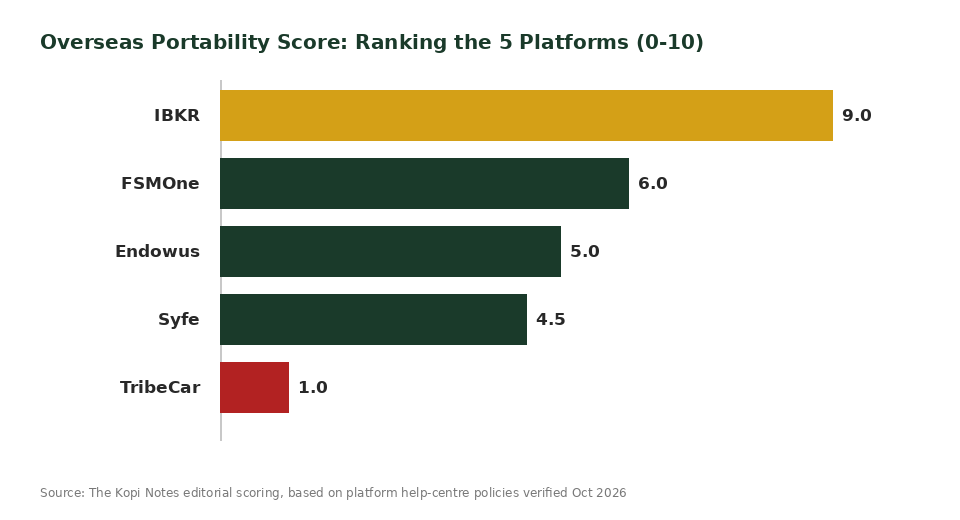
Here’s The Kopi Notes’ own editorial scoring (not an official rating from any platform or regulator) for how well each account survives a Singaporean’s move abroad, where 10 means “built for this, minimal friction” and 0 means “this account effectively ends.”
| Platform | Portability Score | What Happens Overseas | Action Required |
|---|---|---|---|
| IBKR | 9 / 10 | Account continues; may migrate to a regional entity | Update residency + resubmit W-8 |
| FSMOne | 6 / 10 | Likely continues for citizens; true non-residents get a separate FSM Global account | Confirm status with FSM support |
| Endowus | 5 / 10 | Overseas accounts allowed in principle; existing-account policy unconfirmed publicly | Email support before moving |
| Syfe | 4.5 / 10 | Must notify of new country of residence; some jurisdictions unsupported | Notify Syfe; confirm accepted proof-of-address |
| TribeCar | 1 / 10 | Membership has no overseas use case; tied to SG licence + address | Cancel and reclaim deposit |
Source: The Kopi Notes editorial scoring, based on Endowus, Syfe, FSMOne, and IBKR help-centre pages, verified October 2026.
Your Pre-Departure Checklist
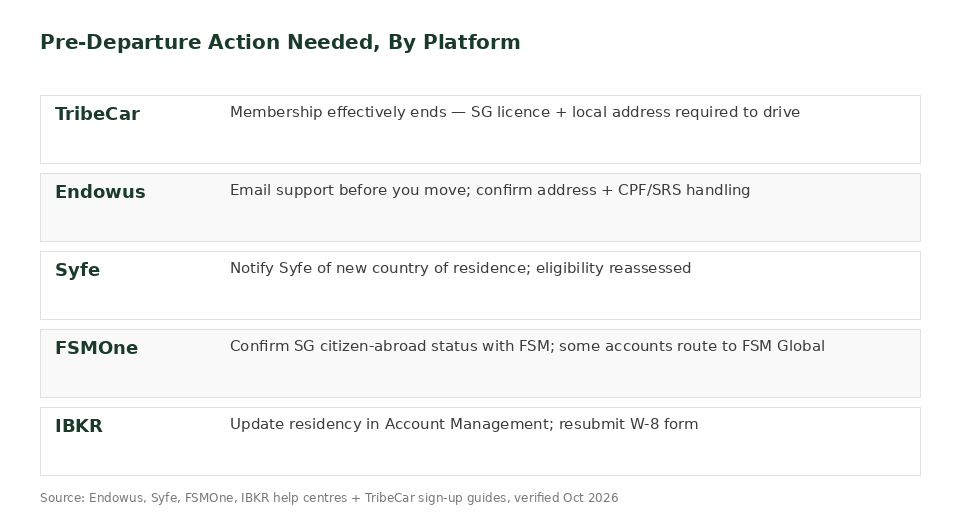
None of this needs to be a scramble if you start it 4–6 weeks before you fly. Here’s the order that avoids the most common mistakes — a frozen Syfe account, a bounced Endowus address-verification email, or an FSM withdrawal stuck in TT processing while you’re already overseas and hard to reach by phone.
| Timing Before Move | Action |
|---|---|
| 6 weeks out | Email Endowus and Syfe to confirm your new country is supported and ask what documents they’ll need |
| 4 weeks out | Confirm your FSMOne account status (citizen-abroad vs needing an FSM Global entity) with FSM support |
| 3 weeks out | Update IBKR residency in Account Management and resubmit Form W-8 |
| 2 weeks out | Initiate any FSMOne withdrawal you’ll need pre-departure — TT transfers take 3–5 business days |
| 1 week out | Cancel TribeCar membership and request your security deposit refund |
Source: The Kopi Notes, compiled from platform help-centre guidance, October 2026.
The Smart Routing Order Before You Pack
If you’re trying to decide which account to prioritise sorting out first, work backwards from consequence severity, not alphabetical order. A US move is the one scenario that changes everything — both Endowus and Syfe state they cannot (or may not be able to) serve US persons, so if your relocation is to the United States, that email needs to go out before you book your flight, not after you land. For every other destination, IBKR needs the least urgency (it’s designed for this) while Syfe needs the most (an unnotified country change risks a forced account closure under its own stated terms).
A practical sequencing many TribeCar-combo readers use: settle TribeCar last-but-one (since there’s no urgency, only convenience) and treat the Singapore retirement calculator as a prompt to recheck your SRS and CPF projections before you lose easy in-person access to CPF Board or MAS-regulated counters for any paperwork that can’t be done online.
Want the context behind each platform? Read our deep dives on whether Syfe is safe for your money and what Endowus actually is before you decide what to keep running from overseas.
Frequently Asked Questions
Do I have to close my Endowus account before moving overseas?
Will Syfe close my account automatically if I move abroad?
Can I keep using my FSMOne account from another country?
Does my IBKR account change when I relocate?
What happens to my TribeCar membership if I leave Singapore?
Does moving overseas affect my CPF or SRS money held through these platforms?
Which of these five accounts should I sort out first before I move?
This article was researched with the help of AI. While we strive to keep all information accurate and up to date, there may be errors. If you notice any discrepancies, please contact us.