Keppel DC REIT WALE & Lease Expiry 2026: How Secure Is the DPU?
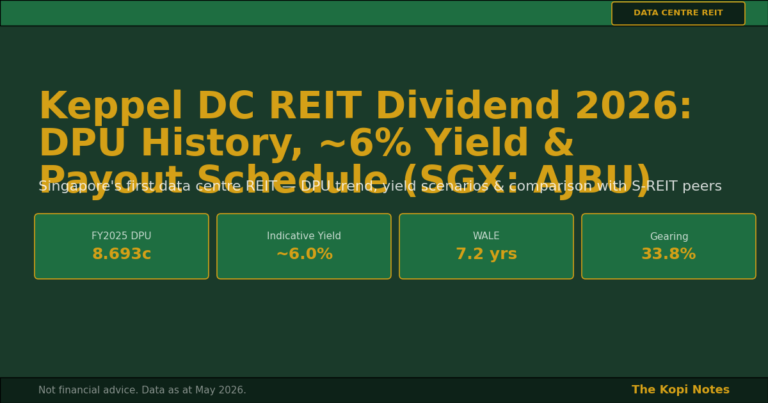
Keppel DC REIT (SGX: AJBU) boasts one of the most secure income profiles among Singapore REITs, with a weighted average lease expiry (WALE) of approximately 7.4 years as at 1H2026. Over 80% of its gross revenue is locked in beyond 2028, underpinned by hyperscaler and enterprise tenants on long-term contracts. This guide examines KDC REIT’s lease expiry schedule, tenant mix, and what it means for DPU visibility in 2026 and 2027.
Not financial advice. All figures are for educational reference only. Data as at October 2026 unless noted. Always verify with official KDC REIT announcements before making investment decisions.
- KDC REIT’s WALE is ~7.4 years — one of the longest in the S-REIT universe
- ~80% of gross revenue secured beyond 2028, giving strong DPU visibility
- Hyperscalers (cloud providers) account for ~45% of revenue with WALEs exceeding 9 years
- Only ~4% of leases expire in 2026 — near-zero near-term rollover risk
- Forward yield ~5.8% at current price (~SGD 2.18, Oct 2026)
Table of Contents
What Is WALE and Why Does It Matter for S-REIT Investors?
WALE — Weighted Average Lease Expiry — is one of the most important metrics for evaluating the income security of any REIT. It measures, in years, how long the average lease has remaining before it needs to be renewed, weighted by the tenant’s contribution to gross revenue.
For Singapore investors hunting passive income Singapore through REITs, WALE answers a critical question: how confident can I be that distributions will keep flowing? A REIT with a WALE of 2 years faces massive rollover risk — if economic conditions sour, tenants may not renew, or renegotiate at lower rents. A REIT with a WALE of 7+ years has its revenue stream locked in well into the next decade.
Data centre REITs like Keppel DC REIT naturally command long WALEs because:
- High switching costs: Moving a data centre workload to a new facility costs millions. Tenants rarely leave voluntarily.
- Mission-critical infrastructure: Cloud providers and enterprises rely on guaranteed uptime — they need stable, long-term leases.
- Colocation economics: Hyperscalers building out capacity commit to multi-year contracts to justify the infrastructure investment.
Compare KDC REIT’s ~7.4-year WALE to retail REITs (typically 2–3 years) or office REITs (3–5 years) — the DPU visibility is structurally superior. To see how this compares across the broader sector, the best S-REITs in Singapore 2026 guide benchmarks WALE alongside yield, gearing, and dividend coverage.
Keppel DC REIT WALE Profile 2026
As at 1H2026, Keppel DC REIT’s portfolio WALE stands at approximately 7.4 years — a figure that has remained consistently above 7 years for the past several reporting periods. This is not an accident; it reflects KDC’s deliberate strategy of targeting long-duration, mission-critical tenants across its 23-asset, 11-country portfolio.
| Metric | KDC REIT (1H2026) | S-REIT Sector Avg |
|---|---|---|
| WALE (years) | ~7.4 | ~3.5 |
| Revenue secured >2028 | ~80% | ~45% |
| Near-term expiries (2026) | ~4.2% | ~12% |
| Portfolio occupancy | ~99% | ~93% |
| Forward DPU yield | ~5.8% | ~5.2% |
Source: KDC REIT 1H2026 results, SGX filings, analyst estimates. S-REIT sector averages are approximate blended figures. For educational reference only.
The near-perfect occupancy and exceptionally low near-term lease expiry percentage mean that KDC REIT’s 2026 revenue base is essentially fully secured — making it one of the safest DPU payers in Singapore’s listed REIT sector.
Lease Expiry Schedule: What’s Due When?
Understanding when leases expire is as important as knowing the overall WALE. A portfolio with 60% of leases expiring in a single year — even if the WALE appears long — carries concentrated rollover risk. KDC REIT’s lease expiry profile is deliberately staggered to avoid this cliff.
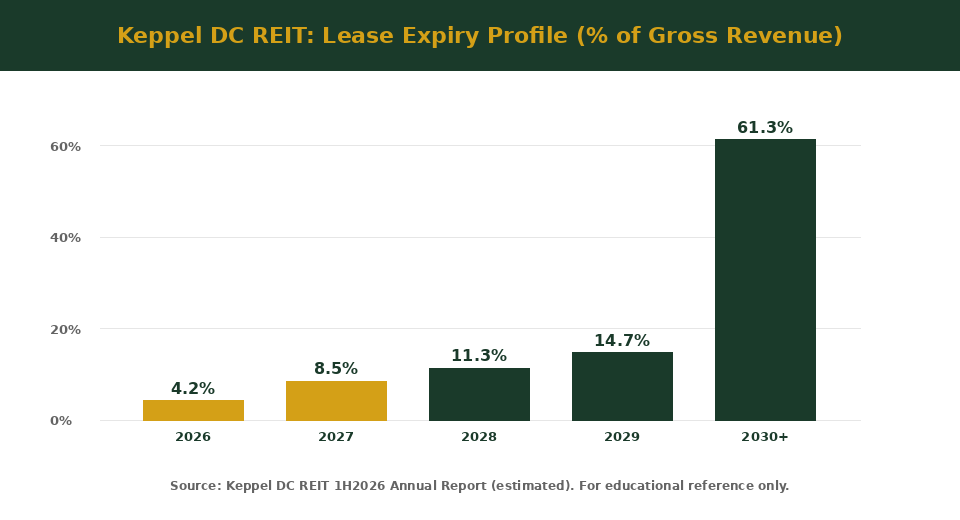
The chart below shows the approximate percentage of gross revenue expiring by year:
Key takeaways from the expiry profile:
- 2026 (4.2%): Minimal near-term rollover. What expires this year is likely already in advanced renewal discussions, given the high cost of data centre migration.
- 2027–2029 (8.5%–14.7%): Moderate annual expiries. These are primarily colocation tenants on shorter 5–7 year leases. Renewal rates historically exceed 90% for data centres.
- 2030+ (61.3%): The bulk of revenue is secured well beyond the 5-year investment horizon of most retail investors. Hyperscaler contracts anchor this cohort.
For Singapore investors using Singapore retirement calculator to model passive income streams, KDC REIT’s expiry profile means that a position established today has a very high probability of delivering consistent distributions for the next 5–7 years without major lease disruption.
Hyperscaler vs Colocation Tenant Mix
Not all KDC REIT tenants are created equal. The quality of the WALE depends heavily on who is signing those leases. KDC REIT’s tenant base breaks down into three broad categories:
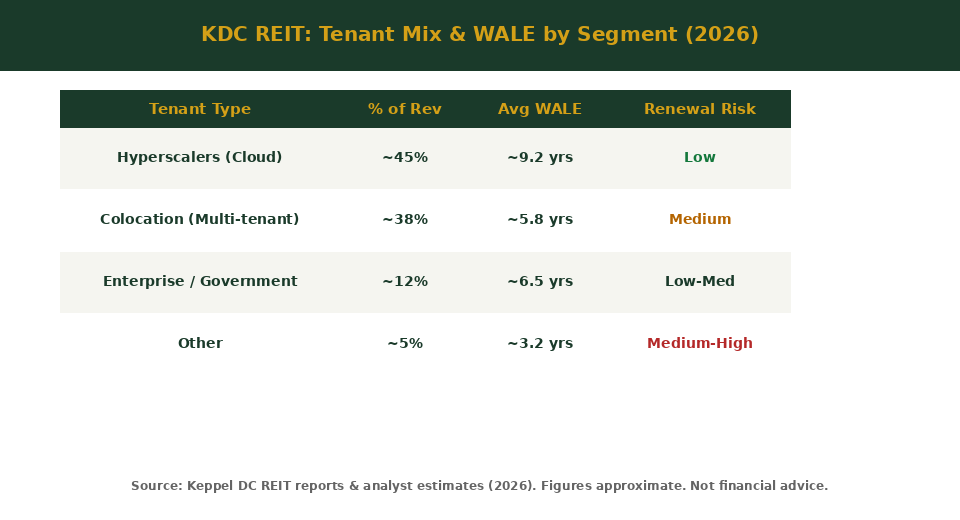
1. Hyperscalers (~45% of revenue, WALE ~9.2 years)
These are the large cloud and technology companies — think the Amazons, Microsofts, and Googles of the world — which lease large, dedicated sections of KDC’s facilities on very long-term contracts. Their WALE of ~9.2 years is exceptional. Hyperscalers rarely terminate early because the cost and operational complexity of migrating petabytes of data exceeds any conceivable rental savings.
2. Colocation / Multi-tenant (~38% of revenue, WALE ~5.8 years)
Colocation tenants lease rack space and power within a shared facility. Contracts are typically 5–7 years. Renewal rates are high (data centre colocation market renewal rates historically run above 90% in Singapore), but there is some risk of downsizing or non-renewal at each expiry event. This is the segment that drives most of KDC’s lease activity in any given year.
3. Enterprise / Government (~12% of revenue, WALE ~6.5 years)
Corporate and government tenants tend to have moderate WALEs with low renewal risk — governments especially are sticky tenants. Singapore’s Smart Nation initiative has driven strong domestic enterprise demand for secure, locally-hosted data infrastructure.
The dominance of hyperscalers by revenue share is the single biggest reason KDC REIT’s WALE is so much higher than peers. As the AI infrastructure buildout accelerates through 2026–2027, hyperscaler demand for colocation capacity is expected to intensify further — potentially pushing renewal rates and achievable rents higher at the 2027–2029 expiry cohort.
How WALE Affects Keppel DC REIT’s DPU Security
The direct link between WALE and DPU security works through three channels:
Channel 1: Revenue Predictability
With 80% of revenue locked in beyond 2028, KDC REIT’s management can forecast distributable income with high confidence. This allows them to distribute consistently without needing to build excessive retained earnings as a buffer. Compare this to a retail REIT that might need to hold back 10–15% of distributable income as a buffer against near-term lease rollover uncertainty.
Channel 2: Rental Reversion Upside
As AI demand drives data centre rents higher, leases expiring in 2027–2029 may renew at positive rental reversions — meaning the same space earns higher rent on renewal. Singapore colocation rates have risen approximately 15–20% since 2023, driven by the data centre moratorium period and subsequent controlled supply reentry. KDC REIT tenants coming up for renewal will face a higher market rent environment, which is DPU-accretive if renewals are achieved.
Channel 3: Gearing Headroom
KDC REIT’s gearing is approximately 37% as at mid-2026 — comfortably below MAS’s 50% ceiling for S-REITs. A stable, predictable cashflow profile from long WALE leases supports the REIT’s ability to borrow at competitive rates for acquisitions, which in turn drives DPU growth. This is part of why KDC REIT has historically traded at a premium to NAV for most of its listed history.
Investors looking to build a diversified S-REIT income portfolio can reference the Singapore REIT ETF guide for a broader approach, or use platforms like Syfe referral code and sign-up bonus to access KDC REIT through a managed REIT portfolio.
2026–2027 DPU Outlook
Based on the secured lease profile and analyst consensus estimates as at October 2026, here is a working model for KDC REIT’s DPU trajectory:
| Period | DPU (cents) | YoY Change | Key Driver |
|---|---|---|---|
| FY2025A (actual) | 9.41c | — | Base year |
| 1H2026A (actual) | 4.73c | +2.6% YoY | Rate cut tailwinds, Singapore colocation + |
| FY2026E (est.) | ~9.75–10.0c | +3–6% YoY | Lease renewals at positive reversions, lower debt cost |
| FY2027E (est.) | ~10.2–10.6c | +4–6% YoY | AI demand-driven rental uplift, acquisitions optionality |
Source: KDC REIT SGX filings, analyst consensus estimates (October 2026). FY2026E and FY2027E are estimates and not guaranteed. Do your own due diligence.
At a current share price of approximately SGD 2.18 (October 2026), the forward yield on FY2026E DPU of ~9.75–10.0c works out to approximately 4.5–4.6% — lower than the broader S-REIT sector average, but justifiable given the superior DPU visibility, near-zero rollover risk, and structural tailwinds from AI and cloud demand.
Investors considering KDC REIT through a Endowus referral code (for CPF/SRS investing) or via FSMOne referral code (for regular savings plans) benefit from lower transaction costs on a regular accumulation strategy, which compounds effectively given the stable DPU growth trajectory.
Risk Factors to Watch
Despite its strong WALE and DPU visibility, KDC REIT is not risk-free. Singapore investors should weigh these specific risks before adding or increasing a position:
1. Hyperscaler Concentration Risk
With ~45% of revenue from hyperscalers, KDC REIT has meaningful tenant concentration risk. If one large hyperscaler were to consolidate facilities or shift to in-house ownership (building their own data centres rather than leasing), KDC could face a sudden revenue cliff at lease expiry. This risk is mitigated by long WALEs (9+ years for hyperscalers) and the high switching costs involved.
2. Interest Rate Sensitivity
KDC REIT’s gearing of ~37% means it carries SGD 3+ billion in debt. A sustained reversal of rate cuts — or if the anticipated 2026 Fed cuts disappoint — would push up refinancing costs and squeeze DPU. Approximately 70% of KDC’s debt is on fixed rates, providing partial insulation.
3. Currency Exposure
KDC REIT’s overseas assets (Germany, Netherlands, Australia, Malaysia) generate revenue in EUR, AUD, and MYR. SGD appreciation against these currencies reduces SGD-denominated DPU. The KDC REIT overseas portfolio analysis covers this FX risk in detail.
4. Data Centre Supply Pipeline
Singapore has been carefully managing new data centre approvals since the 2019 moratorium. While the controlled supply environment has kept rents firm, any sudden surge in new supply — from approved projects coming online simultaneously — could create short-term rental pressure at the 2027–2029 colocation expiry cohort.
5. Premium Valuation
KDC REIT’s strong fundamentals are well-known, and the market prices them in. At ~1.5x P/B, there is limited margin of safety. A re-rating downward — from a broader tech sector selloff, rising risk-free rates, or a loss of a major hyperscaler — could cause meaningful capital losses even if DPU is maintained.
Is Keppel DC REIT Worth Buying in 2026?
KDC REIT’s WALE and lease expiry profile make a compelling case for its inclusion in a Singapore income portfolio — particularly for investors who prioritise DPU stability over maximum yield. The ~4.5–5.8% forward yield range (depending on which DPU estimate you use) is not the highest in the S-REIT universe, but the visibility and quality of that yield is among the best.
The investment case in 2026 rests on three pillars: (1) AI-driven demand providing structural support for data centre rents and occupancy, (2) rate cuts reducing the cost of KDC’s floating-rate debt and widening the yield spread, and (3) a proven management team with a track record of accretive acquisitions and portfolio optimisation.
For investors who already hold KDC REIT and are considering adding on dips, the lease expiry profile confirms there is no near-term fundamental catalyst for a DPU cut — making dips an opportunity to accumulate rather than a warning sign. For new investors, entering at a P/B below 1.5x would represent a more attractive entry given the valuation premium the market assigns.
The best S-REITs in Singapore 2026 guide covers a full sector comparison including other data centre, industrial, and retail REITs for portfolio construction context.
Frequently Asked Questions
What is Keppel DC REIT's current WALE in 2026?
Keppel DC REIT’s WALE (weighted average lease expiry) stands at approximately 7.4 years as at 1H2026. This is one of the longest WALEs among Singapore REITs, driven by long-term hyperscaler and enterprise tenant contracts across its 23-asset global portfolio.
How much of KDC REIT's revenue expires in 2026?
Approximately 4.2% of KDC REIT’s gross revenue is due for lease renewal in 2026 — a very low figure that indicates near-zero near-term rollover risk. This means the vast majority of 2026 and 2027 distributions are already secured under existing leases.
What does a higher WALE mean for KDC REIT's DPU?
A higher WALE means more of the REIT’s revenue is contractually locked in for longer periods. For KDC REIT investors, the ~7.4-year WALE provides high confidence that distributions will continue flowing without major disruption from lease non-renewals or forced rent reductions. It also means the REIT can forecast and declare consistent dividends quarter after quarter.
Are hyperscaler tenants better than colocation tenants for WALE?
Yes, generally. Hyperscalers (large cloud providers) sign longer leases (typically 10+ years) and have very low churn rates due to the massive operational complexity of moving large-scale workloads. Colocation tenants typically have 5–7 year leases and slightly higher renewal uncertainty, though data centre colocation renewal rates still typically exceed 90%. KDC REIT’s ~45% hyperscaler revenue share is a key driver of its above-average WALE.
What is KDC REIT's forward distribution yield in 2026?
Based on a current share price of approximately SGD 2.18 (October 2026) and consensus DPU estimates of 9.75–10.0 cents for FY2026, KDC REIT’s forward yield is approximately 4.5–4.6%. While this is lower than the S-REIT sector average of ~5.2%, the premium reflects KDC’s superior DPU visibility, low rollover risk, and AI demand tailwinds.
How does KDC REIT compare to Digital Core REIT on WALE?
Keppel DC REIT’s WALE of ~7.4 years is generally higher than Digital Core REIT’s WALE (which has typically been in the 3–5 year range), primarily because KDC has a more diversified tenant base including more hyperscaler exposure. Digital Core REIT’s portfolio is predominantly US-based hyperscaler facilities, giving it longer individual leases but also higher concentration risk. See the Keppel DC REIT vs Digital Core REIT comparison for a full side-by-side analysis.
This article was researched with the help of AI. While we strive to keep all information accurate and up to date, there may be errors. If you notice any discrepancies, please contact us.