Hong Kong ETFs for Singapore Investors: Tracker Fund (2800) vs Hang Seng TECH ETF (2026 Guide)
How to access the Hong Kong market’s 2026 tech rebound through Hang Seng Index and Hang Seng TECH ETFs — and the withholding tax quirk most guides miss.
Hong Kong ETFs like the Tracker Fund of Hong Kong (2800.HK) and CSOP Hang Seng TECH Index ETF (3033.HK) let Singapore investors buy the Hang Seng Index or its tech-heavy cousin directly on HKEX. Because Hong Kong imposes no dividend withholding tax, these funds pass through 100% of dividends — a real edge over US-listed alternatives like EWH, which can lose up to 30% to US withholding and carry US estate tax exposure.
Not financial advice. All figures are for educational reference only. Data verified as at October 2026 unless otherwise noted.
Table of Contents
Contents -- Click to expand
- What Are Hong Kong ETFs?
- Why Hong Kong ETFs Are Trending in 2026
- Best Hong Kong ETFs for Singapore Investors
- The 0% Dividend Withholding Tax Advantage
- US Estate Tax: Why EWH Is Riskier Than 2800/3033
- How to Buy Hong Kong ETFs in Singapore
- Risks to Consider
- Who Should Buy Hong Kong ETFs?
- Frequently Asked Questions
What Are Hong Kong ETFs?
Hong Kong ETFs are exchange-traded funds listed on the Hong Kong Stock Exchange (HKEX) that track Hong Kong-listed equities — either the broad market via the Hang Seng Index, or a specific slice of it such as technology stocks via the Hang Seng TECH Index. Unlike a China ETF Singapore investors might use for mainland A-shares, Hong Kong ETFs hold H-shares, Red Chips and HK-domiciled companies — think Alibaba, Tencent, AIA, HSBC and Meituan.
The two largest and most liquid options for Singapore investors are the Tracker Fund of Hong Kong (2800.HK), which has tracked the Hang Seng Index since 1999, and the CSOP Hang Seng TECH Index ETF (3033.HK), launched in 2020 to capture the 30 largest HK-listed technology names. Both are domiciled in Hong Kong, trade in HKD, and are bought the same way as any other HKEX stock — through a broker with HK market access.
Why Hong Kong ETFs Are Trending in 2026
Hong Kong equities had their best year in eight years in 2025, with the Hang Seng Index up more than 27%. The rally carried into 2026: the index jumped 2.76% on the first trading day of the year to close at 26,338, and later climbed above 28,000 — its highest level since July 2021 — as renewed optimism over China’s domestic AI sector (sparked by DeepSeek’s cheaper AI development breakthrough) reignited interest in Chinese tech. Alibaba, in particular, was the single largest contributor to the index’s gains on the back of its cloud and AI business momentum. The Hang Seng TECH Index, more concentrated in these names, climbed over 23% in 2025 alone.
Sell-side forecasts for 2026 were bullish: Everbright Securities International projected the Hang Seng Index would clear 30,000, Haitong International called for 34,000, and DBS, BOC International, Bank of East Asia and HSBC Private Bank each pencilled in 30,000-31,000.
By September 2026, however, the rally had cooled. The index opened September around 25,415-25,482 and had slipped to roughly 24,750 by mid-month, with trend models pointing to a further drift toward the 23,000-24,000 range heading into Q4. (The Standard, Jan 2026) This is the honest 2026 picture: a genuine AI-driven re-rating of Hong Kong tech, followed by a normal pullback — not a one-way bet. That volatility is exactly why Singapore investors researching this theme should understand the structure and tax mechanics of the ETFs involved before buying, which is the focus of this guide.
Best Hong Kong ETFs for Singapore Investors
There are three practical routes into Hong Kong equities for a Singapore investor: two HK-domiciled ETFs listed directly on HKEX, and one US-domiciled alternative listed on NYSE Arca. The table below compares all three using the latest available factsheet data.
| Feature | 2800.HK (Tracker Fund) | 3033.HK (Hang Seng TECH) | EWH (iShares, NYSE Arca) |
|---|---|---|---|
| Index Tracked | Hang Seng Index | Hang Seng TECH Index | MSCI Hong Kong Index |
| Domicile | Hong Kong | Hong Kong | United States |
| Issuer | Hang Seng Investment Mgmt | CSOP Asset Management | BlackRock / iShares |
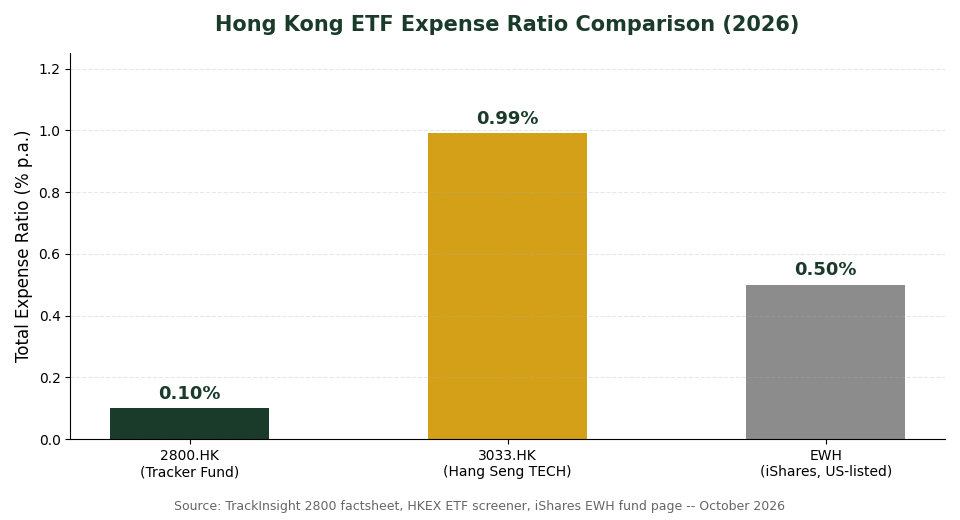
| TER (p.a.) | ~0.10% | ~0.99% | 0.50% |
| AUM | ~HKD 134bn (~USD 17bn) | Smaller, niche fund | ~USD 400-500m |
| Holdings | ~96 | 30 | ~40-45 |
| Trailing Dividend Yield | ~2.88% | Low (growth-tech tilt) | ~4.7% (semi-annual) |
| Currency | HKD | HKD | USD |
| Launched | 1999 | 2020 | 1996 |
Source: TrackInsight 2800 factsheet, HKEX ETF screener, iShares EWH fund page — data as at October 2026.
2800 is the plain-vanilla, lowest-cost way to buy “the Hong Kong market” broadly — financials, property and conglomerates alongside tech. 3033 is the concentrated bet on the AI/tech rally specifically, with a much higher TER and no meaningful dividend income to speak of. EWH sits in between on cost but, as covered below, carries a materially different tax profile because of where the fund itself is domiciled.
The 0% Dividend Withholding Tax Advantage
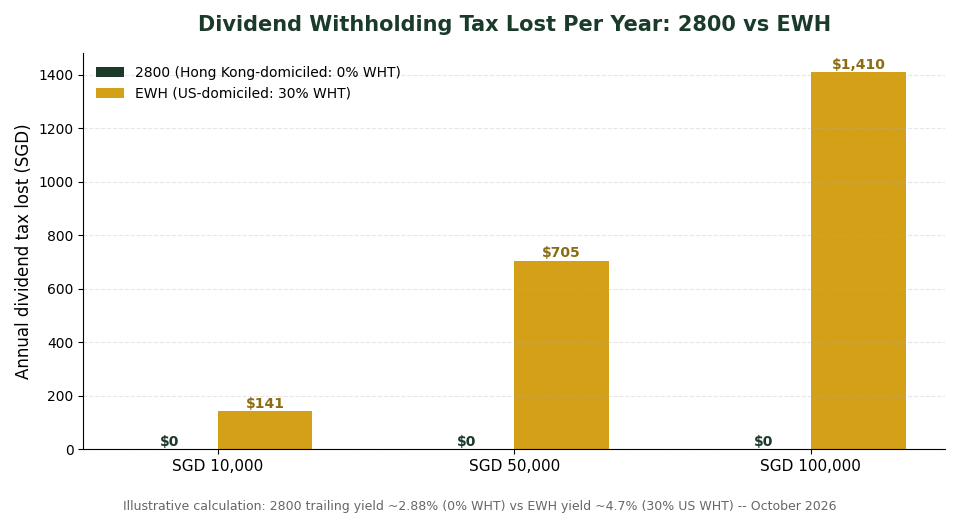
Hong Kong imposes no withholding tax on dividends paid to anyone, resident or non-resident, individual or fund. Because 2800 and 3033 are both domiciled in Hong Kong, the dividends they collect from their underlying Hong Kong stocks — and the dividends they then distribute to unitholders — pass through completely untaxed at source. A Singapore investor holding 2800 keeps 100% of the distribution.
EWH is a different animal. Even though it holds the same type of Hong Kong stocks, EWH itself is a US-domiciled regulated investment company listed on NYSE Arca. Distributions paid by a US-domiciled fund to a non-US, non-resident-alien investor are generally subject to US dividend withholding tax of up to 30% — the same rule that makes a US-listed S&P 500 ETF like VOO less tax-efficient for Singapore investors than an Ireland-domiciled equivalent like CSPX vs VOO. The difference here is that there is no equivalent Ireland-domiciled, UCITS-wrapped Hong Kong ETF with meaningful liquidity — so the real-world choice for SG investors is HK-domiciled (0% WHT) versus US-domiciled (up to 30% WHT), not HK-domiciled versus Ireland-domiciled.
Worked example: on a SGD 50,000 position, 2800’s ~2.88% trailing yield generates roughly SGD 1,440 a year in distributions, all of which lands in the investor’s account untaxed at source. The same SGD 50,000 exposure via EWH, at its ~4.7% yield, generates roughly SGD 2,350 gross — but after a 30% US withholding hit of about SGD 705, the investor nets roughly SGD 1,645. EWH’s higher headline yield narrows the gap, but the tax leakage is real and compounds every year the position is held.
US Estate Tax: Why EWH Is Riskier Than 2800/3033
Beyond the annual withholding drag, EWH carries a risk that 2800 and 3033 simply don’t: US estate tax exposure. Because EWH is organised and listed in the United States, it counts as a US-situs asset for US estate tax purposes. Non-resident aliens — which includes virtually all Singapore citizens and PRs — get only a USD 60,000 lifetime exemption on US-situs assets, versus the multi-million-dollar exemption US persons receive. Holdings above that threshold can be taxed at rates up to 40% on death, a risk covered in more depth in our US estate tax guide for Singapore investors.
2800 and 3033, by contrast, are Hong Kong-domiciled and HKEX-listed. Hong Kong does not impose an estate or inheritance tax, and these funds are not US-situs assets, so there is no equivalent exposure regardless of position size. For investors building a meaningful allocation to Hong Kong equities — rather than a small tactical trade — this is arguably the bigger reason to prefer 2800 or 3033 over EWH, ahead of even the dividend withholding tax difference.
How to Buy Hong Kong ETFs in Singapore
2800 and 3033 trade on HKEX, so you need a broker with Hong Kong market access and the ability to settle in HKD. The three most commonly used by Singapore retail investors are:
moomoo Singapore: Open and fund an account, then search the ticker “2800” or “3033” directly in the app’s HK market tab. moomoo converts SGD to HKD automatically at the point of trade; check current moomoo commission fees before sizing a position, as HK market fees differ from SGX and US fee schedules.
Tiger Brokers: Similar workflow — fund the account, switch to the HK market, and search by ticker. Tiger is often competitive on HK trading commissions and is a popular alternative for investors who already hold a Tiger account for SGX or US trades.
Interactive Brokers (IBKR): IBKR offers HKEX access alongside its US, UK and SGX market access, making it the natural choice for investors who want 2800/3033 sitting in the same multi-currency account as their CSPX or VWRA holdings. See our IBKR vs moomoo Singapore comparison for a fuller breakdown of fees and platform differences.
EWH, being US-listed, is bought the same way as any other US ETF — through a broker with US market access, settled in USD.
Risks to Consider
Volatility and concentration. The Hang Seng Index’s swing from a 2026 YTD high above 28,000 down to roughly 24,000-25,000 by September 2026 is a reminder that Hong Kong equities move sharply on sentiment — especially sentiment about mainland China AI and tech policy. 3033 is more concentrated still, with just 30 holdings dominated by a handful of mega-cap tech names, so single-stock risk (an Alibaba or Tencent-specific shock) can move the whole fund.
China regulatory and geopolitical risk. Many Hang Seng Index and Hang Seng TECH constituents are mainland Chinese companies listed in Hong Kong. Beijing policy shifts — on tech regulation, property, or US-China trade — can move these ETFs independently of global markets.
Currency risk. The Hong Kong dollar is pegged to the US dollar within a narrow band, so HKD exposure behaves largely like USD exposure for a SGD-based investor — it does not diversify currency risk the way a SGD- or EUR-denominated holding would.
Not CPF-investable. Like most HKEX- and NYSE-listed ETFs, 2800, 3033 and EWH are not eligible for CPF Ordinary Account investment under the CPF Investment Scheme. They can be held in a brokerage account funded with cash or, for some brokers, SRS funds — check with your broker before assuming SRS eligibility.
Who Should Buy Hong Kong ETFs?
2800 may suit you if you want broad, low-cost exposure to the Hong Kong market as a satellite position alongside a core global portfolio (such as VWRA or CSPX), and you’re comfortable with emerging-market-style volatility and China-linked regulatory risk for a 0.10% TER and genuinely tax-free dividend stream.
3033 may suit you if you have a specific thesis on the Hong Kong/China AI and tech rebound continuing and are willing to accept concentration in 30 names and a near-1% TER as the cost of a pure-play bet, ideally sized as a small tactical allocation rather than a core holding.
Consider alternatives if you want Hong Kong or China exposure without single-market concentration — a broader China ETF Singapore guide covers mainland-focused options, and investors who prefer a diversified AI theme without the Hong Kong-specific regulatory and currency risk may want to review our AI-powered ETF Singapore guide instead. For most Singapore investors, Hong Kong ETFs work best as a small satellite position — typically 5-10% of an equity portfolio — rather than a core holding, sitting alongside the broad-market exposure covered in our Singapore ETF list.
Frequently Asked Questions
What is the best Hong Kong ETF for Singapore investors?
For most Singapore investors, the Tracker Fund of Hong Kong (2800.HK) is the most practical choice — it has the lowest TER (~0.10%), the largest AUM, broad exposure across the Hang Seng Index, and pays dividends with 0% withholding tax because it is Hong Kong-domiciled. Investors specifically chasing the AI/tech theme may prefer 3033.HK instead, accepting a higher cost and more concentration.
Is Hong Kong ETF 2800 the same as buying the Hang Seng Index directly?
Yes — 2800 is designed to track the Hang Seng Index as closely as possible through physical full replication, holding the same constituent shares in substantially the same weights. It is the original and most widely used vehicle for Singapore and international investors to get Hang Seng Index exposure without buying all 80-plus constituent stocks individually.
Can I buy Hong Kong ETFs using CPF or SRS?
2800, 3033 and EWH are not CPF Investment Scheme (CPFIS) eligible, so they cannot be bought with CPF Ordinary Account funds. Some brokers do allow SRS funds to be used for HKEX or NYSE Arca trades — this varies by broker, so check directly with moomoo, Tiger Brokers or IBKR before assuming eligibility.
Why does EWH have higher withholding tax than 2800 if they both hold Hong Kong stocks?
The withholding tax depends on where the fund itself is domiciled, not just what it holds. Hong Kong charges no dividend withholding tax at source, so a Hong Kong-domiciled fund like 2800 passes dividends through untaxed. EWH, despite holding Hong Kong stocks, is a US-domiciled fund — and US tax rules apply a withholding tax of up to 30% on distributions a US-domiciled fund pays to non-US, non-resident investors, regardless of what the fund invests in.
Is it too late to invest in the Hong Kong tech rally in 2026?
Nobody can answer that with certainty, and this is not investment advice. What’s clear is that the Hang Seng Index has already pulled back meaningfully from its 2026 high above 28,000 to roughly 24,000-25,000 by September 2026, so the easy gains from the initial AI-driven re-rating have likely passed. Whether that makes current levels an entry point or a value trap depends on your view of China’s AI and tech policy trajectory, which is genuinely uncertain.
What are the risks of Hang Seng TECH ETF 3033 compared to the broader Hang Seng Index?
3033 holds just 30 stocks concentrated in technology, versus roughly 96 across sectors for 2800, so it carries higher single-stock and sector concentration risk. It also has a far higher TER (~0.99% vs ~0.10%) and minimal dividend income, since growth-tech companies typically reinvest earnings rather than distribute them. It is a higher-risk, higher-potential-reward way to express a Hong Kong tech view specifically, not a substitute for broad market exposure.
Ready to Add Hong Kong Exposure to Your Portfolio?
Open a brokerage account with HKEX market access and size your position carefully — Hong Kong ETFs work best as a satellite allocation, not a core holding.
This article was researched with the help of AI. While we strive to keep all information accurate and up to date, there may be errors. If you notice any discrepancies, please contact us.