Endowus CPF OA vs CPF Special Account 2026: Is Investing Still Worth It at a 4% Guaranteed Rate?
The real breakeven math behind CPFIS-OA investing through Endowus, now that CPF Special Account money earns a guaranteed 4% p.a.
CPF Ordinary Account (OA) savings earn a guaranteed 2.5% p.a., while CPF Special Account (SA) savings earn 4% p.a. — so moving OA money into an Endowus CPFIS-OA portfolio only makes sense if your expected net return, after the 0.25%-0.60% Endowus access fee and fund-level TER, comfortably clears that 4% guaranteed floor. For most members below 55, the honest answer is: often not, unless you have a long horizon and genuine equity exposure.
Not financial advice. All figures are for educational reference only. Data as at October 2026 unless otherwise noted.
Table of Contents
Contents — Click to expand
- CPF OA vs CPF SA Interest Rates in 2026
- The CPF Special Account Closure: What Still Applies to You
- How Much Endowus Charges to Invest Your CPF OA
- The Breakeven Math: What Return Do You Actually Need?
- Who Should Still Invest CPF OA via Endowus?
- How to Start Investing Your CPF OA with Endowus
- Frequently Asked Questions
CPF OA vs CPF SA Interest Rates in 2026
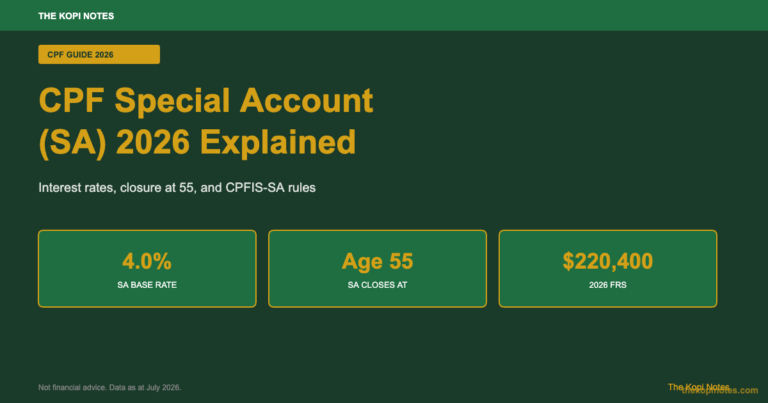
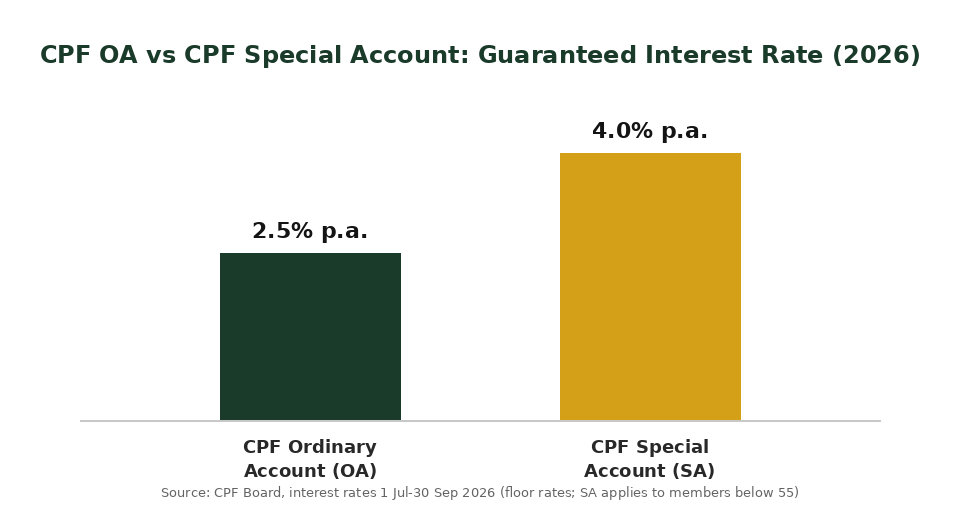
CPF pays different guaranteed interest rates depending on which account your money sits in. The Ordinary Account (OA) — the account CPFIS-OA investing draws from — earns a floor rate of 2.5% p.a. The Special, MediSave and Retirement Accounts (SMRA) earn a floor rate of 4% p.a., pegged to the 12-month average yield of 10-year Singapore Government Securities plus 1%. Both rates have held at their respective floors through the 1 July–30 September 2026 and preceding quarters, according to the CPF Board’s official rate announcement.
That 1.5 percentage point gap is the entire reason the “invest my CPF OA” decision is harder in 2026 than it was when OA and SA rates were closer together. Any CPFIS-OA portfolio now has to clear a materially higher bar just to match what the money would have earned doing nothing.
| Account | 2026 Floor Rate | Who It Applies To |
|---|---|---|
| CPF Ordinary Account (OA) | 2.5% p.a. | All members |
| CPF Special Account (SA) | 4.0% p.a. | Members below 55 only |
| CPF Retirement Account (RA) | 4.0% p.a. (up to Full Retirement Sum) | Members 55 and above |
Source: CPF Board, interest rates 1 Jul–30 Sep 2026 announcement.
The CPF Special Account Closure: What Still Applies to You
Since 19 January 2025, the CPF Board closed the Special Account for roughly 1.4 million members aged 55 and above as part of Budget 2024 reforms, per the CPF Board’s SA closure notice. Their SA savings were transferred into the Retirement Account up to the Full Retirement Sum — still earning 4% — with any excess moved to the OA at 2.5%.
If you’re below 55, your SA is still open and still earning 4% p.a., and this is the account your CPF OA investment decision gets measured against. If you’re 55 or above, the comparison is CPF OA (2.5%) against your Retirement Account’s 4% rate on savings up to the Full Retirement Sum — the same math applies, just under a different account name. Either way, the guaranteed 4% benchmark is real money you’re giving up the moment you move OA funds into a CPFIS-OA portfolio.
How Much Endowus Charges to Invest Your CPF OA
Endowus is the only digital wealth platform approved under the CPF Investment Scheme (CPFIS), and it channels CPF OA balances above S$20,000 into unit trusts via its Fund Smart or Flagship portfolios. The access fee — what Endowus charges for advice, portfolio construction, rebalancing and brokerage — is tiered by portfolio size, and CPF, SRS and cash AUM are tiered separately rather than combined, per Endowus’s published pricing page.
| CPF OA Portfolio Size | Endowus Access Fee |
|---|---|
| First S$200,000 | 0.60% p.a. |
| S$200,001 – S$1,000,000 | 0.50% p.a. |
| S$1,000,001 – S$5,000,000 | 0.35% p.a. |
| Above S$5,000,000 | 0.25% p.a. |
Source: Endowus pricing page, 2026. Fund Smart single-fund portfolios may price differently (around 0.30%).
On top of this access fee sits the underlying fund’s own Total Expense Ratio (TER), typically 0.05%–1.00% p.a. and already priced into the fund’s daily NAV. For most CPFIS-OA Flagship or Fund Smart portfolios, all-in costs land somewhere between 0.65% and 1.10% p.a. once you stack the access fee and TER together.
The Breakeven Math: What Return Do You Actually Need?
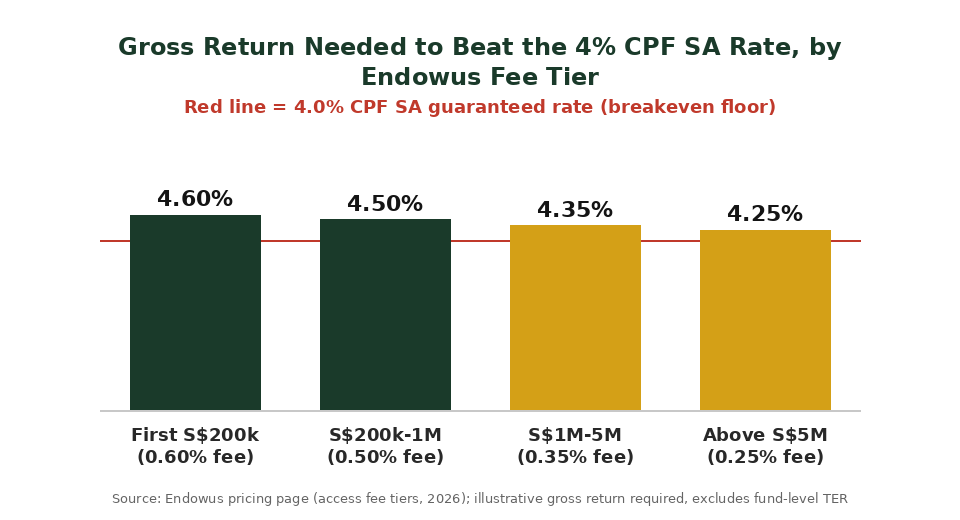
Here’s the calculation that matters more than any fund factsheet: for a Singapore investor with a S$150,000 CPF OA Flagship portfolio paying the 0.60% access fee tier, the fund needs to gross at least 4.60% p.a. (4.0% SA opportunity cost + 0.60% fee) just to match what that money would have earned left untouched in the SA — and that’s before counting the fund-level TER on top. At the largest fee tier (above S$5 million, 0.25%), the bar drops to 4.25% gross, still above the 4% floor.
This is a different calculation from the common “Endowus vs CPF OA at 2.5%” framing you’ll see elsewhere. Because your real alternative isn’t leaving the money in OA earning 2.5% — it’s the fact that, as a long-term CPF strategy, many members eventually top up or transfer towards the SA/RA anyway. Measured against the 4% guaranteed SA rate, CPFIS-OA investing needs genuine equity-level returns to be worth the risk, not just “beat inflation” returns.
| Scenario | Fee Tier | Gross Return Needed to Beat 4% SA | Realistic? |
|---|---|---|---|
| First S$200k portfolio | 0.60% | 4.60% | Only with meaningful equity allocation over 10+ years |
| S$200k–1M portfolio | 0.50% | 4.50% | Achievable with balanced-to-growth allocation long-term |
| Conservative/bond-heavy fund | Any tier | 4.25%–4.60% | Unlikely — stay in SA/RA instead |
Illustrative calculation based on Endowus access fee tiers (2026) and CPF Board floor rates. Excludes fund-level TER, which adds further to the required gross return.
Who Should Still Invest CPF OA via Endowus?
CPFIS-OA investing through Endowus still makes sense if: you’re decades from retirement and can hold through market cycles, your CPF OA balance comfortably exceeds the S$20,000 investable threshold with a buffer left over, you’re choosing a growth-tilted Flagship portfolio rather than a conservative one, and you understand that returns are not guaranteed the way SA interest is.
Consider leaving your CPF OA untouched — or prioritising your SA/RA — if: you’re within 10–15 years of 55, you want zero volatility on this portion of your retirement savings, your OA balance is close to the S$20,000 minimum, or you’re already maximising SA/RA contributions and treating OA investing as a secondary lever. For many Singapore investors, a hybrid approach — investing only the OA balance above a comfortable buffer, while letting SA/RA compound at 4% untouched — captures most of the upside with less regret risk. Our CPF investment strategy guide walks through how to sequence CPF OA, SA and SRS funding priorities.
How to Start Investing Your CPF OA with Endowus
If you’ve decided the breakeven math works for your situation, the mechanics are straightforward: sign up with Endowus using the Endowus referral code, complete the CPFIS-OA application (which requires linking your CPF account and confirming your OA balance exceeds S$20,000), select a Flagship or Fund Smart portfolio matched to your risk profile, and set up the CPF Investment Scheme transfer. Our step-by-step Endowus CPFIS guide covers the full application walkthrough in detail, and our Endowus fund performance review breaks down how Flagship portfolios have actually performed against benchmarks in 2026.
Before committing CPF OA funds, it’s worth running your own numbers through our Singapore retirement calculator to see how a 2.5%, 4%, and projected-equity-return scenario each play out over your specific time horizon — the right answer genuinely differs by age and balance. If cash outside CPF is also part of your plan, the Syfe referral code and sign-up bonus and FSMOne referral code pages cover complementary cash and SRS options.
Disclaimer: This article is for educational purposes only and does not constitute financial advice. CPF rules, interest rates and Endowus fees are subject to change — always verify current figures on cpf.gov.sg and endowus.com before making a decision. The Kopi Notes may earn a referral fee if you sign up through the links on this page.
Frequently Asked Questions
Is it still worth investing CPF OA through Endowus in 2026?
It depends on your fee tier and time horizon. With the Endowus access fee ranging from 0.25% to 0.60% p.a., your portfolio needs to gross roughly 4.25%–4.60% p.a. just to match what the same money would earn as a 4% CPF Special Account or Retirement Account rate. That’s achievable with a growth-tilted portfolio over 10+ years, but not guaranteed, unlike CPF’s rate.
What is the difference between CPF OA and CPF Special Account interest rates?
CPF Ordinary Account (OA) earns a floor rate of 2.5% p.a., while the Special Account (SA), MediSave Account and Retirement Account earn a floor rate of 4% p.a. as at 2026. The SA/RA rate is pegged to the 12-month average 10-year Singapore Government Securities yield plus 1%, which is why it moves more over time than the OA rate.
Do I still have a CPF Special Account if I'm above 55?
No. Since 19 January 2025, the CPF Board closed the Special Account for all members aged 55 and above. Your SA savings were transferred to your Retirement Account up to the Full Retirement Sum (still earning 4%), with any excess moved to your Ordinary Account at 2.5%. If you’re below 55, your SA remains open and still earns 4%.
How much does Endowus charge to invest my CPF OA?
Endowus charges a tiered access fee on CPF OA portfolios: 0.60% p.a. on the first S$200,000, 0.50% on S$200,001 to S$1,000,000, 0.35% on S$1,000,001 to S$5,000,000, and 0.25% above S$5,000,000. The underlying fund’s own expense ratio (typically 0.05%–1.00%) applies on top of this access fee.
What is the minimum CPF OA balance to invest with Endowus?
Under the CPF Investment Scheme (CPFIS-OA), you can only invest CPF OA savings above S$20,000 — the first S$20,000 must remain in your OA earning the guaranteed 2.5% p.a. and cannot be invested.
Is investing CPF OA risk-free like leaving it in the account?
No. Unlike the guaranteed 2.5% OA rate or 4% SA/RA rate, returns from an Endowus CPFIS-OA portfolio are market-linked and can be negative in any given year. You are trading a guaranteed return for the possibility of a higher one, which only suits investors with a long time horizon and tolerance for short-term losses.
Ready to Run Your Own CPF Numbers?
Compare your CPF OA, SA and investment scenarios before you commit any CPFIS-OA transfer.
This article was researched with the help of AI. While we strive to keep all information accurate and up to date, there may be errors. If you notice any discrepancies, please contact us.