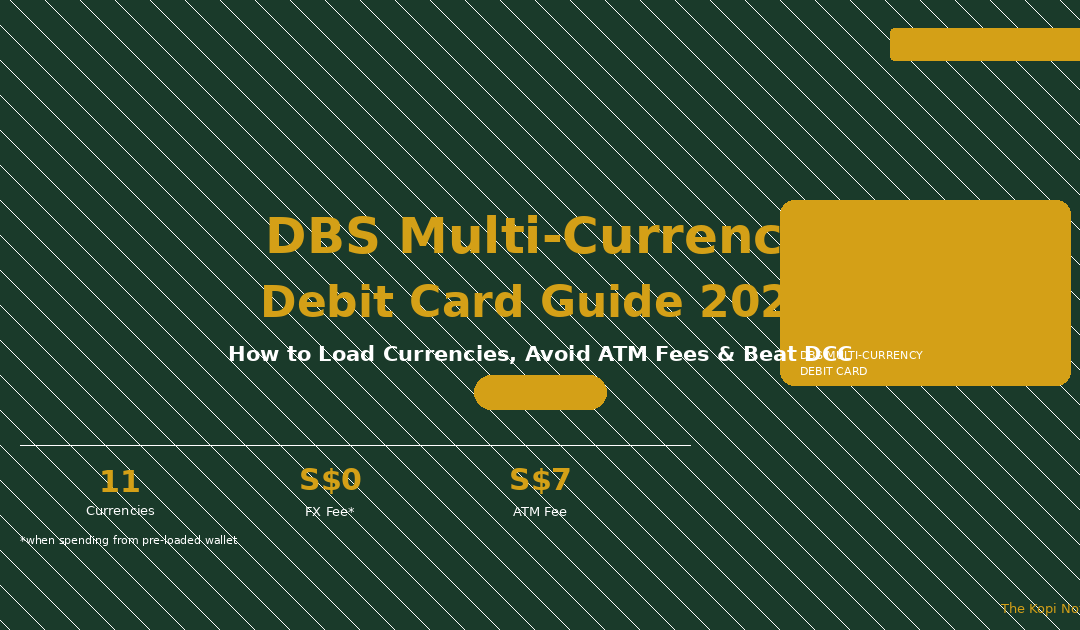
DBS Multi-Currency Debit Card: Step-by-Step Guide 2026
How to load currencies before you fly, avoid the S$7 ATM fee & never fall for DCC again
The DBS Multi-Currency Debit Card lets Singapore travellers spend in 11 foreign currencies — AUD, CAD, EUR, GBP, HKD, JPY, NOK, NZD, SEK, THB and USD — with zero FX conversion fees when funds are pre-loaded via the DBS digibank app. Linked to a DBS My Account, it doubles as a standard Visa debit card at home and abroad. The key is timing: load currencies when rates favour SGD, spend from your pre-loaded wallet, and use the right ATMs overseas to avoid the S$7 withdrawal fee.
Not financial advice. All figures are for educational reference only. Data as at October 2026 unless noted.
The 11 Spendable Foreign Currencies
The DBS My Account holds up to 13 currencies (SGD plus 12 foreign), but the debit card can only spend in 11 of them. CNH (Chinese yuan offshore) is the exception — you can hold it in the account but cannot spend it directly with the card. For spending in China, the card will convert from another wallet or SGD at a 3.25% FX fee. For CNH-specific spending, a separate UnionPay card is needed.
| Currency | Full Name | Common Destinations |
|---|---|---|
| AUD | Australian Dollar | Australia, Pacific islands |
| CAD | Canadian Dollar | Canada |
| EUR | Euro | France, Germany, Italy, Spain & 17 more |
| GBP | British Pound | United Kingdom |
| HKD | Hong Kong Dollar | Hong Kong |
| JPY | Japanese Yen | Japan |
| NOK | Norwegian Krone | Norway, Scandinavia |
| NZD | New Zealand Dollar | New Zealand |
| SEK | Swedish Krona | Sweden, Scandinavia |
| THB | Thai Baht | Thailand |
| USD | US Dollar | USA, widely accepted globally |
Source: DBS Bank Singapore, October 2026. CNH is held in the account but not spendable via the debit card.
If your destination uses a currency not on this list — Korean Won (KRW), Vietnamese Dong (VND), Indonesian Rupiah (IDR) — the card will still work but DBS converts from SGD at a 3.25% FX markup. In those cases, a card with real-time zero-fee conversion like YouTrip (earn S$10 with this referral) is a better choice for that destination.
Step 1: How to Load Currencies in DBS digibank
Pre-loading is the core advantage of the DBS Multi-Currency Debit Card. Do this days or weeks before departure so you can monitor rates and convert when SGD is strong.
Loading Currencies Step by Step
- Open the DBS digibank mobile app
- Go to Accounts → select your My Account
- Tap Exchange Currencies
- Choose SGD as source currency, select your target (e.g. JPY)
- Enter the SGD amount and review the live rate
- Tap Confirm — funds transfer instantly to your foreign wallet
Rate Timing Benchmarks
DBS digibank shows live rates but not historical charts. Use the free XE Currency app or Wise rate tracker to monitor trends. Some rough benchmarks Singapore travellers use:
- JPY: Below S$0.0092 per ¥1 (¥100 = S$9.20 or less) is historically favourable for SGD holders
- EUR: EUR/SGD below 1.42 is near the cheaper end of the 2023–2026 range
- GBP: GBP/SGD around 1.65–1.70 is mid-range historically
- THB: Load when SGD buys more than 27 THB (i.e. THB/SGD above S$0.037)
- AUD: AUD/SGD below 0.90 is a good loading point for Australia trips
Tip: Only load what you’ll realistically spend, plus a 15–20% buffer. Unused foreign currency sitting in DBS My Account earns zero interest. Keep idle SGD working in Singapore T-bills or Singapore Savings Bonds between trips.
Step 2: Activate Overseas Usage Before You Fly
DBS debit cards may ship with overseas transactions disabled as a security default. Don’t discover this at a restaurant in Paris — activate the night before departure.
How to Enable Overseas Transactions
- Open DBS digibank app
- Tap Card in the bottom navigation
- Select your DBS Visa Debit Card
- Tap Manage → Card Settings
- Toggle on Overseas Transactions
- Toggle on Overseas ATM Withdrawals (this is a separate toggle)
- Optionally set a Daily Overseas Spending Limit — recommended: 1.5× your expected daily spend — as a security measure
Magnetic stripe note: Heading somewhere with older terminals (rural Japan, some Indonesian islands, parts of India)? Also enable the Magnetic Stripe toggle. Modern EMV chip readers don’t need it, but it’s a useful backup.
Step 3: How the Card Picks Your Wallet When Spending Abroad
When you tap or dip your DBS Multi-Currency Debit Card at an overseas terminal, DBS applies a simple spending waterfall:
- Check foreign currency wallet first. If you have sufficient JPY and you’re spending in Japan, DBS debits your JPY wallet — 0% FX fee.
- If the foreign wallet is empty or insufficient, DBS converts from your SGD balance at the live rate plus a 3.25% foreign transaction fee.
- If SGD is also insufficient, the transaction is declined.
You can top up your foreign currency wallet in real time from anywhere in the world using the digibank app — useful if you underestimate your spending and need more JPY mid-trip.
Transaction Currency vs Country
The relevant wallet is determined by transaction currency — what the merchant charges in — not where you are. Most merchants in Japan charge in JPY, so your JPY wallet covers it. But international hotel chains in Japan may bill in USD, and some online merchants charge in EUR. In those cases, DBS draws from the respective currency wallet (or converts from SGD if empty).
ATM Withdrawal Strategy: Minimising the S$7 Fee
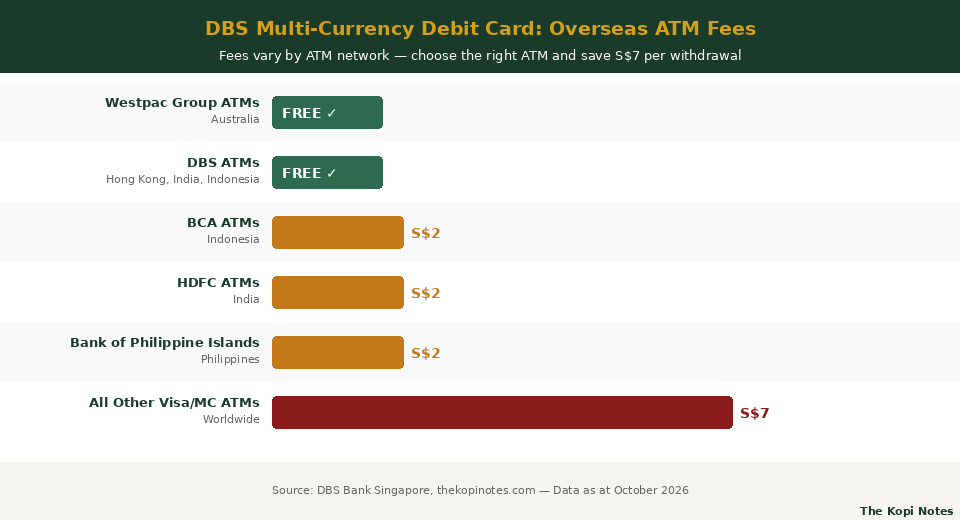
The standard overseas ATM withdrawal fee is S$7 per transaction, billed in the equivalent local currency amount. It’s flat, not percentage-based — so the same S$7 whether you withdraw S$100 or S$600 equivalent. Withdraw in larger amounts less frequently.
DBS has fee waiver and reduction partnerships with selected overseas banks:
| ATM Network | Country | Withdrawal Fee |
|---|---|---|
| Westpac Group (Westpac, St. George, Bank of Melbourne, BankSA) | Australia | FREE |
| DBS branches | Hong Kong, India, Indonesia | FREE |
| BCA ATMs | Indonesia | S$2 |
| HDFC ATMs | India | S$2 |
| Bank of Philippine Islands (BPI) | Philippines | S$2 |
| All other Visa/Mastercard ATMs | Worldwide | S$7 |
Source: DBS Bank Singapore — Overseas ATM Withdrawal Charges page, October 2026. Local ATM operator surcharges may apply additionally.
Country-Specific ATM Tips
- Australia: Westpac ATMs are everywhere in cities and towns. Free withdrawals make DBS MCA excellent for AUD cash needs.
- Thailand: Thai ATMs charge their own surcharge (often ฿200–250, roughly S$7–9) on top of DBS’s S$7 fee. The combined cost can be 10–15% of small withdrawals. Pre-load THB and use card payments wherever possible — Bangkok is highly contactless-friendly.
- Japan: Pre-load JPY and use 7-Eleven ATMs (reliable Visa/Mastercard acceptance). DBS charges S$7; Japan’s own ATM surcharge is usually ¥110–220. Budget for both.
- Indonesia: BCA ATMs are widespread. At S$2, DBS MCA is one of the cheapest options for IDR cash if you’re in a Rupiah-needed destination — though DBS doesn’t support IDR as a pre-loaded currency, so the 3.25% FX markup still applies on the conversion.
⚠️ The DCC Trap: Always Pay in Local Currency
Dynamic Currency Conversion (DCC) is one of the most expensive traps for overseas card users. Here’s how it works:
When you pay by card at a foreign terminal, you may see a prompt: “Pay in SGD (S$142.50) or JPY (¥15,800)?”
The SGD amount is calculated by the merchant’s bank at their own exchange rate — typically 3–7% worse than DBS’s rate. If you choose SGD, the merchant’s bank profits from the conversion spread and DBS doesn’t charge an FX fee (because it’s already in SGD) — but you’ve already paid the markup to the merchant’s bank.
Rule: Always select “Pay in [local currency]” — JPY, EUR, THB, AUD, etc. — never SGD. This applies at ATMs and payment terminals equally.
If you accidentally accept DCC, some banks allow you to dispute the charge. If the terminal auto-converts without asking, ask the staff to void the transaction and re-run it, selecting local currency this time.
DBS Multi-Currency Card vs YouTrip vs GXS: Which Should You Carry?
The short answer: carry two. These cards serve different purposes and using them together maximises savings.
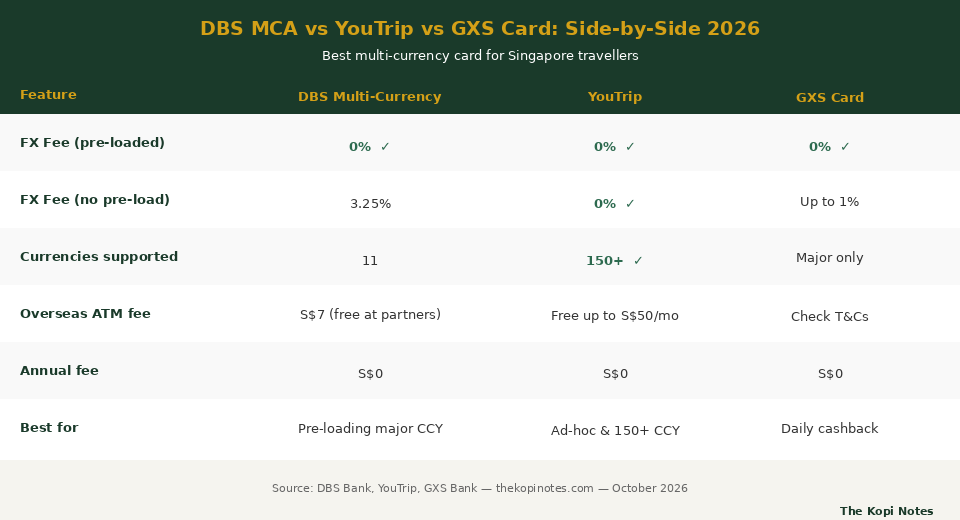
| Feature | DBS Multi-Currency | YouTrip | GXS Card |
|---|---|---|---|
| FX fee (pre-loaded wallet) | 0% | 0% | 0% |
| FX fee (no pre-load / spot) | 3.25% | 0% (always) | Up to 1% |
| Currencies supported | 11 spendable | 150+ | Major only |
| Overseas ATM fee | S$7 (free at partners) | Free up to S$50/mo | Check T&Cs |
| Annual fee | S$0 | S$0 | S$0 |
| Best for | Pre-loading major currencies at good rates | Ad-hoc spending in 150+ currencies | Daily cashback spending |
Source: DBS Bank, YouTrip, GXS Bank — October 2026. Rates subject to change. Always verify current terms on the provider’s official website.
Recommended card stack:
- DBS Multi-Currency Debit Card — pre-load JPY, EUR, GBP, AUD weeks before departure when rates are favourable
- YouTrip (sign up via TKN for S$10) — daily spending in currencies DBS doesn’t support, ad-hoc purchases, free monthly ATM allowance
- GXS Card (sign up with code YONG477 for a bonus) — cashback on SGD daily spending back in Singapore
For a full fee breakdown and detailed comparison against fintech alternatives, read our DBS Multi-Currency Card review.
What to Do with Idle SGD Between Trips
DBS My Account pays no interest on SGD balances. If your next trip is months away, idle SGD is losing purchasing power versus inflation. Two low-risk options Singapore investors use for short-to-medium term parking:
- Singapore T-bills (6-month): Government-backed, recently yielding 3–3.5% p.a. Apply via DBS iBanking or ATM. Minimum S$1,000. Non-competitive bids are almost always filled in full.
- Singapore Savings Bonds (SSBs): Flexible step-up interest, redeemable monthly with no capital loss. Maximum S$200,000 per bond. Ideal for idle cash you might need on short notice.
A practical travel-fund strategy: keep one to two months of estimated trip spending in your DBS My Account as a working float, invest the rest in T-bills or SSBs and redeem as your trip date approaches. This way your idle SGD earns 3%+ while waiting to be converted into JPY or EUR.
Frequently Asked Questions
Can I use the DBS Multi-Currency Debit Card in countries whose currency isn't on the supported list?
What happens if I run out of pre-loaded foreign currency mid-trip?
Is there a minimum balance or monthly fee for DBS My Account?
How do I get free ATM withdrawals in Australia with DBS?
What is DCC and should I ever accept it?
Can I spend CNH in China using the DBS Multi-Currency Debit Card?
This article was researched with the help of AI. While we strive to keep all information accurate and up to date, there may be errors. If you notice any discrepancies, please contact us.