Singapore Savings Plan 2026: Best Types for Every Goal
Insurance Plans · SSB · T-Bills · Fixed Deposits · CPF — Compared
A Singapore savings plan covers a wide range of financial products — from insurance-based endowments and CPF contributions to Singapore Savings Bonds (SSB), Treasury Bills (T-bills) and bank fixed deposits. Each serves a different purpose: insurance savings plans bundle protection with disciplined saving, while SSBs and T-bills offer government-backed capital security with no lock-up penalty. CPF remains the bedrock of retirement saving, offering 2.5%–4% p.a. guaranteed interest. Your best option depends on your goal, timeline and need for liquidity.
Not financial advice. All figures are for educational reference only. Data verified as at 2 October 2026 unless otherwise noted. CPF interest rates sourced from CPF Board official website (Oct–Dec 2026 quarter).
Table of Contents
What Is a Savings Plan in Singapore?
A Singapore savings plan is any structured vehicle designed to help you accumulate money over time — with some degree of capital protection or guaranteed return. In everyday usage, the term most commonly refers to insurance savings plans (endowment policies) sold by insurers like AIA, Prudential, Great Eastern, NTUC Income and Manulife. However, the broader universe includes government-backed options (SSB, T-bills) and bank fixed deposits.
The key distinction: insurance savings plans combine savings with life coverage, while non-insurance alternatives are pure savings or investment instruments with no protection component. As a Singapore investor, you would typically use a mix — CPF as the retirement core, SSBs for liquid capital, and an endowment for a specific medium-term goal.
Types of Singapore Savings Plans Compared (2026)
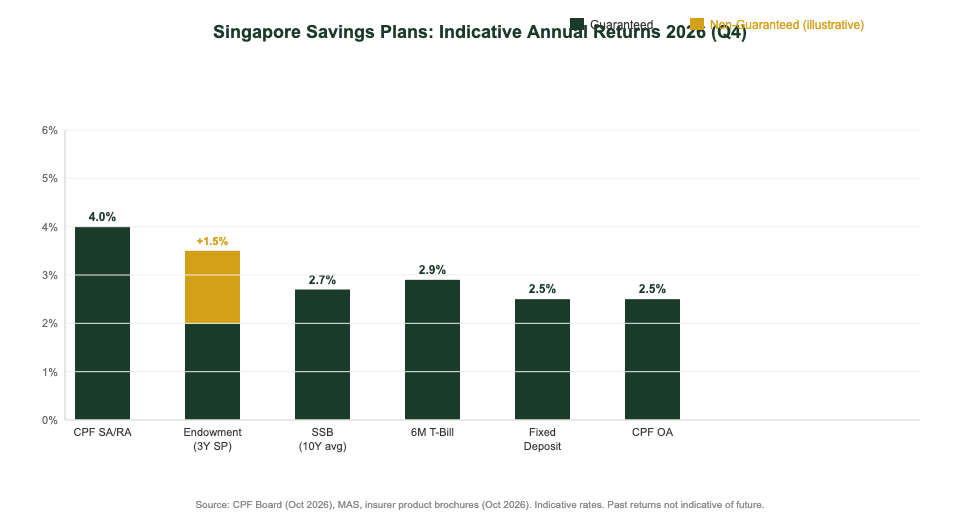
| Plan Type | Typical Return | Tenure | Capital Safe? | Liquidity |
|---|---|---|---|---|
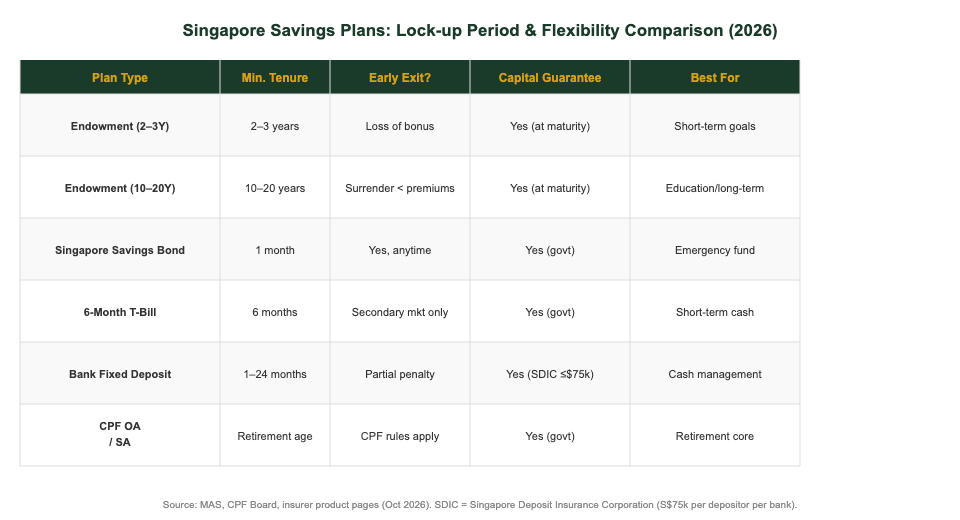
| Endowment (Short, 2–3Y) | 1.8–3.0% p.a.* | 2–3 years | Yes (at maturity) | Low |
| Endowment (Long, 10–20Y) | 3.5–4.5% p.a.* | 10–25 years | Yes (at maturity) | Very Low |
| Singapore Savings Bond | 2.5–3.0% p.a.† | Up to 10 years | Yes (govt) | High (monthly) |
| 6-Month T-Bill | 2.7–3.2% p.a.† | 6 months | Yes (govt) | Low (no early exit) |
| Bank Fixed Deposit | 2.0–3.5% p.a.† | 1–24 months | Yes (SDIC ≤$75k) | Low (penalty) |
| CPF Ordinary Account | 2.5% p.a. | Until retirement | Yes (govt) | Restricted |
| CPF Special/Retirement Acc. | 4.0% p.a. | Until 55/retirement | Yes (govt) | Very Restricted |
* Endowment returns include non-guaranteed bonuses (illustrated, not assured). † T-bill, SSB and FD rates are indicative Q4 2026 ranges. CPF OA 2.5% and SA/RA 4.0% confirmed for 1 Oct–31 Dec 2026 (CPF Board, Oct 2026).
Insurance Savings Plans (Endowment Policies)
Insurance savings plans — commonly called endowment plans in Singapore — are life insurance products that double as savings vehicles. You pay regular or lump-sum premiums over a fixed tenure; at maturity, you receive a guaranteed sum plus non-guaranteed bonuses from the insurer’s participating (par) fund.
- Guaranteed return: The minimum you receive at maturity. Typically 1.5%–2.5% p.a. for short-term plans.
- Non-guaranteed bonus: Declared annually; once added, cannot be removed. Illustrated total returns often reach 3.5%–4.5% p.a. over 10–20 years.
- Life coverage: On death before maturity, beneficiaries receive the higher of total premiums paid or current policy value.
Key risk — early surrender: If you terminate before maturity, you receive only the surrender value — which in early years can be below your total premiums paid. Only commit funds you can lock away for the full tenure.
Short-term endowments (2–5 years): For medium-term goals where you can lock up funds. Examples: NTUC Income Gro Saver, NTUC Income Gro Capital Ease, various bank-distributed single-premium products.
Long-term endowments (10–25 years): Better for retirement or education goals where compound non-guaranteed bonuses add up significantly. Consider our Singapore retirement planning calculator to model how much you need.
SSB, T-Bills and Fixed Deposits: Non-Insurance Options
Singapore Savings Bonds (SSB)
SSBs are issued monthly by MAS. Key features: step-up interest (increases each year), full capital return if redeemed early (1 month’s notice), no risk of losing principal. Maximum SGD 200,000 per individual. Ideal for emergency funds. Check the latest rates at MAS Singapore Savings Bonds. See our full Singapore Savings Bonds guide.
Treasury Bills (T-Bills)
Singapore government T-bills are auctioned fortnightly (6-month) and monthly (1-year). Zero-coupon — bought at a discount, face value returned at maturity. Yields broadly 2.7%–3.2% p.a. in recent months. Cannot be redeemed early without selling on secondary market. See our Singapore T-bills 2026 guide.
Bank Fixed Deposits
Simplest option: deposit with a bank, lock in for 1–24 months, earn stated interest. Guaranteed up to SGD 75,000 per depositor per bank under SDIC deposit insurance. Rates fluctuate — compare across banks before committing.
CPF: Singapore’s Bedrock Savings Foundation
Before exploring private savings plans, maximise CPF first. CPF interest rates are government-guaranteed:
- Ordinary Account (OA): 2.5% p.a. (Q4 2026, legislated minimum) — usable for housing, education, and CPF investment strategy
- Special Account (SA): 4.0% p.a. (floor rate) — ring-fenced for retirement
- MediSave Account (MA): 4.0% p.a. — for healthcare costs
- Retirement Account (RA): 4.0% p.a. — formed at age 55 from OA/SA
- Extra interest: First $60,000 combined balance earns an additional 1% p.a.
CPF SA’s guaranteed 4% p.a. is the benchmark. A private endowment offering 3.5% illustrated return is not obviously superior to topping up your SA at a guaranteed 4% with no par fund risk.
How to Choose the Right Singapore Savings Plan
| Your Goal | Best Option | Why |
|---|---|---|
| Emergency fund (1–3 months) | SSB or HYSA | Full flexibility; no penalty |
| Short-term goal in 1–2 years | T-bill or FD | Matches tenure exactly; capital guaranteed |
| Child’s education fund in 10+ years | Long-term endowment | Forced savings + coverage + compound bonus |
| Retirement savings (20+ years) | CPF SA top-up first | 4% guaranteed; tax relief on cash top-ups |
| Supplementary retirement income | Best S-REITs or Endowus (2V343) income portfolios | Higher yield potential via dividend assets |
| Passive income from cash savings | SSB ladder or Syfe (SRPRFFFCD) Cash+ | Flexibility + reasonable yield |
Source: Author analysis, CPF Board (Oct 2026), MAS. General framework only — individual circumstances vary.
Worked Example: Deploying a SGD 30,000 Lump Sum (5-Year Goal)
| Strategy | Year 1 Return | Year 5 Value (est.) | Key Risk |
|---|---|---|---|
| T-bill roll (6M × 10) | ~$870 | ~$34,600 | Reinvestment risk if rates fall |
| 5-Year Endowment (SP) | Locked | ~$34,200–$36,000* | No liquidity; bonus not guaranteed |
| SSB ladder (hold 5Y) | ~$780 | ~$33,900 | Lower rate but full flexibility |
* Illustrative only using 2.6% guaranteed + 0.4% non-guaranteed bonus. T-bill assumes 2.9% annualised. SSB assumes 2.6% average step-up rate. Not a recommendation. Past performance does not guarantee future results.
For automated investing with managed income funds, consider Endowus (referral code: 2V343) or Syfe (referral code: SRPRFFFCD). Use our Singapore retirement calculator to model how different savings strategies compound over time.
Disclaimer: This article is for general information only and is not financial advice. Always consult a licensed financial adviser before committing to any insurance savings plan or investment product.
Frequently Asked Questions
What is the best savings plan in Singapore in 2026?
Is an endowment plan better than a fixed deposit?
Are insurance savings plans capital guaranteed?
Can I use CPF to buy an endowment plan?
What happens if I stop paying premiums on my savings plan?
How do I compare savings plans in Singapore?
Get Free Insurance Advice
Speak with a licensed insurance advisor. No obligation, no cost.
By submitting this form, you agree to our Privacy Policy.
This article was researched with the help of AI. While we strive to keep all information accurate and up to date, there may be errors. If you notice any discrepancies, please contact us.