Mapletree Industrial Trust Dividend 2026 (SGX: ME8U): DPU History, Yield & Ex-Date Guide
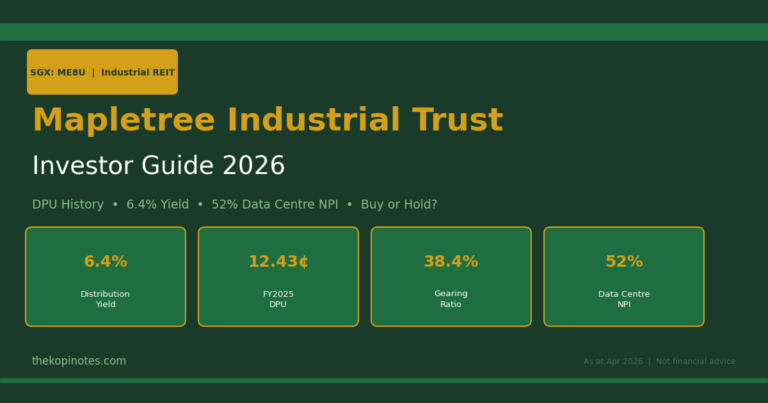
How much does MIT pay, when are the ex-dates, and is the DPU sustainable?Mapletree Industrial Trust (SGX: ME8U) is Singapore’s largest pure-play industrial and data centre REIT, paying semi-annual dividends (DPU) to unitholders typically in June and December. Its FY2026 full-year DPU is estimated at approximately 11.35 Singapore cents per unit — translating to a forward yield of 5.1%–5.7% at the current share price range of SGD 2.00–2.20. MIT’s dual mandate of Singapore hi-tech industrial assets and US data centres provides partial DPU resilience even as interest costs remain elevated.
Not financial advice. All figures are for educational reference only. Data as at October 2026 unless noted. Past dividends are not a guarantee of future payments.
What Is Mapletree Industrial Trust?
Mapletree Industrial Trust (SGX: ME8U) was listed on the Singapore Exchange in October 2010 and is managed by Mapletree Industrial Trust Management Ltd., a wholly-owned subsidiary of Mapletree Investments Pte Ltd. As at mid-2026, MIT’s portfolio comprises 142 properties across Singapore and the United States, with a total assets under management (AUM) of approximately SGD 9 billion.
MIT’s Singapore portfolio includes hi-tech buildings, business park properties, stack-up and ramp-up factories, and flatted factories. Its US portfolio consists of data centre assets located primarily in Northern Virginia, the world’s largest data centre market. This dual exposure gives MIT a differentiated income profile among Singapore industrial REITs — and underpins its ability to sustain DPU in a higher-for-longer interest rate environment.
For Singapore investors seeking passive income Singapore through reliable REIT distributions, MIT has been a consistent payer since its IPO, making it one of the most studied REITs in the S-REIT universe.
MIT DPU History 2022–2026
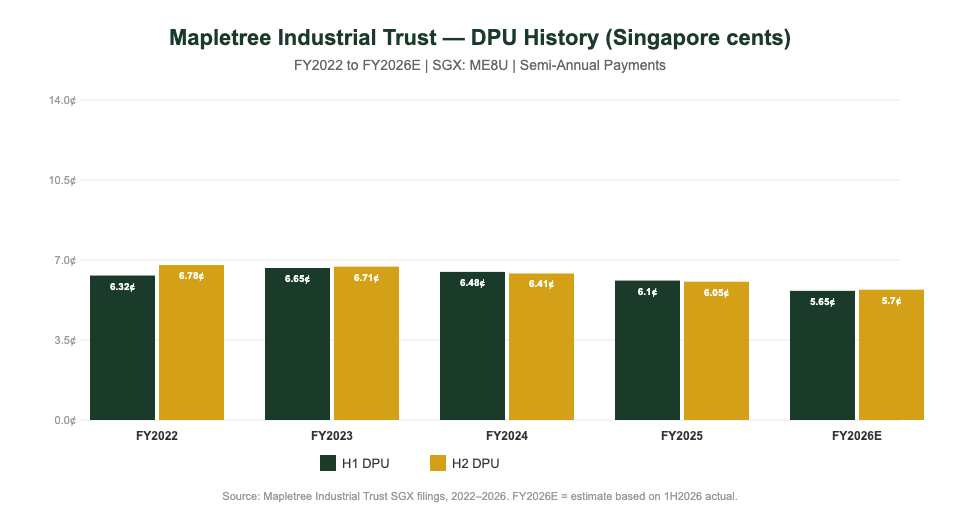
MIT pays dividends semi-annually — once for the first half of its financial year (April–September) and once for the second half (October–March). The following table summarises MIT’s Distribution Per Unit (DPU) history over the past five financial years, based on SGX quarterly results announcements.
| Financial Year | H1 DPU (¢) | H2 DPU (¢) | Full Year DPU (¢) | YoY Change |
|---|---|---|---|---|
| FY2022 (Apr 21–Mar 22) | 6.32 | 6.78 | 13.10 | +3.1% |
| FY2023 (Apr 22–Mar 23) | 6.65 | 6.71 | 13.36 | +2.0% |
| FY2024 (Apr 23–Mar 24) | 6.48 | 6.41 | 12.89 | −3.5% |
| FY2025 (Apr 24–Mar 25) | 6.10 | 6.05 | 12.15 | −5.7% |
| FY2026E (Apr 25–Mar 26) | 5.65 | ~5.70 | ~11.35 | −6.6% est. |
Source: Mapletree Industrial Trust SGX quarterly filings, FY2022–FY2026. FY2026E is an estimate based on 1H FY2026 actual DPU of 5.65¢ and 2H analyst consensus. Subject to change.
The trend is clear: MIT’s DPU peaked in FY2023 at 13.36 cents, then declined over FY2024 and FY2025 as the Trust absorbed higher financing costs from rising SORA rates. The US Federal Reserve’s rate-cutting cycle that began in late 2024 — and Singapore’s SORA following suit — has provided partial relief, but the full impact on MIT’s FY2026 DPU will depend on how quickly the Trust refinances its floating-rate debt at lower spreads.
MIT Dividend Yield at Different Share Prices
Dividend yield moves inversely with share price — the lower the price, the higher the yield for the same DPU. The table below shows MIT’s indicative annualised yield at different entry prices, using an estimated FY2026 full-year DPU of 11.35 Singapore cents. A Singapore investor entering at SGD 2.10 would receive approximately 5.4% yield per annum based on current DPU estimates.
| Entry Price (SGD) | Annualised DPU (¢) | Dividend Yield | Annual Income per 1,000 units |
|---|---|---|---|
| $1.90 | 11.35 | 5.97% | SGD 113.50 |
| $2.00 | 11.35 | 5.68% | SGD 113.50 |
| $2.10 | 11.35 | 5.40% | SGD 113.50 |
| $2.20 | 11.35 | 5.16% | SGD 113.50 |
| $2.30 | 11.35 | 4.93% | SGD 113.50 |
| $2.40 | 11.35 | 4.73% | SGD 113.50 |
Source: TKN calculation based on FY2026E DPU of 11.35¢ per unit. Yield figures are indicative only. Actual DPU may differ. Not financial advice.
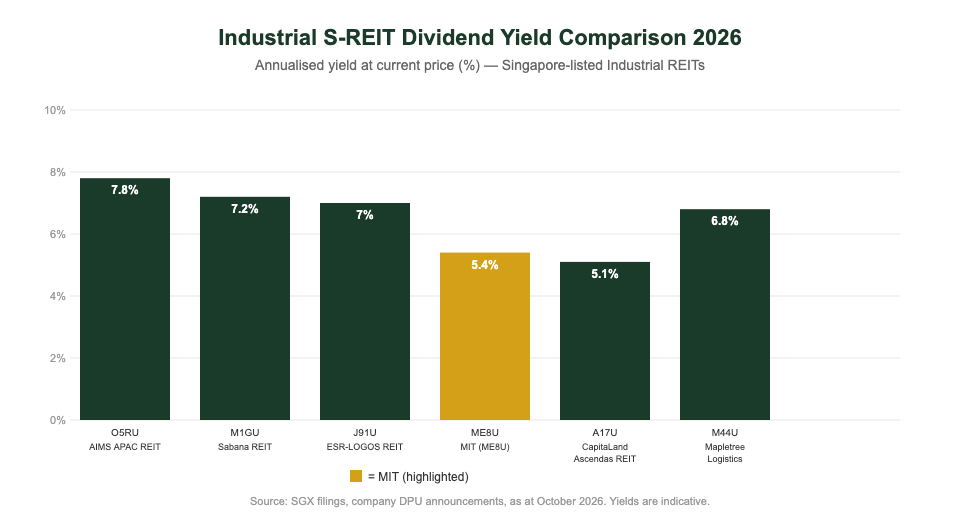
Compared to other industrial S-REITs (see chart below), MIT’s 5.1%–5.7% yield sits in the mid-range of the sector. Higher-yield peers like AIMS APAC REIT (~7.8%) and Sabana REIT (~7.2%) carry greater gearing or portfolio risks, while MIT commands a quality premium for its data centre exposure and longer WALE. Review our guide to best S-REITs in Singapore 2026 for a broader yield comparison across all sectors.
MIT Ex-Dividend Dates 2026
To receive a MIT dividend distribution, you must be a registered unitholder before the ex-dividend date. Buying on or after the ex-date means you will NOT receive that distribution — it goes to the previous holder. For FY2026, MIT’s distribution timeline follows the pattern of prior years, with results announced approximately 4–5 weeks after the close of each half-year period.
Typical MIT dividend calendar (FY2026 indicative):
- H1 FY2026 (Apr–Sep 2025): Results announced ~November 2025 | Ex-date ~late November 2025 | Payment ~December 2025
- H2 FY2026 (Oct 2025–Mar 2026): Results announced ~May 2026 | Ex-date ~late May 2026 | Payment ~June 2026
Always verify the exact ex-dividend dates on the SGX MIT listing page or in MIT’s SGX announcements under “Distribution”. T+2 settlement applies for SGX equities — you must buy at least 3 trading days before the ex-date to ensure settlement before record date.
For Singapore investors using their CPF investment strategy, note that MIT is eligible for CPF Ordinary Account (OA) investment under the CPF Investment Scheme (CPFIS), subject to the prevailing investment limits and your broker’s CPFIS support.
How MIT Pays Its Dividends (Semi-Annual Process)
MIT distributes at least 90% of its distributable income each year to maintain its REIT tax-exempt status under Singapore’s IRAS framework. Distributions are paid semi-annually in Singapore dollars directly to unitholders’ bank accounts (via CDP) or into their brokerage cash accounts (for custodian-held units).
The payment process works as follows:
- Quarterly results announcement: MIT reports results approximately 5–6 weeks after quarter-end and confirms the H1 or H2 DPU quantum.
- Ex-dividend date set: SGX posts the record date and ex-date. Units bought on or before the day prior to the ex-date qualify.
- Record date: MIT freezes its register of unitholders 1–2 days after the ex-date to determine who receives payment.
- Payment date: Typically 4–6 weeks after the ex-date. Funds are credited to your designated bank account or brokerage cash account.
Unlike stocks, REIT distributions in Singapore are not subject to withholding tax for individual investors — you receive the full DPU amount declared. Corporate investors and foreign funds may face different tax treatment. Check IRAS guidelines for your specific tax profile.
For investors building a passive income stream through S-REITs, tracking ex-dates across multiple REITs is essential. Using a Singapore retirement calculator can help model how MIT’s DPU, compounded over 10–20 years through DRP (distribution reinvestment) where available, contributes to a long-term income goal. Visit our Singapore retirement calculator to model different DPU scenarios.
Data Centre Growth & MIT DPU Sustainability
MIT’s US data centre portfolio — acquired in stages from 2020 onwards — provides a significant DPU buffer that distinguishes it from Singapore-only industrial REITs. As at 1H2026, data centres contributed approximately 50% of MIT’s net property income (NPI), with US assets providing USD-denominated income that partially hedges against Singapore dollar movements.
The demand outlook for data centres remains structurally positive: AI workloads, cloud adoption, and enterprise IT migration continue to drive hyperscaler demand in Northern Virginia, where MIT’s US footprint is concentrated. MIT’s data centre leases are typically long-term (10–15 years), providing income visibility that stabilises the H2 DPU.
However, investors should note that MIT’s DPU sustainability depends on three key factors:
- Refinancing of floating-rate debt: Approximately 35–40% of MIT’s total debt was floating-rate as at mid-2026. Every 25bps fall in SORA reduces MIT’s annual interest cost by approximately SGD 8–10 million, which flows directly through to distributable income.
- US data centre cap rate compression: As interest rates fall globally, cap rates on US data centre assets have tightened, supporting MIT’s US portfolio valuation and gearing headroom.
- Singapore hi-tech occupancy: MIT’s Singapore hi-tech buildings maintained ~93% occupancy in FY2026, with positive rental reversions in the 3–5% range supporting steady NPI growth from the Singapore leg.
For context on how data centre demand is reshaping the broader S-REIT sector, see our passive income Singapore 2026 analysis. You can also compare MIT against other industrial REITs in our best S-REITs Singapore 2026 guide.
How to Buy MIT (ME8U) for Dividend Income
Mapletree Industrial Trust trades on the Singapore Exchange (SGX) under the ticker ME8U with a minimum lot size of 100 units. At a share price of SGD 2.15, a starter position of 1,000 units (10 lots) requires approximately SGD 2,150 — well within reach for most retail investors.
MIT can be purchased through any SGX-connected brokerage. Three platforms popular with Singapore retail investors for S-REIT dividend investing:
- Syfe Trade — flat-fee SGX trading with no minimum, useful for recurring accumulation. Check the latest Syfe referral code for a sign-up bonus.
- FSMOne — broker-neutral platform with a dividend tracker and regular savings plan. Use the FSMOne referral code (P0544985) for account opening rebates.
- Endowus — if you prefer managed REIT exposure via fund-of-funds, Endowus Cash Smart and Income portfolios include S-REIT allocations. The Endowus referral code (2V343) gives new users bonus access fee credits.
For dividend-focused accumulation, consider buying MIT in lots of 100–200 units per month between ex-dividend dates, when the share price typically faces mild selling pressure from distribution-chasing investors exiting after the ex-date. This “dividend dip” is not guaranteed but has been observed in prior MIT cycles. Always check the moomoo Singapore review for real-time SGX fee comparisons before switching brokers — moomoo Singapore review 2026.
You can also monitor MIT alongside Singapore T-bills and Savings Bonds to build a balanced income portfolio — see our Singapore T-bills 2026 guide for a rate comparison.
Frequently Asked Questions: Mapletree Industrial Trust Dividend
What is MIT's current dividend yield in 2026?
At an ME8U share price of approximately SGD 2.10–2.20, MIT’s indicative dividend yield is approximately 5.1%–5.4% per annum, based on an estimated full-year FY2026 DPU of 11.35 Singapore cents. This yield may change as the share price fluctuates or if the actual DPU differs from estimates.
How often does Mapletree Industrial Trust pay dividends?
MIT pays dividends semi-annually — twice a year. Typically, the H1 distribution (covering April to September) is paid around December, and the H2 distribution (October to March) is paid around June. Check SGX announcements for exact dates each cycle.
What was MIT's highest ever DPU?
MIT’s DPU peaked at 13.36 Singapore cents in FY2023 (H1: 6.65¢, H2: 6.71¢). This was the Trust’s highest-ever annual payout, driven by full-year contributions from its US data centre acquisitions and relatively lower financing costs before the global rate-hiking cycle fully fed through.
Is MIT's DPU at risk of being cut?
MIT’s DPU has declined from its FY2023 peak due to higher interest costs. The key risks to further cuts include: a reversal of the rate-cutting cycle, weaker-than-expected occupancy at its Singapore hi-tech portfolio, or difficulty refinancing its US debt at favourable spreads. However, the long-term data centre lease structures and >93% Singapore occupancy provide a reasonable DPU floor. Most analysts expect FY2026 DPU to stabilise before recovering modestly in FY2027 if rates continue to normalise.
Do I pay withholding tax on MIT dividends as a Singapore investor?
No — Singapore individual investors are exempt from withholding tax on S-REIT distributions, including MIT. You receive the full declared DPU amount. This is one of the key tax advantages of investing in Singapore-listed REITs versus, for example, US REITs which are subject to 30% dividend withholding tax for non-US residents. See the IRAS REIT tax treatment page for full details.
Can I buy MIT using CPF funds?
Yes. Mapletree Industrial Trust is included on the CPF Investment Scheme (CPFIS) Included List, which means eligible investors can use their CPF Ordinary Account (OA) funds to purchase ME8U units via a CPFIS-approved agent bank or broker. Note that CPF OA has a maximum investable amount (currently limited to 35% of investable savings after a minimum sum), so plan your CPF REIT allocation accordingly. Always check the current CPF Board CPFIS page for the updated list and limits.
This article was researched with the help of AI. While we strive to keep all information accurate and up to date, there may be errors. If you notice any discrepancies, please contact us.