US Treasury ETFs for Singapore Investors: IB01 vs IDTM vs IDTL (2026 Guide)
Short, medium and long-duration Treasury ETFs compared after the Fed’s September 2026 rate hike — plus the estate tax trap that catches investors who buy TLT or IEF directly.
US Treasury ETFs let you buy the world’s most liquid government bonds without picking individual bonds yourself. IB01 (0-1yr), IDTM (7-10yr) and IDTL (20+yr) are Ireland-domiciled UCITS ETFs on the London Stock Exchange that track different points on the yield curve. Their US-listed cousins — SHY, IEF and TLT — charge similar fees, but carry a US estate tax risk the UCITS versions don’t.
Not financial advice. All figures are for educational reference only. Data verified as at 26 September 2026 unless otherwise noted.
- IB01 (0-1yr) barely moves when rates change. IDTL (20+yr) is the most rate-sensitive — it’s the one that fell hardest as the 30-year Treasury yield hit a 2004 high above 5.5% this week.
- IB01, IDTM and IDTL carry zero US estate tax risk. Their US-listed twins — SHY, IEF and TLT — do, even though the actual Treasury bonds inside them are estate-tax exempt. The ETF share itself is the problem, not the bond.
- For most Singapore investors building a bond ladder, IDTM (7-10yr) balances yield and price stability best. Park short-term cash in IB01; use IDTL only if you have a strong rate-cut view.
Table of Contents
What Are US Treasury ETFs?
A US Treasury ETF holds a basket of bonds issued by the US government. Instead of buying one 10-year Treasury note, you buy a fund that holds many of them across a set maturity band.
Treasury bonds pay a fixed coupon and return your principal at maturity. A Treasury ETF never “matures” — it constantly rolls into new bonds to stay within its target maturity band. That makes the fund’s price move up and down with interest rates, unlike a single bond you hold to maturity.
Three maturity bands cover most of what a Singapore investor needs:
- 0-1 year (ultra-short): behaves almost like cash. Tracked by IB01.
- 7-10 years (intermediate): the classic “core bond” duration. Tracked by IDTM.
- 20+ years (long): the most sensitive to rate changes, in both directions. Tracked by IDTL.
All three are managed by iShares (BlackRock), domiciled in Ireland, and listed in USD on the London Stock Exchange — the same LSE structure used by other UCITS bond ETFs Singapore investors already buy.
Why They Matter After the Fed’s September 2026 Hike
On 16 September 2026, the Federal Reserve raised its benchmark rate by 25 basis points to 3.75%-4% — its first hike since 2023. The vote was unanimous, 12-0, and officials signalled at least one more hike is likely before year-end.
Bond markets reacted fast. By 25 September 2026, the 10-year Treasury yield had climbed to around 5.16%, its highest since 2007. The 30-year yield touched 5.5%, a level last seen in 2004.
Here’s why that matters for your ETF pick. When yields rise, existing bond prices fall — and the fall is bigger the longer the bond’s maturity. A short-duration fund like IB01 barely notices a rate move. A long-duration fund like IDTL feels it hard, in either direction.
That’s not a reason to avoid long-duration Treasuries. If you think rates are near a peak, IDTL is exactly the fund that gains the most when the Fed eventually cuts. It’s a reason to know which duration you’re buying and why.
IB01 vs IDTM vs IDTL: Key Facts at a Glance
| Feature | IB01 | IDTM | IDTL |
|---|---|---|---|
| Full Name | Treasury Bond 0-1yr UCITS ETF | Treasury Bond 7-10yr UCITS ETF | Treasury Bond 20+yr UCITS ETF |
| Maturity Band | 0-1 years | 7-10 years | 20+ years |
| TER | 0.07% p.a. | 0.07% p.a. | 0.07% p.a. |
| Domicile | Ireland | Ireland | Ireland |
| Distribution | Accumulating | Distributing (semi-annual) | Distributing (semi-annual) |
| Approx. AUM | Multi-billion USD | ~EUR 3.3 billion | ~EUR 0.8 billion |
| Nearest US-Listed Twin | SGOV / BIL | IEF | TLT |
Source: iShares fund factsheets (IB01, IDTM, IDTL), September 2026. AUM approximate and fluctuates with fund flows.
Notice the TER is identical across all three: 0.07% a year. On a SGD 20,000 position, that’s about SGD 14 a year in fees — the duration you pick, not the fee, is what drives your return and your risk.
A Quick Way to Estimate the Risk: Modified Duration
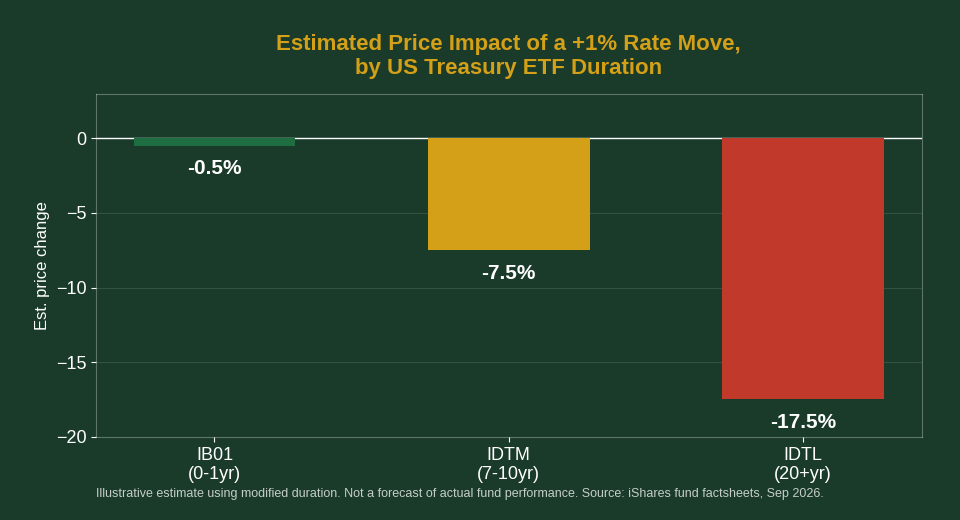
“Modified duration” measures how sensitive a bond fund’s price is to a 1% change in interest rates. IB01 has a modified duration close to 0.5 years. IDTM sits around 7.5 years. IDTL runs about 17 years — it holds bonds with 20+ years to maturity, but coupon payments along the way shorten its effective sensitivity slightly below the full maturity figure.
Multiply the modified duration by the rate change to estimate the price impact. If yields rise another 1%, IDTL’s estimated price impact is roughly -17%. The same 1% move on IB01 is closer to -0.5%. This is why the same “Fed hike” headline barely dents your IB01 position but can meaningfully dent IDTL.
Tax and Estate Risk: UCITS vs US-Listed
Here’s the part most Treasury ETF comparisons skip entirely, and it’s the one that matters most if your bond allocation ever grows past a modest size.
Interest from US Treasury bonds is generally exempt from the 30% US withholding tax under the “portfolio interest exception,” so that part is a wash between IB01/IDTM/IDTL and SHY/IEF/TLT — neither side loses much to withholding tax on the coupon itself.
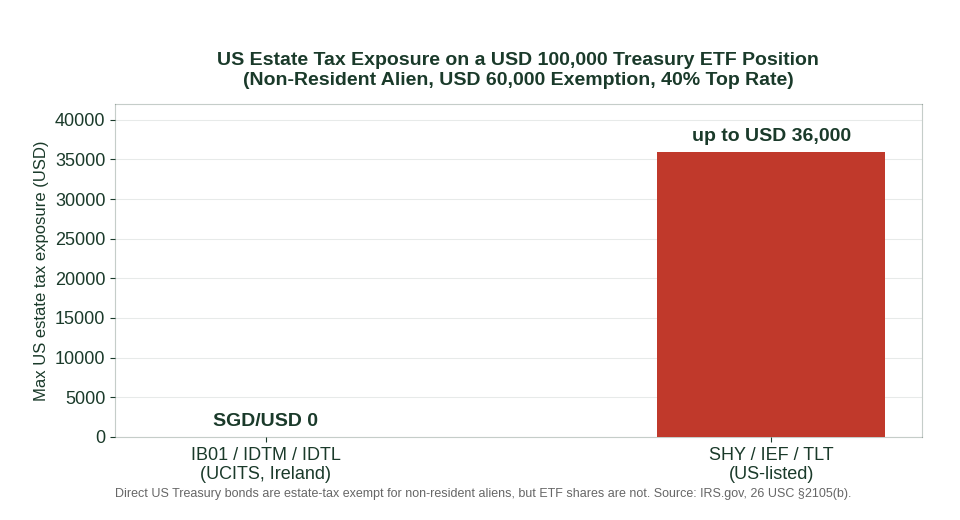
Estate tax is where the two groups split. Direct ownership of a US Treasury bond is explicitly excluded from a non-resident alien’s US taxable estate under US tax law. But an ETF share is not the bond — it’s equity in a fund. That distinction matters: US-domiciled ETFs like SHY, IEF and TLT are treated as US-situs assets for estate tax, even though every bond inside them is exempt. IB01, IDTM and IDTL avoid this entirely because they’re Ireland-domiciled, the same structural fix used by UCITS corporate bond ETFs and by CSPX or VWRA for equities.
| ETF Type | Domicile | US Interest WHT | US Estate Tax Risk |
|---|---|---|---|
| IB01 / IDTM / IDTL (LSE) | Ireland | None (exempt) | None |
| SHY / IEF / TLT (NYSE Arca) | USA | None (exempt) | Yes (above USD 60k) |
Source: IRS.gov (estate tax for nonresidents), 26 USC §871(h) and §2105(b), as at September 2026.
Worked example: Say you hold USD 100,000 of TLT directly through a US broker. As a non-resident alien, only the first USD 60,000 of US-situs assets is exempt. The remaining USD 40,000 is exposed to US estate tax at rates up to 40% — a potential bill of up to USD 16,000 for your estate. Hold the same USD 100,000 in IDTL instead, and that exposure is zero, because the fund itself is Ireland-domiciled, not a US-situs asset.
How to Buy US Treasury ETFs in Singapore
All three UCITS Treasury ETFs trade on the London Stock Exchange in USD. You’ll need a broker with LSE access. Here’s how the main options compare:
Interactive Brokers (IBKR)
Fund your account, search “IB01”, “IDTM” or “IDTL”, and select the LSE listing before placing your order. IBKR usually offers the tightest spreads and lowest commission for larger trades.
Saxo Markets
Similar process to IBKR — search the ticker, confirm the LSE exchange, and buy in USD. Saxo’s platform fee structure suits investors who also trade other asset classes.
FSMOne
FSMOne offers access to these UCITS ETFs with a straightforward interface, useful if you’re already using FSMOne’s referral code for other holdings.
Whichever broker you use, double-check you’re buying the LSE-listed USD share class (tickers IB01, IDTM, IDTL) and not a similarly-named share class on a European exchange — pricing and settlement currency can differ.
Which One Should You Buy?
Choose IB01 if: you want a place to park cash between other investments, with minimal price swings. It behaves close to a money market fund but with the transparency of an ETF.
Choose IDTM if: you want the classic “core bond” building block — meaningful yield, moderate price swings, and the closest match to a balanced 60/40 portfolio’s bond sleeve.
Choose IDTL if: you have a specific view that rates are near a peak and want the biggest gain if the Fed starts cutting. Understand you’ll also take the biggest hit if yields keep rising, as they have through September 2026.
None of these are CPF-OA investable — UCITS ETFs on the LSE aren’t on the CPFIS-approved list. They are typically SRS-compatible if your SRS-linked brokerage supports LSE trading. For a lower-risk, SGD-denominated short-term alternative that IS CPF and SRS friendly, see our Singapore T-Bills 2026 guide — useful if you want yield without the USD currency exposure these Treasury ETFs carry.
Many Singapore investors use these three funds together, not one at a time. A simple bond ladder might hold IB01 for near-term cash needs, IDTM as the core allocation, and a small IDTL position as a hedge against a growth scare that forces the Fed to cut. The mix shifts your average duration without betting everything on one part of the curve.
Ready to Add Treasury ETFs to Your Portfolio?
Open a brokerage account and start building your bond allocation. Use our referral links for exclusive sign-up bonuses.
Frequently Asked Questions
What is the best US Treasury ETF for Singapore investors in 2026?
It depends on your goal. IB01 (0-1yr) suits investors parking cash. IDTM (7-10yr) suits investors wanting a core bond holding with meaningful yield. IDTL (20+yr) suits investors with a strong view that the Fed is close to done hiking and will cut later. Most Singapore investors building a diversified portfolio start with IDTM.
Is IB01 the same as SHY or BIL?
Not exactly. IB01 tracks 0-1 year US Treasuries and is Ireland-domiciled, listed on the LSE. SHY tracks a slightly longer 1-3 year band and is US-domiciled, listed on NYSE Arca. BIL and SGOV are closer duration matches to IB01 but are also US-listed, which brings the estate tax question IB01 avoids.
Do I pay US estate tax on UCITS Treasury ETFs like IDTL?
No. IB01, IDTM and IDTL are domiciled in Ireland, not the United States, so they are not US-situs assets and fall outside the US estate tax regime for non-resident aliens entirely — regardless of position size.
Why do US-listed Treasury ETFs like TLT still carry estate tax risk if Treasury bonds themselves are exempt?
Because you don’t own the bonds directly — you own shares of a US fund that owns the bonds. US law exempts direct holdings of Treasury bonds from a non-resident alien’s taxable estate, but shares in a US-domiciled fund are treated as a separate, US-situs asset. The wrapper, not the underlying bond, creates the exposure.
Can I buy US Treasury ETFs with my CPF or SRS funds?
Not with CPF-OA — LSE-listed UCITS ETFs aren’t on the CPFIS-approved list. SRS funds can typically be used if your SRS-linked brokerage supports LSE trading; check with your broker before assuming SRS compatibility.
What happens to IDTL if the Fed cuts rates instead of hiking further?
IDTL would likely rise more than IDTM or IB01, since long-duration bonds are the most sensitive to falling yields as well as rising ones. That’s the trade-off: IDTL amplifies both directions, so it should only be a large position if you have a specific rate view, not a default core holding.
This article was researched with the help of AI. While we strive to keep all information accurate and up to date, there may be errors. If you notice any discrepancies, please contact us.