CPF Retirement Sum 2026: BRS, FRS and ERS Explained
Your complete guide to Singapore’s three CPF retirement sum tiers — how much you need, how your Retirement Account forms at 55, and what monthly payout to expect from CPF LIFE.
The CPF Retirement Sum is the target balance in your Retirement Account (RA) that activates a lifelong monthly income through CPF LIFE. In 2026, the Full Retirement Sum is $220,400 — enough to generate roughly $1,600–$1,900 per month from age 65. Most Singaporeans who contribute consistently throughout their careers will hit it without extra effort — but understanding the mechanics helps you plan strategically.
Not financial advice. All figures are for educational reference only. Data as at September 2026 unless stated otherwise, sourced from CPF Board.
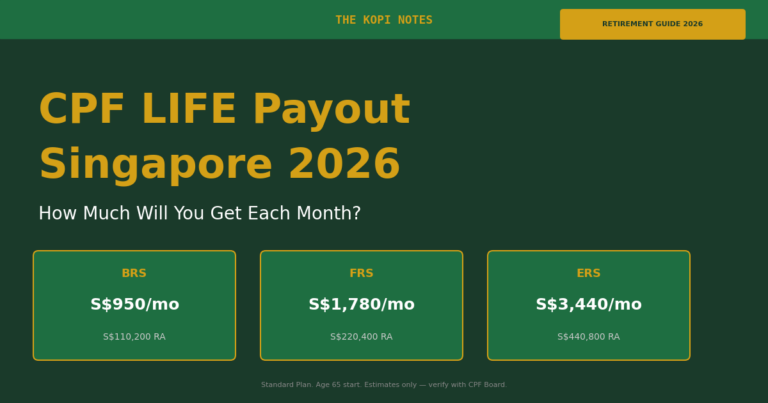
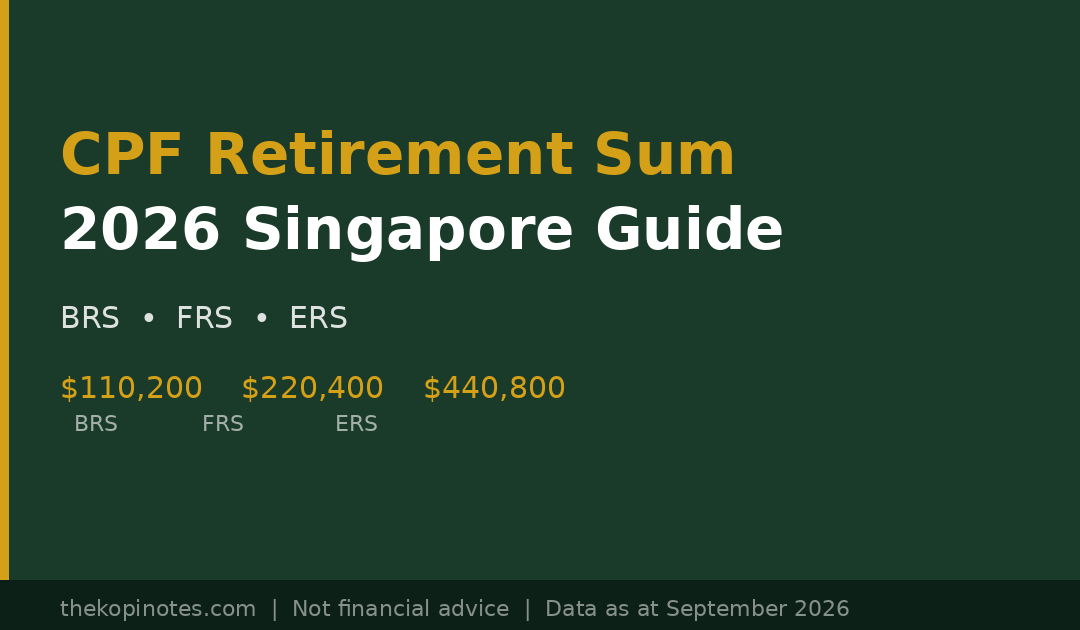
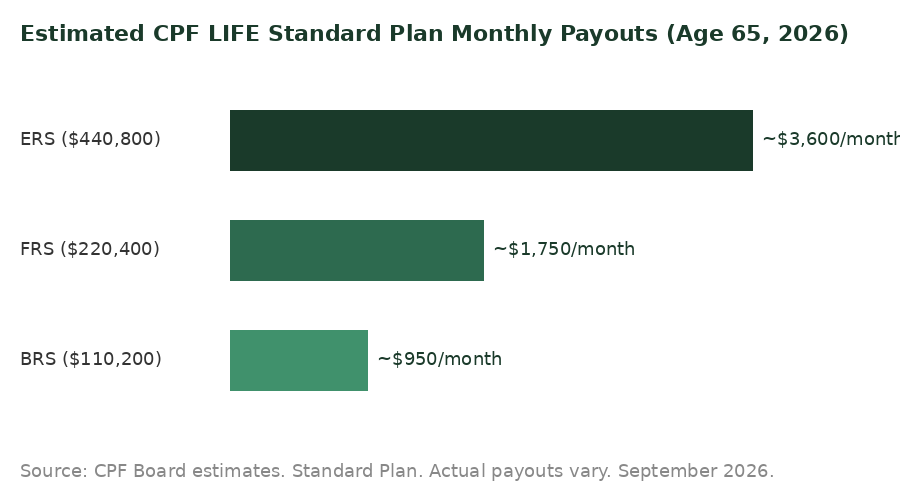
- BRS: $110,200 → ~$900–$1,000/month (CPF LIFE Standard Plan, age 65)
- FRS: $220,400 → ~$1,600–$1,900/month — recommended minimum for most
- ERS: $440,800 (4× BRS) → ~$3,300–$3,900/month — maximum top-up cap
- SA closes at 55 from 2025; OA funds fill your RA instead
- MRSS matches your RA top-ups dollar-for-dollar, up to $600/year (ages 55–70)
- Use the Retirement Planning Calculator to see your personal number
Table of Contents
- What Is the CPF Retirement Sum?
- The Three Tiers: BRS, FRS and ERS (2026 Figures)
- How Your RA Is Formed at Age 55
- CPF LIFE Monthly Payouts by Tier
- Historical Retirement Sum Progression
- The SA Closure: Key 2025 Change
- How to Hit Your FRS (or ERS)
- Worked SGD Example
- Related Tools
- Frequently Asked Questions
What Is the CPF Retirement Sum?
The CPF Retirement Sum is the target balance you need in your CPF Retirement Account (RA) by age 55 to qualify for a monthly income for life through CPF LIFE.
Think of it as your personal pension floor. The CPF Board sets three tiers — Basic (BRS), Full (FRS), and Enhanced (ERS) — each calibrated to fund a different standard of living in retirement. The tier you meet at 55 determines your CPF LIFE payout from age 65 onwards.
The retirement sums are reviewed annually and increase at a fixed 3.5% per year under the current framework (through 2027, per CPF Board). This annual escalation is designed to account for inflation and rising wages in Singapore.
You do not “spend down” your RA like a savings account. Instead, when you turn 65, your RA balance is used to purchase a life annuity through CPF LIFE. You receive monthly payouts for life — and any remaining balance is paid to your CPF nominees as a bequest when you pass.
The Three Retirement Sum Tiers: 2026 Figures
For members turning 55 in 2026, the CPF Board has set the following retirement sum tiers:
| Tier | 2026 Amount | Est. CPF LIFE Payout at 65* | Who It’s For |
|---|---|---|---|
| Basic Retirement Sum (BRS) | $110,200 | ~$900–$1,000/month | Property owners who pledge their home to CPF |
| Full Retirement Sum (FRS) | $220,400 | ~$1,600–$1,900/month | Recommended minimum for most Singaporeans |
| Enhanced Retirement Sum (ERS) | $440,800 | ~$3,300–$3,900/month | Those wanting maximum CPF LIFE income; have higher CPF savings |
*Estimates under CPF LIFE Standard Plan for members turning 65 in 2026. Actual payouts depend on CPF LIFE plan chosen, contribution history, and prevailing interest rates. Source: CPF Board, September 2026.
Key Point: ERS Is Now 4× BRS
Since 2025, the Enhanced Retirement Sum equals 4× BRS (previously 3× BRS). This was announced in Budget 2024 and takes effect for members turning 55 from 2025 onwards. The higher ERS cap lets members with more CPF savings convert a larger portion into lifelong monthly income, reducing longevity risk.
In practice: FRS = 2× BRS. ERS = 4× BRS. All three move up 3.5% each year.
How Your Retirement Account Is Formed at Age 55
At 55, CPF automatically creates your Retirement Account (RA) by drawing down your existing CPF balances. Here is the exact order:
- Any remaining SA balance transfers to RA first (note: SA is closed for members below 55 since 2025 — see Section 6)
- Then OA balance fills the gap up to the FRS (or BRS if you qualify via property pledge)
- Any SA balance above the FRS moves to your OA (not the RA)
- You can voluntarily top up your RA to the ERS cap at any point up to age 65
BRS Property Pledge: The Half-Price Option
If you own a property with a remaining lease that covers you to at least age 95, you can pledge the property to CPF. This lets you set aside only the BRS ($110,200) in your RA instead of the FRS ($220,400) — effectively halving the CPF amount locked away as a life annuity.
The trade-off: Your CPF LIFE payout is correspondingly lower (~$900–$1,000/month vs. ~$1,600–$1,900/month at FRS). The logic is that your HDB flat or private property serves as a parallel retirement asset — through eventual sale, lease buyback, or downsizing.
For members without a property pledge (or those renting), the FRS is the default requirement.
CPF LIFE Monthly Payouts by Tier
CPF LIFE is a national longevity insurance scheme — not a savings account. You receive a monthly payout for as long as you live, funded from a pooled annuity. Your remaining balance is distributed to your CPF nominees when you pass.
Choosing Your CPF LIFE Plan
| Plan | Monthly Payout | Bequest Potential | Best For |
|---|---|---|---|
| Standard Plan | Higher | Lower | Maximising monthly income |
| Basic Plan | Lower (~10–20% less) | Higher | Leaving more to beneficiaries |
| Escalating Plan | Starts lowest, rises 2%/year | Moderate | Inflation hedging over long retirement |
The payout estimates in the 2026 tier table above use the Standard Plan. Compare the CPF LIFE plans in detail here.
Deferring Payouts to 70
You can defer your CPF LIFE payouts from the default age 65 to as late as 70. Each year you defer increases your monthly payout by approximately 6–7%. Deferring from 65 to 70 could increase your FRS payout from ~$1,750/month to ~$2,200–$2,400/month.
The trade-off: you receive no payout for those 5 years, and you need other income to bridge the gap. See CPF LIFE payout eligibility and deferral rules for the full picture.
Historical CPF Retirement Sum Progression
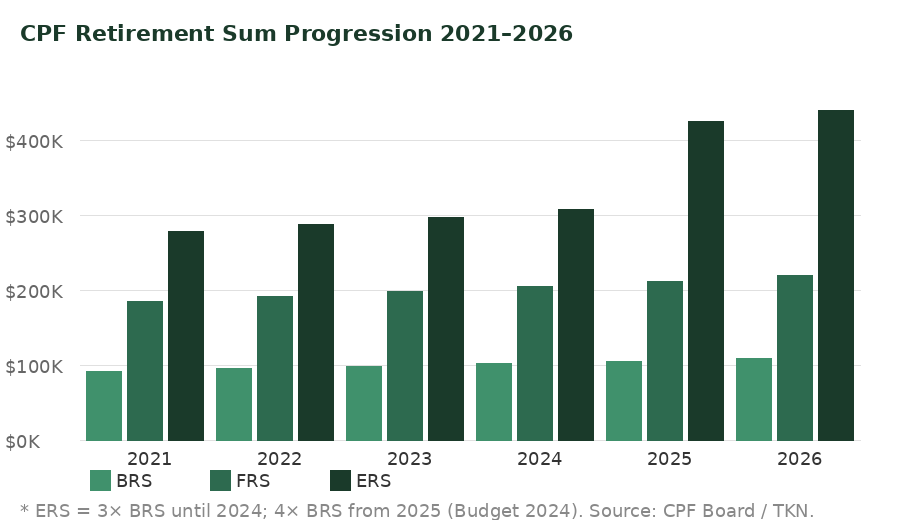
The CPF retirement sums increase by 3.5% per year, as committed by CPF Board through 2027. Here’s how the figures have moved since 2021:
| Year | BRS | FRS | ERS | Note |
|---|---|---|---|---|
| 2021 | $93,000 | $186,000 | $279,000 | ERS = 3× BRS |
| 2022 | $96,000 | $192,000 | $288,000 | ERS = 3× BRS |
| 2023 | $99,400 | $198,800 | $298,200 | ERS = 3× BRS |
| 2024 | $102,900 | $205,800 | $308,700 | ERS = 3× BRS (last year) |
| 2025 | $106,500 | $213,000 | $426,000 | ERS = 4× BRS (Budget 2024 change) |
| 2026 | $110,200 | $220,400 | $440,800 | ERS = 4× BRS (current year) |
Source: CPF Board. Figures for each year apply to members turning 55 in that year. 2025 ERS jump reflects Budget 2024 policy change from 3× to 4× BRS.
The SA Closure: What Changed in 2025
From January 2025, CPF closed the Special Account (SA) for members below 55. This is the biggest structural change to CPF retirement planning in years and directly affects how the RA is formed.
Impact on RA Formation
Before 2025, RA formation at 55 drew from SA first (earning 4%), then OA. Now, with SA closed for those below 55, RA formation at 55 draws primarily from OA (at the lower 2.5% interest rate). This means:
- Members who relied on SA compounding at 4% to build towards FRS will see a lower baseline at 55
- The practical workaround: make voluntary cash top-ups directly to your RA after 55, and use the MRSS matching scheme (below)
- For those already 55+, your RA is unaffected — the SA closure applies only to those who had not yet turned 55
For the full mechanics and what happened to your existing SA balance, see: CPF SA Closure at 55 — Full Explanation.
How to Hit Your FRS (or ERS)
Most Singaporeans who contribute consistently throughout their working lives will reach the FRS through mandatory CPF alone. But there are four levers to accelerate:
1. Cash Top-Ups to RA (Retirement Sum Topping-Up Scheme)
Make voluntary cash top-ups to your RA (or your parents’/siblings’ RA). You receive income tax relief of up to $8,000/year for self top-ups and another $8,000 for qualifying family members. Use the CPF Top-Up Tax Relief Calculator to see your exact savings before acting.
2. Matched Retirement Savings Scheme (MRSS)
For members aged 55–70 with RA balance below the FRS, the MRSS provides $1 government match for every $1 of eligible top-ups, up to $600/year. This is essentially free money — apply via my.cpf.gov.sg or a participating bank when you make your top-up.
3. OA-to-RA CPF Transfers (After 55)
After your RA is formed at 55, you can transfer excess OA savings to your RA — up to the ERS cap. OA earns 2.5%; RA earns a 4% floor rate. Every dollar transferred earns an additional 1.5% per year in a risk-free, CPF-guaranteed account. Use the CPF Transfer Calculator to model the long-term impact.
4. Voluntary CPF Contributions (Under 55)
Before SA closure in 2025, topping up SA at 4% was the gold standard. Now, you can still make voluntary top-ups to your CPF (capped by the Annual Limit of $37,740 including employer contributions). These accumulate in OA at 2.5% and convert to RA at 55. The strategic case for voluntary top-ups is weaker post-SA closure — but the income tax relief on RA top-ups still applies and can be compelling for higher earners.
Worked SGD Example: Mei, Age 45
Here is a concrete illustration of how the CPF Retirement Sum plays out for a typical Singaporean professional.
- Age: 45 | Singapore Citizen
- Gross monthly salary: $6,500
- CPF OA: $165,000 | MA: $68,000 | SA: $0 (closed in 2025)
- HDB flat owner (remaining lease: 55 years)
- Goal: understand her RA position at 55, and whether she will hit FRS ($220,400)
Step 1 — Mandatory CPF Contributions (Age 45–54, 10 years)
On $6,500/month, Mei’s total CPF contribution at her age band (35–45) is:
| Component | Rate | Monthly $ |
|---|---|---|
| Employee contribution | 20% | $1,300 |
| Employer contribution | 17% | $1,105 |
| Total CPF | $2,405/month |
After SA closure, this allocation flows mostly to OA (~62%) and MA (~26%), with a small portion to RA (nil, as RA only activates at 55). Over 10 years, at 2.5% p.a. OA interest, her OA grows to approximately $380,000–$420,000 (rough estimate, not accounting for housing CPF usage).
Step 2 — RA Formation at 55
At 55, CPF transfers OA funds to RA to meet the FRS. Assuming FRS in 2035 ≈ $300,000 (10 more years of 3.5% growth from $220,400), Mei’s OA likely covers this, with ~$80,000–$120,000 remaining in OA for non-retirement use.
Step 3 — Additional Lever: MRSS from Age 55
Mei tops up $600/year to RA from age 55 to 65. The government matches $600/year = $1,200/year injected into RA. Over 10 years: $12,000 additional RA balance — purely from matching. The top-up also qualifies for income tax relief if she is still working.
Outcome at 65
Mei is on track to receive approximately $1,600–$2,000/month from CPF LIFE Standard Plan — covering the bulk of her basic expenses. Combined with SRS withdrawals and any investment income, she has a solid foundation for a comfortable retirement.
Related Tools
Use these free TKN calculators to apply the concepts in this guide to your personal numbers:
| Tool | What It Does |
|---|---|
| Retirement Planning Calculator | Calculate your retirement nest egg target and whether you’re on track |
| CPF Top-Up Tax Relief Calculator | See exact tax savings from voluntary RA/SA top-ups |
| CPF OA-to-RA Transfer Calculator | Model the compounding benefit of moving OA funds to RA at 4% |
| CPF FI Ratio Calculator | How close is your CPF to funding full financial independence? |
For the full retirement planning framework — CPF LIFE, SRS, investment strategies, and how much you really need — read the Singapore Retirement Planning Guide.
Frequently Asked Questions
What happens if I don't meet the BRS at 55?
If your RA balance is below the BRS when you turn 55, you will not be automatically enrolled in CPF LIFE at 65. Instead, you would be placed on the Retirement Sum Scheme (RSS), which pays out from a fixed pot rather than for life. You can still top up to the BRS or FRS at any point before your CPF LIFE start date to switch into CPF LIFE. The BRS for 2026 is $110,200.
Can I withdraw CPF in a lump sum at 55?
Yes. Any CPF balance above the FRS (or BRS if you have a property pledge) can be withdrawn in full or in part from age 55. So if you have $350,000 in CPF at 55 and the FRS is $220,400, you can withdraw up to $129,600. The amount set aside in RA remains locked in until payouts begin at 65 (or your chosen deferral age).
Is the retirement sum fixed after my RA is formed at 55?
No. After your RA is formed at 55, you can continue to top up your RA up to the ERS cap ($440,800 in 2026). The ERS cap also moves up 3.5% each year, so if you aim to hit it, you need to keep topping up annually. Your RA balance itself grows at the 4% floor rate until payouts start.
What's the difference between BRS with property pledge and FRS?
If you own a property with a remaining lease that covers you to at least age 95, you can pledge the property to CPF. This means you only need to set aside the BRS ($110,200 in 2026) in your RA — roughly half the FRS — because your home is considered a parallel retirement asset. Your CPF LIFE monthly payout will be correspondingly lower (~$900–$1,000 vs ~$1,600–$1,900/month for FRS). Without a property pledge, the FRS is the default minimum.
What are the CPF LIFE payouts if I defer to age 70?
Deferring from 65 to 70 increases your monthly payout by roughly 6–7% per year of deferral — approximately 30–35% higher over the full 5-year deferral. For an FRS member receiving ~$1,750/month at 65, deferring to 70 could yield ~$2,200–$2,400/month. The trade-off: you forgo 5 years of payouts and need other income during that period. See CPF LIFE payout eligibility and deferral details.
Does the Majulah Package affect my retirement sum?
The Majulah Package is for Singaporeans born 1949–1973 who are approaching or in retirement. The Retirement Savings Bonus within the Package can add up to $1,000 directly to your RA — it does not change the FRS target but helps bridge any shortfall. The Earn and Save Bonus and MediSave Bonus provide additional support for lower-income seniors still in the workforce.
CPF LIFE Standard Plan vs Basic Plan — which should I choose?
Most Singaporeans choose the Standard Plan for its higher monthly payout, especially those without significant non-CPF assets to leave as an inheritance. The Basic Plan suits members who prioritise leaving more to their CPF nominees. The Escalating Plan (2% annual increase) is best for those concerned about inflation eroding purchasing power over a long retirement. Full comparison here. Note: you have a window to switch your plan — confirm the latest switching deadline with CPF Board.
How do I track my retirement sum progress?
Log into my.cpf.gov.sg and navigate to “Retirement” → “Retirement Dashboard”. It shows your projected RA balance at 55 and estimated CPF LIFE monthly payouts. You can also model different scenarios (extra top-ups, different salary growth) using TKN’s Retirement Planning Calculator.
Know Your Number. Plan Your Payouts.
The CPF Retirement Sum is your retirement floor — but the ceiling is up to you. Use our free calculators to plan above and beyond your CPF LIFE payout.
This article was researched with the help of AI. While we strive to keep all information accurate and up to date, there may be errors. If you notice any discrepancies, please contact us.